Plug

Member of The Crypto Crew:
http://www.thecryptocrew.com/

Please Also Visit our Sister Blog, Frontiers of Anthropology:

http://frontiers-of-anthropology.blogspot.com/

And the new group for trying out fictional projects (Includes Cryptofiction Projects):

http://cedar-and-willow.blogspot.com/

And Kyle Germann's Blog

http://www.demonhunterscompendium.blogspot.com/

And Jay's Blog, Bizarre Zoology

http://bizarrezoology.blogspot.com/
Showing posts with label Photographs. Show all posts

Friday, 9 August 2013

A Longneck Fishing At Loch Ness

This series of photos would seem to represent the forepart of the neck (typically 10 feet long and 1 foot thick, or less in the same  proportion) doing the regularly-reported arching over fishing movement. this action has been compared to the motion of an inchworm.


The original source seems to have been The Daily Mail, but I cannot tell because the text was deleted after this version was posted. Here is a different facsimile of the page in black and white:
 
 Here is another version of a text story as given on another site: The Sun 8 Sep 2002 

One of the photographs taken by tourist Roy Johnston.

New Nessie pictures spark debate

 STEPHEN FRASER

 NESSIE mania returned to Scotland yesterday after new pictures were printed of Scotland’s most reclusive resident. The new photos appeared to show a slimmer Loch Ness monster, prompting fervent speculation that the living dinosaur could have been pregnant. Instead of the usual fleeting glimpse afforded her followers, Nessie stayed above the surface long enough for retired printer Roy Johnston to take at least four photographs showing the suspiciously snake-like Nessie arching out of the water and returning to it with a splash. The new photographs, printed in yesterday’s Daily Mail, prompted an immediate debate as to whether they are genuine. Johnston, 63, said he and his wife, Janet, had been nearing the end of a Highlands driving holiday two weeks ago when he decided to stop in a lay-by near the loch. He made his way to the loch’s edge at around 9am and had been standing there only a few minutes before the "creature" emerged. "I thought I was going mad," he said. "The first thought that sprang into my mind was, ‘That’s an elephant.’ I know it sounds silly but it looked like a trunk. It was the same length and width. "I wondered if the creature was a conger eel, but it was way too big for that. It was about seven or eight feet out of the water and it was obvious that there was more of it underneath the surface." The sighting has delighted tourism businesses in the area. Malaina Krott-Thiarry, a worker at a tourist information centre close to the loch, said: "I have no idea what to make of these pictures, but I think they’re good news for the area. This might lead to a boost for business later this year or next year." Lawrence Sear, the managing editor of the Daily Mail, said there was absolutely no sign the photographs had been doctored. "We collected the negatives from Mr Johnston and they were absolutely genuine. They have not been manipulated at any stage," he said. "Who knows whether the images are of the Loch Ness monster or not? All we can say is that those pictures are genuine and have not been doctored." But Scotland on Sunday’s picture editor, Kayt Turner, said there was room for doubt. The Daily Mail published a sequence of pictures to represent the object emerging from the water and then submerging. But the third picture in the sequence, representing the splash of water, was appreciably lighter in colour than the previous two images. Turner said: "Those pictures were not taken in sequence." A picture editor for 15 years, she added: "Anyone with a spare £500 can get the equipment needed to digitally manipulate this kind of image, using a simple software package such as Photoshop. All you need is a scanner and a computer. "Looking at this image it is impossible to tell if there has been any manipulation. It would be very simple to take a picture of an object and place it in the loch. "The only way you could be sure they are genuine would be to see the original negatives." The pictures have started a squabble between the Daily Mail and the News of the World. The latter is expected to pour cold water over the sighting, as it has signed up a Nessie expert to analyse the pictures. The expert, Adrian Shine, who has spent 20 years in a scientific quest for Nessie, was barred from talking to Scotland on Sunday but a friend said: "We’re all very sceptical."


underwater photo of the neck of the Loch Ness Monster: the photo also shows the thicker and thinner segments of the neck, although the foreshortened perspective makes this harder to see. This photo is reversed.

Here is another similar recent photograph but possibly more likely to be only a log,

http://www.lochness.co.uk/lochnessmonster.html

The Loch Ness Monster
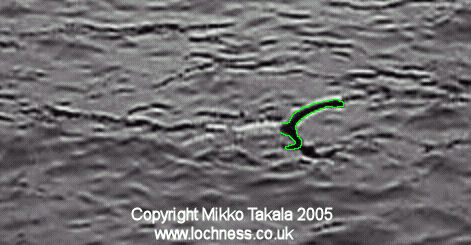
Loch Ness monster - blow up
Finally, the image to silence all the sceptics and Nessie nay-sayers. Innovative Loch
Ness researcher and local commentator, Mikko Takala, has managed to obtain this
clear photograph of Nessie - a plesiosaur - in Loch Ness. The incredible image was
captured at 17.14 on 30 July 2005 in this area. The creature was estimated to be
about three and a half meters long and was about fifty meters offshore. No photo
trickery has been used, although some other sadly envious "researchers" are already
making such unfounded and spiteful allegations. Mikko is interested to know
your views about this image. Special thanks to Strider for the image enhancement
work in the right hand photo.


[The flipper could also continue to extend forward rather than be recurved back.
The neck part outlined in green is said to be about a dozen feet long but the portion that seems to carry on to the left does tend to look like a not so very large branch floating on the surface, with the forked end giving the appearance of an uplifted head and neck with a flipper stretched out  at the base. -DD]

 [Below is an old illustration showing that it was understood that the Loch Ness Monster fishes and attacks by arching its neck and then striking downward
Roy Mackal suggests that the Surgeon's photo at Loch Ness is only a swimming water bird. He does not provide any comparison. Here is a common waterbird, a cormorant, compared to the image from the Surgeon's Photograph: as you can see there is NO similarity to speak of. The creature in the Surgeon's Photo has a much longer neck and smaller head, and the head is a different shape with NO BEAK. And the Cormorant obviously rides higher in the water.

Wednesday, 3 October 2012

Awesome Bigfoot Images From Strange World Fan Page

Awesome Bigfoot Images From Strange World Fan Page


Wednesday, October 3, 2012


read more: http://bigfootevidence.blogspot.com/2012/10/awesome-bigfoot-images-from-strange.html
 
UPDATE: The Strange World page says that the photo has been faked.

Tuesday, 15 May 2012

Kansas Bigfoot Photo, Additional

More on the Kansas Bigfoot photo comes from the Bigfoot Facebook page:
http://www.facebook.com/search/results.php?q=Bigfoot&init=quick&tas=0.48925950899666243#!/FindBigfoot

This was posted on a photo Blog Way off the Trail. It looks very interesting. Solid color, Auburn, inline gate, along a river away from the camera.


 About here is where it gets more interesting:


Comment on Bigfoot Facebook Page: There are two auburn colored objects, one either on or behind a tree. That lends some credibility to the foto

Well this one actually makes logical sense. Sasquatch live in solitary monogamous family groups, the Strategic Male would be watching. This Kansas picture makes sense. Large Black male is watching the photographer. Auburn female is retreating and there is likely another smaller Auburn in the distant tree. Note the shadow of the head cast onto the chest at 2pm. Head shape and attachment looks correct.
I would add that along with this we have been told by witnesses independantly in Florida (Skunk Ape) and in Central Asia (Almasty) cases that the younger/smaller (and possibly including female) creatures are auburn or reddish brown while the adult males (and older females?) are darker brown or blackish, which is a good confirmation of the photo and to the identity of the creatures in it as far as I am concerned.            Best Wishes, Dale D.

Saturday, 12 May 2012

Kansas Bigfoot Photo

I am having technical difficulties with blog postings and that has been delaying some recent entries. Mostly my problem is that I will have text which I put in at the breginning but which disappears when the blog is published and has to be added in again when the problem is discovered and reported to me: on ocasion photos are also failing to show up after I have published the blog article. There have been recent blog entries which came out to nearly 100% text loss (virtually none of the intended text shows up in the first attempt at publication)

However I can try to get simple blog postings through and they should be less difficult to repair than longer and more involved articles.This should be easier: a photograph allegied to be of a Bigfoot taken in Kansas on February 5th of 2012, the current year.


  This one on the bottom is my blowup of the supposed Bigfoot image and I hope a better quality than the intermediary attempt made by somebody else in the middle version. This reminds me of csome of the "Caveman" descriptions for the Eastern Bigfoot.

http://www.wayoffthetrail.com/2012/02/05/bigfoot/

Best Wishes, Dale D.

Thursday, 3 May 2012

Possible Wood Ape Photos From Central Oklahoma

http://texasbigfoot.com/index.php/about-bigfoot/articles/220-oklahoma-prairie-photos


Support the TBRC

Possible Wood Ape Photos From Central Oklahoma

By Alton Higgins

The following is an abridged version of an article that has been submitted to The Relic Hominoid Inquiry provisionally entitled “Photographs of a Possible Unrecognized Bipedal Hominoid From Oklahoma.”

Introduction

Oklahoma has a long record of sightings of large apelike creatures resembling what people often refer to as the sasquatch or Bigfoot. Most of these accounts originate in the mountainous eastern areas of the state; however, sightings are also affiliated with locations along or near Oklahoma’s major rivers. One such area with a history of accounts pertaining to mysterious manlike creatures is the Cheyenne and Arapaho tribal trust lands in Canadian County, located west of Oklahoma City.
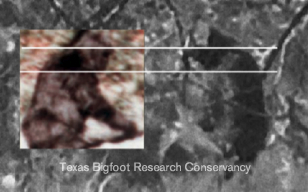
In November 2000 Russell Lumpmouth, a member of the Arapaho tribe, took two photographs that appear to feature a sasquatch-like figure. According to his account, he and several co-workers were cleaning up after an outdoor tribal function. His supervisor walked over a short distance from their vehicles to pose for a picture with a piece of litter seen lying on the ground. Lumpmouth followed with a borrowed digital camera. As he looked through the viewfinder and took the picture, he noted the appearance of a dark object in the background, visible through gaps in the foliage that aligned from his position. Advancing a step or two out of curiosity, he took a second picture as the subject turned and departed. The men did not initiate a pursuit. The photos were printed on high quality 8×10 photo paper. According to Lumpmouth, the office secretary said the images disturbed her and the files were deleted from the computer. Higgins corroborated this description of events during on-site visits and conversations (Higgins, 2004). Further details regarding area investigations are available online via the “Sasquatch on the Oklahoma Prairie” interview available here (MP3).


Methods
The prints were copied in February 2001 using a Microtek ScanMaker X6EL scanner and a Power Macintosh 6100/60 AV computer. Parts of the images containing the subject were scanned at 1200 dpi. The key question that arose concerned the possibility of a hoax. Comparison images were obtained about thirteen months after the original photos were taken to help in assessing the relative size of the subject. Of significance for evaluative purposes was the location of the subject behind a distinctive small tree. Photos were taken using a human model positioned near the small tree so as to derive a conservative estimate of the subject’s size. The man in the comparison photo held a 2.3 m (7.5-ft) pole draped with an Army field jacket. This photo was cropped and enlarged to enable side-by-side comparisons with the subject depicted in the original photographs.
One should expect to see similarities in body structure and proportions among members of the same species. Therefore, comparisons were also made to the subject filmed in 1967 by Roger Patterson and Bob Gimlin in northern California, a creature thought by many to be a genuine record of an unrecognized species of bipedal primate (Bayanov, 1997; Krantz, 1999; Meldrum, 2006).


Results
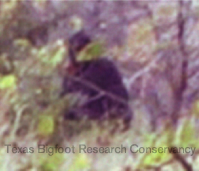
A cropped portion of the first photograph shows the subject facing the camera with the body at about a three-quarter anterior angle (Fig. 1). The face, partially obscured by a foreground leaf, presents what appears to be a deep-set right eye. The lighter area around the socket could represent the presence of a protruding supraorbital ridge, extending to prominent frontal and zygomatic processes. These areas may be relatively hairless producing highlights of the skin in the bright sunlight. The face looks to be tall, relative to the neurocranium, with heavy jaws.

Figure 1. Close-up of a photo taken in central Oklahoma showing a bipedal figure.

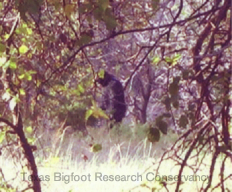
The second picture shows the subject from the left side (Fig. 2). The head appears to sit at a very low position, with the chin clearly located well below shoulder height (cf. Krantz, 1999, p. 150). There is a forward lean of the head and upper torso. The facial profile appears to be quite flat, but specific facial characteristics are unresolved. The left arm looks to be thick, and the subject appears to have a powerful barrel-shaped torso. What could be abdominal muscles are visible, possibly indicating sparse or short hair on that part of the body. The buttocks is prominent, a characteristic of habitual bipedal posture in hominins. What looks to be a muscular thigh is partially revealed through the grass.
Figure 2. Close-up view of the second photograph.

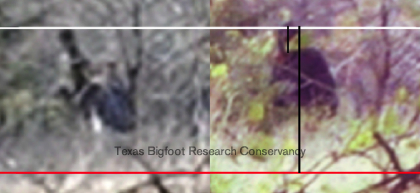
In side-by-side comparisons the subject towers over the 1.7 m (68 in) man holding the pole. Extrapolations indicate the possibility of a stature in excess of 2.3 m (7.5 ft). The difference in body mass is substantial. The subject’s massive head appears to be twice the size of the man’s head and represents approximately 18% of its body height (Fig. 3).
Figure 3. Height and head/stature proportional comparisons.

The white line is approximately 2.3 m (7.5 ft) high. The red line approximates ground level where the subjects stood, as determined by the height of the man and the jacket-draped pole. Based on the lengths of the black lines in the image, depicting conservative estimates of head and total body heights (30 and 165 pixels, as initially measured), the subject’s head appears to represent 18.2% of height. This differs significantly from typical human ratios, where the head averages about 13% of height.
The second photo was compared to a frame from the Patterson-Gimlin film. Although the California subject appears to be a female, similarities of posture, proportion and morphology between it and the Oklahoma subject are striking (Fig. 4). The configuration of the head and shoulders appears to correlate with that commonly seen in the great apes.
Figure 4. Head position of the Patterson-Gimlin film subject (inset) compared to the Oklahoma figure.

Conclusion
Any evidence in support of the existence of a species such as the sasquatch must be carefully considered. In the present case, because of the nature of the photos, only two options for interpretation exist: either the photos are a genuine record of a species not previously accepted, or the pictures are a hoax. The behavior of the photographer has not been consistent with what one might expect from a hoaxer, presuming most such individuals are motivated by a desire for attention or profit. If the Oklahoma photo subject represents a person wearing a gorilla suit, it certainly appears that a person of gigantic proportions was recruited to pull off the prank, wearing what surely must have therefore been a customized costume. However, based on morphological similarities between the Oklahoma and California subjects, and the size and proportions of the individual photographed in Oklahoma, it seems most reasonable to posit that the photographic evidence presented here supports the hypothesis that a currently unrecognized hominoid species exists in North America.


Acknowledgments
Thanks must be given to Russell Lumpmouth for approving the use of the photographs. Roger Roberts and Brett Elliott assisted with the recreation photos. Special recognition must go to Jeffrey Meldrum for his encouragement and guidance.


References
Bayanov, D. (1997). America’s bigfoot: Fact, not fiction. Moscow, Russia: Crypto Logos. 222 p.
Higgins, A. (2004). Evaluating purported sasquatch photographic evidence. Bigfoot Information Project.
Krantz, G. S. (1999). Bigfoot sasquatch evidence. Blaine, WA: Hancock House. 348 p.
Meldrum, D. J. (2006). Sasquatch: Legend meets science. New York, NY: Forge–Dougherty Associates. 320 p.

Thursday, 29 March 2012

Another Possible FW Monkey in Arkansas?

Wednesday, March 28, 2012

http://www.thecryptocrew.com/2012/03/what-is-this-thing-in-photo.html

What is this "Thing" in the Photo

The picture below was taken in Arkansas on a nice warm day. It just looks like a normal picture but if you will notice there is something in the background. Lupe Mendoza,The person who took this picture, did not see the figure while taking the picture. Once someone pointed it out Lupe showed the picture to us here at TCC.
Original photo by Lupe Mendoza

Now, we will zoom in on the object of interest...the figure becomes much more visible.
zoomed
At this point you can see what appears to be an upright walking figure,but it looks kind of odd.
Now we will zoom right in on the figure and try to find out what it might be.
close up of figure

So after zooming it ..we can still not determine what this thing is...so I have tried to enhance the photo and below is the results.


is that eyes?

So after zooming and trying to enhance this photo, we can see what could be eyes but we can still not say what it really is or isn't. It don't really seem to fit the appears of a bigfoot.

I have has shown this picture to a few people in private to see what they might think it could be and I have got replies ranging from Alien to werewolf.
So now Lupe has decided to release the photo for all to see and maybe someone can tell us what this figure is.

TCC thanks Lupe for showing us the photo and now releasing it to the public.
If you have an idea of what this could be, then please let us know.
Thanks
Tom

[Copyright The Crypto Crew]
[Photo by Lupe Mendoza]
[Enhancements by TCC]
--Under those circumstances, that would NOT be an owl. Owls do not hover around swimming pools in broad daylight waiting for a chance to dip in (it looks like). Best Wishes, Dale D.

Disclaimers:'The Crypto Crews blog' is protected under the Lanham (Trademark) Act (Title 15, Chapter 22 of the United States Code)

Hotlinking of The Crypto Crew images and copyrighted material is strictly
forbidden unless permission is obtained.
[If your interested in licensing any of our content,Articles or pictures contact us by Clicking Here]
Disclaimer:
The publication of any and all content e.g., articles, reports, editorials, commentary, opinions, as well as graphics and or images on this web-site does not constitute sanction or acquiescence of said content unless specified; it is solely for informational purposes.
Fair Use Notice:
This site may contain copyrighted material the use of which may not be specifically authorized by the copyright owner. We are making such material available in our efforts to advance understanding of environmental, political, human rights, economic, democratic, scientific, social justice, and religious issues, etc. We believe this constitutes a 'fair use' of any such copyrighted material as provided for in section 107 of the US Copyright Law. In accordance with Title 17 U.S.C. Section 107, the material on this site is distributed without profit to those who have expressed a prior interest in receiving the included information for research and educational purposes.

Thursday, 22 March 2012

'El Chupacabras del Sur America'


This photo of a very large bat has been circulating around the internet lately. It has a confusing perspective, but it looks as if it is about the depth into the photo as the man closest to the front. I have seen the photo referred to as "El Chupacabras del Sur America" or "The Chupacabras of South America." Part of the problem in identifying the bat is that the head has been damaged. I make an estimation that the wingspan as about eighty inches or seven feet across, the size of a big flying fox bat (for comparison see at Left) but the conformation of the body and wings are not quite the same. If this is indeed South America, then there is no bat of comparable size that is supposed to live there and it is indeed at the right size range to be our basic ChupaBat, the outsized False-Vampire one. It would be helpful to have a better view of the head but from what I can tell at this distance, it would seem that the ears have been removed and the creature de-fanged at the very least. The wings are slightly different in structure and the one at top seems to have longer fingers than in the wing of the flying fox, and a broader span of the mobile wingtip area as a result. If this is indeed South America then this creature is the original for the local vampire stories under the names of "Chonchon" and so on.

There is something of a parallel to the Thunderbird photo in that there is an element of forced perspective in the photo , but it is likely not top be a deliberate attempt at deception; rather, it seems to have been just an ambiguous positioning of the elements when the photo was taken.

At  5 Am on 3/24/2012, I received the following update from Quinton R. Godsell:
hi dale.about the s.american bat pic. i am in manila at the moment,my filipino friends informed me the pic was taken in the south of the philippine islands.they called it a tik tik.

Dale Drinnon replied
That is a vampire name. Thanks for the info. Any other particulars on it?

Quinton R. Godsell
yes they believe its a giant vampire bat.possibly mindanao.low level war going on down there.filipino soldiers in photo.
...If I get any additional information I shall add it on here.

In the meantime, I also found a recent reference to an older ChupaBat type creature from Texas called The Blood Beast and subject to scares about Vampires in the middle of the 20th Century: This is mentioned in pasing on a more frivolous internet Chupacabra site together with the illustration here. The illustration is profoundly interesting in that it shows a large bat very like the False Vampire bat, our candidate-model for the ChupaBat. The wingspan would be about six feet, or a man's armspan

Sunday, 6 March 2011

Lake Windemere Photo, Again


'Bownessie' was photographed on a camera phone in England's Lake Windermere.


The Cut-up Automobile Tyre in the Lake.


Mysterious lake creature 'may be floating tyre'
07:00 AEST Mon Mar 7 2011
By ninemsn staff

The photograph of a mysterious four-humped creature on England's Lake Windermere may have been a floating car tyre.

The image made news around the world last month, adding to speculation another Loch Ness monster lived in the Cumbria lake.

John Phillips, 46, of Solihull, West Midlands, was holidaying in Windermere with his wife Liz Phillips and their three daughters last week when they came across a large tyre cut open and stretched out in the shape of the humped "monster".

Read more: Lake 'monster' photographed

Mr Phillips came across the type lying on the footpath at the edge of the lake and was stunned by the close resemblance.

After throwing the tyre into the water, Mr Phillips said, from a distance, the thread of the black tyre tread gives the supposed creature a "leathery" look, resembling the skin of a seal or a snake.

"If you looked at this tyre floating from a distance, it did look a Nessie-like creature," he said.

"I don't want to ruin anyone's fun, but maybe this tyre is the Bowness Monster."

In February, IT worker Tom Pickles, 24, from Shrewsbury and colleague Sarah Harrington, 23, were kayaking as part of a team-building exercise near the Belle Isle, when they saw a four-humped creature emerge from the water.

Mr Pickles took a picture of the mysterious creature with his camera phone and said it was moving at about 15km/h in a rippling motion.

Mr Phillips said the wave of water may have been created if the tyre was pulled with a rope by a person or a boat.

Experts who examined Mr Pickles' photograph reportedly said the image was authentic but the file size was too small to tell if it had been altered.

However, Nigel Wilkinson, of Windermere Lake Cruises, claimed the "monster" in the photo is a group of otters.

"The problem with the tyre theory is that if it is a hoax, you don't normally leave the evidence behind, lying around," Mr Wilkinson said.


http://news.ninemsn.com.au/world/8220433/mysterious-lake-creature-may-be-floating-tyre

Thursday, 17 February 2011

Bow-Nessie: New Photos From Lake Windemere in the SUN

Bow-Nessie: New Photos From Lake Windemere in the SUN

This photo has just been posted in the SUN as representing the monster of Lake Windemere:
credit is given to the Westmorland Gazette, photographer Tom Pickles.

The photo does indicate an object moving at speed and leaving a wake. The body itself is rather peculiar in appearance and resembles a partially-inflated plastic sack tied off at intervals.

We shall be most interested in seeing any developments that may arise from an expert evaluation of the photo.

Lake Windemere is in northern England, roughly opposite the Isle of Man. It is nowhere near to Loch Ness. The object as shown in the photo does resemble sightings reported from Loch Ness.