FRONTIERS OF ZOOLOGY Dale A. Drinnon has been a researcher in the field of Cryptozoology for the past 30+ years and has corresponded with Bernard Heuvelmans and Ivan T. Sanderson. He has a degree in Anthropology from Indiana University and is a freelance artist and writer. Motto: "I would rather be right and entirely alone than wrong in the company with all the rest of the world"--Ambroise Pare', "the father of modern surgery", in his refutation of fake unicorn horns.
In future all information pertaining to living examples of fossil humans, Almas of Asia and the American counterpart,is to be sent to the Frontiers of Anthropology blog. If there is any new information on uncaught anthropoid apes, Yetis, Yeren, Yowies or Skunk apes (NAPEs), it shall be treated as any other news item, but I don't see any particular value in going over the older information again. Any information on fossil Gigantopithecus or possible survival of Gigantopithecus is to be given a higher priority, but once again we intend to focus on new material and news items on this blog.
Orangutan and Orang Pendek. Orang Pendek is considered identical to the smaller kind
of Yeti and Yeren, and a kind of Australian Yowie: similar creatures are also reported in
both North and South America. This information is still in exact accordance with Ivan T.
Sanderson's remarks on the subject made in 1961
On the basis of the new tracks and other new data I would say that beyond any shade of a doubt the (Apelike) Orang Pendek is the same as The Little Yeti (le Petit Yeti, of Heuvelmans), the smaller Yeren (Of Greenwell LINK), presumably the Hibagon of Japan, and the NAPES of North America (Category created by Loren Coleman but including earlier statements of Ivan Sanderson and others) Commonly also known as Swamp Ape, Wood Ape and Skunk Ape LINK & LINK.
This is my statement and not the conclusion of Cliff Barackman or anybody associated with the site.
North American Mittenfoot track, right foot print with
Opposed big toe off to the side on the left in this photo
It is absolutely imperative that we determine whether this is a different species from the more usual orangutans: word so far is that they are not recognizably genetically distinct from them. That could change later, and if it changes for the one form it should change for the same series because their footprints are all similar. There is a related Latin American form but its footprints do NOT match
The caveat remains that "Orang Pendek" in common usage is not a specific term for only the apelike creature and it can be applied to humans as well, and that in fact the same also applies to Yeti, Yeren, Skunk Ape and so on, none of these terms are specific to any one thing in common usage.
Some Comparisons of the Yeti "Mittenfoot" track cast of Cronin as provided by Dr. Meldrum
with Asian apes (Orangutan) and some purported "Unknown" ape tracks:
First the cast compared to the foot of an adult male orangutan,
and then the cast "Trimmed" to show only the contact (footprint) area
The Yeti track is more developed but the big toe does seem to come off about the same
place as it does in the orangutan. The (uncurled) toes are much shorter and both adaptations
are for a ground living (terrestrial) species as opposed to a tree-climbing one.
Above, Orang Pendek and a young orangutan foot (extended)
and below the Yeti track cast compared to the Orang Pendek track cast
Please remember that Heuvelmans referred to the commoner reddish form of Yeti as
"The Little Yeti (Le Petit Yeti), later saying it was likely only another form of orangutan,
and that Ivan T. Sanderson said this one was the same as the Orang Pendek
The fact that orangutan feet can be very variable even in the same individual at different ages makes it more difficult to say whether or not the Yetis and Orangutans or Orang Pendeks are actually completely different species. It also makes sorting out "Yeti" tracks more difficult.
Gordon Mullet's Eastern Bigfoot cast
(Evidentally the same as the Skunk ape of Florida and Swamp ape of Texas/Louisiana)
Shows resemblance to both Yeti and Orang Pendek-Broader and heavier like the Yeti but with the reduced big toe like the Orang Pendek and Orangutan.
Gordon Mullet Writes:
Hello, Here is a ORANGATANS HAND,, looks like the one I photographed on the EASTERN BIGFOOT, Coshocton, county ,Ohio,, See: Cover MY page f/b,See: profile
Above, photograph by Glen Mullet, and below the closeup
Impression of Eastern Bigfoot by Gordon Mullet
Gordon Mullet and a track cast, from Dr Meldrum's Facebook page
Hoax footprint of the Honey Island Swamp Monster. From M K Davis' Facebook wall, and Davis writes: This person is Ricky Holiness. He is the discoverer of the shoe out in the swamp.
He had to look for quite a while in his home for the shoe, but eventually found it.
This is really a great story and Jay Michael tells it eloquently in his documentary.
This same type of hoax footprint (Alligator's foot fastened to the bottom of a shoe) has been repeated elsewhere and some of the Skunk Ape, Swamp Monster or Eastern Bigfoot tracks
(including "3-Toed tracks") come from such a source.
The footprint does unfortunately have some similarities to the more legitimate, more apelike tracks
Some of the Ape tracks feature a long narrow foot and heel and resemble this "Dogman" footprint (from Scott Campbell on Facebook) and are probably actually from dog footprints where the whole foot is printed and not just the paw pads, and composite tracks from more than one footprint from the dog, superimposed.
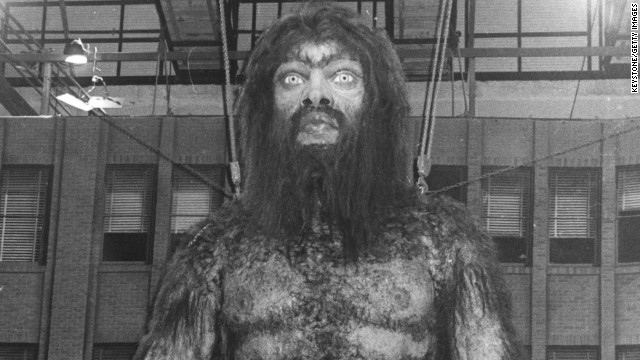
Terrifying mythical creature or just a bear? UK geneticist may have unlocked the truth about the Yeti, or Abominable Snowman.[The picture obviously represents the more standard Almas or Wildman type instead of the type of creature under discussion-DD]
STORY HIGHLIGHTS
Geneticist: Mystery samples from the Himalayas match an ancient polar bear jawbone
Professor is looking for evidence of unknown species that may be linked to humans
He invited people around the world to send in samples of mystery creatures for analysis
Tales of the mysterious Yeti, or Abominable Snowman, have fascinated generations
(CNN) -- For centuries, tales of the Yeti, an elusive but terrifying creature said to roam the inhospitable Himalayan Mountains, have enthralled curious minds.
Now, research by a leading UK geneticist may have unlocked the truth about the Yeti, or Abominable Snowman, after hair samples from two mystery animals proved to be a genetic match to an ancient polar bear.
The findings, to be explained in "Bigfoot Files," a documentary series on Britain's Channel 4 TV network, are the work of Bryan Sykes, a professor of human genetics at Oxford University.
He put out a worldwide call last year for people to submit hair or other tissue from "cryptids," or previously undescribed species, and collected more than 30 samples for analysis.
Sykes' research focused on two samples in particular, both from the Himalayas but found about 800 miles apart, one in the Ladakh region and the other in Bhutan.
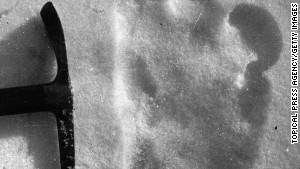
An [Alleged] footprint of Yeti, discovered near Mount Everest in 1951.
To his surprise, testing found a 100% match with a polar bear jawbone from Svalbard, the northernmost part of Norway[A group of islands in the Arctic Ocean], that dates back between 40,000 and 120,000 years, according to a news release from Channel 4.
What Sykes called an "exciting and completely unexpected result" casts new light on the Yeti legend, although it may not satisfy the legions of "Bigfootologists" around the world.
"There's more work to be done on interpreting the results. I don't think it means there are ancient polar bears wandering around the Himalayas," Sykes said.
"But we can speculate on what the possible explanation might be. It could mean there is a subspecies of brown bear in the High Himalayas descended from the bear that was the ancestor of the polar bear. Or it could mean there has been more recent hybridization between the brown bear and the descendant of the ancient polar bear."
Sykes' DNA testing forms part of the Oxford-Lausanne Collateral Hominid Project, which is also looking for genetic evidence of other mysterious creatures -- including the Sasquatch, or Bigfoot, in the Pacific Northwest and the Almasty in Russia -- to study their possible links to humans.
Those who submitted samples to the project last year were asked to give a description of the material and details of where and when it was found, as well as their own opinion of its likely species type and the reasons for that view.
The analysis, which involves sophisticated DNA testing and comparison of the findings with a database of other animals' genomes, doesn't come cheap, costing about $2,000 for each hair sample.
But it may finally allow scientists to pin down whether all those Yeti or Bigfoot "sightings" over the years -- often captured in blurred photos or shaky video footage -- are based on fact, mistaken identity or elaborate hoaxes.
" 'Bigfootologists' and other enthusiasts seem to think that they've been rejected by science," Sykes is quoted as saying. "Now I think that's a complete distortion of what science is about. Science doesn't accept or reject anything. All it does is examine the evidence, and that is what I'm doing."
Sykes has submitted the DNA results for publication in a peer-reviewed science journal and is also due to publish a book based on his research next year.
The answer is quite simple and is a point I personally have been trying to drive home since the onset of this study: THE YETI IS NOT ONE SPECIES BUT SEVERAL. THE WORD YETI DOES NOTAPPLY TO ONLY ONE THING, IT APPLIES TO SEVERAL DIFFERENT THINGS.
The word "YETI" is no more precise than the English word "Monster" or "Bugbear"
To quote Jay Cooney on the matter: "If this isn't just false media information, we should keep in mind that one of the reported Asian mystery animals lumped under the 'Yeti"'term is called the 'Chemo' [or Dremo] and is described as a large and occasionally upright walking bear which sometimes vocalizes through whistling. So perhaps Professor Sykes did find genetic evidence of a "Yeti" in the referenced genetic match after all. But I think it's STILL best to wait for the paper itself rather than to listen to media claims."
Eberhart's Mysterious Creatures lists this Cryptid as:
Mystery Primate or Bear of Central Asia, oftenconfused with the Yeti.
Etymology: Tibetan (Sino-Tibetan) word, apparently
with various meanings, among them: a
female demon, a person who has gone astray
from a religious life, a she-bear, and the red and
blue varieties of the brown bear.
Variant names: Chemo (“big”), Chemong,
Dredmo (“brown bear”), Dremo.
Physical description: Looks like a bear or large
monkey. Taller than a human. Shaggy reddish,
black, or dark-gray hair. Sometimes white headhair.
Small eyes. Pointed mouth.
Behavior: Nocturnal. Walks on all fours as
well as bipedally. Growls and whistles. Omnivorous.
Looks for food under large rocks. Throws
rocks. Kills with its hands (or paws).
Distribution: Eastern Tibet; Bhutan.
Significant sighting: Somewhere southwest of
Alamdo, Tibet, in July 1986, Reinhold Messner
encountered a large, dark-haired animal that
emerged from rhododendron bushes onto the
path about 30 feet ahead of him. It rose on its
hind legs, turned, and ran away on all fours.
Local Tibetans told him it was a Chemo.
Possible explanations:
(1) The Brown bear (Ursus arctos),
especially the isabelline or red variety found
in the eastern and central Himalayas, is
known in the Karakoram Range of
Baltistan, Pakistan, as the dreng mo; to the
Ladakhs in Jammu and Kashmir as drin
mor; and in Tibet as the dred mong.
Considered by some a subspecies (U. a.
isabellinus), the red bear is generally 5 feet 6
inches–8 feet long, with a reddish, grizzled
coat. It eats grasses, roots, and scavenged
kills such as ibex.
(2) The blue or horse variety of brown bear,
sometimes considered a subspecies (U. a.
pruinosus), is found in eastern Tibet and
Sichuan Province, China. Its blue-tinted
brown hairs are tipped with gold or slategray.
A yellowish-brown or whitish cape
forms a saddle mark over its shoulders,
hence the name “horse bear.”
(3) The Chemo may refer to the Yeti or
Dzu-Teh, while the Dre-mo is a bear.
Sources: Edmund Hillary and Desmond
Doig, High in the Cold Thin Air (Garden City,
N.Y.: Doubleday, 1962), pp. 100–101
119–123; Odette Tchernine, The Yeti
(London: Neville Spearman, 1970), p. 175;
Terry Domico, Bears of the World (New York:
Facts on File, 1988); Reinhold Messner, My
Quest for the Yeti (New York: St. Martin’s,
2000).
As a postscript, here is a statement made by Paul Mead on the CFZ Facebook Message board
Paul Meadwhatever it is, I certainly don't buy the bipedal bear theory, Hilary in his 60s expedition book linked the brown/blue bear identification to the 'yeti', a bear pelt was brought back from Bhutan & identified by Sykes as an unknown subspecies of brown bear so this DNA may well have contributed to today's announcements, I agree however, that it is too early to state for certain that this bear is the definitive yeti as there is still a wealth of evidence that points to a large unknown primate possibly a sub species of orangutan living in the forests of SE Asia today
I have not been keeping readers posted about events in the World of Bigfooters. I'd have to say that since I've become involved in Bigfoot themed events and posting them to this blog, Ive become both disenchanted and discouraged. Not about the creature(s) itself (themselves) but at the quality of what is advanced as evidence and bickering among Bigfooters. Any more I would rather not get involved. Still readers do deserve an update and so I have decided to reprint Robert Lindsay's Bigfoot News blog from this morning.
Dr. Bryan Sykes study may well prove that Bigfoots exist. From multiple sources, I have now received the news that not only will the Sykes DNA study publish soon, it will also prove that Bigfoots exist. None of the sources would tell me this in so many words, but they certainly implied that the findings would be positive. So I am looking forward to publication of the study. On the other hand, it is possible though not likely that the sources are all wrong and the study could be negative.
Rick Dyer dead Bigfoot video is taking orders now. Dyer’s video After the Shot is now on sale for $129. It is said to contain 45 minutes of HD footage of the dead Bigfoot, Hank, that Rick definitely shot and killed in San Antonio, Texas last year. Rick says that the film was shot soon after the shooting by a film crew from a film company that he is associated with in some way. Rick says he had to pay the film crew $20,000 for their efforts.
He is only selling 100 copies, so he should make $13,000 off this video. Therefore, he is not even making his money back. Dyer says that the crew did an excellent job, much better than Rick could do, in shooting the movie, and that it looks very nice and professional. They will get 100 orders and then ship the video. This is so they can make at least $13K before the video goes viral on the Internet as they fully expect it to do.
The videos have not yet started shipping, so Dyer has not yet received 100 orders.
Each copy has some sort of markers on it to distinguish it from all of the others. Therefore, if anything gets uploaded to the Net, Dyer says he will know who put it up there he will sue the pants off them. However, almost no one is ever sued for uploading copyrighted content to the Web. The DMCA was written to avoid the lawsuit abuse associated with pirating videos. In general, a DMCA takedown order is issued to the website or whoever put the video up there. Youtube will ban you if you get three DMCA orders. In addition, Youtube protects its uploaders and will not give out their name to any copyright holders to avoid lawsuit abuse.
There is an extremely stupid and evil law that was written a while back that actually makes it a federal offense to upload copyrighted material to the Internet. Two people have so far been prosecuted under this idiotic law. One fellow uploaded a copy of a new Star Wars movie to the Net and Lucasfilm went after him.
Curious incident when someone pretended to order a copy of Dyer’s new video. Someone pretended to order a copy of the new video After the Shot and the order came up After the Hoax instead of After the Shot. The person who faked the order says they think Dyer got the title mixed up because he was working on some other video about the 2008 Dyer Bigfoot hoax. Obviously the skeptics are going to have a great time with this news!
It is recommended that Dyer skeptics get their hands on the video. The skeptics insist that this video is a hoax using a dummy prop as a dead Bigfoot. Although Christopher Noel and I disagree with that and feel that there is probably a real dead Bigfoot in the video, the possibly yet exists that this video may be a gigantic hoax. As the movie has not yet shipped, there is no evidence one way or the other whether this video is real or faked.
However, if it is fake and the skeptics can prove it, Dyer is taking a huge risk. He would be risking interstate commerce fraud for promising a video of a real Bigfoot and delivering a clever hoax. In addition, to the criminal offenses, Rick would be civilly liable and could be sued for damages in civil court by anyone who bought the video. I would like to see the skeptics get their hands on some of this video or stills from it at the very least so they can try to debunk it.
[I was contacted by Rick Dyer early on in the current hoax affair and basically that was all I needed to hear. I have unfriended him on Facebook and I tell anybody that asks me that he had nothing before and this time around he has nothing again. He thinks anybody involved in looking for Bigfoot is a fool and all he wants to do is have a laugh at their expense. My opinion only of course and you are free to disbelieve me if you like-DD]
Real Bigfoot photo from a state park in Florida.
A screenshot from a recent video of a Bigfoot hunting deer at dusk in Florida.
I cannot remember the name of the video, but it was shot by a father and son who noticed cars pulled over by the side of the road in a state park in Florida (forget the name). In the video, you see a number of visitors pulled off the to the side of the road with their binoculars out looking at some odd events happening in a field about a mile away. Deer would pop up, run a bit, and then plunge down to the ground out of sight.The visitors were mostly tripping on the strange antics of the deer, and they did not seem to notice the other figure.
It was the strangest thing to see!
In the background, some sort of a bipedal creature seemed to be moving towards the deer. The deer appeared to be reacting to the bipedal creature. They seemed to fear that the creature was hunting them or trying to kill them and they were using strange eluding tactics to avoid the thing.
Whatever this is, I do not believe it is a hoax. You mean some guy, presumably in cahoots with the videographer, put on a Bigfoot suit a mile away from the road at dusk and moved his way towards some deer? No. Anyway, if it just a guy in a suit, the deer would figure it out and would not be acting so weird. They would just run away from the man or maybe just stand their ground since it is a state park and hunting is prohibited. There is no way that everyone who pulled over was in on some sort of a hoax, and it is extremely dubious that the man and his son were involved in a hoax with a man in a suit running around in the sawgrass at dusk.
So what else is it? Misidentification? Nope. It’s a bipedal creature and it looks large and hairy. What else could it be? It’s a Bigfoot or skunk ape.
Further, the rangers at the park acted very weird when the heard about this sighting, denying that it happened in the first place and even closing down the road where the sighting occurred. Furthermore, they tried to ticket the videographer apparently as a message to back off of his story.
In other words, just another government Bigfoot coverup!
My opinion: This is a real Bigfoot herding the deer, possibly towards another Bigfoot who is trying to hunt one. The quality of the screenshot and the video are not that great due to distance, but I do not see who this could be anything else. One thing I am sure it is not is a hoax. Notice the swaying motions of the arms and how much that looks like Patty from the Patterson film!
[Closeup by Dale D: note big round head of subject]
[The proportions are of course nothing like Patty and neither is the head shape. However "Being Authentic" does not necessarily mean "Like the Patterson Film". In this case the torso is impressively burly but the arms are shorter, and the proportions more human-like. It could still be a Skunk Ape, Eastern Bigfoot version but the best evidence is behavioral as Robert Lindsay states. The actions would be consistent with what I had heard about Eastern Bigfoot hunting deer up here in states further North.-DD]
Rocky Mountain Sasquatch Organization catches possible Bigfoot on video.
In this video shot in Rough Hollow, Utah by the RMSO, there are 38 seconds of a possible Bigfoot seen from 2:16 to 2:54. The Bigfoot goes from a crouching position to a kneeling position to all the way down on its stomach. The possible movements are very slow and deliberate so as not to cause notice. The possible creature is in dark black in the video and was not noticed until later on. Skeptics are saying it is a stump or a cave overhang or a shadow, but it appears to move. Do stumps, cave overhangs and shadows move while you are filming them? Overall, a good video.
Possible juvenile Bigfoot filmed in Havana, Florida on a game cam.
The video above just shows a still from the game cam. There is a very interesting shadow there that could well be a juvenile Bigfoot. It does somewhat resemble the Jacobs juvenile Bigfoot photo from a game cam in Pennsylvania. Those photos are definitely pictures of a juvenile Bigfoot. It can’t be anything else. This Havana photo may be a juvenile Bigfoot, and then again, it may just be a stump or a shadow.
Vladimir Putin believes that Yetis are real.Very interesting. Putin is the Prime Minister of Russia, and it is said that he believes that Yetis are real. We need more celebrity believers. I am quite certain that if Bigfoots are real then Yetis will be proven to be real someday too. A source close to the Ketchum Project told me that an initial male-female peaks study of a Yeti sample by Ketchum showed that they were related to Bigfoots but not the same species. The entire sample was used up by the quick and dirty test, and there was no more to test. Ketchum also stated herself that she believes that Yetis are real in addition to Bigfoots being real.
[There is a problem in that the Russians are abusing the term "Yeti", having appropriated the term from the Tibetan Plateau area where the term is native. It is now being used freely where the term "Almas" had been used in former decades. However since the term as it is used seems to apply to some of the same creatures also called Yetis in Tibet and Bigfoot in North America, the point may be moot. Please note that all terms are nonspecific, general-category references rather than specific references to specific creatures (They are regularly applied to more than one thing and more than one species, probably species from different families even.)-DD]
Let`s see if the videos really exist, get shipped to Dyer and if they then get send out to customers as soon as possible. You mentioned the legal implications. Is Dyer really this stupid or ignorant? I have the feeling: No. However, IF the videos really exist and they reach the general public, then it gets really interesting. Decision time. About the Sykes study: would just be fantastic if these rumours are really true.
To RL; Happened to see this about the Minnesota Iceman being put back on display again. I’m sure you are aware of the ‘Iceman’ story from the ’60′s. What got me is that this ‘exhibit’ is in Austin, Texas…..perhaps RD is selling his video of his visit there….he doesn’t claim that the ‘dead bigfoot’ in his video is the one he shot. anyway….I thought is was some what of a coincidence…site has a couple of pics also: Thanks for your time, J.Lucas http://www.huffingtonpost.com/2013/06/28/minnesota-iceman-photos_n_3517680.html
In the 1960s, the “Minnesota Iceman” was paraded from mall to fairground, leaving rumors of Bigfoot, missing links and government conspiracy in its wake.
Then, just as quickly as the 6-foot-tall frozen beast surfaced, it vanished — until now.
Earlier this year, Steve Busti — owner of the Museum of the Weird in Austin, Texas — bought the ice man from the family of its original owner in Minnesota. He’s going to once again reveal the ape-like creature to the world starting July 3 at his museum.
Before his big purchase, Busti spent the last two years researching the Minnesota Iceman and trying to pin down its location. He found that the original exhibitor, Frank Hansen, had it in a freezer at his home for decades after its last showing. It’s still unclear why the big, hairy popsicle’s tour abruptly ended.
Somehow, Hansen managed to keep Mr. Freeze out of the public eye until he died about 10 years ago. Busti also learned that rumors of the Minnesota Iceman being discovered in Siberia were untrue.
“[Hansen] shot it in Wisconsin — its eyeball’s blown out and its arm is broken,” Busti told HuffPost Weird News. “I couldn’t believe it had been in Minnesota the entire time.”
Hansen froze the remains and put them on display. What’s not explained, however, is what the Minnesota Iceman really is. It’s big. Hair covers its entire body. And it doesn’t look too happy. It’s easy to see why many continue to think it’s proof of Bigfoot, and why others think it’s simply a primate. From Wisconsin.
Below are two never-before-seen photos from Hansen’s collection in the late 60s. Busti wouldn’t show us photos of the Minnesota Iceman in its current state. You’ll have to head to Texas to see for yourself.
[This story has also been covered on this blog before. It is interesting that Busti is quoting from Hansen's description which does not describe the model now on display in two key features-the broken arm and the popped-out eye-DD]
On the Sykes study: also the first “rumours” sound very promising (for believers like me), one has to be cautious. Remember the DNA brought back by a British TV expedition to Bhutan in 2001 or 2002? The hair samples from a place called Sakteng were handed over to Sykes. Sykes told the press after the first check that his team found DNA “never encountered before”? After that nothing was heard from Sykes anymore, but when a British “cryptozoologist” asked him about more conclusive results about one year later, Sykes told him that it was DNA from an Asiatic/Himalayan black bear! Black bear?!! One would think, DNA of such an obvious species would be identified easily during the very first examination. I also wrote an email to his laboratory and they given me the same answer. So, why did Sykes told the press there was “unknown DNA” in it? Just a comment to “advise caution” regarding Sykes – at least for those believers who expect too much from this study.
Is the legendary Yeren, China’s version of Bigfoot, actually real and living in the most remote regions of China? According to an expert researcher on the subject, the answer is a resounding yes.
Yuan Guoying is a researcher with the Xinjiang Environmental Protection Institute, and has researched the subject of China’s Wildman for over 40 years. He claims that “at least” 200 such creatures are living in the country today, and possibly as many as 500. He also claims that there are actually seven or eight different species of the Wildman, and not just one.
Long history of Wildman sightings
Legends of the Yeren date back centuries in China. The Shennongjia region of northwestern Hubei province has long been a particular hotbed of sightings, which is why the Wildman is often referred to as Shénnóngjiàyěrén, “The Wildman of Shennongjia”. The creature is often described as having a red or brown coat of hair, and being 6½ to 7 feet tall. Reported incidents of Yeren sightings have not only been made by private citizens, but also by more reputable public figures. In 1940, biologist Wang Tselin claimed to have examined the corpse of a female Yeren killed in Gansu region. A decade later, geologist Fan Jingquan claimed to have seen two wild men, described as a mother and son. In 1976, six bureaucrats claimed they encountered a Yeren on a remote highway in Hubei province, near Chunshuya. They described the creature as having thick brown and red fur, an ape-like face with human-like eyes, and large buttocks, which one of them threw a rock at. Yeren do not like rocks being thrown at their buttocks apparently, as the creature rose up on two legs and frightened the bureaucrats away, before retreating. That account prompted the Chinese Academy of Sciences to send a team of 110 investigators to the region in search of evidence. No sightings were made of any creature, though the investigators did make off with some hair and feces which locals claimed were from Yeren. A more recent account occurred in 2007 when four separately traveling tourists all claimed to have had near-encounters with two Yeren in the Shennongjia Nature Reserve.
Serious doubt cast on expert’s assertions
Despite the numerous sightings over the years, several intricate expeditions to unearth evidence, and researcher Yuan’s unwavering belief in the existence of the Yeren, bodies or fossils of such a creature have never been found. Yuan references the supposed hair and footprints of the creatures that have been discovered as further proof, though nothing definitive has ever been revealed about those specimens. Without any real proof to sustain them, most scientists show little interest in the Yeren, and funding for research into their existence has dried up. Yuan refuses to give up however and vows to continue his search. "If they do not exist, how come we have so many witnesses and stories about them?" he questions. - - See more at: http://gbtimes.com/past-present/modern-china/are-wild-men-secretly-roaming-chinas-forests#sthash.qI3vNs5f.dpuf http://coombs.anu.edu.au/~vern/wildman.html http://coombs.anu.edu.au/~vern/wildman/anu796.txt
Seeing is believing, or is it?
How scientific is 'Wildman' research?
COMMENT By Helmut Loofs-Wissowa*
A surprising reappraisal has been taking place in human
biology during the past few years. The border between what
is "human" and what is "animal" is being subtly shifted to
include in the human category the Great Apes (gorilla,
chimpanzee and orangutan, with all the moral and ethical
implications inherent in such a shift. More modestly, we may
see ourselves as being part of the Great Apes (see Colin
Groves' talk on Occam 's Razor on 28 April) and perceive the
Great Divide as being between Us and the monkeys.
There is also talk about the possibility of a new species of
humans walking the land, their DNA artificially altered,
straight into the rosy-fingered dawn of yet another Brave
New World.
And yet, while all this dramatic rethinking is going on, we
do not even know the exact situation within our own genus
Homo. We blindly persist in believing that we, Homo sapiens,
are the only extant species within this genus. We are
convinced, in spite of steadily growing evidence to the
contrary, that we hold the monopoly of human-ness proper
(never mind our closeness to the great apes), not unlike the
conviction some centuries ago that the Earth was the centre
of the Universe. And like Galileo, those who dare question
this dogma find themselves in the impossible position of
having to prove something that cannot be proved to those who
do not want to know. In those times, such heretics were in
danger of being burnt at the stake; at present they are
branded, by the Establishment, as being "unscientific". It
is idle to speculate what hurts more: at the stake it was
over in an hour or so, but the "unscientific" label may
stick to you for many years if not for life.
The question thus is whether the search for still unknown
non-sapiens hominids, usually called "Wildmen", has anything
to do with science. There are by now thousands of reports of
such Wildmen throughout the world: Abominable Snowmen or
Yetis in the Himalayas, Yeren in China, Sasquatch or Bigfoot
in North America, "Forestmen" in Indochina, and Yahoos,
Yowies or Hairymen in Australia. There are also reports of
such beings, under different names, from Indonesia,
Malaysia, Burma, Pakistan, Mongolia, the Caucasus, various
parts of Africa and even South America.
To dismiss all this as collective hallucination, the
primitive need for the mythological or simply as archetypal
legends common to all mankind will not do any more. Even
though some of these explanations are the results of fairly
recent profound thinking, they now appear like rear-guard
attempts by some medieval Church authorities to explain away
an irritating (because it does not fit into the orthodox
world-view) natural phenomenon. That is precisely what the
continuing existence of "Wildmen" is: there is no room for
them.
The best way to solve the parking problem is to erect "no
parking" signs everywhere, is it not? Same here: affirm that
the Wildmen problem does not exist and it is ipso facto
solved. To ridicule those who believe in their existence by
saying that therefore they must also believe in UFOs does
not help either, because these are two totally unrelated
issues, separated by a huge gap on the probability scale and
lumped together in the minds of some naive "skeptics" only
because both are outside the rigid boundaries of
conventional knowledge. No, we as academics owe it to our
contemporaries to come to grips with this problem and solve
it on a scientific basis. But how do we go about doing this?
Having recently returned from "Wildman" research in Laos
with what I thought were very good results, I was accused of
not being scientific enough by some of my colleagues, and
even by a journalist. I therefore wish to Justify myself;
but this is done more in sorrow than in anger.
There seems to be a general agreement that the essence of
the scientific method is the "validation of hypotheses by
observation or experiments" (The Heritage Dictionary), to
which should be added that this must be verifiable by
others. The formulation of an hypothesis is thus to be seen
as the first and foremost criterion for something to be
"scientific".
My own hypothesis, based on many years of research, is that
there still exist higher primate forms distinct from both
the Pongidae and Homo sapiens, i.e. either still unknown
bipedal pongids or non-sapiens hominids, in certain
inaccessible parts of the Indochinese Peninsula and in
particular in a well-defined spot in Central Laos near the
border with Vietnam, from which I had reports of the
existence of "gorillas" in the late 1960s. These reports
came from Vietnamese, Laotian, American and Australian
sources, checked and double-checked with regard to their
authenticity and trustworthiness.
My "experiment" consisted in going there (which is far from
easy), interviewing old people in remote villages and
eventually recording first-hand information about powerfully
built hairy manlike creatures which/who used to live in
precisely the area I expected them to have been until it was
bombed, defoliated and napalmed (because the Ho Chi Minh
Trail was going through it) which resulted in the
destruction of the primary forest, their habitat. In order
to pinpoint more closely their physical appearance, I had
prepared a set of pictures to choose from: photographs and
drawings of the Great Apes, reconstitution drawings or
paintings of some prehistoric hominids such as "Java Man"
and the reconstitution drawing, after the original
photographs, of the famous "Minnesota Iceman", identified by
one of the foremost zoologists of our time, Dr Bernard
Heuvelmans of Paris, as being a relic Neanderthal
originating very probably from Vietnam. It was to this
latter picture (which is reproduced on this page), drawn by
Heuvelmans' exwife Alika Lindburgh that everybody pointed
without the slightest hesitation as being the best
representation of the creatures they had seen.
My original hypothesis has been validated inasmuch as there
are irrefutable indications for the existence at least into
the recent past, if not into the present, of obviously
non-sapiens hominids, almost certainly of the relic
Neanderthal type, in the area I hypothesised them to be.
This can be verified by whoever is game enough to repeat my
experiment! This research has been conducted strictly
according to the rules and should therefore qualify for the
coveted label "scientific".
Not so, say certain skeptics or "mainstream"
anthropologists, palaeontologists, human biologists or
whatever: where is the proof? We want to be convinced! The
counter-argument is "this cannot be: non-sapiens hominids
cannot exist any more because they are extinct, as we all
know"; end of conversation. There is thus either no initial
hypothesis at all (ignore the problem and it ceases to
exist), which is certainly not "scientific", or the
hypothesis is that such creatures do not and cannot exist,
which is impossible to prove by any experiment or
observation, the less so if one keeps in mind the dictum
that "the absence of evidence is no evidence for absence".
Back to the demand of proof by those who must be convinced.
Unfortunately, "proof" and "evidence" are never a matter of
simply yes or no; there are grades and shades. There is "no
proof", "hardly any proof', "proof", "good proof' and
"ironclad proof". As to evidence, it can be "not a skerrick
of evidence", "some evidence", "evidence" and, if you are
lucky, "hard evidence". But the degree of hardness is always
determined by the receiver of the evidence, not the giver of
it (perhaps we should call them now the "evidencer" versus
the "evidencee"). If the evidencee just does not want to be
convinced, there is little the evidencer can do except for
breaking some crockery or hitting a punch-bag to relieve
his/her frustration. The decision of what is "convincing"
and what is not is entirely in the hands - or rather the
minds-of the custodians of "science as we know it".
Obviously, these custodians know more of the theoretical
framework of evolution and of palaeontology than the
illiterate peasant in the Lao-Vietnam border region. And
yet, when it comes to observing the jungle around them, the
latter, free from preconceived ideas, is by far the more
reliable provider of evidence than the former. The jungle is
the testing ground for theories, not the study of the
armchair academic. However, as proof, the testimonial of the
Laotian montagnard (or Nepalese sherpa or Chinese peasant),
faithfully transmitted by the researcher, is usually
considered to be insufficient, although all workers in the
field know of the fundamental honesty of indigenous people
towards strangers (Margaret Mead and her informants not
withstanding! ). I cannot help smelling the nauseating odour
of racism here. What, then, would really convince these
unscientific skeptics? The first answer to this question,
usually accompanied by an arrogant smirk, is: I believe it
when I see it! But if ever they were really to see the
object of their disbelief, e.g. a Wildman in up-country
Laos, they would in turn not be believed upon their return
home! They would themselves see the smirk on the faces of
their interlocutors and would have enormous and
well-deserved trouble in trying to convince them. "Seeing is
believing" only works for the individual and cannot be used
as proof or evidence for those who do not want to be
convinced.
The next step normally is "Wanted: one wildman, dead or
alive". Thus runs the revealing title of the rather negative
review of Myra Shackley's book Wildmen by a well-known
British human biologist in New Scientist, August 1983.
Revealing, because it shows the unyielding attitude of the
Establishment in the face of over-whelming evidence gathered
by an intrepid, although fallible, scholar by simply
demanding the impossible. It is physically and materially
impossible for any one scholar working in the field to
produce a living, fierce, growling and biting six-foot
Wildman from Outer Mongolia (or for that matter from Central
Laos), or even its/his decomposing body, like a rabbit out
of a hat, for the benefit of an incredulous armchair
colleague in London. It is also ethically impossible. And
here we come to the crux of the matter.
Unlike cryptozoological research for other animals like the
Tasmanian Tiger, that for Wildmen is really anthropological
research (i.e. the search for unknown human beings) and must
therefore be conducted according to the ethical principles
and scientific rules of anthropology rather than of zoology
or palaeontology. If there is now the tendency, among more
enlightened primatologists and other scholars, to view the
Great Apes as being entitled to the same protection as
humans (right to life, protection of individual liberty and
prohibition of torture), why should this not be so for still
unknown hominoids and especially non-sapiens hominids? The
latter are clearly man and should automatically enjoy the
rights thereof, regardless of whether these rights will
eventually also be accorded to the Great Apes.
In practical terms this means that in no circumstances
(except in self-defence) is a researcher allowed to kill the
object of his/her research in order to get possession of it
as iron-clad proof of its existence. Even the hunting,
subduing, stunning or capturing of a Wildman cannot be
permissible because it would deprive this creature of its
liberty and would probably even involve some form of
torture. What if, for argument's sake, a hitherto unknown
tribe was discovered tomorrow in a remote valley in Irian
Jaya: could any western scholar, sitting in his armchair,
say "get me one of those blokes dead or alive or else I am
not convinced of their existence"? Certainly not; he would
either have to go to the remote valley to see for himself or
he would have to be content with the description provided by
the anthropologist in the field without this being less
scientific. Anthropological research has been done in this
way ever since it began and it developed into a fully
fledged science without there ever having been this arrogant
demand for "proof" by those who stayed at home.
One last-ditch argument by the skeptics often is that even
though you are not supposed to kill a Wildman, there must be
lots of bodies or skeletons of them around there where you
claim they live: why can you not bring home a skull or at
least some bones to convince us? So: must there? How many
bodies or skeletons of the Great Apes were found before
their existence became known through eye-witness accounts?
At the very least, we want something tangible beyond mere
hearsay, such as footprints, tufts of hair, faeces, sound
recordings or photographs, as if any of these was in itself
more trustworthy and unequivocal than the testimonial of
honest, observant and unbiased - if uneducated -"natives".
On the contrary: every single such item has again and again
been dismissed by those who do not want to be convinced.
Footprints must be those of a bear or are dilated by
weathering, tufts of hair could be from any odd beast, same
for faeces, sound recordings are probably fakes and
photographs are vague, not in focus, too dark and probably
fakes, too. To which the researcher could add that even the
best photograph cannot answer better than a faithful eye-,
ear- or nose-witness account certain questions regarding the
exact taxon of the observed creature, its gait, habits,
movements, reactions, smell, etc., thus everything that
transforms it from a theoretical into a real human being.
The more one deals with these matters, the more one is
struck by the close similarities and yet paradoxical
differences between what is going on in a court of justice
and in the corridors of what masquerades as science. There
are a number of expressions in the legal vocabulary which
science, and in particular that dealing with human beings,
could do better than ignore, such as "balance of
probabilities", "onus of proof" "beyond reasonable doubt",
and above all the admirable Anglo-Saxon maxim of "innocent
until proven guilty" which is constantly contravened by
skeptics for the sake of scientific objectivity. A person
"claiming" to have seen a Wildman is automatically presumed
to be guilty of lying(because Wildmen cannot exist!) unless
he can "prove" the existence of Wildmen by some other means
and thus his innocence to the satisfaction of the one who
accuses him of lying! What a charade! This kind of "science"
clearly has reached its use-by date and should be taken off
the shelves immediately. Time has come in Wildman research
to shift the onus of proof squarely on to the skeptics and
to realise that beyond a certain point doubt is not only not
any more reasonable but also a positive (or should one say
negative?) hindrance to the advancement of real science.
This is the more urgent as all still insufficiently known
relic hominoids are endangered species and they may
disappear before they have been officially "discovered".
This would certainly not be to the greater glory of the
scientific Establishment at the tum of the millennium. At
fault is not the scientific method as such, which has been
adhered to scrupulously by most researchers in this field,
what is at fault is the one-sided and short-sighted
interpretation of what is thought by "main-stream"
researchers to be the essence of this method: its thrust.
The scientific method aims at finding out, not keeping out.
Long live the scientific method!
*Dr Helmut Loofs-Wissowa, a trained anthropologist, is
retired Reader in Asian History and now a Visiting Fellow at
the Southeast Asia Centre, Faculty of Asian Studies, ANU.
A
showing of the Japanese television film on "Wildman"
research, which covers Dr Loofs-Wissowa 's work among other
topics, will be screened in the common room of the Asian
Studies (Baldessin Precinct) Building on 31 July at 6pm.
The film will be in Japanese.
Source ANU Reporter 27(12): 4. Wednesday 17 July 1996
For the record I was in contact with Loofs-Wissowa before he died because he was interested in certain information I had. For the record I consider that two basic species are involved in reports of the Yeti, Yeren and Nguoi Ring: one more humanlike one and one more apelike one, and neither one seems to be verifiably an unknown species yet. The hairy man seems to be a subtype of Homo sapiens and the ape a kind of orangutan, and we DO have some possible remains of them as fossil forerunners and more recent samples of bones, hair and teeth that have been tenatively identified as being a type of early man and a kind of orangutan. So actually so far we do not have a real Cryptozoological mystery about either one of them. Above and beyond both is the larger, rarer mystery creature which could be a Gigantopithecus and this one would be the genuine cryptid of the bunch. The same exact situation and even the same exact species seem to be on North America, going by the tracks. Once again, the more manlike one would be a man and the more apelike one would be an ape.
My friend and frequent debating partner Paul Mead drew my attention to this matter on Facebook. It seems that believers in the existence of Yetis have some cause for rejoicing and justifiable excuse for lording it up over on the skeptics. One of the Cryptozoological discussion boards states the situation thusly:
"In 2008, Joshua Gates and his "Destination Truth" crew recovered a Yeti hair sample in Bhutan. The analysis reportedly came back as indicating 'an unknown DNA sequence.'
Fast forward 4 years later and now rumor has it that Dr. Melba Ketchum's DNA study will finally prove the existence of the Yeti in addition to Bigfoot.
According to Robert Lindsay:
'We have not been able to verify this rumor, but we have heard from several people that the Ketchum study also includes purported Yeti hair gathered by Josh Gates, apparently in Bhutan. We just heard it from someone very close to the study, so we think it is good.
The Yeti hair tested as no known animal, not human, unknown primate. Not only that, but the Yeti sample was actually close to the nearly 100 Bigfoot samples. So not only do Yetis exist, but they are closely related to Bigfoots. Some of us have always thought that Yetis were real, but lately, there has been a lot of skeptical research pouring cold water on the theory. The Wikipedia article on the subject says Yetis do not exist, and they are mythical.'
All of this has been very confusing to follow but I am glad that the DT Yeti hair is not part of this study and not associated with Ketchum's media circus. Although I would like to know what the eventual DNA results were of that hair.
Ketchum stated that she has been working with Bigfoot hair and tissue samples. I am sure that this story will change Yeti(yet) again as the saga continues."
There is good news here and bad news. The good news is that the Yeti hair has tested out as positively primate and unknown. The bad news is that coming from the source it does and in the context it does, the results cannot be trusted and in fact the analysis having been done by Ketchum actually hurts the case since her main study has been discredited.
However I am thinking that when Ketchum is out of the picture and this evidence is viewed again, This Yeti will turn out to be a valid unknown species and the same species as the North American Sasquatch. THIS Yeti is the Big Yeti of Heuvelmans, and the Dzu-Teh of Sanderson, the one that everybody agrees is likely to be a relict Gigantopithecus. Basically all we need is a new review of the evidence and that is already under way.
Paul Mead to Dale Drinnon on Facebook, 2 hours ago (5:20 PM July 2) Dale, watched Josh Gate's program about the Yeti in Bhutan & the discovery of DNA from a large as yet unknown primate, surprised you haven't rubbed us the unbelievers noses in it
Dale DrinnonI'm not the type that does that sort of thing (Blinking big blue eyes innocently). No I'll just bash you to kingdom come while the point is still an arguable issue.
Paul MeadDale, just joking, but surprised more wasn't made of this news at the time, unless of course, at a later date, the DNA was discovered to have come from the lesser spotted blue toed possum of the outer Himalayas!
Dale DrinnonPart of the problem is that the sample was apparently sent to Melba Ketchum for analysis, and a lot of half-true statements were issued as a result (according to Robert Lindsay) And nobody knew what to do with it after that point. I actually don't know what I can say about the results myself (BTW to readers unfamiliar with the case, the DNA sample is from supposed Yeti hairs recovered in Bhutan in 2008)
Dale DrinnonOne of the guys on one of the discussion boards said " I guess having possible proof of the existence of the Yeti is not a big deal after all. " and actually, I think that's about the size of it
Paul Meadbeing totally facetious about the blue toed possum, interesting thought on the yeti, however, there will be no end to the debate, unless we discover to what group of animals it belongs - whether bear, orang-utan, unknown primate
Dale DrinnonThere remains the very important factor that "Yeti" is a generic term and does not definitely mean any one thing in particular. Switching over to a scientific term such as "Pongo sp" will make conversing about actual creatures something more concrete. As it is, you can say "Yeti" or "Bigfoot" or any comparable term and mean an unknown primate, a bear, or even a human being equally well in the ears of the listener. A most unsatisfactory arrangement!
Dale DrinnonI realize you were being facetious about blue-toed possums, but that was a pertinent point about pandas and raccoons. In Biogeography you can have something like raccoons in the orient, but not possums, even though it is closer to Australia that way around. So you have more of a faunal continuity across Beringia than you do across Wallacea. (American possums evidently came up from South America) [This has a direct bearing on how reasonable it is to have the same species of Gigantopithecus in East Asia and in North America]