Plug

Member of The Crypto Crew:
http://www.thecryptocrew.com/

Please Also Visit our Sister Blog, Frontiers of Anthropology:

http://frontiers-of-anthropology.blogspot.com/

And the new group for trying out fictional projects (Includes Cryptofiction Projects):

http://cedar-and-willow.blogspot.com/

And Kyle Germann's Blog

http://www.demonhunterscompendium.blogspot.com/

And Jay's Blog, Bizarre Zoology

http://bizarrezoology.blogspot.com/
Showing posts with label Plesiosaurs. Show all posts

Monday, 14 July 2014

The Plesiosaur Body Shape and its Impact on Hydrodynamic Properties

Scott Mardis sent this to me and it is a very valuable resource. The entire article can be downloaded from the site


http://mds.marshall.edu/etd/274/


Cryptoclidus is the genus with a body shape most like what we are after and the others do not concern us just now


Cryptoclidus' torso is unusually steep-sided for a Plesiosaur and it indicates some better degree of vertical movement at the surface, for surfacing, poking its head up, and then going straight down again.


Emerging the last one just a little more and allowing for the neck flexibility we already know was in there, we can have the animal in virtually any "Periscope" position the sightings actually suggest

 Another one of my colleagues calls the animals in the vertical-periscope position "Bobbers" and I think it is a good term. In reviewing the cases, we found many examples. The foreflippers can be spread out at the sides for stability when in this position. 15-20 feet is a common height  reported


The Saint-Fancois-Xavier sighting evidently has the animal showing a rear fin as it rolls and here is a version of the Plesiosaur in that position:


I am adding this now as a start of a more in-depth analysis to bee built up later over time, but what is here so far does look very promising.

Sunday, 13 July 2014

Plesiosaur Family Tree


I posted this at Lake Monsters and so I thought I should post it here. Darren Naish made the base chart of this BUT he threw some rather puzzling "Leftover" Longnecked Plesiosaur fossil genera in with the Elasmosaurs mostly because he did not seem to want another family. Those genera were formerly stated said to be a prolongation of the Cryptoclidid family by the standard references and the family would include the putitive genus of surviving post-Cretaceous Plesiosaurs. It is marked with an asterisk (*) on the chart above. The reason to draw attention to this group and to make a fuss is because the structure of the neck is entirely different from the Elasmosaurs, and lumping them in with the Elasmosaurs suggests their necks were similarly stiff and inflexible. The key point is that the anatomy of the vertebrae was different, the cross-section of the vertebral centrum was different, the neck was much shorter overall and very likely was considerably more flexible
http://en.wikipedia.org/wiki/Aristonectidae
Because the vertebrae of this group was known first, Edward Drinker Cope had at first assumed that the vertebrae of Elasmosaurus were reversed back to front in order to have a comparable anatomy. This soon became an obvious error. But it goes to show you that the anatomy of the vertebrae were really very much different in comparison

Friday, 7 March 2014

First Look At Caddy Via Scott Mardis


Scott Mardis:
Charles Eagle's eyewitness sketch of his "Cadborosaurus" from 1933, with a pronounced underbite. This resembles the alligator with an underbite in the photo. Note: it is believed that some plesiosaurs had teeth that protruded out like those of crocodilians.

Dale Drinnon:
The head of the creature as shown does have that distinctive wedge shape that some plesiosaurs had, highest at the back of the head and tapering toward the snout:

But it would seem to me that the vertical profile is exaggerated and the entire creature made to be too thick. This might be due to poor drawing but also could be an effect of the viewing conditions. Below are the skull and the reconstruction of Styxosaurus from the Oceans of Kansas website
http://www.oceansofkansas.com/plesiosaur.html


cd95styx.jpg (22644 bytes)

And some scientists have suspected that the head of our surviving Plesiosaurs would have looked like this (They were classified together) This is speculative, however.
If the Caddy in question had a Plesiosaur's head, though, the opening in the back of the skull would be the Euryapsid skull openings, the eye sockets would be that other hump abut halfway along the length of the head. Mistaking the rear openings of the skull for eye sockets is a mistake which laymen frequently make.

Oudemans_Great_Sea-Serpent

The proportionate lengths given for this "Cadborosaurus" atre very like Oudemans' reconstructed sea serpent with its exaggeratedly long tail (Half of the full length) and this is probably due to a confusion with the wake. The thickness of 8 feet is very nearly doubled over Oudemans' version and so it is an independant indicator that the Vertical thickness was much exaggerated in this sighting.

It is notable that in this first Cadborosaurus sighting there is a spiny ridge down the middle of the back and not a mane as such.

Scott said the original source was Cadborosaurus: Survivor of the Deep. He also sends some other photo comparisons but in the non-Plesiosaur examples the head is too long and the wrong shape, and the length of the neck is much to short:


Vertical height decreased by one half and is much better in line with other sightings. there are a number of things which could cause this optical illusion but the most obvious would be confusion of the actual body with its reflection on the surface of the water. The inset drawing shows the head and the orange circle indicates where the eye should be (A number of sightings suggest the eyes are cryptically coloured the same as the skin but the Euryapsid opening in the top back of the skull might have false eyespots (Ocelli) that draw attacks instead of the real eyes.)

Tuesday, 4 March 2014

Flexibility of Plesiosaur Necks

Jay Cooney just posted this message this morning:

A diagram by Mark Evans which was recently included in an article on the Tetrapod Zoology blog. This is meant to show the possible ranges of vertical motion present in the necks of Cryptoclidus and Muraenosaurus based on fossil remains. Although this would seem to put a damper on the relict plesiosaur hypothesis, the article noted "that cartilage and other soft tissues may have allowed more flexibility than we can predict based on osteology alone." Add to that the SV-POW study which found that fossil reptile forms would most likely hold their necks at elevated angles. Please note that none of the people I cited here agree with the thinking that relict plesiosaurs exist.

And then I added:
Dale Drinnon ...Which is precisely what I have been saying all along, none of these people allow for cartilages. And it is virtually nothing to go from the position at upper right into the standard "Periscope" position (The standard periscope does not include the base of the neck but by its very nature ordinarily only the front 2/3 of the length of the neck)

The more extreme type of perriscope has no forward motion and the body can be assumed to be held vertically in the water, thusly:
The turnover at the end in the periscope uses the first several vertebrae which is the most flexible part of the neck. You can tell these vertebrae look different (red circle below)

And this is using Mark Evans' own drawing from the illustration posted by Jay Cooney

Monday, 3 March 2014

REPOST: Scott Mardis on Plesiosaurs in Cold Water and Freshwater


Scott Mardis on Plesiosaurs in Cold Water and Freshwater

PERSPECTIVES ON THE “LIVING PLESIOSAUR” CONTROVERSY                                                                                                                                                                                                 Edited by and featuring commentary by Scott Mardis             
nessie.png
“
Loch Ness Monsters (Nessies) are—if they exist—animals of a species either not yet known to science or known but thought to have been long extinct.  
Much controversy has concerned eyewitness testimonies and photographs whose relevance and validity are uncertain. However, there also exists a body of objective evidence that critics have been unable to gainsay: the Dinsdale film; numerous sonar echoes obtained over many years by different investigators; and underwater photography in 1972 coincident with sonar detection of large targets.
If the descriptions of Nessies provided by photos and eyewitnesses could be interpreted as some species of animal known from anywhere else in the world, there would be no great fuss about it. If sharks, say, or dolphins, or some small whales had adapted to fresh water, that would be quite interesting to biologists but no reason for world-wide media or public interest. The trouble is, Nessies look like nothing now known to be aliveanywhere. Perhaps even worse, they look rather dinosaur-like. The real animals that they resemble most closely are plesiosaurs, marine creatures that once thrived in the oceans all over the globe but that are believed to have been extinct for tens of millions of years .”- Henry H. Bauer, The Case for the Loch Ness “Monster”: The Scientific Evidence, Journal of Scientific Exploration 16(2) (2002), pp. 225–246                  
nessieplesio.jpg
Top image: 1975 Academy of Applied Science Loch Ness photograph, Bottom image: Skeleton of Cryptocleidus oxoniensis plesiosaur   
“I think they got frightened. Those who make their living from this, the zoologists, are not ready to believe, on the basis of one picture, that something that should have been dead 65 million years ago is still existing in some form at Loch Ness, Scotland.” - Dr. Robert Rines, NOVA: The Beast of Loch Ness, PBS Television, 1999
"The publication of Scott and Rines and the photographs in the national press indicate that there may be a plesiosaur-like reptile inhabiting Loch Ness . It is exceedingly difficult to envisage how a former tropical marine reptile could endure the cold waters and harsh environment provided by a small lake in Scotland . Since Loch Ness did not exist until some 12,000 years ago, one is faced with the problem of the survival of Nessiteras for a period of 64 million years in a world where it’s former ecological niche has been occupied by modern cetaceans and pinnipeds” – L.B. Halstead, P.D. Goriup and J.A. Middleton, Departments of Geology and Zoology, University of Reading, U.K., letter to the journal Nature 259 (1976), pp. 75-76. 
“What the body temperature and thermoregulation processes of extinct vertebrates were are central questions for understanding their ecology and evolution. The thermophysiologic status of the great marine reptiles is still unknown, even though some studies have suggestedthat thermoregulation may have contributed to their exceptional evolutionary success as apexpredators of Mesozoic aquatic ecosystems. We tested the thermal status of ichthyosaurs, plesiosaurs, and mosasaurs by comparing the oxygen isotope compositions of their tooth phosphate to those of coexisting fish. Data distribution reveals that these large marine reptiles were able to maintain a constant and high body temperature in oceanic environments ranging from tropical to cold temperate. Their estimated body temperatures, in the range from 35°
T 2°C to 39°
T 2°C, suggest high metabolic rates required for predation and fast swimming over large distances offshore.                                                                            
Paladino et al. proposed that some marine reptiles such as leatherback turtles display endothermy instead of inertial homeothermy, thus helping them to feed in cold waters. However, Lutcavage et al. showed that the studied gravid female specimens raised their metabolic rates because of egg laying, thus biasing the evaluation of their true metabolic status.
Adaptation to cold marine waters was also revealed by the fossil reptile assemblage discovered in the Aptian southern high-latitude deposits of the White Cliffs in southeast Australia. The specimens were attributed to at least three families of plesiosaurs and at least one of ichthyosaurs . Paleoclimatic proxies indicate cold to near-freezing conditions at the seasonal scale, a climate mode that is not tolerated by modern ectothermic reptiles such as turtles or crocodiles. This observation suggests that some Mesozoic marine reptile taxa were able to cope with low temperature marine environments .”-Aurélien Bernard, et al. Regulation of Body Temperature by Some Mesozoic Marine Reptiles, Science 328(2010);pp.1379-1382                         
nessieseadragon.jpg
(from
Ryosuke Motani, Warm-Blooded “Sea Dragons”?, Science 328, 2010, pp.1361-1362)
meso+age.jpgaustralia2.jpg
(Left) Mesozoic Geologic Table. (Right) South Pole (Early Cretaceous Period).                                                                                       
“The subsurface opal-bearing deposits of the Bulldog Shale at Coober Pedy and Andamooka in South Australia, and the Doncaster Member of the Wallumbilla Formation at White Cliffs in New South Wales, represent localities of some significance, producing ichthyosaurs and a high diversity of plesiosaur taxa. The sediments comprise predominantly finely laminated shaly mudstones and claystones representing deposition under transgressive shallow marine conditions, and in an Early Cretaceous high latitude zone (60(–70(S;). Because of severe weathering and often-poor locality data (a result of specimens being discovered serendipitously and extracted during opal mining), assignment of most marine reptile fossils to exact stratigraphic horizons is again problematic. However, a predominantly Aptian age can be suggested on the basis of macro invertebrate assemblages , and the presence of potentially ice-rafted quartzite/porphyritic boulders and glendonite (pseudomorphs of the calcium carbonate hexahydratemineral ikaite) nodules
.                                                                                    
These conspicuous sedimentary structures characterise the early depositional stages of the Bulldog Shale and Wallumbilla Formation in the southern Eromanga Basin and have been correlated with a period of very cold to near-freezing climatic conditionsduring the Late Neocomian–Early Albian. A similar cool temperate to very cold environmental setting has been suggested for the Lower-mid Albian (C. paradoxa Zone) estuarine–coastal plain facies of the Griman Creek Formation at Lightning Ridge, New South Wales/Suratregion, Queensland, and the Aptian–Lower Albian (C. hughsiiSubzone–C. striatus Subzone) braided stream and overbank flood plain deposits of the Wonthaggi and Eumeralla formations in Victoria. These units have produced a handful of plesiosaur remains (mainly isolated teeth) that represent animals living near to or within the Cretaceous southern polar circle and evidently adapted to at least seasonal occupation of inland freshwater environments .
Leptocleidus is currently the most widely distributed plesiosaur genus known from Australia. Isolated remains also possibly attributable to Leptocleidus have been described from Albian freshwater sediments of the Griman Creek Formation at Lightning Ridge in New South Wales and the Surat district of Queensland. The bulk of these specimens consist of isolated teeth, although some skeletal elements, including a large propodial similar to that of Leptocleidus clemai (from the Hauterivian–Barremian Birdrong Sandstone of Western Australia),have been discovered. Fragmentary pliosauroid teeth and ribs closely resembling those of Leptocleidus sp. have also been recorded from the freshwater braided stream and overbank floodplain deposits of the Wonthaggi and Eumeralla formations in Victoria. Interestingly , these deposits were laid down in a very cold, high-latitude environment and provide evidence of plesiosaurs living within inland streams and rivers at the Cretaceous South Pole.”- Benjamin P. Kear, Cretaceous marine reptiles of Australia: a review of taxonomy and distribution, Cretaceous Research 24 (2003), pp. 277–303                                                                                                                                                                                                                   
“ The record of plesiosaurians from freshwater deposits is sparse in comparison to those from marine sediments. Despite this, a number of discoveries have been made from around the world. The fact that these range in age from Early–Middle Jurassic to Late Cretaceous attests to the group’s long history of habitation in non-marine environments. The vast majority of non-marine plesiosaur specimens are fragmentary, and many are taxonomically uninformative. Where they are diagnostic, however, many of the freshwater specimens are referable either to ‘rhomaleosaurid-like’ taxa, or to the widespread Cretaceous pliosauroid genus Leptocleidus. Not surprisingly, therefore, the material from southeastern Australia shares similarities with this latter taxon, and lends support to the hypothesis that freshwater and near-shore marine environments may have served as refugia for plesiomorphic pliosauriform plesiosaurs well into the late Early Cretaceous. The plesiosaur fossils from southeastern Australia constitute one of a number of recognized finds from Cretaceous high-latitude deposits. However, most other occurrences are marine in origin, including examples from central Australia, New Zealand, the Chatham Islands, Patagonia, Antarctica and the Canadian Northwest Territories. Amongst the currently documented specimens, those from the Early Cretaceous units of central and southeastern Australia are unusual because they occur in association with paleoclimatic indicators (e.g., cryoturbated sediments, glacial erratics, glendonites, and growth-banded wood) denoting seasonally very cold to near freezing conditions. This contrasts markedly with climatic regimes typically tolerated by modern aquatic reptiles, but suggests that some plesiosaur taxa may have been able to cope with extremely low average water temperatures.”-Benjamin P. Kear, PLESIOSAUR REMAINS FROM CRETACEOUS HIGH-LATITUDE NON-MARINE DEPOSITS IN SOUTHEASTERN AUSTRALIA, Journal of Vertebrate Paleontology 26(1) (2006), pp.196–199                                                                                                                    
nessiefresh.png
Freshwater plesiosaurs from southeastern Australia (from Kear 2006)                                                                                                                                                                                               
“The taxonomic status of three previously reported plesiosaurian specimens from the non-marine Horseshoe Canyon Formation (Campanian-Maastrichtian, Upper Cretaceous) is reassessed. The holotype of Leurospondylus ultimus and a previously undescribed partial skeleton from Red Deer River Valley represent indeterminate elasmosaurids. The two plesiosaurian specimens came from different horizons for which different environments are inferred. The larger individual may be closely related to
Elasmosaurus . This study supports the hypothesized decline of polycotylid plesiosaurs in the North American during the Late Campanian and suggests small adults and juveniles of elasmosaurids existed in both marine and non-marine environments whereas large adults were limited to the latter .”- Tamaki Sato and Xiao-Chun Wu,REVIEW OF PLESIOSAURIANS (REPTILIA: SAUROPTERYGIA) FROM THE UPPER CRETACEOUS HORSESHOE CANYON FORMATION IN ALBERTA, CANADA,Paludicola 5(4) (2006), pp.150-169                                                                                                 
nessiefresh2.jpg
Freshwater plesiosaurs, probably Elasmosaurid, from Horseshoe Canyon, Alberta, Canada(from Sato and Wu 2006)                                                                                                                                                                                                                                                                                                                                                                    
“While the majority of plesiosaur material is associated with marine shelf deposits, some specimens have been found associated with lagoonal, estuarine or delta-margin environments and freshwater environments. Sedimentological evidence for the environment of deposition of the Axel Heiberg locality indicates that it was deposited in a lagoon or bay, but the evidence is equivocal as to the salinity of the water during deposition. While the occurrence of the plesiosaur suggests marine or brackish-water conditions, the associated fauna suggests a non-marine environment. Taxa found in association with plesiosaurs recovered from marine and near-shore lagoonal environments typically include a diverse assemblage of marine vertebrates. Mosasaurs (Kear, 2003) are typically found in association with plesiosaurs in Late Cretaceous vertebrate assemblages. Other marine vertebrates typically found in association with plesiosaurs include marine turtles and various fishes, such as Enchodus, Coelodus,Oseroides, and Hoplopteryx. However, such taxa are absent in the Axel Heiberg assemblage. At this locality, the vertebrates found in association with the plesiosaur remains are all taxa that are typical of non-marine vertebrate assemblages.Thus the faunal evidence suggests that these teeth represent an additional non-marine occurrence of plesiosaurs.
Plesiosaur occurrences in non-marine settings are typically dominated by small individuals. In the Late Campanian Dinosaur Park Formation of Alberta, all the plesiosaur remains recovered are from individuals of small size, and one-third of the specimens show features indicative of juvenile individuals. The small size of the plesiosaur from the Axel Heiberg assemblage is consistent with the dominance of juveniles in non-marine environments. The Cretaceous saw an explosion of plesiosaurian diversity, and distributions extended to above the Arctic Circle. In the Southern Hemisphere, high-latitude occurrences of Cretaceous plesiosaurs have been reported from Seymour Island of the Antarctica Peninsula, New Zealand, Argentina, and Australia. In addition to the new Axel Heiberg occurrence, high-latitude occurrences of plesiosaurs in the Cretaceous of the Northern Hemisphere include reports of plesiosaurs from the Kanguk Formation of Ellesmere Island and from Upper Cretaceous sediments on Banks Island, Eglinton Island and Melville Island in the western Canadian Arctic. The ages of some of the western Arctic occurrences are not yet well constrained, but it is possible that they are from sedimentary correlates of the Kanguk Formation. Seasonal migration of vertebrates has been discussed for some Cretaceous Arctic vertebrates. But the high-latitude distribution of plesiosaurs may also be a further reflection of the extreme Turonian-Coniacian climatic warmth, which is apparent from other vertebrates found in the Axel Heiberg assemblage” – Deborah Vandermark et al., Late Cretaceous Plesiosaur Teeth from Axel Heiberg Island, Nunavut, Canada,Arctic 59 (1) (2006), pp.79-82                                                                 
nessiefresh.jpgturtle.jpg
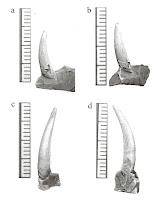
(Left) Freshwater Elasmosaurid Teeth, Axel Heilberg Island, High Canadian Arctic (from Vandermark et al. 2006) (Right) Leatherback Turtle (Dermochelys coracea)                                                                                                                                                                  
“There used to be a time when the BBC’s ability to produce good science documentaries was highly respected: they generally portrayed a balanced view of the subject, had their facts straight, and were careful not to cast ideas, or scientists themselves, in an inappropriate light. Alas, those days are long gone, as viewing of any Horizon documentary made within the last five years will show. The BBC’s Loch Ness documentary shown last Sunday was no exception, though let me say that I like Steve Leonard and I enjoy watching his stuff. When wondering if a hypothetical plesiosaur could survive in waters as cold as those in Loch Ness, Leonard pointed to leatherbacks and to Australian fossil sites yielding (apparently) coldwater plesiosaurs.                 
Leatherbacks really can swim in cold boreal seas , but despite initial results from Paladino et al. (1990) they are no longer thought to have a resting metabolic rate elevated compared to that of other similar-sized reptiles. In other words, they are bradymetabolic. However, they are endotherms and have a bunch of features that allow them to be cold tolerant including an insulative carapace, a thick, oil-saturated skin, fibrous fatty tissue and counter current heat exchange mechanisms in the flippers. The presence or absence of all these things can be determined from fossils and there are enough good plesiosaur fossils (including at least one good specimen with skin impressions- my info on it is from Arthur Cruikshank, an expert on plesiosaur anatomy) for us to be confident that these things were absent in plesiosaurs. The bone microtexture and histology of plesiosaurs is not consistent with endothermy- they appear to have been ‘traditional’ reptiles. So the only getout for having them as cold tolerant is to argue that they were gigantotherms.                                                  
Problem: the entire theory of gigantothermy is based on Paladino et al.’s erroneous data on leatherbacks, and it has since been retracted by these authors. Given that other studies do not show leatherbacks to have an elevated metabolic rate (Lutcavage et al. 1990), the theory of gigantothermy has died a death, and there is no evidence that giant bradymetabolic vertebrates converge in physiology with giant tachymetabolic ones. Even if gigantothermy were a viable theory, in marine reptiles it is only theoretically possible with the suite of features cited above. Indeed Orenstein (2001) writes ‘Gigantothermy…would not be enough to keep a leatherback warm in cold northern waters’ (pg. 134). At the moment the idea that plesiosaurs may have been cold tolerant is not based on any good evidence.                                                                     
As for the evidence showing that some Cretaceous plesiosaurs inhabited cold water with icebergs etc., this is controversial: the Cretaceous poles were nowhere near as cold as the modern ones and the evidence that the Australian sites they referred to were frequented by icebergs rests on the presence of drop stones- rocks alien to the local sedimentary geology and which appear to have been carried to their new home by ice. The problem is that icebergs are not the only way in which drop stones get dropped. Stones and rocks can also be carried for miles and miles in the roots of floating trees and as seaweed holdfasts.”- Darren Naish, CZ Conversations: Darren Naish on Plesiosaurs, Basilosaurs and the Problems with Reconstructions, North American BioFortean Review 5 (3) (2003), pp.10-19                                                                                                                                                                                                     
“ Higher metabolic rates for these ancient reptiles, relative to modern ones, have previously been suggested, on the basis of bone histology and swimming energetics.All three groups (plesiosaurs, ichthyosaurs and mosasaurs) had a higher body temperature than co-occurring fish by about 5° to 20°C, with the exception of Triassic ichthyosaurs. This suggests that they had heat conservation systems such as blubber layers and specialized blood circulation.”- Ryosuke Motani, Warm-Blooded “Sea Dragons”?, Science 328 (2010), pp.1361-1362
“ No other known extant reptile shows this combination of chondro-osseus developmental features. However, certain extinct reptiles show some similarities to the leatherback: plesiosaurs have been described as having endochondral and periosteal cones that do not remodel ; ichthyosaurs, plesiosaurs, nothosaurs and mesosaurs are known to have amedullary bones with cancellous-compacta differentiation paralleling that of marine mammals, and protostegid turtles have also been noted briefly to be somewhat similar in this respect. All these fossil reptiles were highly adapted to a marine existence as shown by other skeletal features. No terrestrial vertebrate has these chondro-osseus developmental features. The fact that such diverse groups as cetaceans, sirenians, pinnipeds, penguins, extinct marine reptiles and amphibians, and leatherback turtles have such a high degree of physical similarity in bone morphology suggests an underlying mechanism of marine adaptability which has led to a highly developed pattern of skeletal evolutionary convergence .”-Anders G. J. Rhodin et al., Chondro-osseus Morphology of Dermochelys coreacea, a marine reptile with mammalian skeletal features, Nature 290 (5803) (1981), pp. 244-246                                                                                    
birth.jpg
The Plesiosaur Polycotylus latippinus giving birth
“Among modern reptiles, the plesiosaur-like trait combination of viviparity, small brood size, and large birth size is rare, but it does occur in the scincid Egernia species group. Because both cetaceans and Egernia-group lizards are highly social and engage in substantial maternal care, plesiosaurs may have behaved similarly. We hypothesize that large plesiosaur fetus size may indicate that plesiosaurs lived in gregarious social groups and engaged in parental
care. ”- F. R. O’Keefe and L. M. Chiappe, Viviparity and K-Selected Life History in a Mesozoic Marine Plesiosaur (Reptilia, Sauropterygia),Science 333(2011), pp. 870-873                                                                                                                                                                                                                                                       
“ The ability of plesiosaurs to move on land is another point of contention . The mechanics of their skeletons imply a completely aquatic existence: the limb girdles are only weakly connected to the axial skeleton and this would inhibit the transfer of force from limb strokes into movement on land. However, small plesiosaurs may have been relatively unaffected by these constraints and might have used their powerful limb downstrokes to propel themselves forward in short ‘hops’.”- Adam Stuart Smith, Fossils Explained 54: Plesiosaurs, Geology Today 24(2) (2008), pp.71-75      
crypto.png
The plesiosaur Cryptocleidus oxoniensis on land from the BBC’s Walking With Dinosaurs, Copyright Dave Martill and Darren Naish 2000                     
grant+nessie.png
Arthur Grant’s sketch of Loch Ness “ Monster” on land, Jan. 1934                                                                                                                                                                                                                                  
“An hypothesis requires two elements. It has to be 1) verifiable - supported by evidence and 2) falsifiable - capable of being shown false by evidence. For example: "Plesiosaurs became extinct at the end of the Cretaceous period" is a useful hypothesis. It is verified by the fact that we have not found any plesiosaurs in post-Cretaceous deposits. It can be falsified by the discovery of plesiosaurs in post-cretaceous deposits. So far, no plesiosaur fossils have been found in post-cretaceous deposits, so the hypothesis stands. "Plesiosaurs did not become extinct at the end of the Cretaceous period" sounds as if it is the corollary hypothesis to the first hypothesis. After all, if they didn't become extinct at the end of the cretaceous, the only possible alternative is that they did not become extinct. But science can't work this way: The assertion is not verified - there are no plesiosaur fossils in post-cretaceous deposits, even though it could be verified by the discovery of such fossils. However, it cannot be falsified: there is no evidence which could show that plesiosaurs did *not* become extinct at the end of the cretaceous. We may look for such fossils but never find them because they don't exist, or because we are looking in the wrong places, or because the places in which post-cretaceous plesiosaurs lived did not provide conditions suitable for fossilisation, or for any other number of unknown reasons. This makes is it not a useless hypothesis, but not an hypothesis at all. An inherent element of any hypothesis that it should be falsifiable. Without falsifiability there is no hypothesis.                                                                                                                                                
There is an obvious parallel in the discovery of Latimeria. Before 1938, one might have formulated the hypothesis that coelacanths became extinct by the end of the Cretaceous. This hypothesis would be verified by the lack of such fossils, and could be falsified by the discovery of post-cretaceous coelacanths. It was falsified rather dramatically in 1938 when Latimeria was discovered. This does not mean that it was not a good hypothesis - the fact that it was falsified means that it was. Furthermore, it does not mean that we now have to work from the hypothesis that coelacanths survived to the present day: that's a fact, not an hypothesis. The assertion that they have survived to the present day is verified by the existence of Latimeria, but that assertion is not an hypothesis: it cannot be falsified. Latimeria can't be ‘undiscovered’ again.”- Richard Forrest, Something about hypotheses,

Wednesday, 5 February 2014

Scott Mardis and Plesiosaurs of Lake Champlain


Scott Mardis sent this to my Facebook Wall yesterday and said " It's the unenhanced version of the previous Dennis Hall picture I sent you earlier"
After some discussion I said that there seemed to be two different objects of similar size and shape, facing in different directions but with about a hundred feet of open water in between them. And the objects seem to be differentiated into neck and back portions of equal length in either case. I made the following pasteup showing the object on the left in the orientation as shown and also reversed, and added the Mansi photo also including the reversed image of that one, for purposes of comparison.

The left hand object is not possibly a ripple in the water or any object such as a tree trunk lying flat in the water owing to the fact that the far end of it is clearly elevated above the surface.


While we both agree the Dennis Hall picture is too indistinct to be certain about, I did think the fact that the neck portion i all the objects was similar but for the fact that it seems flexible and is shown in different positions each time.

Katy Elizabeth then (separately) sent in a comparison of the Rhines underwater long necked creature photo
and said she thought it was possibly the same as the Mikko Takala photo object (In the last case I think it is more likely to be a branch in the water) However the Rhines underwater creature would also seem to have a neck that is a good match for the creature in the Lake Champlain images shown above.


Thursday, 16 January 2014

Champ Reconstructions Followup

The  owner of the Lake Monsters Facebook page went ahead and made up this lovely piece of artwork depicting a typical Lake monster (saying it could be Loch Ness or Lake Champlain, or anywhere where the Longnecked creatures venture inland) and using my composite published on this page recently. While this was unauthorised use of my image I was very glad to see it and I thanked him for making it up.

Scott Mardis had told me that some theorists at Lake Champlain think the creature could be a large turtle: Both Scott Mardis an I feel that an actual plesiosaur would be more likely than a giant turtle that looks so much like a plesiosaur otherwise.

Recently I mentioned Tim Dinsdale's reconstruction for the Loch Ness Monsteras coming out statistically close to mine, and so here is a news photo of a young Tim Dinsdale showing off his composite model, and below, the Australian version, which is nearly identical once again(allowing for 2 or 3 humps equally)


Scott Mardis sent some materials about the Australian Aboriginal Yarru, which he thought seemed to have small rounded rocks inside like the Plesiosaur's gatroliths

Driver, Rebecca. 1999. Australia’s Aborigines ... did they see dinosaurs? Creation Ex Nihilo 21(1):24–27.

Dennis Fields, a former missionary to Far North Queensland’s Kuku Yalanji tribespeople, told the CMIministry in Australia some years ago of a story the elders of the tribe told him, of a creature called Yarru (or Yarrba). The tribe inhabits the rainforest regions, where there are a number of waterholes in which, in earlier days, Yarru was said to live. There is a story of how the Yarru devoured a young maiden. The missionary asked one of the tribe’s artists to paint the story for him. The tribal artist, with very little formal education, had no knowledge of what so-called prehistoric animals looked like, and was drawing only from the descriptions handed down in the ancient stories. The painting (later donated to Creation International Ministries, and shown at the right [below]) shows a creature with a remarkable resemblance to the extinct Plesiosaurus.
Yarru or Yarrba (Plesiosaur) Painting


 European sightings of water monsters also often match this description.[11] Most evolutionists, however, find this unacceptable, since they insist such creatures vanished with the dinosaurs over 65 million years ago. For centuries, the Dharuk people have spoken of the mighty ‘Mirreeulla,’ whose home is the Hawkesbury River near Sydney. Sightings of plesiosaur-like creatures in this river have continued to modern times, with some estimating the creature at up to 15 metres (50 feet) long.

[11. Nessie’s kin? Creation 18(4):18, September 1996]


Scott also showed this diagram of an Elasmosaur to show where the gastroliths were located
And below a "Cadborosaurus" report with a 3-humped Plesiosaur-shaped creature giving some indication about the "Mane" (which is a point of contention in such reports). 
 This is actually another "Sea Giraffe" with a fairly short mane, described as being like a "fin" (fleshy material) and with a length of a few inches  (3-6 inches irregularly, it looks like from the witness' drawings)


Wednesday, 23 October 2013

No Your Dinosaurs! Who Knows for Certain What Dinosaurs Actually Looked Like?

This link was sent to me by one of the people connected to the s8int blog that knew I had an interest in the topic:
http://s8int.com/WordPress/2013/10/19/no-your-dinosaurs-who-knows-for-certain-what-dinosaurs-actually-looked-like-nobodyexcept-perhaps-the-eyewitnesses-responsible-for-the-ancient-dinosaur-art-at-the-peabody/

No Your Dinosaurs! Who Knows for Certain What Dinosaurs Actually Looked Like?Nobody!
Except Perhaps the Eyewitnesses Responsible for the Ancient Dinosaur Art at the Peabody.

Posted by Chris Parker


Isaiah 35:7
“And the parched ground shall become a pool, and the thirsty land springs of water; in the habitation of dragons, where each lay, shall be grass with reeds and rushes.”

         
“No Your Dinosaurs! Who Knows for Certain What Dinosaurs Actually Looked Like? Nobody! Except Perhaps the Eyewitnesses Responsible for the Ancient Dinosaur Art at the Peabody”. by Chris Parker, s8int.com


Did Ancient Artists See and Memorialize Dinosaurs In Their Art?

Loading ... Loading ...

Prologue

In the movie; “The Princess Bride” an important character, Inigo has a conversation with the man in black during a sword fight and that conversation has become a trope in television and movies (convention or device used in creative works). The conversation goes something like this:
Inigo: “I admit it: you are better than I am!”
Man in Black: “Then why are you smiling?”
Inigo: “Because I know something you don’t know.”
Man in Black: “And what is that?”
Inigo: “I AM NOT LEFT HANDED” [Switches the sword to his right hand and starts driving him back]

I sometimes have the feeling that I am in Inigo’s position when I find myself in a conversation with someone about man and dinosaurs living at the same time.

“You believe that man and dinosaurs lived together at the same time within the last 10,000 years they’ll say incredulously”? Or perhaps they’ll say it sneeringly, or contemptuously or in some rare cases even sadly or compassionately.
They are quite certain that they have the upper hand, the science, the good sense, the pure knowledge the unmitigated certainty. They slap their foreheads. They roll their eyes. All that. They believe that they are winning this “fight”-discussion-debate because-come on! They may even be fellow believers.
They’re thinking that I have set science aside for some kind of blind faith belief in what science has said is impossible-for the sake of the Bible. They’re thinking I’m living in some anti-science anti-evidence bubble. However, as a Christian I have choices. I could believe as some Christian’s do that God created through evolution and that man and dinosaur did miss each other by millions of years.
I could believe that the dinosaurs were wiped out in the flood and thus man and dinosaur barely met. I could believe as some Christians do that God sent unbelievers a strong delusion because of their unbelief (Romans 1) and simply put the bones of animals that never existed in the ground in order to further delude them.
I could simply choose not to speak when this topic is raised thinking that as a Christian it is outside of my pay grade, that the answers are unknowable. I could choose to be cowed by the sheer numbers of people who unblinkingly accept the current paradigm.
But I know something they don’t know. I took a fact based approach. I went where the evidence took me and in this internet age the truth can be found. Many non-Christians don’t know that faith is supposed to be built- not on nothing as they assume—but on evidence. “Now faith is the substance of things hoped for, the evidence of things not seen.” Heb 1:1
I have spent a lot of time sifting through the evidence in ancient history, the work of ancient “biologists” the articles in old newspapers and recently the evidence in world famous archaeological museums. The evidence is clear. The evidence is persuasive.
The evidence proves that dinosaurs and man lived together all over the world in the last few thousand years. Now, the Bible is a “type” of sword and in this dinosaur and man conversation we’re having they are the ones who don’t have the facts or the truth. There is a reason why I am smiling:– I AM NOT LEFT HANDED!
Peabody Museum Zoomorphic Stone Heads

Historians say that dragons appear in the history and art of virtually every ancient culture (as do stories of a great flood). Here’s an interesting fact along those lines; no matter what culture a piece of ancient art comes from everyone can instantly recognize a dragon. Isn’t that interesting? Here we have a supposedly completely mythological creature, a product of the imagination of man and culture and yet they agree across geography and time in the salient characteristics of their portrayals with the added peculiarity that everyone knows that they are dragons?
No modern artist who works for a science journal or a museum or is otherwise engaged in depicting dinosaurs from a few bones is going to draw a dragon-like creature. So, although dragons are reptilian, frightening sometimes preternaturally large creatures—and so are dinosaurs they don’t often look much alike when you get down to the details. But here’s the rub when it comes to that; no one living actually knows what dinosaurs looked like.
In prior articles on this topic we’ve often quoted Discover Magazine on this point;
There’s a running joke among professional dinosaur artists that goes like this: Given just an elephant skeleton, they’d probably render a titanic hamster. Does anyone know what dinosaurs really looked like? Sure we do. We see them everywhere, not just in the museums, but in magazines, movies, even in value meals at McDonald’s. But all of these lifelike renderings are mostly artistic interpretations based on very sparse scientific evidence. Discover Magazine, What Did Dinosaurs Really Look Like? By William Speed Weed, Christopher Griffith|Friday, September 01, 2000
http://discovermagazine.com/2000/sep/featdino
Of course, Discover Magazine isn’t the only source that admits that science is just guessing when it puts forth a drawing or illustration of a dinosaur—particularly when many dinosaurs are only known from a few bones.
A new book entitled “All Yesterdays: Unique and Speculative Views of Dinosaurs and Other Prehistoric Animals” by paleo artists C.M Koseman and John Conway is a review of dinosaur depictions and misconceptions in science art and a speculation about potential alternate depictions. They are basically letting the reader in on their secret that the work they do is simply informed speculation.

In the photo on the right they freely speculate on how a dinosaur paleontologist might have interpreted the bones (absent muscle and soft parts) of the cow and the housecat (bottom).
This interpretation problem makes it tougher on “crypto-zoo-archaeologists” like me. My hypothesis that man and dinosaur lived during the same age and that the ancient peoples would have left evidence in the form of their art, history and artifacts is complicated by the fact that the work of paleo artists today might not match up with the work of the actual eyewitnesses living in the past.
Thus, for instance a dinosaur in an archaeological museum like Harvard’s Peabody Museum might be perfectly depicted by the ancient artist but not match up with current thinking on how that dinosaur looked and go unrecognized; categorized as zoomorphic, unknown, animal, mythological creature or simply reptile. (Actually my experience is that any depiction recognizable as a dinosaur or one which is deemed too close does not end up in the front room of the museum in any case).
For example, in eyewitness viewings of what I believe are living pterosaurs over the last few years some have described the creature the saw as “almost prehistoric looking”, which could mean that they saw a living creature that did not completely comport with modern illustrations of the creature.
Moche Culture Vase in the Form of…?

In the last few weeks I set out to prove my hypothesis at the Harvard Peabody, online archaeological museum site as well as at other online collection sites. The Peabody Museum of Archaeology and Ethnology at Harvard University “is steward to one of the oldest and largest collections of cultural objects in the Western Hemisphere”. Other online collections visited include, the Penn Museum, the Met and several Museums of Central and South America.
Could it be shown that creatures that are recognizable as dinosaurs and Not dragons-in the mythological sense are somehow going unnoticed in their online collections? Can we show how specific types of dinosaurs might have been erroneously depicted? In that case, the depiction would have to be close enough for an identification to be made.
In this article and shall we say “collection” I intend to show once again through the arts of ancient peoples that man and dinosaur lived together within the last 5,000 years—but only to the fair and open minded.
         
The Eyewitness to Recent, Ancient History Dinosaur Collection, Part 1
1)Chasmosaurus at the Museo Larco, Peru

Actually it is not a piece from the Peabody that I wish to start with. It is a piece from the Museo Larco that illustrates the points we have been making about identification and misidentification most clearly. (See complete vessel at top of this article).
The Larco Museum (Spanish: Museo Arqueológico Rafael Larco Herrera) is a privately owned museum of pre-Columbian art, located in the Pueblo Libre District of Lima, Peru. The museum is housed in an 18th-century vice-royal building built over a 7th-century pre-Columbian pyramid.
The Inca civilization spanned the period of 1438 to 1533 in pre-Columbian South America. That would make this piece between 500 to 600 years old.
Inca Pot Water Carrier Lima
Museo Larco, Peru

I believe that the animal atop this Inca water carrier (and atop this article) is a ceratopsian dinosaur of a type similar to Chasmosaurus particularly given the placement of its horn and the shape of its frill. Ceratopsians might have broken down neatly into the categories now suggested by science or they could have been as widely divergent as dogs are today. They may have been sexually dimorphic and animals identified as belonging to another species may have only been sexually dimorphic or juvenile versions of other science-identified species.
“Chasmosaurus (/?kæzm??s?r?s/ KAZ-mo-SAWR-?s) is a genus of ceratopsid dinosaur from the Upper Cretaceous Period of North America. Its name means ‘opening lizard’, referring to the large openings (fenestrae) in its frill (Greek chasma meaning ‘opening’ or ‘hollow’ or ‘gulf’ and sauros meaning ‘lizard’). With a length of 4–5 metres (13–16 ft) and a weight of 2 tonnes (2.2 short tons), Chasmosaurus was a ceratopsian of average size. Like all ceratopsians, it was purely herbivorous. It was initially to be called Protorosaurus, but this name had been previously published for another animal.
All specimens of Chasmosaurus were collected from the Dinosaur Park Formation of the Dinosaur Provincial Park of Alberta, Canada. C. russelli comes from the lower beds of the formation while C. belli comes from middle and upper beds. “…Wikipedia

Let me explain what I believe that you’re looking at. It is a ceratopsian dinosaur similar to the Chasmosaurus. It is 500 years old. The right horn has broken off and is probably what is seen on the animal’s right side from the reader’s perspective.
The heavy ceratopsian tail curls up at the back and the animal fits in terms of body shape and tail for a ceratopsian. The animal has a crest and you should be able to see that the complete head, ending behind the horns includes a solid neck frill ending in a ‘V” shape similar to that of the chasmosaurus. In the photo on the left I have thoughtfully replaced the animals missing horn. The artist took pains to make sure that the ceratopsian toes were outlined for the viewer as well.
I believe what we have here is a depiction of a ceratopsian dinosaur that differs slightly from what one expects given modern depictions. The beak is slightly less pronounced-but evident. The horns are actually in the exact place on its head as the horns on modern Chasmosaurus depictions. The creature has growths (possibly pre-horn?) growths on the front of its face that are not seen on ceratopsian depictions.
This is clearly a depiction of a ceratopsian dinosaur by an actual eyewitness some 500 years ago in pre Columbian South America. It should be noted that all the ceratopsia were supposed to have gone extinct 65 million years ago.
         
2)Peabody Museum ”6,000 to 7,000 Year Old” Ceramic Bottle with Bi-Pedal Dinosaur (Iguanodon?) from South America
“Peabody Number: 90-27-30/54866
Display Title: Black ware stirrup spouted vase
Descriptions:
Inventory Description: Ceramic bottle, stirrup spout, chipped rim, animal effigy, molded body, lying on its side.
Classification:
Stirrup spout
Department: Archaeological
Geography/Provenience:
South America/Peru
Materials: Ceramic


The earliest ceramics known from the Americas have been found in the lower Amazon Basin. Ceramics from the Caverna de Pedra Pintada, near Santarém, Brazil, have been dated to 7,500 to 5,000 years ago. Ceramics from Taperinha, also near Santarém, have been dated to 7,000 to 6,000 years ago.” Peabody Museum
This appears to me quite clearly to represent some type of bi-pedal theropod dinosaur. Here we show the artifact on its side so that the identification of this dinosaur is more easily made.
The trio below is shown with two versions of the dinosaur iguanodon, a bi-pedal dinosaur which has been found in North America.
Distinctive features of iguanodon include large thumb spikes, which were possibly used for defence against predators, combined with long prehensile fifth fingers able to forage for food…Wikipedia.
Unfortunately that part of the sculpture has been worn away-like noses in Egyptian artifacts. Part of the tail has apparently broken off as well. I believe that this piece represents a bi pedal theropod dinosaur like iguanodon or a relative.
         
3)Nayarit Chinesco “Embryonic Dog” May Be Baby Sauropod


Nayarit is a state in western Mexico. The Nayarit culture from which this artifact comes is from the period 300 B.C. to 400 A.D.—or even older. This piece is said to represent an embryonic dog. Another identification would seem to be in order for this piece.
         
For one thing, dogs do not have necks this long. Here I’ve shown it in comparison to an animal that really did have such a long neck; the sauropod dinosaur.
Nayarit Chinesco Pottery Painted Embryonic Dog
Online Collections Auction
Auction date November 2012
Pre-Columbian, West Mexico, Ca. 300 BC to 200 AD.
Buff pottery, unique representation, elastic form.
Surface has traces of original polychrome color.
Provenance: Ex-Dr. R. Boyd Stifler, Vanderwagen NM.
Rare specimen Authenticity Guaranteed
Condition:Some wear to surface and with nice dendrite
deposits.”..Online Collections


Recently a sauropod embryo was found and the sauropod embryo depicted comes from the “Tiniest Giants: Discovering Dinosaur Eggs”.
Sauropods are supposed to have gone extinct 65 million years ago.
         
4)Ancient Pueblo Culture (1200 B.C.-1500 A.D.) Native Americans of What is Now Arizona Craft Dinosaur Named Aetosaur; Most of Whose Fossils Have Been Found in Arizona
         
Aetosaur Skeleton Top and Ancient Pueblo Artifact below.

“The Pueblo people are Native American people in the Southwestern United States comprising several different language groups and two major cultural divisions, one organized by matrilineal kinship systems and the other having a patrilineal system.
These determine the clan membership of children, and lines of inheritance and descent. Their traditional economy is based on agriculture and trade. At the time of Spanish encounter in the 16th century, they were living in villages that the Spanish called pueblos, meaning “towns””…Wikipedia
This piece comes from a 1936 expedition to the Hopi reservation and was determined to be from one of the Pueblo Native American cultures. It is described by the Peabody Museum as “zoomorphic”. Looking at a list of dinosaur fossils found in Arizona one can quickly see that there is a similarity between the archaeological piece and –the aetosaur. (Angle of aetosaur skeleton head adjusted for comparison purposes.)
“Aetosaurs order name Aetosauria from Greek, ????? (aetos, “eagle”) and ?????? (sauros, “lizard”)) are an extinct order of heavily armoured, medium- to large-sized Late Triassic herbivorous archosaurs. They have small heads, upturned snouts, erect limbs, and a body covered by plate-like scutes. All aetosaurs belong to the family Stagonolepididae.
Most fossils have been found from Arizona, New Mexico, and Texas…Wikipedia
.
Here is a sobering fact for those of us who can accept the fact that the ancient Pueblo people of Arizona actually saw and depicted an aetosaur which supposedly lived from 200 million years ago becoming extinct 65 million years or more ago;

“Since their armoured plates are often preserved and are abundant in certain localities, aetosaurs serve as important Late Triassic tetrapod index fossils. Many aetosaurs had wide geographic ranges, but their stratigraphic ranges were relatively short. Therefore, the presence of particular aetosaurs can accurately date a site that they are found in.”
You see the problem? Aetosaurs were roaming around the North American continent during the span of the Pueblo peoples; 1200 B.C. to 1500 A.D. and one of their artists memorialized the aetosaur in ceramic.
Peabody Number: 36-131-10/8060
Display Title: Zooomorphic black on white potsherd–animal form
Inventory Description: Ceramic, zoomorphic figurine, with tail, opened mouth, two feet, black painted design on back and sides
Classification: Figurine
Department: Archaeological
Culture/Period: Pueblo
Geography/Provenience: North America/United States/Arizona/Navajo County/Hopi Reservation/Antelope Mesa/Awatovi
Intrasite: Test 14
Geo-Locale: Antelope Mesa
Materials: Ceramic Pigment
Provenance: Dr. John Otis Brew (1936)
Provenance: Peabody Museum Expedition (1936)

         
5) Crested Hadrosaur Depiction by the Ancient Peoples of Costa Rica at the Peabody Museum. (Modern Artists May Need to Put Some Weight on the Bones of these Depictions)
Crested Dinosaurs are fairly easy to recognize. Most of the crested dinosaurs are from the Lambeosaurinae of the hadrosaur group. The hadrosaurs were also known as the duck billed dinosaurs.

This depiction forms the legs of an ancient pottery piece. The pot is from Costa Rica, Central America. The crests on the various types of lambosaurines differed in size and shape even among the same species and they likely differed due to age and due to sexual dimorphism.
The hadrosaurs depicted have relatively small, round crests. Here we compare them to a number of known lambeosaurines including corythsaurus.

It is interesting that the depictions are clearly of the same animal but that the portraits differ. The ancient depictions are similar to modern ones except for the apparent weight of the creatures and the size of the eyes depicted.
“Archaeologists now know that civilization existed in Costa Rica for thousands of years before the arrival of Columbus, and evidence of human occupation in the region dates back 10,000 years. Among the cultural mysteries left behind by the area’s pre-Columbian inhabitants are thousands of perfectly spherical granite bolas that have been found near the west coast.

The sizes of these inimitable relics range from that of a baseball to that of a Volkswagen bus. Ruins of a large, ancient city complete with aqueducts were recently found east of San Jose, and some marvelously sophisticated gold and jade work was being wrought in the southwest as far back as 1,000 years ago. Some archeological sites in the central highlands and Nicoya peninsula have shown evidence of influence from the Mexican Olmec and Nahuatl civilizations.
By the time Columbus arrived, there were four major indigenous tribes living in Costa Rica. The east coast was the realm of the Caribs, while the Borucas, Chibchas, and Diquis resided in the southwest. “..geographia.com
Peabody Number: 26-44-20/C9956
Display Title: Small pottery vessel
Descriptions: Inventory Description: Ceramic complete tripod jar, zoomorphic rattle feet (1 missing)
Classification: Jar
Department: Archaeological
Geography/Provenience:
Central America/Costa Rica
         
6)A New Look at Dicynodont Therapsids Like Moschop from the Ancient Peoples Living I Peru, South America

The identity of this animal portrait was unknown apparently and thus it was given the general description “animal effigy” by the Harvard Peabody Museum. Was this animal purely a mythological one seen only in the imaginary eye of the artist—or was it seen with the artist’s actual eyes?
As you will see the depiction of the living therapsid is actually close enough to modern depictions of these types of creatures as to be readily identified. In appearance it is close to that of therapsids such as moschops which we know from fossils found in South Africa.
‘Moschops (Greek for “calf face”) is an extinct genus of therapsid that lived in the Guadalupian epoch, around 268-260 million years ago. Therapsids are synapsids which were at one time the dominant land animals. It was around 2.7 metres (8 ft 10 in) long..
….Moschops was heavily built, and had short, chisel-like teeth for cropping vegetation. Moschops mostly ate plants, but sometimes ate meat. The forelegs sprawled outwards, like those of a modern lizard, but the hind legs were under the body, like those of a mammal.” Wikipedia
Peabody Number: 46-77-30/5868
Display Title: Pottery animal figurine
Descriptions: Inventory Description: Ceramic whistle, animal effigy
Classification: Whistle
Department: Archaeological
Geography/Provenience:
South America/Peru/La Libertad Region///Sausal
Materials: Ceramic


Here we show the ancient, ceramic artifact in comparison to moschop and to another dicynodont therapsid. Moschops and therapsids similar to him supposedly went extinct before the dinosaurs even evolved. Clearly of this ancient Peruvian artifact represents one of these creatures something is extremely wrong with the evolutionary time scale.
         
7) Quapaw’s “Underwater Panther” from the 1500”s Could In Fact Be an Eyewitness Depiction of Dinosaur Such As Tenontosaurus

According to Wikipedia the Mississippian culture was a mound building group of indigenous people who lived in the Midwestern, Eastern, and Southeastern United States from approximately 800 A.D. to 1500 A.D. The collectors at Artsmia.org believe it to be a depiction of a mythological creature called an underwater panther. That makes these people seem “mystical” all right.
But what if it is an accurate depiction of an animal living at the time that we would call a dinosaur-rendered somewhat invisible as a depiction because modern versions of the creature differ greatly? Here is the museum description:
“The prominent colored swirls and eye motifs mark this animal as an Underwater Panther, one of the primary beings in the ancient Mississippian belief system and that of their descendants. The swirling pattern on its sides signifies water, while the eye markings allude to the animal’s unusually keen vision.
Red and white were symbolically significant colors that represented fundamental oppositions such as peace and war, light and dark and the on-going struggle between the celestial and subterranean realms. Underwater Panthers belonged to the subterranean and possessed great supernatural power. Their significance led Mississippian and subsequent artists to depict them frequently in many forms and media, including three-dimensional sculptures like this vessel. “
The toes of this creature appear to be triple toed-similar to a dinosaur. Its tail is very thick in the way dinosaur tails are often illustrated by modern paleo artists. I took a look to see what types of dinosaur fossils were prominent with respect to quadruped dinosaurs in those parts of the United States.

Here we show the “underwater panther” in comparison to tenontosaurus a genus of medium to large ornnithopod dinosaurs. It should be noted that there were a number of ornnithopod dinosaurs found to have lived in those parts of north America which would have had similar body shapes.
The genus tenontosaurus is known from the late Aptian to Albian ages of the middle Cretaceous period sediments of western North America, dating between 115 to 108 million years ago. It was formerly thought to be a ‘hypsilophodont’, but since Hypsilophodontia is no longer considered a clade, it is now considered to be a very primitive iguanodont.
The teeth of this portrait do give me pause. The point is however not that we know the specific type of dinosaur that was sculpted, but rather that it is more likely that it is a dinosaur being depicted here rather than an underwater panther (which itself sounds like a cryptid).
Vessel
Artist Unknown (Quapaw)
(United States, North America), c. 1500
Ceramic, pigment
9 1/8 x 10 3/8 x 5 1/4 in. (23.18 x 26.35 x 13.34 cm)
The William Hood Dunwoody Fund 2004.33
         
8)Metropolitan Museum of Asian Art’s Sauropod Dinosaur from Iran 250 B.C. to 225 A.D.

This artifact is from the Metropolitan Museum of Asian art and is labeled “zoomorphic”. I’m somewhat surprised that they didn’t call it a camel. Clearly however it is a sculpted ceramic in the form of a sauropod dinosaur.
Sauropod dinosaurs went extinct 65 million years ago according to science. This piece was estimated to have been made between 250 B.C. and 225 A.ZD. That period obviously covers the time of Christ.
Zoomorphic vessel
250 B.C.E.- 225 C.E.
Parthian period
Ceramic
H: 15.2 W: 28.4 D: 12.1 cm
Northern Iran, Northern Iran S1987.944
         
9) Ulisse Aldrovandi’s Detailed Drawing of A Long Tailed Pterosaur; Before They Were “Discovered” By Science
Ulisse Aldrovandi (also Aldrovandus) was born in 1522 and died in 1605. He is sometimes referred to as the father of natural history studies. By profession he was a professor of philosophy but eventually became one of the first professors of the natural sciences at Bologna (no offense intended).

Ulisse died 250 years before the first pterosaur was discovered by a scientist and he mistakenly thought it was a sea going creature. It was not until the beginning of the 19th century that science realized that pterosaurs were flying creatures.
“The first pterosaur fossil was described by the Italian naturalist Cosimo Collini in 1784. Collini misinterpreted his specimen as a seagoing creature that used its long front limbs as paddles.
A few scientists continued to support the aquatic interpretation even until 1830, when the German zoologist Johann Georg Wagler suggested that Pterodactylus used its wings as flippers. Georges Cuvier first suggested that pterosaurs were flying creatures in 1801, and coined the name “Ptero-dactyle” in 1809 for the specimen recovered in Germany.” …Wikipedia
After his death his book Serpentum, et draconum historiæ Serpentum, et Draconum was published. In it, was a drawing supposedly from life (well it was dead!) of a dragon which comports very well with a long tailed, crested pterosaur especially given that Aldrovandi was a philosopher and naturalist –and not an artist.
The interesting thing about Aldrovandi’s pterosaur is that it has the crest of the pteranodon and the tail of one of the long tailed rhamphorhynchoid pterosaurs. Although we don’t know this exact pterosaur from science it closely matches modern day eyewitness descriptions and drawings of a long tailed pterosaur. (There are long tail crested pterosaurs known to science but none with the classic bone sticking out the back of its head kind).
Note what might look like another set of small wings at the legs of Aldrovandi’s dragon. It is shown here in the more modern drawing between the pteranodon’s legs. That is called the uropatagium; and since it does not appear on birds it is one indication that Aldrovandi actually saw what he drew.
“some pterosaur groups had a membrane that stretched between the legs, possibly connecting to or incorporating the tail, called the uropatagium; the extent of this membrane isn’t certain, as studies on Sordes seem to suggest that it simply connected the legs but did not involve the tail (rendering it a cruropatagium). It is generally agreed though that non-pterodactyloid pterosaurs had a broader uro/cruropatagium, with pterodactyloids only having membranes running along the legs; Pteranodon in particular might have developed/redeveloped an uropatagium, given the structure of the tail”..Wikipedia
The picture on the right (above) shows Aldrovandi’s dragon compared to Eskin Kuhn’s drawing (bottom, right) from his eyewitness sighting in the 1970’s. Kuhn was an artist and a soldier stationed at Guantanmo Bay, Cuba. His “pteranodon” had both the backwards facing “crest” and the long tail with tail vain of the rhamphorhynchoid pterosaurs. Top right is a modern drawing of a pteranodon without the long tail. Aldrovandi has the tail, crest and bat like wings of a pterosaur.
         
10) Peabody Museum Seeks to Make an Ancient Veraguas Culture Dinosaur Evolve Into a Bird Right Before Our Eyes
The “Bird” effigy ceramic whistle (middle) is from the ancient Veraguas Culture of Panama. That culture inhabited Panama from approximately 700 A.D. to 1530 A.D.
“This culture inhabited the central region of what is now province of Veraguás in Panama. The area extends from the Pacific to the Caribbean coast and includes a number of islands. The climate here is mainly humid and tropical, and the landscape includes wooded areas and valleys suitable for agriculture, as well as high mountains, hilly areas, and coastal lowlands.” Museo Chileno de Arte Precolombino

The ceramic sculpture with three legs does not have the correct number for either the bird (two) or the crested hadrosaur (four). My take is that given the teeth (which birds do not have) and the thick tail this is not a depiction of a bird but rather of a crested hadrosaur such as corythosaurus.
The single combined front legs represent the two front legs of the creature and this is not uncommon with pre Columbian art. One can certainly decide for his or her self.
Peabody Number: 39-90-20/6461
Display Title: Pottery bird effigy whistle. Light brown, probably faded from red.
Descriptions:
Inventory Description: Ceramic whistle, animal effigy with tripod legs
Classification: Ceramic
Department: Archaeological
Culture/Period: Veraguas
Geography/Provenience: Central America/Panama/Veraguas
         
11)Plesiosaur or Dinosaur? Mythological or Cryptozoological?

Here are a number of ancient artifacts that do beg the question; sea monster or dinosaur. It may not be clear what animal the artist has in mind but I believe that they so clearly mirror what modern day artists see as dinosaurs and marine reptiles that they simply cannot be imaginary creatures.
The ancient artist in each case intended to represent an actual living creature and they must have expected the beholder to recognize what the creature was as well. In each of these examples only a portion of the animal is sculpted making the crypto detective work more difficult.
In situations like these the museum or the auction house usually leaves this kind of speculation to the viewer but often uses the term “zoomorphic” as the description. Often as well they will name a creature for which if it were truly what the ancient artist intended he/she would have proven to be a terrible artist. That should drive down prices!
Christie’s auction house described this artifact as a horse which may seem reasonable at first but no horse would have that long a neck. Alternative identifications include the plesiosaur or a dinosaur. Plesiosaurs of course supposedly went extinct around 65 million years ago as did it is claimed, the dinosaur.
The artifact is thought to have come from the period of up to 1,000 Years before Christ.
Christie’s
• Overview
• Features
Lot Description
ANCIENT NEAR EASTERN TERRACOTTA ZOOMORPHIC RHYTON
CIRCA LATE 1ST MILLENNIUM B.C.
One in the form of a seated camel, black glazed, carrying two jars on either side of its back; another in the form of a horse, a strap handle joining the rim to the back of the vessel, a perforation at the top of the head forming the spout, 16 cm. high max.; an Amlash terracotta steatopygous idol, possibly 2nd Millenium B.C., 20.5 cm. high, mounted (repaired); and a bull rhyton, not ancient, 15 cm. high (4)
This item is described as a “serpent” effigy bowl; perhaps a “sea serpent”?

This pottery piece has been categorized as Neeley’s Ferry which are artifacts of one of the ancient group of State of Arkansas cultures. Ancient peoples are thought to have lived in Arkansas between 600 B.C. and 1600 A.D.
The Peabody specifically dated the artifact between 1350 and 1550.
This piece is further described as an earthen bowl, animal. The animal has a head with teeth giving the appearance of either a sea creature with long winding tail or perhaps a dinosaur.

Peabody Number: 80-20-10/21621
Display Title: Neeley’s Ferry serpent effigy bowl head and tail start on body & on short axis
Descriptions:
Inventory Description: Ceramic, complete vessel, bowl, mended, serpent head and tail
Object Description: Earthen bowl, animal. Neeley’s Ferry serpent effigy bowl, head and tail start on body, tail turned on itself, head and tail on short axis.
Classification: Bowl
Department: Archaeological
Date: A.D. 1350 – 1550
Culture/Period: Parkin Phase
Geography/Provenience: North America/United States/Arkansas/Cross County//Halcomb’s Mounds; Arkansas State Intrasite: Grave, 18 inches deep; 2 feet from river
Above shows our “sea monster” at another angle which provides additional detail concerning the shape of the head and tail. By the way, seals have fins and flippers not “tails”.
This final piece is also from the Neeley’s Ferry mounds and is described as a “ceramic effigy vessel of zoomorphic design”.

This artifact was found in a gravesite buried three feet below ground level and has been dated from the period between 1350-1550.
As you can see it is very reminiscent of modern paleoartist’s depiction of theropod or meat eating dinosaurs. Of course, we only have the head but is it possible that the artist saw and knew about a then living version of such a creature?


Or is it more believable that this is an effigy of a mythological animal which accidently reminds us of modern ideas about how dinosaurs looked?
Peabody Number: 80-20-10/21195
Display Title: Ceramic effigy vessel, zoomorphic design
Descriptions: Inventory Description: Ceramic effigy vessel, zoomophic design
Classification: Effigy
Department: Archaeological
Date: A.D. 1350 – 1550
Culture/Period: Parkin Phase
Geography/Provenience:North America/United States/Arkansas/Cross County//Neeley’s Ferry Mounds; Arkansas State # 3CS24
Intrasite: Grave, 3 feet deep Geo-Locale: Saint Francis River, West side of
Materials: Ceramic
Collector: Edwin Curtiss (01/01/1880)
         
Bonus: Nicoya, Pre Columbian Incense Burner Maker Tops Reptilian Artifact with Feet of a Theropod Dinosaur Which is Quite A Feat for Someone Who Missed Dinosaurs by 65M Years


Top left is a pre Columbian Censer (Incensario), from the 10th–12th century. There are many examples of this type of pre Columbian censer topped by a dragon/dinosaur. The excellent example at the top left is at the Metropolitan Museum of Art. If you take the time you can see the full body of a quadruped, dinosaur like creature with an extremely ornate crest or horns. This is typical of these artifacts.
No matter how un crocodile like the animal perched at the top is this type of vessel is known as either alligator or crocodile ware and elaborate stories have been concocted by archaeologists about the sacred nature of crocodiles and alligators in the pre Columbian cultures. Here’s a quote describing the object, top left by the Met.
The flare-footed, spherical bowl of this ceramic censer is enhanced, in silhouette, by the flamboyance of its chimney. Textured, appliqué bands encircle and emphasize the tall smoothness of the chimney. On the perforated cap rests an elaborate crested crocodilian. Smoke from the incense that was burned in the bowl escaped through the holes of the cap and from openings in the animal’s body. The rhythmical texture of the appliqué visually unites it with the surface of the creature’s body where the nubby portions are taken to represent the scutes of the reptile.
Both textured appliqués and scutes are surfaced in white. The spiky crest that surrounds the head is customarily found in incensarios of this period. Crocodilians frequently appear in Costa Rican art, strongly suggesting the supernatural import of these creatures in ancient times…The Met
On the Top right is a photo of one of those pre Columbian artifacts, Nicoya, an incense burner.
what is interesting about the artifact on the top, right is that a close up of the animals feet (bottom left) reveal and striking similarity of its feet as sculpted to that of the theropod dinsoaurs (bottom, right) and unlike those of lizards-or crocodiles.
         
Conclusion: There are hundreds if not thousands of artifacts in museums around the world containing representations of extinct creatures that we now called dinosaurs. The most obvious examples are labeled as fakes and are in provide collections.
Those that are not obvious dinosaurs are labeled dragons, unknown, zoomorphic, mythological, animal etc. Of course many artifacts are just those things. The issue is that when a group (archaeologists) are absolutely convinced that these animals lived millions of years ago all evidence will be viewed to reflect that belief and those that don’t will be reinterpreted, labeled or hidden away.
In any case if you should find that even one of the items in our collection is a dinosaur-or that a dinosaur is the most likely explanation that one should be enough to make you question the current scientific history control. But we understand that bucking the system is difficult to do.
Since I began with a quote from the Princess Bride it might be appropriate to finish with a modified version of another such quote:
Big Science: We face each other as God intended. Sportsmanlike. No tricks, no weapons, skill against skill alone. (not actually a believer)
Believer: You mean, you’ll put down your rock and I’ll put down my sword, and we’ll try to convince each other like civilized people-with facts and evidence?
Big Science; [brandishing rock (public opinion, science mythology, ridicule] I could just wipe you out now.
Believer: Frankly, I think the odds are slightly in your favor at hand fighting.
Big Science: It’s not my fault being the biggest and the strongest. I don’t even exercise.