Plug

Member of The Crypto Crew:
http://www.thecryptocrew.com/

Please Also Visit our Sister Blog, Frontiers of Anthropology:

http://frontiers-of-anthropology.blogspot.com/

And the new group for trying out fictional projects (Includes Cryptofiction Projects):

http://cedar-and-willow.blogspot.com/

And Kyle Germann's Blog

http://www.demonhunterscompendium.blogspot.com/

And Jay's Blog, Bizarre Zoology

http://bizarrezoology.blogspot.com/
Showing posts with label dragons. Show all posts

Wednesday, 31 July 2013

Little Lithuanian Dragons

 
I thought this was interesting: an internet art-collector's site was advertising this dish as being a piece of Lithuanian Folk art, depicting "Dragons and other legendary monsters"
 
Except for the addition of the uselessly short stubby wings, the two larger creatures shown on the plate seem to be pretty good representations of giant salamanders such as are known to live in Japan and China. From some descriptions of "Small (2-foot-long to 4-5 foot-long) four-legged dragons" we had already come to suspect the presence of giant salamanders as water monsters and legendarily as dragons in and around Lithuania (Smij, Ukis / Pukys / Puhkis / Puk / Puuk /Pisuhand / Puik and Tulihand in Lithuania, Latvia, Estonia and Karelia, said to bring luck if they live on your farm but they can bring disaster if displeased. They can deliver material goods to the farmer's benefit, but the goods will have been stolen from neighbours. Source: Giants, Monsters, and Dragons)

Wednesday, 26 June 2013

Late Eastern Zhou ?Sauropod from s8int.com


Late Eastern Zhou Sauropod
http://s8int.com/WordPress/tag/living-dinosaurs/

“The Shang dynasty (1766 BC – 1027 BC) ruled parts of northern and central China. Its capital city was located at Anyang near the border of Henan from about 1384 BCE. This dynasty was based on agriculture; millet, wheat, and barley were the primary crops grown.

Fang Jian Dinosaur 1

In addition to the crops, silkworms, pigs, dogs, sheep, and oxen were raised. Aside from their agricultural prowess, the Shang dynasty was also advanced in metallurgy. Bronze ships, weapons, and tools were found from that era.” Thinkquest
This Ancient Chinese ornamental box of bronze features an unmistakable depiction of a sauropod dinosaur. To be more precise, likely a prosauropod dinosaur. A version of the object appeared in the book (The Great Bronze Age of China, Metropolitan Museum of Art, 1980, p. 285.)
Fong, Wen ed. This photo is from Zhengzhou, from the Henan Museum.

The sauropod dinosaurs are easily recognizable and difficult to miss, however, might science here again made its depictions of the creature to large? One alternative to consider is that the creature depicted is one of the group that modern science now calls prosauropods who among other things was generally smaller. The creature crawling up the side of the box is also making an appearance here out in the water in the introductory photo at the very top of the page.[Not shown here]

Fang Jian Dinosaur 2


Closeup by DD
 
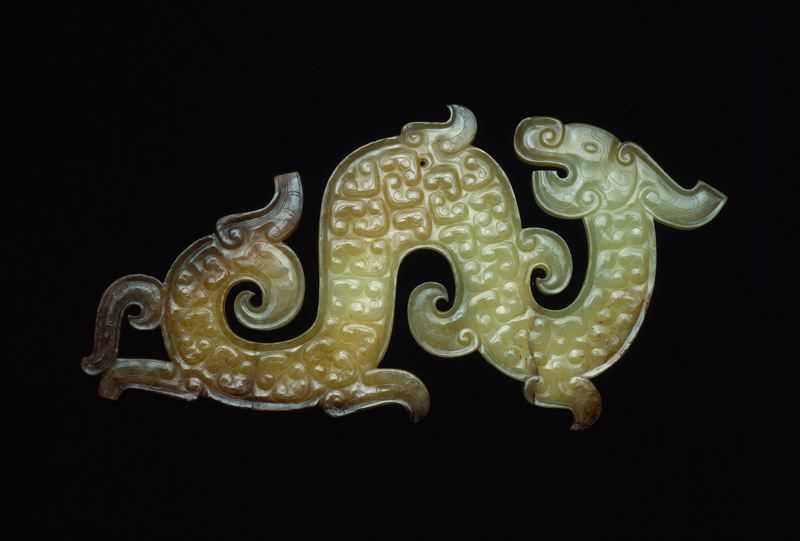
Actually the creatures being depicted are quite obviously dragons of the early conventionalized sort, and we have discussed the matter on this blog before. They appear to represent the Longnecked kind of Sea/Freshwater Monster with such features as the long necks, humps on the back (sometimes a long winding body) Flipperlike limbs and a short tail, frequently a finned tail. And they are usually shown as more compact than some of the later stylisations of dragons, but they can be of any length. During the Zhou (Formerly "Chou") period they were often depicted in jade.
 
It is notable that these depictions at the sides of the vessel forming handles makes them exactly like some of the "Patagonian Plesiosaur" native depictions also mentioned on this blog earlier. And that is appropriate because both of them are being represented as "Water Tigers"
 
 
Above and below, two Zhou Dragons depicted in nephrite jade
 

Saturday, 18 May 2013

Nagas, Plesiosaurs and Rainbow Serpents

 
Nagas are the South Asian (Indian and Indonesian) equivalents of Dragons, and the name "Naga" simply means "Snake", In Indonesia the Nagas tend to be a very peculiar sort of snake with a distinct neck; shoulders with forefins, wings or legs; a short thick torso tapering down into what looks like a distinct tail also. In more elaborate depictions they are shown with several loops in the water following the head and neck in typical "Sea-Serpent" style. The range of size in depicted Nagas is very great, from less than human size (three feet?) to a very great size, perhaps over fifty feet long.


 I had seen a similar pattern to this Suma Islands textile [below] before from the Phillipines before but I did not have a photo for it. It occurred to me that the creature on the other textile had a body plan like a Plesiosaur. One of the styles of depiction on the other cloth had an enlarged "Snake Head" and this one has "Devil Heads" instead. at any rate, the heads are mostly symbolic, the important thing is that the depictions are not showing ordinary crocodiles but something different.

(The lizards shown in the center are possibly very large and unclassified monitor lizards)
 
Cast of a Plesiosaur fossil, to show the similar body plan.
 
The two Batak carved wooden panels below show something like the local version of the Tao-tieh (Taotie) Chinese dragon head and once again it seems that the spiral design behind the eyes represents the Euryapsid skull openings that Plesiosaurs have (but that snakes do not have) The pineal 'eye' may also be intended by thesmall diamond shape above the eyes but situated medially: the boxed-off area in front of the eyes may indicate the area where the nostrils are located.


It turns out that in Northern Australia the Rainbow Snake (also known in Southern India) is a local variation on the Naga design. I am borrowing the logo of the Aboriginal Northern Land Council (This is not meant in any way to be disrespectful, I just needed to illustrate the design). Compare to the body plan of the first Indonesian Naga at the top of this article. An earlier blog noted the comparison of the Rainbow Serpent's teeth to PLesiosaur teeth: I did not make the comparison myself but it is also a good argument.
And finally it seems that the Nagas of Indonesia carry over intio New Guinea and Melanesia, where some of the native names sound as if they are variations of "Naga" and "Naga Raja" (King-of-Serpents) in the sield below, the Naga is shown in an ambiguous way, either as the top half done X-ray style with the throat indicated from the mouth down and then a schematic herart (The curlicues at the ends of the jaws is a design also known from Indonesia) and then as the top half, showing the twi foreflippers in the same manner as the Rotomahana sighting off New Zealand in the 1800s: and it is also a stlyised profile with both head and tail ends up, and indicating both fore and rear flippers.
 The catline face at the top of the shield is also interesting and I wonder if there are local reports of "Phantom panthers" to go along with the catfaced design?

Here is a comparison of a Plesiosaur reconstruction by National Geographic
to compare to the "Winged Foreflippers" top-part sighting design.
 Such sightings are infrequent but have been recorded in the Baltic sea, in the North
Atlantic, near New Zealand, off the US East Coast, off the US West Coast and near Japan.


Tuesday, 24 January 2012

Welcome to the Year of the Dragon

Welcome to the new year of the Dragon by the Chinese calendar (A most auspicious year)
I have written on Oriental dragons extensively on this blog before. For a refresher, although I consider several different creatures to be involved in what could be called dragon sightings in Chinese past history, and ranging from giant salamanders to Inland Sea-Serpents, I consider the "True" Oriental dragon to be an intermediate category recognised as more or less the "Average" Oriental dragon. See the older Blog posting at:
http://frontiersofzoology.blogspot.com/2011/11/some-more-on-oriental-dragon.html

Neolithic Chinese Royal Grave with dragon figure laid out in shells, cmparable in size to similar representation of a tiger and the human skeleton between the two, cultural context radiocarbon dated to approx. 6000 BC.

This would be the moderate-sized creature corresponding to descriptions of the Buru of Assam and otherwise to the Komodo dragon known to be living in Australia. An amphibious, saltwater and freshwater-inhabiting monitor lizard much like the Komodo dragon but up to twice the usual dimensions has been reported from various parts of Southern Asia and including even occasionally on Komodo island itself, and Bernard Heuvelmans lists several locations where it occurs as separate types of dragons because its range actually is so widespread. (Heuvelmans considers the shoreline-traveling larger dragon and the highlands dwelling Buru to be the same species but I am not so sure about that myself. It does make things easier for the Cryptozoologists to refer to only one new species of surprisingly large lizards yet to be discovered and catalogued)

Above, a Komodo dragon stretched out at length. To the left, the yellow tongue looking like a flickering flame. Another similar type of large monitor lizard could also be the origin for stories of Western dragons and the opponent of such legendary figures as St. George.
The newly-hatched Komodo dragon has a pattern of smallish red and yellow eyespots or Ocelli. In my reconstruction of the larger Water-Monitor of Southern Asia and Indonesia, I include a representation of about the same colour scheme in contrast to the regular New Guinean "Crocodile monitor" although all three large monitor lizards must be very closely related.

It turns out that both Crocodile monitors and the Komodo Dragons originated on Australia and are related to the even bigger "Megalania" (actually Varanus) prisca ,but all are one clade within the genus Varanus (Monitor lizards)

The Komodo dragons are the only lizards known to be living today that are thought to be actually dangerous to unarmed human beings.Tourists have been eaten by the dragons and it is best to keep out of their way.
Karl Shuker once voiced his objection that some accounts of the Buru say that the creature hasn't any legs, only "Flanges" at the sides (in a conversation that was admittedly difficult to translate.) Here is a photo of a Komodo dragon digging itself into the ground, and indeed the legs are not noticeable as anything that would ordinarily be described as legs.In wet mud the effect is more pronounced.

Best Wishes, Dale D.

Thursday, 9 June 2011

Some Late Dragons and Dragon-Slayings

While I was on a photo search for dragons, I came across a few interesting illustrations that I thought I should share.


The first illustration is the "Winged Serpent" Wyvern or Gwiber type, shown as if it were an Ouroboros. In this case I thoought it was an important depiction because it is obviously feathered and has a feathered neck, but also thatit is feathered in green and that the long green feathers of its tail have ocelli like a peacock's tail. The reminisces of Gwibers in Wales mentioned that their bodies were feathered and gaudy. and the feathers resembled peacock feathers. I wrote a blog for the CFZ in which I identified these "Flying serpents" as a sort of long-tailed pheasant-like bird and this looks like the illustration is going right along with the identification. It also seems to have a couple of feather tufts or "Horns" on its head, as some other more usual pheasants do.

The first part of this article was reprinted in Richard Muirhead's journal FLYING SERPENTS (April 2011) and the part two is now pending. It had been a recent blog entry at that time and one of the first articles on the current blog was a posting on New World Flying Serpents (Amphitheres)which was a follow-up from the CFZ articl;e on Gwibers.


This illustration was labelled as a dragon slaying as illustrated in Lucas Jennis' Bestiary. This would once again be one of the "Flying serpent" Wyverns or Cockatrices. It is interesting in that it seems to be another long-tailed bird but that the long trailing tail is interpreted as a snake's tail. In the case of a pheasant the long tail feathers are not exactly stiff bur can bend and curve around to some extent. I had some photos illustrating this in my CFZ blog on Gwibers (and in the reprinted article)


This is another bestiary illustration indicated as coming from the renaissance period but in Northern Europe, possibly Germany (or Holy Roman Empire as it was then) In this case (one of a few others I have found like it), it seems the "Dragon" or Dragonet is a Master-otter: a nursing mother if the artist isn't being extravagent. The creature would appear to have a full set of teats. The style is probably from the 1500s and this kind of "Dragon" depicted from the British Isles up through Scandinavia. There is some confusion of types because "Salamanders" would be illustrated as just about the same: the size of this one would probably be more the size of a "Salamander".

Best Wishes, Dale D.

Thursday, 3 March 2011

Ropens, Pterosaurian Sightings And Manta Rays


Pterosaur repoted by Kuhn in Guantanamo Bay, Cuba: Ropen seen in New Guinea.


Various witnesses in warmer regions of the world claim to have seen living pterodactyls as long-tailed creatures with two-pronged heads and long thin tails. No legs or feet are ever reported but wingspans are commonly reported as 20-30 feet across and the long thin tail is commonly estimated to be ten feet long. The surface has no feathers and is leathery and although different lighting conditions make the colour difficult to make out, it is most often darker or black on the back and lighter or white on the belly. A sighting made by a married couple in Perth, Australia, is typical:

' . . . in Perth, Western Australia on the coastline around 10:30 pm. We
were walking along Marmion Avenue between the suburbs of Heathridge and Ocean Reef. This creature could not be written off as a bird as it was bigger than any bird on the planet, it did not flap it's wings (just glided on the air current), it had a ruddy reddish brown leathery skin; (we could see it's underneath as it flew over us at about 100ft up; the glow from all the ground lighting made that possible), it had a long tail and a wingspan that we estimated at between 30-50 feet across.'

[Measurements and altitude more than double the norm and probably both exaggerated]

'My husband and I both have talked about what we saw many times since that night in 1997. . . It had a lizard appearance, and was a ruddy reddish brown colour, bearing in mind that all we could see was its dark shape until the ground lighting hit it, it was only for maybe between 5 to 10 seconds . . . but enough time for us to see it was a living creature. I should imagine a creature that size would have had legs and feet, but we didn't see them. It was gliding across the night sky, flying quite low, without a sound.'

It is a quite consistent feature that the sightings take place along the shoreline or on islands, or actually out at sea and seen from boats or airplanes, and ordinarily for only a few seconds. A comparison of two sightings one in 1944 and the other in 1971, as published on ropens.com, produces the results that both have no indication of feathers; pointed head crest at back of head; overall, dark colour; tail at least ten to fifteen feet long, and a longish narrow tail; loud swishing sound of wing-flaps; one or two seconds per wing-flap; 'prehistoric' appearance; 1944 - on mainland of Papua New Guinea, 1971- Bougainville Is., Papua New Guinea: the 1944 witness Hodgkinson is a professional flight trainer and the 1971 witness Hennessy is a professional psychologist. Neither one would want to damage credibility by sending in a hoax or false report.


There is a problem in all of these sightings (which occur world-wide and in fact are becoming more and more frequent with the passage of years) in that the body conformation is NOT what you would expect of a giant Pterosaur. The giant Pterosaurs were of a type that did not have much in the way of a tail: the tailed pterosaurians were the smaller kinds. Also the assumed wing membrane filling in all the way to the feet and being of a broad rhomboid overall appearance do not agree with the shape of the wings as they seem to be in these pterosaurs (nor yet with the shape of the wing membranes as preserved on fossils). On the other hand, they are exactly as represented in 1960s dinosaur movies and animated cartoons (eg, The Mighty Mightor shows Pterosaurs of that type, actually an imaginary design).


As a matter of fact I had heard of such reports and mentioned the creatures in my first letter to Ivan T. Sanderson in the 1970s. And I soon afterward came up with the solution myself: 'I supppose they could be manta rays leaping out of the water and assumed to be Pterosaurs on brief viewings. The witnesses on shore could get confused if they saw the creatures over land or see when they were remembering about it afterwards'. And in fact the size and shape of the wings and tail in all of these reports exactly correspond to a manta ray when they do NOT corresond to any type of Pterosaurian.

There is more to it than just that: witnesses in New Guinea are also apparently describing a type of very large hornbill (which is also recognised under a different name as a separate cryptid) and the reports of 'Bioluminescence' are basically either 'spook lights' or marsh gas. 'Spook lights' otherwise occur world-wide without any connection to supposed pterosaurian sightings and I would write such sightings off as red herrings in these cases.


Ropen
From Wikipedia, the free encyclopedia

The Ropen is a flying cryptid[1] alleged to live in the vicinity of Papua New Guinea.[2] According to the book Searching for Ropens, it is "any featherless creature that flies in the Southwest Pacific, and has a tail-length more than 25% of its wingspan." On Umboi Island the word "ropen" refers to a large nocturnal creature that glows briefly as it flies.[3] The ropen is the subject of folklore (like a man but also like a spirit) but it's believed by some natives to be a real animal.[4] Descriptions vary, but it is often said to be batlike,[5] and sometimes, Pterosaur-like;[6] although pterosaurs are generally accepted to have been extinct for 65 million years.[7][8] The ropen is believed to be nocturnal and to exhibit bioluminescence.[9][10] Purportedly it lives on a diet of fish,[11] though there have been some reports of the creature feasting on human flesh, especially grave robbery.[12][13][14]

[The descriptions obviously include inferrances that the Ropen is a Demonic or Undead-human rather than a normal living animal-DD]

Investigations
As an attempt to discredit mainstream scientific views on the age of the Earth, several expeditions[15] have been embarked upon by American creationists, including Carl Baugh, Paul Nation, Jonathan Whitcomb,[16] David Woetzel, and Garth Guessman.

In late 2006, Paul Nation, of Texas, explored a remote mountainous area on the mainland of Papua New Guinea.[17] He videotaped two lights that the local natives called "indava." Nation believed the lights were from the bioluminescence of creatures similar to the ropen of Umboi Island. The video was analyzed by a missile defense physicist who reported that the two lights on the video were not from any fires, meteors, airplanes or camera artifacts. He also reported that the image of the two lights was authentic and was not manipulated or hoaxed.[18]

In 2007, cryptid investigator Joshua Gates went to Papua New Guinea in search of the Ropen for his TV show Destination Truth. He and his team also witnessed strange lights at night and could not confirm what they were.

In 2009, the television show Monster Quest conducted an expedition in search of the "demon flyer" but found no evidence of the creature. Later, they had a forensic video analyst examine the Paul Nation video. The analyst could not definitely conclude what was causing the lights, but ruled out vehicles and campfires believing the footage was of a pair of bioluminescent creatures perched in a tree that later take flight.

Identity
As is often the case with cryptids, the Ropen's true identity is subject to debate. Some believe it to be a Rhamphorhynchidae-like creature, while others suggest that the Ropen is a misidentified bat (e.g. flying foxes, which are large fruit bats than can have wingspans up to two metres (six feet), or frigatebird. Flying lights in Papua New Guinea have been reported by not only natives but by Western visitors. Evelyn Cheesman, the entomologist, mentions them in her book The Two Roads of Papua (published in 1935): "baffling" lights that lasted "about four or five seconds." The book Searching for Ropens says that the "ropen" light of Umboi Island lasts for about "five seconds." There is also said to be a creature called "Duah" that is said to be another kind of ropen, but according to Searching for Ropens the correct word is actually "duwas," and it is just another name, in a different language, for the same creature.[It can also mean "Devil" apparently-DD]

References
1.^ http://www.cryptozoology.com/cryptids/ropen.php.
2.^ Pterosaur-like Creatures Reported in Papua New Guinea
3.^ Expedition - A Pterodactyl in Papua New Guinea
4.^ PSL Gideon was terrified by the ropen
5.^ Living pterosaurs are not Flying Fox fruit bats
6.^ PSL Is the ropen a pterosaur?
7.^ Penny et al. (2004) The rise of birds and mammals: are microevolutionary processes sufficient for macroevolution?. Trends in ecology & evolution vol. 19 (10) pp. 516-22
8.^ Robertson et al. (2004) Survival in the first hours of the Cenozoic. Bulletin of the Geological Society of America
9.^ http://www.ropens.com/
10.^ Bioluminescent Organisms
11.^ Whitcomb's Book, Searching For Ropens, Asserts Pterodactyl Reported In Papua New Guinea - EWORLDWIRE
12.^ Michael of Opai Village and the ropen light
13.^ What Happened to Pterosaurs page 2
14.^ Jim Blume's ropen investigations in Papua New Guinea
15.^ Flying Dinosaurs in Papua New Guinea
16.^ PSL Ropen Light Sighting by David Woetzel
17.^ Living Pterosaur Expedition of 2006
18.^ Analysis of the Ropen-light Video, pg-1
External links
Credibility of the Umboi Island eyewitnesses
Indava and Ropen of Papua New Guinea
Live Pterosaurs and Evolution


Monday, 21 February 2011

THE REAL DRAGONS


Heuvelmans's Checklist of Cryptozoological candidate species (CRYPTOZOOLOGY 5, 1986) contains a series of large monitor lizards and in fact possible very large monitor lizards make up a large portion of his total (a fourth to nearly a third of his freshwater categories and easily the dominant category for the freshwater tropics). I have a proposal that will unite several of these cryptid slots into one over-arching species and solve a few puzzles that have been around for most of recorded history in the process.

[Illustration of "25-Foot Sundabarbans Buru" from an internet Cryptozoology site quoting Heuvelmans]

Under heading (2), In Tropical Lakes, Rivers and Swamps, Heuvelmans's first candidate category includes the Burus of Assam. However, his description actually basically means something different. It reads:
*Amphibious animals, probably huge monitor lizards, some up to 20 feet long-and thus larger than the Komodo dragon (Varanus komodoensis)-currently reported from India and neighboring countries. In the Gir area (Kathiawar Penninsula), where they are known as the Jhoor, they are largely mythicized, but they have been fairly well observed in the Sundabrabans (mouths of the Ganges), where, strangely enough, they live in symbiosis with the salt-water crocodile (Crocodylus porosis) In Assam where they are known as the Buru to the Apa Thanis, they seem to have been exterminated in modern times (Izzard 1951, Mackal 1980). In Bhutan, however, some have recently been sighted in one of the Northern lakes, once by the king himself, and they have also been reported from [Northern] Burma[And all along the Andaman Islands-DD]. There is even a historical record extant of their existence in Sumatra during the 16th century (Heuvelmans 1965a)

The next entries also seem to me to be a continuance of the same category
*A dinosaur-like animal resembling a sauropod or possibly a plesiosaur-like animal, seen in two lakes of Pahang, in the Malay Peninsula: the Tasek Bera and Tasek Chini [Nagaq]

* A similarly-described reptile in Lake Patenggang, in Western Java [Naga]

[* To which may be added the large monitor-lizard-like Meikong River Monster, known in Thailand and Laos as a Naga Phaya]

And to this might be the singularly outsized early report of a Komodo dragon more than 27 feet long, if the creature travels by sea as well as living in freshwater and being amphibious. This is in accordance with some of Ivan Sanderson's statements concerning "Evidence for living Dinosaurs" in Indonesia, particularly mentioning certain wood carvings coming from Bali, which brings us further down the line geographically to the Australasian section:

* Gigantic monitor lizards, up to 30 feet in length, known to some Aborigines as Mungoon-galli, in various places of Eastern Australia, particularly in the forests of Northern Queensland [as Water-Monsters-DD], but also further South (see Terrestrial Forms, In Australasia[Australasian Realm]). They could be relic individuals of Varanus priscus from the Upper Pleistocene of Australia.

*Similar amphibious monitor lizards, almost as large, and called Au Angi-Angi [The Snake-snake, or Snake Above All Other Snakes, a term from Pidgin language-DD]by the Papuans of Eastern New Guinea [ALSO in Indonesian New Guinea, Irian Jaya-DD](Heuvelmans 1965a)

*An Unknown species of crocodile (or is it, as has been suggested, a surviving mosasaur?)known as Migo, in Lake Dakataua, on the Island of New Britain, In the Bismark Achipelago (Neill 1956)
-To which can be added more recent "Dinosaur" sightings of New Britain and New Guinea-ALL OVER New Guinea, in fact, and then again reports of seagoing monitor lizards reported in Island Melanesia and Southern Polynesia (Guangin and Ngarara) as far away as formerly in Northern New Zealand (Kumi Lizard and Ngarara)


[Varanid, from Tony "Stormwalker's" New Zealand Cryptozoology site]

For technical reasons (mostly because of habitat but also climate) we can omit BOTH the Burus and the larger "Megalania" or V. priscus sightings in Australia, which include a more recent outbreak of "Tyrannosaurus" sightings. Monitor lizards can stand up on their hind legs, and from the rock art I have seen in photos, these "Tyrannosaurs" are only huge and heavily-built monitor lizards rearing up. And the difference in habitat and description is too much for the Sundabarbans monitors to be the same as the Burus, more than likely they are two distinct species. One easily-observed discriminant feature is that the Burus are relatively stout with a shorter tail: the really long Water-Monitors are not only more elongated overall, their tails are especially long in proportion. They are also shown in Rock art of Southern India, were reported in Roman times as noted by Heuvelmans elsewhere, and reports continue on up into recent times (one recent news item called them "Mosasaurs") Furthermore they seem to be the same as the more "Highly mythicized" Dragons of the Indus (Ahi), the Dragons of Iran and ancient Persia (Azhi, which are represented similarly to Chinese dragons or Lungs) and then again to a giant monitor lizard rumored in the Tigris-Euphrates (Afa) (in Eberhart, Mysterious Creatures)


[AzhiDakha, Iranian Water Dragon, in Cartoon form]
What makes this all fit together is Heuvelmans' curious statement that the giant monitors live in symbiosis with the Indopacific crocodiles in the Sundabrabans. This presumably means they have learned to toleate each other's presence, and that alone would be remarkable enough. Several persons have expressed extreme doubts over that statement, myself included. But it does provide a vital clue: The range of the big water-monitor is basically similar to that of the Indopacific C. porosus, and it seems the two species nest together. Hence the ranges of the two species both match and they are both found from Eastern India to Northern Australia and sometimes further out to sea. They are also about the same size, it seems, and presumably rarely as long as 20-25 feet (30 feet long is probably an exaggeration, as the occasional claom of 50 to 60 feet long-or much longer by counting the wake-would certainly be.)


[Current General range of Crocodylus porosus]
In the case of reports from New Guinea, several Cryptozoologists up to including Karl Shuker stated that reports of extralarge monitor lizards are due to outsized individuals of the Tree Crocodile monitor, Varanus salvadorii. This has led to such statements found on some of the Cryptozoology sites as "Artellia is a giant monitor lizard reported to grow to 30 feet long and to drop down from trees on people." Actually, that combines two different situations: 1) the reports of giant monitors reach to 30 feet or more, and 2) the KNOWN Crocodile monitor is a tree-living creature. For this reason I make a distinction between Tree Crocodile monitors and True Crocodile monitors. They are undoubtedly closely related species (both of them in turn closely related to the Komodo dragon and "Megalania") but besides the decided difference in habitat, the bigger one is at least twice the size of the "Known" species. (A similar situation seems to exist in the case of Indopacific or Saltie crocodiles) The Tree crocodile does not have a recorded length of over eight feet long: reports of the monitor at 12 to 24 feet long or longer are NOT the same as the common "Artrellia" but they would belong to the closely similar but much larger True Crocodile monitor. I append a mockup comparison (The original artist's signature is still on his artwork and I do not mean to take credit for his work, this is for demonstration purposes)


Furthermore, the True Crocodile monitor occsionally appears in Southern China where it is called a Lung (Dragon) Reports can be spotted periodically throughout the historical records.

Best Wishes, Dale D.