Plug

Member of The Crypto Crew:
http://www.thecryptocrew.com/

Please Also Visit our Sister Blog, Frontiers of Anthropology:

http://frontiers-of-anthropology.blogspot.com/

And the new group for trying out fictional projects (Includes Cryptofiction Projects):

http://cedar-and-willow.blogspot.com/

And Kyle Germann's Blog

http://www.demonhunterscompendium.blogspot.com/

And Jay's Blog, Bizarre Zoology

http://bizarrezoology.blogspot.com/
Showing posts with label Euryapsids. Show all posts

Tuesday, 6 August 2013

Longneck / Loch Ness Monster Composites


Here are my statistical outcomes from doing my own analyses on Longneck reports worldwide, together with explanatory notes. The 40 foot long figure was the one obtained by Dinsdale and my data tends to reinforce that: but in sightings at sea the figures are typically at a 60 foot scale, or measurements 150% of these. I assume the difference is because the sightings at sea tend to be less accurate because the scale and distance cannot be made out as easily.


The reconstructions of the head were done independently of the video resulta below, which come here by way of Scott Mardis' comparisons and from the "Not Just Nessie" website. 


The profile is very significantly the same wedge shape tapering down from back to front, with a wide gash of a mouth and the eyes placed about halfway along the length.


"Not Just Nessie": below is Scott Mardis' comparison to a Plesiosaur skull.


Above, Oudeman's SS reconstructions showing the heads as being much the same shape as the statistical averages reconstruction I made myself. I have put a lighter-coloured circle around the eye to make it show up better in this enlargement.
 
Below are two views from sightings of the Loch Ness Monster showing the appearances of the head from above and from in front too compare to the other comparable points of view from the other locations. The view of the neck overall in the drawing of a recent Periscope sighting at Loch Ness shows the longer forward section of the neck, much the same thickness throughout, and then the larger and thicker rear portion of the neck (Significantly also shown in the Surgeon's Photo) The same type of neck features in the Corinthian SS witness' illustration reproduced below.


The Cuba SS drawings chosen in the Sea Slug article actually help illustrate that the reported shape of the head is consistently reported in all of the reports from the different points of view.
These illustrations are from Heuvelmans' book In the Wake of the Sea-Serpents and they are added here to illustrate the apparent head shape of Longnecks from several angles. The Southwold SS has a good view of the wedge-shaped head tapering down from back to front, and Mrs. Borgeest's sighting shows the very flat and wide "Snakelike" head from front-on. Heuvelmans remarks on both aspects (The wedge-shaped, taper-down profile is what is sometimes called "Horselike") in the case of the Corinthian SS it seems the Euryapsid openings in the back of the skull are taken for eyes (this seems to be a consistent misinterpretation among some witnesses and it is even possible that this area is marked with false decoy-eyes such as occur in many different kinds of animals. There is a quandary about sea-serpent eyes in that some of them have them prominently marked while the rest (Femalse and young) have the eyes coloured about the same as the rest of the animal and the eyes are not obvious. In the reconstruction composite above I have indicate the eye sockets as being fairly large and visible from all angles, but it is entirely possible witnesses are seeing false eyespots instead. Among their own kind the false eyespots serve to divert potentially damaging attacks from the real eyes when males are sparring. And my interpretation of the Corinthian SS is that it actually is a male surprised while sparring with another male, and the creature has a mouthful of the "Mane or fin" material ripped off of the other male. The position of the material makes it look more like it is coming out of the mouth rather than from the places where animals ordinarily have whiskers.
The head on this one is exaggerated by making it too long generally but it does show about the right overall shape as seen from above.The statistical norm would have it that the head would be much smaller in proportion to the neck, and more especially much shorter.


Depiction of traditional Scandinavian Sea Serpent. Same kind of head, I think the dark patches behind the eyes once again indicate the presence of Euryapsid skull openings such as are also indicated in many other sightings and artistic depictions.. Below "The Children of Loki"
with the big snake being the Midgard Serpent. The head is modeled after carvings of Dragons on Viking churches and such, also traditional, and once again the same type of head. [Traditionally the tongues are depicted as pointed, not forked) There is an earlier separate blog entry on Viking depictions of Longnecks and why they are Euryapsids, and other blog articles on various similar dragons heads the world over and back to the dawn of civilization, with specifications as to why they are Euryapsids, too. Snakes do not have skulls that are anything like a Plesiosaur's skull and they have no structure corresponding to a Euryapsid skull opening.


The original study was done between 1975 and 1980 in several revisions and the SITU archives should still have handwritten copies of the earlier drafts. The document was ultimately never published but these result are easily summarised and presented as they are here. The 1980, final version of the manuscript included "A Field Guide to Water Monsters" which was being submitted for publication in PURSUIT as a series of articles starting in 1986, but stopped when I moved out of New Jersey, and started up again for submission to PURSUIT in 1990 (Typed articles with illustrations provided, also ultimately unpublished, PURSUIT became moribund at about that point)

 
 ADDENDUM:
"Joe Richardson" is becoming dreadfully tedious insisting that I explain every single instance of why a Euryapsid skull opening has to be a Euryapsid skull opening. I have said on numerous occasions, the matter is written up in earlier blogs on this site. "Joe" really must learn how to look things up in the provided index and do his own research. I refuse to spoon feed him any further and I refuse to repeat myself endlessly on matters where I have already answered him before. He has never shown me once that he even pays attention when I cite sources to him and he never seems to learn anything, he continues to re-assert the same tired old arguments even after he has been thoroughly refuted. "Joe Richardson" is hereby served notice that he is making an irritant of himself and his comments will be deleted until and unless he can stop sounding like a broken record. And once again, if you "Joe" do not have the anatomical expertise which gives you the authority to criticize or comment on Plesiosaurian anatomy, your remarks carry no weight as criticism or indeed even as any sort of a relevant argument.

Wednesday, 26 June 2013

Late Eastern Zhou ?Sauropod from s8int.com


Late Eastern Zhou Sauropod
http://s8int.com/WordPress/tag/living-dinosaurs/

“The Shang dynasty (1766 BC – 1027 BC) ruled parts of northern and central China. Its capital city was located at Anyang near the border of Henan from about 1384 BCE. This dynasty was based on agriculture; millet, wheat, and barley were the primary crops grown.

Fang Jian Dinosaur 1

In addition to the crops, silkworms, pigs, dogs, sheep, and oxen were raised. Aside from their agricultural prowess, the Shang dynasty was also advanced in metallurgy. Bronze ships, weapons, and tools were found from that era.” Thinkquest
This Ancient Chinese ornamental box of bronze features an unmistakable depiction of a sauropod dinosaur. To be more precise, likely a prosauropod dinosaur. A version of the object appeared in the book (The Great Bronze Age of China, Metropolitan Museum of Art, 1980, p. 285.)
Fong, Wen ed. This photo is from Zhengzhou, from the Henan Museum.

The sauropod dinosaurs are easily recognizable and difficult to miss, however, might science here again made its depictions of the creature to large? One alternative to consider is that the creature depicted is one of the group that modern science now calls prosauropods who among other things was generally smaller. The creature crawling up the side of the box is also making an appearance here out in the water in the introductory photo at the very top of the page.[Not shown here]

Fang Jian Dinosaur 2


Closeup by DD
 
Actually the creatures being depicted are quite obviously dragons of the early conventionalized sort, and we have discussed the matter on this blog before. They appear to represent the Longnecked kind of Sea/Freshwater Monster with such features as the long necks, humps on the back (sometimes a long winding body) Flipperlike limbs and a short tail, frequently a finned tail. And they are usually shown as more compact than some of the later stylisations of dragons, but they can be of any length. During the Zhou (Formerly "Chou") period they were often depicted in jade.
 
It is notable that these depictions at the sides of the vessel forming handles makes them exactly like some of the "Patagonian Plesiosaur" native depictions also mentioned on this blog earlier. And that is appropriate because both of them are being represented as "Water Tigers"
 
 
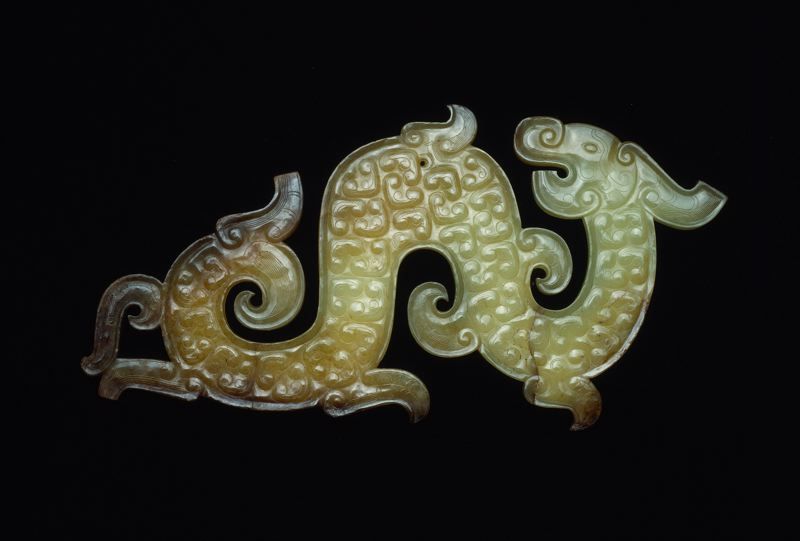
Above and below, two Zhou Dragons depicted in nephrite jade
 

Saturday, 18 May 2013

Nagas, Plesiosaurs and Rainbow Serpents

 
Nagas are the South Asian (Indian and Indonesian) equivalents of Dragons, and the name "Naga" simply means "Snake", In Indonesia the Nagas tend to be a very peculiar sort of snake with a distinct neck; shoulders with forefins, wings or legs; a short thick torso tapering down into what looks like a distinct tail also. In more elaborate depictions they are shown with several loops in the water following the head and neck in typical "Sea-Serpent" style. The range of size in depicted Nagas is very great, from less than human size (three feet?) to a very great size, perhaps over fifty feet long.


 I had seen a similar pattern to this Suma Islands textile [below] before from the Phillipines before but I did not have a photo for it. It occurred to me that the creature on the other textile had a body plan like a Plesiosaur. One of the styles of depiction on the other cloth had an enlarged "Snake Head" and this one has "Devil Heads" instead. at any rate, the heads are mostly symbolic, the important thing is that the depictions are not showing ordinary crocodiles but something different.

(The lizards shown in the center are possibly very large and unclassified monitor lizards)
 
Cast of a Plesiosaur fossil, to show the similar body plan.
 
The two Batak carved wooden panels below show something like the local version of the Tao-tieh (Taotie) Chinese dragon head and once again it seems that the spiral design behind the eyes represents the Euryapsid skull openings that Plesiosaurs have (but that snakes do not have) The pineal 'eye' may also be intended by thesmall diamond shape above the eyes but situated medially: the boxed-off area in front of the eyes may indicate the area where the nostrils are located.


It turns out that in Northern Australia the Rainbow Snake (also known in Southern India) is a local variation on the Naga design. I am borrowing the logo of the Aboriginal Northern Land Council (This is not meant in any way to be disrespectful, I just needed to illustrate the design). Compare to the body plan of the first Indonesian Naga at the top of this article. An earlier blog noted the comparison of the Rainbow Serpent's teeth to PLesiosaur teeth: I did not make the comparison myself but it is also a good argument.
And finally it seems that the Nagas of Indonesia carry over intio New Guinea and Melanesia, where some of the native names sound as if they are variations of "Naga" and "Naga Raja" (King-of-Serpents) in the sield below, the Naga is shown in an ambiguous way, either as the top half done X-ray style with the throat indicated from the mouth down and then a schematic herart (The curlicues at the ends of the jaws is a design also known from Indonesia) and then as the top half, showing the twi foreflippers in the same manner as the Rotomahana sighting off New Zealand in the 1800s: and it is also a stlyised profile with both head and tail ends up, and indicating both fore and rear flippers.
 The catline face at the top of the shield is also interesting and I wonder if there are local reports of "Phantom panthers" to go along with the catfaced design?

Here is a comparison of a Plesiosaur reconstruction by National Geographic
to compare to the "Winged Foreflippers" top-part sighting design.
 Such sightings are infrequent but have been recorded in the Baltic sea, in the North
Atlantic, near New Zealand, off the US East Coast, off the US West Coast and near Japan.


Saturday, 16 March 2013

Longnecked Beast on Ancient Peruvian Tapestry

This turned up on my facebook page as purportedly showing a longnecked unknown animal on a Chuimu tapestry (ornamental embroidered cloth meant for a wall covering) from prehistoric Peru.


These appear to be representations of long-necked water monsters and "Dinosaurs" are still supposed to be sighted in the lower-lying jungle areas of Peru and Bolivia. These are not otters, otters do not have such elongated snouts nor such long flat ears. However, if the "Ears" are meant to show the Euryapsid skull openings again, we are once again talking Plesiosaurs and probably even "Patagonian Plesiosaurs." the legs are not very important and they could be representing flippers: I notice that the tail ends of these creatures send in a "Whirlpool" and I have seen the same conventionalization elsewhere,

Notices were also posted that this cloth is a National Treasure of Peru, that it was taken from the country illegally and is loot. I have no connection to this matter and I know nothing of the whereabouts of this cloth now. But if such is the case, I do hope the people of Peru get it back again.

Wednesday, 23 January 2013

17th Century 'Dragon' At Metropolitan Museum of Art


Sea Dragon
Date:17th century

Geography:Italy

Medium:Wood, brass

Dimensions:
Approx. : H. 20.3 x W. 8.9 x L. 138.4cm (8 x 3 1/2 x 54 1/2in.) Bocal & Reed: L. 22.9 cm (9 in.)
Classification:Aerophone-Reed Vibrated

Credit Line: The Crosby Brown Collection of Musical Instruments, 1889

Accession Number:89.4.881a-c

This artwork is currently on display in Gallery 684

This and a similar dragon in The Cincinnati Art Museum are the only known instruments of this kind to survive. Used as a stage prop, it probably appeared in masquerades and theatrical scenes depicting the underworld. The instruments were capable of producing sounds and noises that supported onstage dramaturgical actions both visually and aurally. Made from two joined hollowed out lengths of wood, the dragon was then sculpted, painted a dark green and gilded on its head and fins. During the 19th century the body was partially re-painted black. The original mouthpiece and bocal are now missing

-Interestingly, this late dragon design is basically also like a Plesiosaur with a big head: the head and neck, body and tail are each about one third of the total length. The head is clearly separated from the body by a length of neck and at the base of the neck are two large fins or flippers: there are also indications of sockets for two more fins or flippers at the base of the tail, but these have been removed. The neck is thinner than the body and is curved into a very shallow s-shape, the body is thicker at the shoulder and then tapers back to the end of the tail, as is specified in certain reports. The head is remarkable in that it does show the "horns" as ears once again, but also the nostrils are placed in front of the eyes (in the proper place for a Plesiosaur) and there seem to be indications for both the Euryapsid openings of the skull and also the ear-holes indicated separately. Furthermore there are reports whuch seem to indicate a "Ruffle" of loose skin all the way around the back of the head, and in this case adorned with the "Mane" which once again seems to be composed of fleshy strips rather than hair) -DD.

Saturday, 8 December 2012

Possible Further Support for Continued Plesiosaurian Survival

Scott Mardis sent me a notice about some fossils from the Miocene ("Beginning of the End" for the Age of Mammals) which he noticed had some features of Plesiosaurian anatomy and which famous 19th Century Paleontologist Edward D Cope had thought actually was a surviving Plesiosaur. The anatomical features that Scott had noticed were actually present in the fossil but this was an unusual sort ot actually be looked upon as a surviving Plesiosaur ANCESTOR, a Choristodere. The genus which Cope had named was called either Ischyrotherium or Ischyrosaurus,but the latter name was pre-empted by a Sauropod dinosaur. The familiar Choristoderan Champsosaurus is shownb at left in its Wikipedia reference photo. So while the fosdsil material in question might not be evidence of a Plesiosaurian survival, we  something even more surprising: a line of Plesiosaurian ANCESTORS had vanished for most of the length of the Age of Dinosaurs, most of the Jurassic and Cretaceous, and then reappeared on the fossil record  , and continued on through most of the Age of Mammals, but with pretty poor fossil representation all along. If this could be true of Plesiosaur ancestors then it could certainly also have been true of Plesiosaurs themselves at the same timeby way of the same unknown mechanisms.

Two Triassic Nothosaurs (Plesiosaur ancestors) pictured  below, both of which have the unusual rib formation which Scott Mardis pointed out in the Oligocene- Miocene Choristodere Ischyrotherium


Lazarussuchus, Miocene Choristoderan presumably close to Cope's Ischyrotherium, has a skull like a little Plesiosaur with what look very like the standard Eyryapsid skull openings.

Archosauromorpha


From Wikipedia, the free encyclopedia

(Redirected from Archosauromorphs)

Jump to: navigation, search

Archosauromorphs
Temporal range: Late Permian–Present
Reconstruction of Trilophosaurus, a primitive archosauromorph
Scientific classification e
Kingdom:Animalia
Phylum:Chordata
Clade:Sauria
Clade:Archosauromorpha
von Huene, 1946
Subgroups
Teraterpeton?
Prolacertiformes
Rhynchosauria
Trilophosauria
Archosauriformes
Archosauromorpha (Greek for "ruling lizard forms") is an infraclass of diapsid reptiles that first appeared during the late Permian and became more common during the Triassic. It was defined by Michel Laurin (1991) as the clade containing the most recent common ancestor of Prolacerta, Trilophosaurus, Hyperodapedon and archosaurs and all its descendants;[1] David Dilkes (1998) formulated a more inclusive definition of Archosauromorpha, defining it as the clade containg Protorosaurus and all other saurians that are more closely related to Protorosaurus than to Lepidosauria.[2]
Included in this infraclass are the groups Rhynchosauria, Trilophosauridae, Prolacertiformes and Archosauriformes. While superficially these reptiles vary in appearance (at one time they were even included in different subclasses – the trilophosaurs were considered euryapsids, and the rhynchosaurs were considered lepidosaurs and were included in the same order as the tuatara), they are actually united by a number of small skeletal and skull-related details that suggest they form a clade that descended from a single common ancestor. Additional groups with uncertain phylogenetic position that are included in Archosauromorpha by some authors (and excluded from it by others) are Choristodera, drepanosaurs[2], thalattosaurs, ichthyopterygians, sauropterygians[3][4][5] and turtles.[6]
Of the taxa mentioned above rhychosaurs, trilophosaurs and prolacertiforms died out at or before the end-Triassic extinction. The choristoderans continued as a minor group until the Miocene, and the Archosauriformes were important factors in early Triassic environments before giving rise to the even more successful Archosauria.


Taxonomy

Classification

 
Genus: Ischyrotherium LEIDY, 1856 (nomen dubium)
Etymology:
= Ischyrosaurus COPE, 1870 (non) HULKE, 1874 Species: antiquum LEIDY, 1856
Etymology:
= Ischyrosaurus antiquus (LEIDY, 1856) COPE, 1870
Syntypes: 11559
Locality: Between Moreau River and Grand River, Nebraska.
Horizon: Lignite.
Biostratigraphy:
Age: Cretaceous. [this turned out to be incorrect and the material is MIOCENE in date]
Material: Dorsal vertebrae and 7 rib fragments.
NOTE: possibly a Plesiosaur. [Later called a Choristodere]

Wikipedia discussion page on status of Ischyrosaurus/Ischyrotherium


Ischyrosaurus Cope, 1876
The correct date of the publication of Ischyrosaurus Cope is 1876, not 1869 [1], making Ischyrosaurus Hulke, 1874 in Lydekker, 1888 unpre-occupied. Cope [2] tried to create Ischyrosaurus for Ischyrotherium on the grounds that Ischyrotherium was a reptile and not a mammal as originally classified by Leidy [3]. However, the name Ischyrosaurus Cope, 1876 is a nomen nudum, on the condition of Cope's attempt, and a junior synonym of Ischyrotherium Leidy, 1856.
[1] http://www.paleofile.com/Demo/Mainpage/Taxalist/Archosauromorphs.htm
[2] Cope, E. D., 1876, On some extinct reptiles and Batrachia from the Judith River and Fox Hills beds of Montana: Proceedings of the Academy of Natural Sciences, Philadelphia, 1876, p. 340-359.
[3] Leidy, J., 1856, Notices of remains of extinct vertebrated animals of New Jersey, collected by Prof. Cook, of the State Geological Survey, under the Direction of Dr. W. Kitchell: Proceedings of the Academy of Natural Sciences, Philadelphia, v. 8, p. 220-221. —The preceding unsigned comment was added by 72.194.116.63 (talk) 17:13, 31 December 2006 (UTC).
The link (once I found it; for some reason, I had to go through Google to get to it) claims it was Cope 1870 (which would be "Synopsis of the extinct Batrachia, Reptilia and Aves of North America". Transactions of the American Philosophical Society 14:1-252.), which is not 1869, but still predates it. A JSTOR link I found on Google to an 1871 Cope paper implied he'd coined it before 1871:
JSTOR: On the Families of Fishes of the Cretaceous Formation of Kansas
The case appears to me to be different with the name Ischyrosaurus, which I proposed to replace with Ischyrotherium (Leidy). The latter was given to a genus ...
So, it was in use before 1871. That it was a nomen nudum, or a superfluous name, does not matter. However, since it may have been abandoned by 1871 (if I'm reading that sentence fragment correctly), Cope's version could be declared a nomen oblitum if for some reason Ischyrosaurus Hulke became important to paleontology.[Subsequent discussion on the same Wikitalk page showed the name was NOT a nominum nudem]
Why some have it as Cope (1869) and some have it as Cope (1870) (it looks like it was a typo in this message to the DML, which looks like it was referring to the 1870 work) I don't know, but it was definitely coined before 1871. J. Spencer 20:30, 1 January 2007 (UTC)
Correction: Cope had several 1869 or 1870 works dealing with Batrachia (see for example the ref list here for a few, one of which is repeated in 1870 because of the famous Elasmosaurus-head-on-tail thing), so I can't firmly say which one without having read them. The important thing is still the pre-1874 date. J. Spencer 20:38, 1 January 2007 (UTC)
The reasoning for the different dates is explained by Spamer et al. (1995- pg. 333). The portion up to page 105 was issued in August, 1869, up to page 235 in April, 1870 and the rest was published in December, 1870. This is on page ii of the index in the volume itself. Since Cope named Ischyrosaurus on pages 38 and 39, the proper year is 1869. -Mickey Mortimer

The Longevity and Variety Within the Choristodera
Choristoderes appeared in the Late Triassic, but probably originated in the Late Permian, along with their sister taxa. Some survived into the Miocene. Despite the longevity of this clade, relatively few modifications to the basic body plan appeared. Oh, sure, the lateral temporal fenestra disappeared in Doswellia and Lazarussuchus. The rostrum elongated in Champsosaurus. The neck elongated in HyphalosaurusDoswellia was the giant of the clade, reaching 1.6 m in length, or slightly larger than Champsosaurus at 1.5 m, so their largest size was about the size of a human being. Traditional enigmas, choristoderes were a monophyletic clade that nested between Youngoides and Parasuchia, close to the base of the Archosauriformes. Relatively conservative in morphology, choristoderes were a relatively minor presence throughout the Mesozoic and into the Cenozoic.

ReferencesBrown B 1905. The osteology of Champsosaurus Cope. Memoirs of the AMNH 9 (1):1-26. http://digitallibrary.amnh.org/dspace/handle/2246/63
Cope ED 1876.
On some extinct reptiles and Batrachia from the Judith River and Fox Hills beds of Montana: Proceedings of the Academy of Natural Sciences, Philadelphia. 28, p. 340-359.
Dilkes D and Sues H-D 2009.
Redescription and phylogenetic relationships of Doswellia kaltenbachi (Diapsida: Archosauriformes) from the Upper Triassic of Virginia. Journal of Vertebrate Paleontology 29(1):58-79
Evans SE and Hecht MK 1993.A history of an extinct reptilian clade, the Choristodera: longevity, Lazarus-Taxa, and the fossil record. Evolutionary Biology 27:323–338.
Foster JR and Trujillo KC 2000.
New occurrences of Cteniogenys (Reptilia, Choristodera) in the Late Jurassic of Wyoming and South Dakota. Brigham Young University Geology Studies 45:11-18.
Gao K-Q, Tang Z-L and Wang X-L 1999.
A long-necked reptile from the Upper Jurassic/Lower Cretaceous of Liaoning Province, northeastern China. Vertebrata PalAsiatica 37:1–8.
Gilmore CW 1928.
Fossil lizards of North America. Memoirs of the National Academy of Sciences 22(3):1-201.
Hecht MK 1992. A new choristodere (Reptilia, Diapsida) from the Oligocene of France: an example of the Lazarus effect. Geobios 25:115–131. doi:10.1016/S0016-6995(09)90041-9.
Matsumoto R and Evans SE 2010. Choristoderes and the freshwater assemblages of Laurasia. Journal of Iberain Geology 36(2):253-274. online pdf
Weems RE 1980.
An unusual newly discovered archosaur from the Upper Triassic of Virginia, U.S.A. Transactions of the American Philosophical Society, New Series 70(7):1-53
wiki/Champsosauruswiki/Cteniogenyswiki/Hyphalosaurus
wiki/Lazarussuchus

Compare Triliphosauria, Prolacertaforms ("Protosauria")

Tuesday, 1 November 2011

Some More On Oriental Dragon Development


"Lifesized" dragon state in a Chinese park, from Wikipedia.


Characteristics of Chinese Dragons and Their Developmental Stages

Chinese art and cultural beliefs have been dominated by dragons for thousands of years. A mix of animal features are seen in Chinese dragons, and thanks to the scholarship of Wang Fu some time between 206 B.C. and A.D. 220 during the Han Dynasty, the features and complex stages of dragon growth and maturity were described.

From Hatchling to Maturity – The Fantastic Stages of Chinese Dragon Development

The profound influence the dragon has had on Chinese culture can be seen in the complexity and detail with which their mythical character has been envisioned. Chinese dragons go through a lengthy series of metamorphic stages before becoming the rare wonder of a winged Chinese dragon.
To begin, a Chinese dragon does not even hatch from its gem-like egg (1) until 1,000 years after it has been laid. The hatchling dragon looks like a water snake (2) and 500 years will pass before it develops the head of a carp. (3) Then over another 1,000 years the carp scales will cover its body and four short limbs will grow. During this time the tail will grow long, the face will become elongated, a beard will develop, and sharp claws will emerge from the feet.(4)
Antlers will grow over the next 500 years, and strangely the Chinese dragon hears through its antlers. (this legend arose because some reports specify "ears" and others say "Horns" for evidently the same protrusions on the head) Despite the presence of ears, it has been deaf until the growth of antlers.(5) Not until the passing of another 1,000 years will the dragon grow wings and achieve the ultimate state of a mature and glorious Chinese dragon. (6)
[Source: "Dragons: A Natural History." 1995. Dr. Karl Shuker. Simon & Schuster , New York . Pages 87-89.The photo is from another source, a book which is named A Natural History of Unnatural Things in the edition I own. This is a book of pretend-Cryptozoology and not the "Real Thing"]
Despite the description, Chinese dragons are almost universally wingless. Stage 6 does not ordinarily apply.
The story of eggs lying dormant for a thousand years is part of a separate tradition which has nothing to do with dragons. That the eggs are "Jewel-like" or "Pearl-like" is due to a confusion of the dragon's egg with the disc or "Pearl" that is often shown near the dragon's head in some representations. Peter Costello made the suggestion (unusual for him) that perhaps Plesiosaurs were ovoviviparous but occasionally dropped the bad eggs, similar in size and shape to an ostrich's eggs, which then in turn gave rise to the legend of dragon's eggs (In Search of Lake Monsters) This may be true but I think there is an actual reptile involved at the base of dragon stories and that is where the legend came from (Oddly enough, the lizard has also been suggested to be ovoviviparous, which is to say, laying eggs but reetaining them in the body until they hatch, and then giving birth to fully-developed young)

However stage 3 is the part which I'd like to point out first. It seems obvious to me that this is nothing more nor less than a depiction of the Chinese giant salamander. the earlier stages 1) and 2) therefore only represent its tadpole stages (Lasting a few months instead of many years)


Stage 4 is the Kao-Lung or the "Deaf" (Hornless) dragon. it has fully-developed and clawed digits and lives mostly in the water although it is also amphibious. Its measurements are identical to those given for the Buru and it seems certain that this is a large aquatic lizard akin to the Buru (as mentioned in one of my early CFZ Blogs) http://forteanzoology.blogspot.com/2009/09/dale-drinnon-buru.html

Saturday, September 05, 2009


DALE DRINNON: The Buru

On August 6th Richard Freeman posted an article about Chinese lake monsters, and I'm going to say the dreaded word again: some of those Lake Monster reports from Richard sound like Burus and especially the mention of the forelimbs with five distinct digits....

The reason I say "Buru" is because it seems that the Tibetan reports are from off the Bramaputra River and just north of the region of the regular Buru reports. And when I went through my home files for Lake Monster reports in Tibet, Yunnan and Sichuan, I got a distinctive pattern: lizard-shaped creatures; usually about 10-12 feet long, with a head the size of a horse's; long neck about that long again; body as long as head and neck together; and tail about as long as head, neck and body together; with four regularly-shaped legs, with five distinct clawed toes on the feet. All of this is in agreement with the Buru and Meikong River Monster (One of the Yunnan reports is on the upper Meikong River) and those Chinese reports from Charles Gould's Mythical Monsters quoted here before (records allgedly from 200 BC to 1500 AD at the very least).

And once again, there is a sightings mockup of the types on file in this group, which has a photo of a Komodo dragon representing the Buru: that photo has the lizard in mud up to its elbows and knees, if an explanation for the one report of "Flanges not legs" still needs to be accounted for. That file is named 'Scale Mockup for Unknown Monitor Lizards.'

Not only are there adequate local fossils for Komodo-dragon-sized monitor lizards in India, their ancestors were in the Himalayan region at the same time as the highlands were building. Populations of them could conceivably have stayed put and adapted to the highland conditions. Viviparous lizards in Northern Scandinavia live under a similar climate and hibernate a long time, and the Burus could have become viviparous in parallel to them. I imagine the creatures ordinarily derive much of their diet from grubbing up crustaceans and molluscs out of the muddy bottoms, but that the will take fishes when possible and the old Chinese records speak of such creatures greedily eating birds and eggs when they can be had. They may only swallow solid food under water. I don't think that they are ambush predators like crocs, although that has been alleged, but that they would gladly eat carrion of drowned corpses. In other words, I doubt if they would drag a yak into the water but if there was the body of a drowned yak in the water, surely then they would be seen eating it.

Chinese Buru Dragon, from
Charles Gould's Mythical Monsters

APPENDIX VII.

EXTRACTS FROM THE "PAN TSAOU KANG MU."

THE KIAO-LUNG. (The four-footed coiled Dragon. The Iguanodon.
Eitel.)
This animal, according to Shi Chan, belongs to the dragon family. Its eye-brows are crossed, hence its name signifies "the crossed reptile." The scaled variety is called the Kiao-Lung, the winged the Ying-Lung. The horned kind are called K‘iu, the hornless kind Li. In Indian books it is called Kwan-P‘i-Lo.[=Buru]
Shi Chan, quoting from the Kwan Cheu Ki, says: “The Iguanodon (?) is more than twelve feet long; it resembles a snake, it has four feet, and is broad like a shield. It has a small head and a slender neck, the latter being covered with numerous protuberances. The front of its breast is of a red colour, its back is variegated with green, and its sides as if embroidered. Its tail is composed of fleshy rings; the larger ones are several. Its eggs are also large. It can induce fish to fly, but if a turtle is present they will not do so.
“The Emperor Chao, of the Han, when fishing in the river Wéi, caught a white Iguanodon. It resembled a snake, but was without scales. Its head was composed of soft flesh, and tusks issued from the mouth. The Emperor ordered his ministers to get it preserved. its flesh is delicious; bones green, flesh red.”
From the above it may be seen the Iguanodon is edible.
On this blog the pertinent posting is "The Real Dragons" from 11th February of the current year:
http://frontiersofzoology.blogspot.com/2011/02/real-dragons.html

And it can be easily understood that it has no horns or external ears (nor yet mane or beard imparted onto the dragon's image from other sources) but that it would be deaf because it had no horns would be a needless superstiotion. The real reason is that its ears are not noticeable and some people assumed that since it had no ears it must be deaf: a lizard's ears are flat to the head in any species anyway.

Now the point I wanted to impart especially is that the pig-dragon jade amulets are not the earliest representations of dragons in Chinese archaeology. There are lizardlike representations of dragons in the same Neolithic culture. A most important one is illustrated by the arrangement of shells in a royal grave.


Which appears to show a creature at least comparable to a Komodo dragon in size, although probably the tail would be longer in life. This is no doubt an early representation of the hornless Kiao-Lung


By the Zhou (Chou) dynasty, which follows the Chang, the larger-end of "Developed Dragons" are depicted a little more clearly. Here the lower extended dragon is another Kiao-Lung and it corresponds to some of the longbodied jade "dragon-pigs" of the Hongshan period. I would suggest that these be relabelled as "Water-Tigers" instead, and some of them could indeed be mant to represent giant otters (Megalenhydris?) But in this case the larger and more elongated dragon at the top has a definite long snaky neck and four flippers indicated on the sides of the


body at approximately the correct places where Plesiosaurs would have flippers. The more convoluted jade dragon shown below it starts to have the traditional problem with the traditional dragon, depicting a long and winding body and yet getting the perspective of the different limbs right. The body shape is still pretty well Plesiosaurian with the body being the more or less horizontal section in the middle with limbs on both ends, and the shorter tail shown as a fishtail. note that the four limbs are once again shown as winglike flippers. The head once again has thatcurlicue behind the eye to indicate a Euryapsid skull.
In fact the Hongshan Neolithic might well include the oldest forerunner of the Taotie mask if this goat head is meant to represent a dragon's head: we have plenty of Long-necked Water Monster reports that say it has a head like a goat, and in which case we can see where the traditional beard got stuck on the Oriental Dragon (The mane is evidently meaning the maned "Merhorse" males of the LongNeck, which can otherwise be called a lion's mane in other traditions) In this case the correspondance to a Euryapsid skull is once again striking but for the fact the nostrils are in the wrong place (A common enough mistake) The spot in the forehead where the pineal "Eye" would be located also might be indicated here.


Please also see the earlier blog on Taotie masks as representing Euryapsid Chinese Dragons:

http://frontiersofzoology.blogspot.com/2011/08/taotie-tao-tieh-dragon-faces.html

Here are another couple of Zhou white jade dragons indicating somehat more clearly the breakdown of the body length into head and neck, body and tail, and the four flipperlike limbs at the front and rear end of the body section. I also assume that the heads are once again indicating the Euryapsid condition:

white jade dragons, tomb marquis of zeng, Zhou (Chou)dynasty

And if the dimensions given by the dragon statue at the start of this article (Which is from Wikipedia) are anywhere near accurate, the standard Chinese dragon has about the same linear proportions (Length of neck, body and tail) as Tim Dinsdale's reconstruction for the Loch Ness Monster, and the difference is of course that the statue does not have the same extreme variation in diameters of the body parts that Dinsdale's reconstruction shows. The dragon (Lung) statue might be construed as indicating two shallow humps along the back, also.


Odd late "Serpopard" as Astrological figure,
presumably imported from Babylon, Han Dynasty
(approx. equal to the Classical age Mediterranean)

And this last one is an oddity but seems to indicate once again that the Babylonian "Sirrush" dragon design had been imported Eastward into China during about Roman times, something which was suspected already and mentioned in the earlier blog posting on the matter.

Best Wishes, Dale D.