Plug

Member of The Crypto Crew:
http://www.thecryptocrew.com/

Please Also Visit our Sister Blog, Frontiers of Anthropology:

http://frontiers-of-anthropology.blogspot.com/

And the new group for trying out fictional projects (Includes Cryptofiction Projects):

http://cedar-and-willow.blogspot.com/

And Kyle Germann's Blog

http://www.demonhunterscompendium.blogspot.com/

And Jay's Blog, Bizarre Zoology

http://bizarrezoology.blogspot.com/
Showing posts with label Seals. Show all posts

Sunday, 16 February 2014

'Bristol Crocodile'

VIDEO: Bristol Crocodile captured on camera - or is it an al-log-ator?

By The Bristol Post  |  Posted: February 11, 2014


 Comments (12)
IS this the proof that Bristol is playing host to a six-foot crocodile? Tom Aditya, a Bradley Stoke town councillor, believes he has captured the elusive Bristol crocodile on video.
He made the film while walking by the River Avon near Pill.
In his amateur footage, an object – not dissimilar to a log – can be seen moving towards the banks of the river where birds take flight, possibly in fear.
The film, captured in October but published exclusively by the Bristol Post for the first time today, follows two sightings of a crocodile last week which have led to a police investigation and city-wide speculation.

RELATED CONTENT

But Mr Aditya has dismissed the idea that the object he filmed is a crocodile – or a log – in favour of his own theory that our reptilian friend is an alligator.
In the video, Mr Aditya focuses on a dark brown object drifting in the brown waters of the mouth of the Avon.
The camera is focused on the object for almost two and a half minutes.
Mr Aditya told the Bristol Post that when he first spotted the alleged reptile in October he "didn't think much of it".
But when he read the news that Avon and Somerset police chief constable Nick Gargan had told the public that police were searching for the beast, he was reminded of his close encounter.
He said he has now contacted the police but they declined his offer to send the video to them.
Mr Aditya, a management consultant who runs his own firm from Bristol and London, said he spotted the reptile while on one of his regular walks down the Avon to Pill.
He said: "I remember I could see its eyes there and at first I thought it could be a seal, but then it kept moving up the river slowly.
"I thought it was quite natural at first. I was a bit amazed, I thought 'why?'
"After that I didn't really think about it. I thought it might be naturally there.
"Then when I heard someone spotted a crocodile in Bristol, I went back to the video."
Sceptics have already dismissed various sightings of the Bristol crocodile as nothing more than a floating log.
Mr Aditya added that he had consulted his friend about the video who had offered his own conclusion.
He said: "I have shown it to a friend in Florida and he believes that it is a crocodile of the gharial species from the Indian subcontinent. It is a fish-eating crocodile.
"It may have reached here through any vessel that passed through the Bristol channel."
Fears that a crocodile was on the loose in Bristol were first triggered when Mr Gargan tweeted last week that a bus driver had reported a sighting from Bedminster Bridge.
Mr Gargan revealed the police had launched an investigation, but a search "found no trace" of the beast.
A second sighting of the alleged crocodile in the Avon came from 41-year-old mother-of-three Kelly Gray, of Bishopsworth, who saw the beast from Clarence Road on Wednesday.
Police said Mr Aditya's call about his video had been logged, however, they added there was no on-going investigation into the sightings. A spokesman said the police were unable to say how many calls they have received about crocodiles since last Monday's first sighting.


Read more: http://www.bristolpost.co.uk/Bristol-beast-Crocodile-captured-camera-ndash-al/story-20601058-detail/story.html#ixzz2tUa90zTr


[In my opinion the object shown is possibly a seal, as Mr Aditya thought at first. Historically, though, some of the reports seem to have been giant salamanders and it is possible some reports out of the current crop of sightings are, too-DD]

[Additional note, a later photograph purported to be this same "Bristol Crocodile" seems to me to be transparently a hoax-DD]

Monday, 19 March 2012

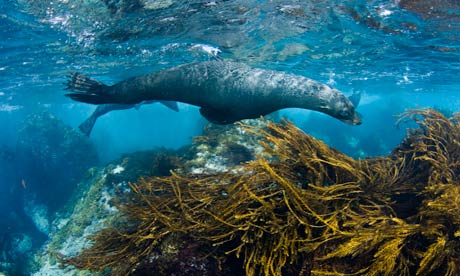
This seal was declared extinct in 1892. So what is it doing alive and well today?

http://apps.facebook.com/theguardian/environment/2010/sep/29/third-of-extinct-species-alive?fb_source=other_multiline&fb_action_types=news.reads
From The Guardian Online:

This seal was declared extinct in 1892. So what is it doing alive and well today?

Guadalupe fur seal: feared extinct in 1890s.   Photograph: Visuals Unlimited/Corbis
Guadalupe fur seal: feared extinct in 1890s. Photograph: Visuals Unlimited/Corbis

Wednesday 29 September 2010
Good news for Guadelupe fur seal, Bahian tree rat and bridled nailtail wallaby – but survey warns rate of extinctions still accelerating
• One in five plant species face extinction
• 'Lost' amphibian species rediscovered

The Guadalupe fur seal was feared extinct, gone the way of the dodo after being slaughtered by Russian and American hunters for their skins. None could be found at breeding grounds and as sightings elsewhere tailed off the species was consigned to history.
So why are there thousands of Guadalupe fur seals swimming off the coast of Mexico now? As naturalists gladly admit, reports of the species' demise at the end of the 19th century were premature. Small numbers of the animals clung on in island caves and were rediscovered only decades later. The population is now thriving, with the latest estimate putting their number at 15,000 or more.
But the case of the Guadalupe fur seal is far from unique – and more animals feared extinct could be waiting to be rediscovered. A survey of the world's mammals published today reveals that more than a third of species once feared extinct have since been spotted in the wild, in one case 180 years after the last confirmed sighting. Rare mammals that were considered dead but later rediscovered were typically missing for 52 years.
The Guadalupe seal was hunted to apparent extinction in 1892, but a tiny colony was spotted on the island by two fishermen in 1926. After a failed attempt to sell two of the animals to San Diego zoo, one of the fishermen went back to slaughter the colony out of spite. He later turned up in Panama to sell the skins, but was killed in a bar brawl. The seals were only rediscovered and protected when a zoologist tracked down the second fisherman, who revealed their location on his deathbed in 1950.
One rodent, the Bahian tree rat, which lives in forests on the Brazilian coast, went missing in 1824. Despite efforts by conservationists, the animal was not rediscovered until 2004. The bridled nailtail wallaby was once common in eastern Australia but seemed to die out in the 1930s. It was spotted in 1973 by a contractor who was preparing to clear an area of land. After he raised the alarm, the habitat was bought by the local parks service to save the animal. Another creature, a small marsupial called Gilbert's potoroo, was missing for 115 years before it was rediscovered in the south of Western Australia in 1994.
Diana Fisher, who led the survey at the University of Queensland, said the number of mammals going extinct was still accelerating despite large numbers of lost animals being found.
Conservation experts have already warned that the world is in the grip of the "sixth great extinction", as imported species and diseases, hunting and the destruction of natural habitats deal a fatal blow to plants and animals.
Writing in the journal Proceedings of the Royal Society B, Fisher lists 180 mammals reported as extinct, feared extinct, or missing since the year 1500. Of these, 67 were later found to be alive and well. Animals that were picked off by new predators were rarely rediscovered, while those threatened by a loss of habitat or hunting by humans were more likely to be holding on in small colonies, she found.
The survey highlights the uncertainties in lists of extinct species, but Fisher said it should help conservationists target their searches for missing species by focusing on those most likely to be alive.
More than 25 large-scale searches have failed to find thylacines, the carnivorous, dog-like marsupials that have not been seen in Australia for nearly 80 years.
Fisher said her analysis puts the chance of the species surviving at "virtually zero". Mammals that were hunted to extinction before the 20th century, such as Steller's sea cow, the Falkland Islands wolf, sea mink and the large Palau flying fox are also unlikely to be found now, Fisher said.
"Conservation resources are wasted searching for species that have no chance of rediscovery, while most missing species receive no attention," Fisher told the Guardian. "Rather than searching ever more for charismatic missing species, such as thylacines in Australia, it would be a better use of resources to look for species that are most likely to be alive, find out where they are, and protect their habitats," she added.
According to Fisher's survey, the most likely missing mammals to be found alive are the Montane monkey-faced bat in the Solomon Islands, Alcorn's pocket gopher, which was last seen in the high forests of Mexico, and the lesser stick-nest rat, a large, soft-furred desert animal from Australia.

Four other 'extinct' species


REDISCOVERY: The Diatomyidae or Laotian rock rat
 which was thought to have been extinct.

Bahian tree rat
A small rodent that lives in the coastal forests of Brazil. Was missing and presumed extinct for 180 years from 1824. A year-long search of the area in 2004 found only one of the animals living in the region. The species is critically endangered and is considered at threat from ongoing deforestation.
Bridled nailtail wallabyOnce common in eastern Australia, this nocturnal species was thought to have died out in 1930. The animal was rediscovered in Queensland after a contractor recognised it from a picture of extinct creatures published in a women's magazine. It gets its name from the horny, pointed tip on its tail. It was hunted for its fur, but more recent threats include foxes and habitat loss. It remains endangered.
Gilbert's potoroo
A small, silky-coated marsupial that was missing in Australia from 1879 to 1994, when conservationists found a tiny population of the animals in the Two People's Bay park area in the west of the country. The animal is likely to have survived because the reserve was already protected to save the habitat of a rare bird. The potoroo suffered from predation by cats and foxes that were introduced to the area. Those that remain are genetically very similar, leaving them vulnerable to diseases. It is one of Australia's rarest animals.
Leadbeater's possumA grey marsupial with black markings. Leadbeater's possum was known from only four specimens collected around 1900. It was considered extinct in 1920 when its habitat was destroyed, but was rediscovered in 1961 during a survey of a mountain forest in Victoria. The population stands at around 2,000 adults, a number that is expected to fall by 90% in 30 years as den trees and nesting habitat are lost.

Thursday, 27 October 2011

Water Pigs and Pig-Dragons


Han Dynasty Jade Pig-Dragon or Makara

While I was on the same photosearch that turned up the "Little Jade Yeti" earlier, I also turned up a common type of unidentified jade artefact from the same cultutre:
http://en.wikipedia.org/wiki/Pig_dragon

A pig dragon or zhulong (Chinese 猪龍) is a type of jade artifact from neolithic China. Zhulong are zoomorphic forms with a pig-like head and elongated limbless body coiled around to the head and described as "suggestively fetal". [1] Early pig dragons are thick and stubby; later examples have more graceful, snakelike bodies.
Pig dragons were produced by the Hongshan culture, and often featured as grave goods.[2] For example see [1]. Pig bones have been found interred alongside humans at Hongshan burial sites, suggesting that the animal had some ritual significance.
There is some speculation that the pig dragon is the first representation of the Chinese dragon. The character for "dragon" in the earliest Chinese writing has a similar coiled form, as do later jade dragon amulets from the Shang period.[3]

References

  1. ^ Childs-Johnson, Elizabeth (1991). "Jades of the Hongshan culture: the dragon and fertility cult worship". Arts asiatiques 46: 82–95. http://www.persee.fr/web/revues/home/prescript/article/arasi_0004-3958_1991_num_46_1_1303. Retrieved 14 July 2011. 
  2. ^ Howard, Angela Falco, et al. (2006). Chinese Sculpture, pp. 21-22. Yale University Press. ISBN 0300100655.
  3. ^ Salviati, Filippo (2002). The Language of Adornment: Chinese Ornaments of Jade, Crystal, Amber and Glass, Fig. 17. Ten Speed Press. ISBN 1580085873.
"Ouroboros has Origins With Hongshan"

  1. http://www.asiafinest.com/forum/lofiversion/index.php/t218030.html


Some Commentators have remarked that the most obvious forerunner for the Pig-Dragon is the foetal pig, something which would be a well-known object in a pig-slaughtering society, and probably with some superstitious import.
A Shang Dynasty Closed Pig-Dragon loop, with continuous backfin.


The more fully developed "C-Dragon" is more common later and I have previously compared the design to the Celtic Horse-eels. I am not really certain of that because there is a flip up at the base of the mane which could easily indicate where a Longneck's foreflipper would be. However, I prefer to deal with Longnecked-WaterMonster-Oriental Dragons separately (there is another blog following this one to deal with the subject)

However, other jade objects from the same culture and showing a similar creature in a different posture tell a different story. The stumpy-ended, big-headed Pig Dragons turn out to correspond to a legendary creature known throught the Orient as a Water Pig, and which is more than likely a kind of seal. Some of the water-monsters still being reported in Northern China are apparently seals, and there are comparable land-locked freshwater seals in bothnearby Siberia and Central Asia, and in Alaska as well.. This small jade for sale on ebay is not only seal-shaped but also seems to even have whiskers on its snout.
Seals and sea lions are infrequently seen off of Japan and China and described in the same tone as if they were legendary monsters (Yokai). This is from the Pink Tentacle site:
Bizarre creature at Kanezaki Inlet
Many Edo-period scrolls featured illustrations of unfamiliar creatures -- animals that actually existed but were rarely seen in Japan (such as fur seals and sea lions), along with creatures generally regarded as imaginary (mermaids and kappa). This illustration shows a 3-meter-long seal that was captured in the early 19th century at Kanezaki Inlet. [from ‘Kaikidan Ekotoba’ monster scroll posted on 07 Apr 2010]
http://pinktentacle.com/2010/04/kaikidan-ekotoba-monster-scroll/


Young Male Elephant Seal


at three meters (9-10 feet) long, this could be a very large medium-sized seal or a subadult elephant seal. I think Elephant seal is more likely because of the very long belly area: the foreflippers would not be correct in any seal and I presume they are drawn that long to emphasize that they are dangerous. The size and the shape of the head depicted makes me think it was a female (like the ones here and below)Elephant seals from California do occasionally wind up on the shores of Japan, on the opposite side of the Pacific ocean. there are also the rare reports of the 3-toed monster tracks on Japanese beaches but these are generally thought to have been hoaxes.

Elephant seal showing trackway: at extreme magnification, the foreflipper tracks can be seen to look as if they were 3-toed. This is just as general information since there are no really good allegations of 3-toed "Monster" tracks found off of Japan. When the sand is packed very hard, the body drag marks in the center tend to disappear.


More to the point, the first (later) Chinese jade Zhoulong from Wikipedia has also been compared to the Makara of Southern India and Indonesia, and there are also the occasional reports of seals as "Water Pigs" in the Indian Ocean far from the more arctic realms where they would be more usually expected.

Lake Tianchi Creature as possibly a Freshwater Seal:

Water Pig

At the Frontiers of Zoology Yahoo group we are aware of very rare sightings and captures of (Harbour) seals in Vietnam and Hong Kong(We also have photos of the same). Ivan Sanderson spoke of an as-yet-unclassified species on Monk Seal that inhabited the Indian Ocean, in particular the Maldive and Lacadive islands and the South of India. It seems these were also called Water Pigs or Water Boars.Literature on any of these things is very sparse and no sources other than Sanderson even seem aware there was supposed to be such a thing as a seal native to the Indian Ocean.
Chinese Makara

Makara Head From Java

However, comparing artwork from Southern India and Indonesia to photographs of the living animal, it is fairly easy to believe that the stories of Makaras were originally inspired by sightings of Antarctic elephant seals strayed far to the North of their usual territories.
Male Elephant Seal

Best Wishes, Dale D.

Tuesday, 5 July 2011

More WaterMoose And Other Water Monsters

Below, moosehead trophy at men's quarters of the school at Kinneeeburn, Scotland, where it is a tradition for students to attempt to steal the moosehead from one another. This is traditional at several Scottish Universities including at Edinburgh: in several instances (such as the one illustrated) nobody seems to remember where the moosehead came originally.


Copperplate engraving of a European elk (Moose) as an illustration in a Scottish child's schoolbook during the 1830s


                             The Moose as Water-Horse

"Cadborosaurus" animated gif (Blogger seems to have taken the animation out of it), showing mooselike head conformation, developing antlers, drooping ears and the "Beard" or bell at the throat-all of which are characteristics of a moose. Moose can also swim out to sea for miles and might still be the origins for some "Merhorse" reports off Scandinavia, off China, Off The Eastern Coast of North America and also the Northwest Coasts area.

[Stock photo of a moose for comparison]


"Two Heads" Ogopogo


[Cow and Calf Moose Swimming up close]


Lake Opeongo (Algonquin Park, Ottowa, near Muskrat Lake) "Monster" recognised as a swimming moose by photographer.


Muskrat Lake "Mussie" statue, based on reports of swimming moose (note the antlers) Compare to the statue "Ogopogo" below [in two views, looks like two different paint jobs.


Recent Blurry video of Champ the Monster of Lake Champlain: this has plausibly been interpreted as a swimming moose and the unusual round shape of the head due to the palmate moose antlers. The size of the body is exaggerated by thge ripples around it, which make the part emerged out of the water look much larger than it actually is. The first sighting that I had heard about as coming from Lake Champlain, in the 1930s, was an obvious swimming moose report with obvious moose antlers and large drooping ears.


Memphre (Memphremagog Lake Monster) and Champ of Lake Champlain seem to be Lake monsters more legitimately described as being like the Loch Ness Monster Sketches of body conformations as seen in the water can be a very good match.


"Champ" as Merhorse, with obvious long neck and two large humps including serrated ridge. the Icelandic "Skrimsl" as illustrated in Costello's In search of Lake Monsters could have been a very poor attempt to convey a similar sort of sighting.


[Two local depictions of Champ of Lake Champlain]

CFZ REPOST: Tuesday, January 26, 2010
DALE DRINNON: Champ sightings Mock-up

I was going through Lake Champlain sightings recently and I decided to do this little demonstration of what the common physical characteristics and size ascribed to Champ are actually supposed to be. This subtracts obvious sightings of fish and swimming moose, and the occasional stray seal.


I make no remarks about what this means at this point; this mock-up is merely to demonstrate what one series of witnesses are describing with a fair degree of consistency. Sightings like this have been recorded for the whole length of the 20th century.

1 comments:
Dale Drinnon said...
BTW, this is meant as a two-part demonstration: I wanted this part established before bringing in Paul Le Blonde's analysis of The Mansi photo of "Champ" again. Theses sightings were made for a long time before the photo was published.

It is incidentally a Sinclair Oil Company logo dinosaur: several of the reports specify the resemblance.

3:44 AM


"Two-humped" sighting photographed on Lake Champlain by Olsen in the 1980s. It is very similar in profile to a harbour (Common) seal swimming at the surface. Seals and sea lions are even reported around Lake Okanagan, where they presumably had been dumped by human agency.


Big-Fish Ogopogo, probably a sturgeon if the photo is legitimate.

Lake Manitoba's Manipogo, sighting with odd pattern indicated on sides: probably based on large sturgeon with widely-spaced (but regularly spaced) scutes along the sides. The pattern incidetnally is NOT like the usual smaller sturgeons but is instead like the giant Sturgeons of Siberia, Like the Lake Baikhal monster shown below is supposed to be.


Below is an amended Lake Monster map from one of the Cryptozoology Information sites. Within the dark blue line including Scandinavia, Russia, Siberia and Canada, the majority of sightings appear to be "Water Horse" reports based largely on sightings of swimming moose.