
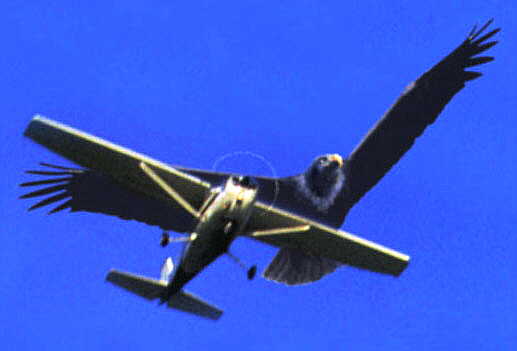
Giant Thunderbird Returns
Posted: Thu Mar 08, 2007 10:35I have read increasing accounts of sightings of the giant Thunderbird. There have been many recorded accounts. Several years ago, I was eating in a patio restaurant in New Braunfels, Texas. A huge thunderstorm was heading our way and so we stayed extra long after eating waiting for the fast moving thunderstorm to pass. In Texas a huge thunderstorm can appear out of a clear blue sky. I was looking up at the approaching thunderstorm from my seat in the patio. I was watching a Cessna single engine aircraft at about a two thousand feet above, rushing around the coming dangerous storm. Just then at about another thousand feet above the Cessna a huge bird flew out of the thunderhead. The bird was larger than the Cessna even though it was at least another thousand feet above the Cessna. I told my date to look up and see what was happening. She was totally shocked and she asked me, "that bird isn't above that plane is it?" I replied, "yes, that plane is lower and still the bird is bigger than the plane!" It was an incredible size, she asked me what it was and I told that it had to be the mythical thunderbird.
I heard stories as a child about thunderbirds and Indian parents always told their kids to come in when a thunderstorm was coming because a thunderbird could take them. I didn't believe it as a child. I was told that there used to be loads of thunderbirds and that they fed on baby buffalo. They started from the mountains in Mexico and flew Northwards during the thunderstorm season all the way to Canada and then back again in the fall storms.
I was told as a child that since the destruction of the Buffalo, the Thunderbird's main food source, they were nearly starved to extinction. But now they are making a comeback a hundred and fifty years after their near destruction.
Here is another story from Illinois.
THUNDERBIRDS OVER ILLINOIS
STRANGE THINGS ARE HAPPENING IN THE SKY!
They appear out of the sky like the shadow of doom. They have been described as having wingspans of up to 20 feet wide, hooked talons and razor-like beaks. They are the mystery birds of Illinois.
The ancient Indians of Illinois were no strangers to these birds. Two giant petroglyphs once decorated the stone bluffs near Alton, Illinois. The paintings portrayed a huge, winged creature known as the PIASA: The Monster Bird, which is translated to mean the "bird that devours men". The French explorer Pere Marquette recorded the first accounts of the paintings in 1673. He was impressed enough by them to record them in his journals and note that the account of the Piasa involved a terrible creature that preyed on the local Indians. An Indian warrior killed the creature and a painting of it was etched onto the bluffs to recall the legend.
[This is a misrepresentation and it is also quite irrelevant to the topic-DD]
American Indian lore is filled with stories of strange, monster birds with enormous wingspans and the propensity to carry away human victims. They called these creatures "Thunderbirds" because the Legend of the Giant Bird claimed that their flapping wings made a sound like rolling thunder. The birds have been described as having wingspans of 20 to 40 feet or more; hooked talons; razor-sharp beaks; and sometimes descriptions which seem oddly close to Quetzalcoatlus, one of the pterodactyls of prehistoric times.
But not all of these stories and accounts date back to the times of the early Americans. Most of them come from times that are not so long ago.... and are disturbingly close to home.
One modern day "flap" of Thunderbird sightings began in April 1948, according to Loren Coleman in his book, CURIOUS ENCOUNTERS. On April 4, a former Army Colonel named Walter F. Siegmund revealed that he had seen a gigantic bird in the sky above Alton. He had been talking with a local farmer and Colonel Ralph Jackson, the head of the Western Military Academy, at the time. "I thought there was something wrong with my eyesight," he said, "but it was definitely a bird and not a glider or a jet plane. It appeared to be flying northeast... from the movements of the object and its size, I figured it could only be a bird of tremendous size."
A few days later, a farmer named Robert Price from Caledonia would see the same, or a similar, bird. He called it a "monster bird... bigger than an airplane". On April 10, another sighting would take place and this time in Overland. A huge bird was spotted by Mr. and Mrs. Clyde Smith and Les Bacon. They said they thought the creature was an airplane until it started to flap its wings furiously.
On April 24, the bird was back in Alton. It was sighted by EM Coleman and his son, James. "It was an enormous, incredible thing with a body that looked like a naval torpedo," Coleman recalled later. "It was flying at about 500 feet and cast a shadow the same size as a Piper Cub at that height."
Then, on May 5, the bird was sighted for the last time in Alton. A man named Arthur Davidson called the police that evening to report the bird flying above the city. Later on that same night, Mrs. William Stallings of St. Louis informed the authorities that she had also seen it. "It was bright, about as big as a house," she said. A number of sightings then followed in the St. Louis are, but ironically, just when the public excitement over the bird reached its peak, the sightings came to an end.
Sightings of strange birds have not ended in Illinois and in fact continue today. One of the most exciting, and frightening, Illinois encounters occurred in 1977 in Lawndale, a small town in Logan County. On the evening of July 25, two giant birds appeared in the sky above Lawndale. The birds were reported several times as they circled and swooped in the sky. Finally, they headed straight down and reportedly attacked three boys who were playing in the backyard of Ruth and Jake Lowe. One of the birds grasped the shirt of ten-year-old Marlon Lowe, snagging its talons into the cloth. The boy tried in vain to fight the bird off then cried loudly for help.

The boy’s cries brought Marlon’s mother running outside. She later reported that she had seen the bird actually lift the boy from the ground and into the air. She screamed loudly and the bird released the child. It had carried him, at a height of about three feet, for a distance of about forty feet. She was sure that if she had not come outside, the bird had been capable of carrying the boy away. Luckily, although scratched and badly frightened, Marlon was not seriously injured.
Four other adults appeared on the scene within seconds of the attack. They described the birds as being black in color, with bands of white around their necks. They had long, curved beaks and a wingspan of at least 10 feet. The two birds were last seen flying toward some trees near Kickapoo Creek.
A second version of the Lawndale event is as follows:
July 25, 1977 Lawndale Illinois it was around 8:30 p.m. when Marlon Lowe a 10 year old boy was running for his life. He was playing with two friends in his family back yard when suddenly out of no where two huge black birds came out of the sky and began pursuing one of Marlons friends Travis Goodwin happily, Travis managed to escape by jumping into the swimming pool. Then the two switched there attention to Marlon. Marlon ran away as fast as he could but it was not fast enough. As he w as running he felt the talons of one of the birds grip the shoulder straps of his sleeveless shirt. Next the boy weighing 65 lb. was lifted of the ground 10 ft. Screaming and shouting at the top of his lungs as the bird easily carried him 40 ft. through the air from the back yard to the front yard. His parents Ruth and Jake Lowe heard the screaming and ran out side so did two family friends working near by Ruth was the first to see this horrific sight that would froze her blood. There her son was being abducted by a huge black bird resembling a Condor, punching up at its legs with all his might as his feathered kidnapper carried him aloft. Seconds later however, one of his punches must have hit home, because the bird suddenly opened his talons and dropped him to the ground before souring away with its mate. The four adults ran to the boy and discovered to there relief that except for a frayed shirt where the bird had grabbed him Marlon was physically ok. This is just one of the many bizarre accounts on file featuring encounters in North America with giant birds. Birds that should be impossible but yet seem to exist. In the case of Marlon Lowe he and his parents said the bird most closely resembled a Andean Condor, a black vulture like species with a wing span up to 10 ft. this species however is not native to North America. There is however a smaller version called the California condor which was once widely distributed across North America but by 1977 was virtually extinct in either case the structure of the condors feet in incapable of lifting and transporting anything as heavy as a ten year old boy.
Three days later, a McLean County farmer spotted a bird of the same size and description flying over his farm. He, his wife, and several friends were watching radio-controlled airplanes when the bird flew close to the models. He claimed the bird had a wingspan of again, at least 10 feet across. It dwarfed the small planes that buzzed close to it.
The next sighting took place near Bloomington when a mail truck driver named James Majors spotted the two birds. He was driving from Armington to Delevan when she saw them alongside of the highway. One of the birds dropped down into a field and snatched up a small animal. He believed the two birds were probably condors, but with 8 to 10 foot wingspans!
On July 28, Lisa Montgomery of Tremont was washing her car when she looked up and saw a giant bird crossing the sky overhead.
At 2:00 AM on Saturday, July 30, Dennis Turner and several friends from Downs reported a monstrous bird perched on a telephone pole. Turner claimed that the bird dropped something near the base of the pole. When police officers investigated the sighting, they found a huge rat near the spot.
Reports of giant birds continued to come in from Bloomington and the north central Illinois area, then finally further south, from Decatur to Macon and Sullivan. On July 30, the same day the birds were reported near Bloomington, a writer and construction worker named "Texas John Huffer" filmed two large birds while fishing at Lake Shelbyville. Huffer was a resident of Tuscola and was spending the day with his son when they both spotted the birds roosting in a tree. Huffer frightened the birds with his boat horn and when they took flight, he managed to shoot over 100 feet of film. He sold a portion of the footage to a television station in Champaign for a newscast. Huffer said that the largest bird had a wingspan of over 12 feet.
After the footage aired, experts were quick to dismiss Huffer’s claims, along with the reports of everyone else who reported the birds. Officials from the Department of Conservation insisted the birds were "merely" Turkey Vultures of the species cathartes aura. Not surprisingly, these claims were also refuted by wildlife experts and cryptozoologists who stated that no turkey vultures were of the size reported by witnesses. The largest flying bird in North America is the California Condor, which has a wingspread of up to 9 feet. The Condor is also on the endangered species list and is restricted to a few areas in California. There is little chance that a few stray birds traveled to Illinois to attack small children!
Another tale, related by Loren Coleman, involved the killing of a giant bird in December 1977. Strangely, this event also took place near Lawndale. Apparently a woman was on her way to work one morning when she saw something that looked like "a man standing in the road with something over its arms". The woman collapsed and was hospitalized, but later recovered. A group of men, after hearing this report, went to the spot, killed a large bird and then burned the body. The story was kept under wraps for some time for fear of ridicule.
So, what are these creatures? Some cryptozoological researchers like Loren Coleman believe that these thunderbirds may be Teratorns, a supposedly extinct bird that once roamed North and South America. If these prehistoric survivors are still around today, they could certainly account for the reports of the giant birds.
At this point, such creatures remain a mystery but one thing is sure, the sightings have continued over the years and occasionally an unusual report still trickles in from Central Illinois. So keep that in mind the next time that you are standing in an open field and a large, dark shadow suddenly fills the sky overhead. Was that just a cloud passing in front of the sun... or something else??
GIANT BIRD UPDATE: As late as Wednesday October 16, 2002, in an article published in the Anchorage Daily News, and also picked up by the wire services, reported "a giant winged creature like something out of Jurassic Park" sighted several times in Southwest Alaska. (source)
http://sped2work.tripod.com/thunderbirds.html
'
 |
| Skeleton of a Teratornis. In the biggest Teratorns, the body was as large as that of a human being and the wingspan in life was over 20 feet |
http://paranormal.about.com/library/wee ... 00801a.htm
The Giant Thunderbird Returns
Today these enormous birds have been seen soaring through the skies of Pennsylvania, and in the past they've even been blamed for snatching children from the ground
A gigantic bird has been sighted in Pennsylvania. On the evening of Tuesday, September 25, 2001, a 19-year-old claimed to have seen an enormous winged creature flying over Route 119 in South Greensburg, Pennsylvania. The witness's attention was drawn to the sky by a sound that resembled "flags flapping in a thunderstorm." Looking up, the witness saw what appeared to be a bird that had a wingspan of an estimated 10 to 15 feet and a head about three feet long.
This is the most recent sighting of an incredible creature - most often considered a myth - known as a "Thunderbird." Sightings of these gigantic birds, apparently unknown to science, go back hundreds of years and are a part of many Native American legends and traditions. They have even been blamed for abducting, or attempting to abduct, small children. And now they seem to be soaring through the skies of Pennsylvania.
On September 25, the witness told researcher Dennis Smeltzer, that the huge black or grayish-brown bird passed overhead at about 50 to 60 feet. "I wouldn't say it was flapping its wings gracefully," the witness told Smeltzer, "but almost horrifically flapping its wings very slowly, then gliding above the passing big rig trucks."
The witness observed the creature for about 90 seconds in total, even seeing it land on the branches of a dead tree, which nearly broke under its great weight. Unfortunately, no other witnesses saw the bird on this date and no tangible evidence could be found for the bird after the site was searched.
What makes this story more interesting, however - even plausible - is that other sightings of similar description were reported in Pennsylvania in June and July, 2001.
On June 13, a resident of Greenville, Pa
. was startled by the great size of the grayish-black creature seen soaring overhead, at first thinking it was a small airplane or ultralight aircraft! This witness observed the bird for at least 20 minutes, clearly seeing its fully feathered body and confidently estimating its wingspan to be about 15 feet and its body length at about 5 feet. This bird, too, was seen to perch on a tree for at least 15 minutes before taking to air again and flying off toward the south. A neighbor of this witness claimed to have seen the creature the next day, describing it as "the biggest bird I ever saw."
Less than a month later, on July 6, a witness in Erie County, Pa. reported a very similar sighting, according to an item in Fortean Times magazine. Again, the creature's wingspan was estimated to be 15 to 17 feet and was described as "dark gray with little or no neck, and a circle of black under its head. Its beak was very thin and long - about a foot in length."
These were not the first sightings of Thunderbirds in Pennsylvania, as you'll read later in this article. And if these reports are accurate, these birds are the largest flying creatures not yet identified by science. By comparison, the largest known bird is the wandering albatross with a wingspan of up to 12 feet. The largest predatory birds - which the Thunderbird is most often likened to - are the Andean condor (10.5-foot wingspan) and the California condor (10-foot wingspan).
Centuries-Old Legend
The legend of the Thunderbird reaches back hundreds of years as part of the mythology of several Native American tribes of the Pacific Northwest and the Great Lakes region. And the legend might have remained strictly a part of those cultures had not the great winged creature been seen countless times by the "white man" over the centuries.
According to the Native American myths, the giant Thunderbird could shoot lightning from its eyes and its wings were so enormous that they created peals of thunder when they flapped. (For an excellent article on the Thunderbird of Native American myth, see "The Fabulous Thunderbird.")
Blackbeard Posted: Thu Mar 08, 2007 18:39
Man, this is something I've read about for many yeras, Nagualqo because it interests me very much.
Several years ago there was a documentary about a native american who was travelling in a canoo. He came upon a couple of large trees and saw something really weird: on the branches of those trees two giant birds were perched. He stopped rowing, took his camera, and filmed these birds for a minute or so. At some moment they took off and you could see by the way they flapped their wings they were very large birds.
Maybe I can find that film on YouTube.
EDIT: I didn't find that film yet, but the next quote is what I was talking about:
Quote:
The evidence thus far for the existence of a large undescribed predatory bird in North America is based on historical and modern anecdotal evidence with no physical evidence. There are however two tantalizing images of the Thunderbird, or at least of a large bird. The first was taken in the same year as Marlon Lowe's attack and in the same state. On July 30, 1977 John Huffer, an ex-marine and photographer, took a 100 foot roll of color film of two birds taking off from a tree in an inlet of Lake Shelbyville. The film concentrates on one of the birds only. Highly controversial, and thought by many to be of a turkey vulture, it sits as a little known film of a possible mystery animal. To date little, if any, evaluation of the birds in the film has been done. The Discovery Channel in their program "Into the Unknown" did give the film some mention, with a dismissal of a medium sized bird, probably a vulture.
http://www.cryptozoology.com/cryptids/thunderbird.php
The comments say it may have been only a turkey vulture, but when you see the film for yourself, you'll certainly get the impression of a bird very much larger than a turkey vulture.

Quote:
More sightings of Big Birds continue to be reported in Illinois, plus Texas John Huffer now claims to have taped the creatures near Shelbyville and the film was shown on the local central Illinois news broadcasts.
http://www.cryptozoology.com/articles/marlon.php
and here:
http://s8int.com/eyewit23.html
http://sped2work.tripod.com/evidence.html
Nahualqo Post subject: Here are more stories of live sightings of Thunderbirds
|
Reflections on Cryptozoology
Return Of The Thunderbird: Avian Mystery of the Black Forest
by Gerald Musinsky
Copyright © 1997 Gerald Musinsky
Gerald Musinsky
P. 0. Box 514
North Bend, PA 17760
(717) 923-0134/326-3761
(4,100 words)
"There are no more conspicuous creatures than birds...
Certainly it is very rarely that a large and quite unknown
bird is discovered." -- Bernard Heuvelmans
Return Of The Thunderbird:
Avian Mystery of the Black Forest
by Gerald Musinsky
Once known as the Forbidden Land, the Pennsylvania Black Forest region encompasses Clinton, Potter, Lycoming, Tioga, Cameron, and McKean counties. Predominantly sparsely populated state forest and game lands, it has been haunted for centuries by giant aves known as "thunderbirds." The earliest known account is that of Mrs. Elvira Ellis Coats, who claimed to have seen Thunderbirds in the 1840's (Lyman, Sr., Robert R. Amazing Indeed, Strange Events in the Black Forest vol 2. 94). But even now, people continue to claim having seen this mythical bird.
Before dusk in July, 1993, Shane Fisher, his mother and father, saw a very large bird flying above the trees on their property near Larry's Creek. "Looked just like a Piper Cub. You could hear the air rush through the wings," Shane Fisher said. He described the bird as eagle-like with large black eyes, larger beak than an eagle, no light markings, and wings "wider than a cross bar on a telephone pole." His father thought it "had to be some kind of eagle" so he searched through a reference guide for birds of prey, but to no avail. No hawk or eagle fit the description. Fisher's mother said it was "large enough to carry one of us away."
Early one April evening, Tammy Golder and her two year old son returned home on Beaver Lake Road. As she travelled a steep grade known as Frantz Hill a few miles east of Hughesville, her headlights revealed a very large bird.
"It jumped and circled over the hood, then hit the truck above the windshield on the passenger side and flew off! It wasn't a turkey or a vulture," she said. The bird left a dent the size of an apple in the cab roof. She was traveling about 40 mph when it hit the truck. She couldn't believe it survived and flew away.
In late September, 1992 as Kim Foley drove home late in the afternoon her two year old son, Jayson shouted, "Mommy, look at the puppy!" What she saw was not a dog, but a large bird hunched over a deer carcass. "I expected to see a dog," she explained. "But it was a very big bird eating a dead deer. It was huge!" she said, "and dark brown, almost black, an ugly beak. Looked right at us in the car, it was that tall."
At the time of the sighting she was near Mt. Zion Church cemetery, south of a marsh near State Game Lands No. 252 and North White Deer Ridge in Lycoming County. Her sighting occurred where a bird of such dimensions would attract the least attention. No houses. The former dental technician, admits she's not a bird expert but knew it was not an eagle after looking through a field guide. "More powerful, bigger chest and shoulders, and a big, ugly beak,... Something like this," she said pointing to Steller's sea eagle (Haliaeetus Pelagicus), "but not that one. It was much bigger."
Two weeks later near Hyner, in Clinton County, Dave Sims and children, Zach and Casey, saw a large bird. "It flew ahead of the truck and disappeared in the trees," he said. "I know the hawks around here, but I never saw this one before," Sims continued. "I've heard `thunderbird' stories but chalked that up to regional folklore. I don't know if this was or not, but it was a big, dark gray bird, and flew faster than 55 mph."
In June, Todd Hackenberg and Erin Goundie went crawfish hunting in Young Woman's Creek near North Bend. About 4:30 that afternoon while driving parallel to the creek, Goundie pointed to a large bird standing in the shallow water.
"Down from the spillway stood an awfully big, whitish bird," she said, "About five feet tall, had a long beak, thick legs as long as the stocky body. The neck was long. Not skinny, not thick. Didn't look like a bird that belonged around here, it was so big and strange."
To get a better look, Hackenberg drove in reverse but lost sight of the bird in the trees.
"The wings were as wide as the creek. Two and half times longer than the body... held straight like an airplane when it flew off," Hackenberg said.
The shoreline is thickly wooded except at the clearing where the sighting occurred less than thirty feet from the observers. Hackenberg is familiar with hawks, vultures, and eagles, but Goundie is not. Both agree the bird was very large and very strange looking.
Later that summer Allison Stearn was hiking near Shingletown when she saw a bird she described, "like a small plane, dark brown or black, and maybe some yellow. I guess it could've been a Golden Eagle. Do they get that big? I mean, it was like an airplane."
On Thanksgiving Day 1989, Shannon Breiner saw what she thought was a deer on her grandmother's farm near Barbours. When she approached, the creature stood up on two legs and ran towards the swamp. Before it was out of sight, she saw it had no arms! The creature was "a large eagle-like bird." Where she first spotted the bird she saw a mound of grass flattened in the center like a large ground nest. Breiner, a librarian at Pennsylvania State University is an avid raptor enthusiast. "Not a stork or heron, it had a shorter and thicker neck, and broad chest and shoulders. Not a frail bird," she
said. The area around Barbours (not far from Hughesville) has coniferous and deciduous forest, high elevations, swamp and farmland, and is sparsely populated. Ideal for a giant bird of prey.
While solo backpacking the Doughnut Hole Trail in Sproul State Forest in August 1977, Terry McCormick, a science teacher, saw what he thought "was an airplane in trouble because of how low and silent it flew, as if the engine had cut out." As he watched the plane fly near he realized "it was a bird and when it flapped its wings once and flew out of sight."
McCormick described it as dark brownish gray with a large beak and a straight leading wing edge. Certainly larger than any known eagle. "At least not one I've ever seen before," McCormick said before balking about its size.
"How big is a Piper Cub? Because that's how big it looked," he said.
Driving through the Algerines, Russ Powers, Jr. and Denny Eckley stopped for deer crossing the road at Bear Run. As they watched, they saw a bird with wings that "spanned the forest road." The deer bolted into the surrounding woods, except the yearling that stood on the road. Out of nowhere the bird attacked, ripping the yearling's vital areas, and turned to look at them. It flew off struggling with its kill before disappearing above the trees.
Powers described the bird as having: "a longer and less hooked beak than an eagle, dark grayish brown plumage, thick legs, talons larger than a man's hand, and grayish legs." The head was flat with "feathers, like on a chick." The bird stood "eye level with us" and had wings as wide as the forest road, approximately 14-16 feet.
Later Powers and Eckley went to a library and found a photograph in what Powers thought might be The Guiness Book of World Records. The photo depicted a giant bird nailed to a barn wall with the caption "Thunderbird" greatly resembled what they saw. Often people believe they have seen a particular photograph of a giant bird but cannot recall the source (Hall, Mark,
Thunderbirds, 65-66) This mysterious photograph resurfaces from time to time in "thunderbird" lore and is an autonomous enigma.
In August, 1945, the school bus left Helen Erway off by Ole Bull 2 miles from home because the dirt road had been oiled. After walking near a stretch of pines along the road she saw a large shadow on
the ground. Overhead was a very large bird. She feared being carried off, so she ran until a neighbor stopped and drove her home. "It was not an eagle. The wings were straight out. It made a high pitch noise. The shadow on the road was about 30 feet," she said recalling the incident.
Erway suffered severe nightmares and could not sleep or eat. Finally her parents took her to her grandmother, Marion Erway, an Indian "medicine woman", who told her she saw a Thunder Bird. That it was there to protect her because she was part Indian. Her grandmother said it was a magic moment and that Helen shouldn't be frightened. Helen Erway also told of a "thunderbird" hovering over Delbert Schoonover, when he was bitten by a rattlesnake by the dam, until help arrived. Other loggers who came to assist him also saw the bird.
Contemporary "thunderbirds" are not limited to the scenic areas of the Keystone State. Significant sightings have occurred in Illinois, West Virginia, and other states across America. Not surprising since the Thunder Bird myth was as wide spread among the Native Americans. The Thunder Bird is a nature spirit shared by most if not all Algonquian tribes (McClintock, Walter. "The Thunderbird Myth I" 170 and 16; also Alanson Skinner, "The Algonkin and The Thunderbird" 71-72).
According to Winnabego tradition, "Thunder is a spirit, and it is an emblem of war, it is winged, mighty and awful and it is called the Thunder Bird." (Curtis, Natalie, THE INDIANS BOOK: Song & Legends of the American Indian 252). The Chippewa supreme bird had "eyes of fire, his glance was lightning, and the motions of his wings filled the air with thunder." (Emerson, Ellen Russell. Indian Myths 34). Concerning the origins of thunderstorms, "The Mandan supposed that it was because the thunderbird broke through the clouds (Hodge, Frederick Webb Handbook of American Indians (North of Mexico) 747)."
This colloquial nomenclature to identify a raptor larger than an eagle is presumably inappropriate since the Thunder Bird in the majority of Native American myths is benevolent toward humans. "Thunder Bird... was a friend of man... a willing protector; ...also a teacher and, at times, a creator" (Wherry, Joseph E. Indian Myths of the West 59-60). "It was the Thunderbird who taught the Kwakiutl how to build houses." (Wherry 60-65). An Assiniboin account claims, "...but the old Thunder, or big bird is wise and excellent, he never kills or injures anyone" (Judson, Katherine B. Myths and Legend of the Great Plains 48).
But a Comanche story differs, "...a hunter once shot a large bird...it was so large he was afraid to go near it alone..." (Judson, 47). The hunter believed he shot a Thunder Bird. When he returned with the Medicine Man and others from the village, the bird was gone, and the hunter was struck by lightning during the resulting storm. This tale implies another large bird, not a mythical deity, but an earthly creature, existed concurrently with early Native Americans.
Thunder Bird lore can be classified as a benevolent nature deity or a malicious predator; not a spirit but mortal and co-extant with the aboriginal inhabitants of pre-colonial North America. The non-spirit myth might lead to the conceivable origins of giant birds reported in more recent times.
Powerful enough to carry away full grown deer, the piasa was a bird of prey and in spite of its size, could quickly surprise a hunter and carry him off to devour him in its cave. Entire villages were decimated. A painted rock once existed near present day Alton, Illinois honoring Chief Ouatago and his band of twenty braves who slew the beast and delivered the Illini from its grizzly depredations (Russell, John. "The Piasa, An Indian Tradition of the Illinois", The Piasa 11-19). The Hu-huk (Hoh-hoq) was a mythical bird of prey among the Pawnee was said to devour hunters (Curtis 258). Described as cannibalistic it is similar in behavior to the piasa; having tasted human flesh preferred it to deer.
"According to Indian legends the thunderbird flew down, seized a victim by the shoulders, and carried the prey to a barren mountain top where it was devoured. First the belly was ripped open, while the victim was still alive, and then the insides were eaten. Lastly, it picked a hole in the skull and ate the
brain. The Indians said it was capable of carrying away deer or a man" (Lyman, Sr. Amazing Indeed 93). Lyman's "thunderbird" is unlikely the same Thunder Bird mentioned in the vast amount of Native American myths.
Other accounts of giant birds preying on humans in post-colonial times exist. Stories such as Marie Delex and Jemmie Kenny (Pouchet, F. The Universe 255), Landy Junkins ("A Modern Roc" St. Louis Globe Democrat, February 1895 7) and Marlon Lowe (The Daily Pantograph July 1977 A-3) which irritate ornithologists fearing unwarranted attacks on more familiar and endangered species. But also, these tales appear to substantiate Indian accounts of immense avian carnivores lingering from a neolithic past which might still exist in the most remote parts of North America, like the Black Forest region of Pennsylvania.
Regional historian and folklorist, Robert Lyman, Sr. recorded "thunderbird flocks" were seen near Dent's Run in 1892, (94). In April 1922, Hiram Crammer saw his first Thunderbird with a 35 foot wing spread at Hammersley Fork. In 1957 "thunderbirds" appeared regularly over Renovo, Westport, Shintown, and Hammersley Fork (Cranmer's letter-to-the-editor, FATE, August 1957, also Lyman 94). Near Bush Dam in 1964, road workers watched a "thunderbird" carry off a fawn (Lyman 95). A couple saw a giant bird fly at the car. "She said the claw was at least 4 times as big as her hand, and its legs as large as her arm..." "Thunderbirds" soared over Jersey Shore in 1970, with estimated 18 foot wings. A family saw a "gigantic winged creature... almost like an airplane" (96). In 1971, two women saw a "'thunderbird' devouring a dead opossum, "...its wings covered the tops of four trees which was 18 feet" (97).
In 1892, a farmer in Centerville caught a bird eating a dead cow at the edge of his field. Former Potter County school superintendent, A. P. Akeley, saw the bird and said "its color was grey. It stood upright. He is not sure how tall it was, but certainly over 4 feet and perhaps as much as 6 feet" (Lyman 97). Near Coudersport in 1940, Lyman Sr. sighted a huge bird "between 3 and 4 feet tall... like a very large vulture.... its wing spread was equal to the width of the road..." (97).
The number of giant birds sighted in Pennsylvania were numerous enough for Mark A. Hall to devote a chapter on "Pennsylvania Thunderbirds," in his book Natural Mysteries (67-82, also see Thunderbirds). He lists additional sightings at Jersey Shore, Oregon Hill, Sundlinerville, Cross Forks, by Lyman and others, and the last near Snow Shoe by Herb Nesman (Hall 77-78). Nesman also later revealed that he and several others had seen small flocks near Hammersley Fork in the 1940's and recalled Cranmer's theories about "thunderbirds" and the Eastern Condor (another regional avian myth).
After the Agnes [Hurricane] Flood of 1973, a Renovo librarian watched what appeared to be two airplanes dipping and diving in tight circles above Hyner. She realized "they were not airplanes, but birds the size of planes high in the air. No plane could fly like that," she said. A woman in Hyner, while hanging the wash with her infant in a basket beside her, saw a bird bigger than an eagle overhead. She dropped the wash, grabbed the child, and rushed into the house. The bird flew within thirty feet of her home. She had never mentioned it before. Another reason for the dearth of contemporary reports: observer reluctance to speak.
Mike Floryshak, Sr. was near Huntsville in summer of 1973 when he saw an airplane flying across a field before he realized it was a bird "...gliding about six to ten feet above the ground beside the car. I didn't think it possible," he said, "the wings appeared to be twenty feet wide." It was "dirty brown," with a large beak and very level, stiff wings. The bird didn't flap but turned on edge and disappeared into woods bordering the farm.
Late one afternoon, Charlie Passell and others sighted a "thunderbird" west of Renovo in late May, 1964. The bird was spotted perched in a dead Hemlock tree at a strip mine near Bush dam. "Where the wing meets the body was thick, longer neck than a hawk's but not as long as a stork or crane, bigger beak than an eagle," he said. Passell heard of "thunderbirds" and figured "that's what we must've seen because it wasn't like any bird we were familiar with. Definitely no eagle. Larger than a buzzard, real large."
From his camp at Kettle Creek, Robert Lyman, Jr., son of the regional historian and folklorist, sighted "thunderbirds" over Rattle Snake Mountain in 1973. Too far to notice any distinctive markings, he used his forestry skills to estimate the size of the bird. "Over the very tall mountain in front of the camp, I saw two huge birds, slow wing thrusts, I used my finger nail to triangulate the size. By knowing distance and height of the mountain I calculated the wing span between 14-15 feet."
Lyman's father recorded "thunderbird" reports from Hiram Cranmer, a central figure in "thunderbird" lore. Both men professed theories about the "thunderbird" and the "Eastern condor" (Gymnogyps pennsylvanianus). Lyman, Jr. regards the "thunderbird" and the "Eastern Condor" as being distinctly separate species aptly describing the Eastern condor as identical to the California condor (G. californianus) except for minor variation in plumage (G. pennsylvanianus is lighter, the head darker). [Gymnogyps fossil remains were found in Genesee County, NY, north of the Black Forest]. Regarding the "Thunderbird" photograph Lyman, Jr. commented, "I've seen that photograph Hi Cranmer claimed to have." Crystal, Lyman Jr.'s daughter, recalled the photograph, possibly in Ripley's Believe It or Not.
Because of the frequent sightings, Lyman, Sr. speculated the "thunderbird" home is in the Black Forest, "north of the Susquehanna River, between Pine Creek in the east and Kettle Creek in the west (97)." But sightings have occurred in Clearfield, Cameron and Centre counties, beyond Lyman's designated boundaries.
In Spring of 1977 two Curwensville school teachers, Debbie Wright and Sue Howell, while driving to Du Bois about 7:30 am were unsettled by a very large bird "wider than the car." It flew
straight at them before it veered away. The sighting occurred on Route 219 near Drocker's Woods about nine miles south of Du Bois, bordered by State Game Lands No. 87 and Moshannon State Forest. Sue Howell said, "It was big, black or very dark brown with a huge beak." Debbie Wright said, "It was horrible, big, black and ugly. I'll never forget that. It was frightening!"
A large, charcoal grey bird perched on a rock in the Susquehanna parallel Route 879 at Curwensville was seen twice by a Clearfield store clerk. She first saw the bird about 9:00 am in the early Autumn 1991 and in October 1992, near the same spot at 7:30 am while on the way to work. The bird stood on one leg, head twisted around and the beak nuzzled over the shoulder. She said the legs were "thick like an ostrich and it appeared to be sleeping." It wasn't a Great Blue Heron. Truck drivers on Boot Jack Hill, north of the Howell/Wright sighting, were "harassed by large dark birds resembling "big buzzards" over the last few years.
This extended range of recent sightings could indicate populations spreading into "thunderbird" territory, while strip-mining and developments force the bird into more populated areas. Eagles are not known as domiciles and rarely frequent the area. The observers are certain the birds sighted are strikingly larger than eagles.
How can an immense unknown avian species elude detection? If the "thunderbird" exists then why haven't people reported it?
People have. But the reports are denied and trained observers fail to investigate. Most reports come from people who live in the areas and have a greater chance of sighting the bird than infrequent visitors. To dismiss the reports as "too incredible" lacks scientific rigor. The opinion that all witnesses are incapable of identifying eagles, hawks, or vultures is a false assumption. The most outstanding and condemning feature is the bird's tremendous size. Even skilled observers have difficulty accurately assessing the size of a bird in the air. An eagle in flight is an awe inspiring sight. Witnesses agree their
reports are fantastic and hard to believe yet attest that the extraordinary bird they saw cannot be a known species.
Another argument against the "thunderbird" as a "bona fide" species is that no bird with so wide a wingspan could dwell in the thick forests where it has been sighted. Yet, the world's two largest eagles, the Harpy (Harpyia harpyia) and the Monkey Eater (Pithecophaga jefferyi) live near rivers in dense tropical forests. Both prey on primates and have ten foot wingspans. Like most tropical birds their plumage is colorful and they possess other features which rule out a several thousand mile periodic visit to scenic Pennsylvania. But is it unreasonable to consider a similar North American species?
Not unless one wonders how it was able to remain undiscovered for so long a time and still secreted from eyes of contemporary naturalists.
Early pioneers considered the "thunderbird" to be an eagle other than the Bald and Golden eagles already known, like Audubon's Great Washington Eagle. The Monkey Eater of the Philippines was only discovered by John Whitehead in 1896 (Heuvelmans, Bernard. On the Track of Unknown Animals, 20) while a year earlier a distant kin might have been nesting in Webster Springs ("A Modern Roc" St Louis Globe Democrat).
John Audobon, famed naturalist and artist, twice had sighted what he refered to as the Great Washington eagle (present day ornithologists claim is the juvenille of the Bald eagle) once near Alton, and the other time en route through northern Pennsylvania. Also regional lore claims Mark Twain while writing on rock (in present day Ravensburg State Park) and Edgar Allen Poe (now Poe Valley) sighted immense black birds in Pennsylvania.
Collectively the sightings possess more common than contrary characteristics. To dismiss the reports as embellished tales, hoaxes and fabrications prejudges the issue. Native American accounts regarding mythic birds of prey coincide with contemporary living folklore. To suggest an identity for the illusive Thunderbird is difficult since no verified physical evidence has been collected; such as nests, feathers, droppings, or even the "mythic" photographs.
Speculative analysis of the empirical evidence says more about what the "thunderbird" is not, than what it might be. But what it is not might lead to what it is. Yet one fact remains, an avian of immense dimensions has been sighted again in the remote areas of Pennsylvania's Black Forest.
End Part I
Works Cited
Addison. "A Modern Roc." St. Louis Globe Democrat 24 February 1895
Cranmer, Hiram. Letter-to-the-editor. FATE August 1957
Curtis, Natalie, THE INDIANS BOOK: Song & Legends of the American Indian. New York: Dover, 1966
Emerson, Ellen Russell. Indian Myths. Minneapolis: Ross and Haines, 1965
Hall, Mark A. Thunderbirds. 2nd Ed. Bloomington: Mark A. Hall Publications, 1994
----, "Pennsylvania Thunderbirds," Natural Mysteries. Bloomington: Mark A. Hall Publications, 1991
Hodge, Frederick Webb Handbook of American Indians (North of Mexico). New York: Pageant Books, 1959
Heuvelmans, Bernard. On the Track of Unknown Animals. Cambridge: MIT Press, 1971
Hultkrantz, Ake. The Religions of the North American Indian. Trans. Monica Settwerwall.
Berkely: University of California Press, 1979
Judson, Katherine B. Myths and Legend of the Great Plains. Chicago: A. C. McClure 1913
"King Vultures or California Condors." The Daily Pantograph (Bloomington/Normal, IL) 27 July 1977 A-11
Lyman, Sr., Robert R. Amazing Indeed, Strange Events in the Black Forest. vol. 2.
Coudersport, PA: Potter Enterprise, 1971
McClintock, Walter. "The Thunderbird Myth I." vol. 15 nos. 5 and 6. 1941
Pouchet, F. The Universe, New York: Scribners, 1881 255
Russell, John. "The Piasa, An Indian Tradition of the Illinois." The Piasa. Alton Arts Council 1970
Skinner, Alanson, "The Algonkin and the Thunderbird." American Museum Journal vol. 14 no. 2 February 1914
Wherry, Joseph E. Indian Mass Myths of the West. New York: Funk and Wagnalls, 1969
Return Of The Thunderbird: Avian Mystery of the Black Forest | Reflections on Cryptozoology | Table of Contents | Home
http://www.cryptozoology.net/english/re ... eturn.html
Return Of The Thunderbird: Avian Mystery of the Black Forest
by Gerald Musinsky
Copyright © 1997 Gerald Musinsky
Gerald Musinsky
P. 0. Box 514
North Bend, PA 17760
(717) 923-0134/326-3761
(4,100 words)
"There are no more conspicuous creatures than birds...
Certainly it is very rarely that a large and quite unknown
bird is discovered." -- Bernard Heuvelmans
Return Of The Thunderbird:
Avian Mystery of the Black Forest
by Gerald Musinsky
Once known as the Forbidden Land, the Pennsylvania Black Forest region encompasses Clinton, Potter, Lycoming, Tioga, Cameron, and McKean counties. Predominantly sparsely populated state forest and game lands, it has been haunted for centuries by giant aves known as "thunderbirds." The earliest known account is that of Mrs. Elvira Ellis Coats, who claimed to have seen Thunderbirds in the 1840's (Lyman, Sr., Robert R. Amazing Indeed, Strange Events in the Black Forest vol 2. 94). But even now, people continue to claim having seen this mythical bird.
Before dusk in July, 1993, Shane Fisher, his mother and father, saw a very large bird flying above the trees on their property near Larry's Creek. "Looked just like a Piper Cub. You could hear the air rush through the wings," Shane Fisher said. He described the bird as eagle-like with large black eyes, larger beak than an eagle, no light markings, and wings "wider than a cross bar on a telephone pole." His father thought it "had to be some kind of eagle" so he searched through a reference guide for birds of prey, but to no avail. No hawk or eagle fit the description. Fisher's mother said it was "large enough to carry one of us away."
Early one April evening, Tammy Golder and her two year old son returned home on Beaver Lake Road. As she travelled a steep grade known as Frantz Hill a few miles east of Hughesville, her headlights revealed a very large bird.
"It jumped and circled over the hood, then hit the truck above the windshield on the passenger side and flew off! It wasn't a turkey or a vulture," she said. The bird left a dent the size of an apple in the cab roof. She was traveling about 40 mph when it hit the truck. She couldn't believe it survived and flew away.
In late September, 1992 as Kim Foley drove home late in the afternoon her two year old son, Jayson shouted, "Mommy, look at the puppy!" What she saw was not a dog, but a large bird hunched over a deer carcass. "I expected to see a dog," she explained. "But it was a very big bird eating a dead deer. It was huge!" she said, "and dark brown, almost black, an ugly beak. Looked right at us in the car, it was that tall."
At the time of the sighting she was near Mt. Zion Church cemetery, south of a marsh near State Game Lands No. 252 and North White Deer Ridge in Lycoming County. Her sighting occurred where a bird of such dimensions would attract the least attention. No houses. The former dental technician, admits she's not a bird expert but knew it was not an eagle after looking through a field guide. "More powerful, bigger chest and shoulders, and a big, ugly beak,... Something like this," she said pointing to Steller's sea eagle (Haliaeetus Pelagicus), "but not that one. It was much bigger."
Two weeks later near Hyner, in Clinton County, Dave Sims and children, Zach and Casey, saw a large bird. "It flew ahead of the truck and disappeared in the trees," he said. "I know the hawks around here, but I never saw this one before," Sims continued. "I've heard `thunderbird' stories but chalked that up to regional folklore. I don't know if this was or not, but it was a big, dark gray bird, and flew faster than 55 mph."
In June, Todd Hackenberg and Erin Goundie went crawfish hunting in Young Woman's Creek near North Bend. About 4:30 that afternoon while driving parallel to the creek, Goundie pointed to a large bird standing in the shallow water.
"Down from the spillway stood an awfully big, whitish bird," she said, "About five feet tall, had a long beak, thick legs as long as the stocky body. The neck was long. Not skinny, not thick. Didn't look like a bird that belonged around here, it was so big and strange."
To get a better look, Hackenberg drove in reverse but lost sight of the bird in the trees.
"The wings were as wide as the creek. Two and half times longer than the body... held straight like an airplane when it flew off," Hackenberg said.
The shoreline is thickly wooded except at the clearing where the sighting occurred less than thirty feet from the observers. Hackenberg is familiar with hawks, vultures, and eagles, but Goundie is not. Both agree the bird was very large and very strange looking.
Later that summer Allison Stearn was hiking near Shingletown when she saw a bird she described, "like a small plane, dark brown or black, and maybe some yellow. I guess it could've been a Golden Eagle. Do they get that big? I mean, it was like an airplane."
On Thanksgiving Day 1989, Shannon Breiner saw what she thought was a deer on her grandmother's farm near Barbours. When she approached, the creature stood up on two legs and ran towards the swamp. Before it was out of sight, she saw it had no arms! The creature was "a large eagle-like bird." Where she first spotted the bird she saw a mound of grass flattened in the center like a large ground nest. Breiner, a librarian at Pennsylvania State University is an avid raptor enthusiast. "Not a stork or heron, it had a shorter and thicker neck, and broad chest and shoulders. Not a frail bird," she
said. The area around Barbours (not far from Hughesville) has coniferous and deciduous forest, high elevations, swamp and farmland, and is sparsely populated. Ideal for a giant bird of prey.
While solo backpacking the Doughnut Hole Trail in Sproul State Forest in August 1977, Terry McCormick, a science teacher, saw what he thought "was an airplane in trouble because of how low and silent it flew, as if the engine had cut out." As he watched the plane fly near he realized "it was a bird and when it flapped its wings once and flew out of sight."
McCormick described it as dark brownish gray with a large beak and a straight leading wing edge. Certainly larger than any known eagle. "At least not one I've ever seen before," McCormick said before balking about its size.
"How big is a Piper Cub? Because that's how big it looked," he said.
Driving through the Algerines, Russ Powers, Jr. and Denny Eckley stopped for deer crossing the road at Bear Run. As they watched, they saw a bird with wings that "spanned the forest road." The deer bolted into the surrounding woods, except the yearling that stood on the road. Out of nowhere the bird attacked, ripping the yearling's vital areas, and turned to look at them. It flew off struggling with its kill before disappearing above the trees.
Powers described the bird as having: "a longer and less hooked beak than an eagle, dark grayish brown plumage, thick legs, talons larger than a man's hand, and grayish legs." The head was flat with "feathers, like on a chick." The bird stood "eye level with us" and had wings as wide as the forest road, approximately 14-16 feet.
Later Powers and Eckley went to a library and found a photograph in what Powers thought might be The Guiness Book of World Records. The photo depicted a giant bird nailed to a barn wall with the caption "Thunderbird" greatly resembled what they saw. Often people believe they have seen a particular photograph of a giant bird but cannot recall the source (Hall, Mark,
Thunderbirds, 65-66) This mysterious photograph resurfaces from time to time in "thunderbird" lore and is an autonomous enigma.
In August, 1945, the school bus left Helen Erway off by Ole Bull 2 miles from home because the dirt road had been oiled. After walking near a stretch of pines along the road she saw a large shadow on
the ground. Overhead was a very large bird. She feared being carried off, so she ran until a neighbor stopped and drove her home. "It was not an eagle. The wings were straight out. It made a high pitch noise. The shadow on the road was about 30 feet," she said recalling the incident.
Erway suffered severe nightmares and could not sleep or eat. Finally her parents took her to her grandmother, Marion Erway, an Indian "medicine woman", who told her she saw a Thunder Bird. That it was there to protect her because she was part Indian. Her grandmother said it was a magic moment and that Helen shouldn't be frightened. Helen Erway also told of a "thunderbird" hovering over Delbert Schoonover, when he was bitten by a rattlesnake by the dam, until help arrived. Other loggers who came to assist him also saw the bird.
Contemporary "thunderbirds" are not limited to the scenic areas of the Keystone State. Significant sightings have occurred in Illinois, West Virginia, and other states across America. Not surprising since the Thunder Bird myth was as wide spread among the Native Americans. The Thunder Bird is a nature spirit shared by most if not all Algonquian tribes (McClintock, Walter. "The Thunderbird Myth I" 170 and 16; also Alanson Skinner, "The Algonkin and The Thunderbird" 71-72).
According to Winnabego tradition, "Thunder is a spirit, and it is an emblem of war, it is winged, mighty and awful and it is called the Thunder Bird." (Curtis, Natalie, THE INDIANS BOOK: Song & Legends of the American Indian 252). The Chippewa supreme bird had "eyes of fire, his glance was lightning, and the motions of his wings filled the air with thunder." (Emerson, Ellen Russell. Indian Myths 34). Concerning the origins of thunderstorms, "The Mandan supposed that it was because the thunderbird broke through the clouds (Hodge, Frederick Webb Handbook of American Indians (North of Mexico) 747)."
This colloquial nomenclature to identify a raptor larger than an eagle is presumably inappropriate since the Thunder Bird in the majority of Native American myths is benevolent toward humans. "Thunder Bird... was a friend of man... a willing protector; ...also a teacher and, at times, a creator" (Wherry, Joseph E. Indian Myths of the West 59-60). "It was the Thunderbird who taught the Kwakiutl how to build houses." (Wherry 60-65). An Assiniboin account claims, "...but the old Thunder, or big bird is wise and excellent, he never kills or injures anyone" (Judson, Katherine B. Myths and Legend of the Great Plains 48).
But a Comanche story differs, "...a hunter once shot a large bird...it was so large he was afraid to go near it alone..." (Judson, 47). The hunter believed he shot a Thunder Bird. When he returned with the Medicine Man and others from the village, the bird was gone, and the hunter was struck by lightning during the resulting storm. This tale implies another large bird, not a mythical deity, but an earthly creature, existed concurrently with early Native Americans.
Thunder Bird lore can be classified as a benevolent nature deity or a malicious predator; not a spirit but mortal and co-extant with the aboriginal inhabitants of pre-colonial North America. The non-spirit myth might lead to the conceivable origins of giant birds reported in more recent times.
Powerful enough to carry away full grown deer, the piasa was a bird of prey and in spite of its size, could quickly surprise a hunter and carry him off to devour him in its cave. Entire villages were decimated. A painted rock once existed near present day Alton, Illinois honoring Chief Ouatago and his band of twenty braves who slew the beast and delivered the Illini from its grizzly depredations (Russell, John. "The Piasa, An Indian Tradition of the Illinois", The Piasa 11-19). The Hu-huk (Hoh-hoq) was a mythical bird of prey among the Pawnee was said to devour hunters (Curtis 258). Described as cannibalistic it is similar in behavior to the piasa; having tasted human flesh preferred it to deer.
"According to Indian legends the thunderbird flew down, seized a victim by the shoulders, and carried the prey to a barren mountain top where it was devoured. First the belly was ripped open, while the victim was still alive, and then the insides were eaten. Lastly, it picked a hole in the skull and ate the
brain. The Indians said it was capable of carrying away deer or a man" (Lyman, Sr. Amazing Indeed 93). Lyman's "thunderbird" is unlikely the same Thunder Bird mentioned in the vast amount of Native American myths.
Other accounts of giant birds preying on humans in post-colonial times exist. Stories such as Marie Delex and Jemmie Kenny (Pouchet, F. The Universe 255), Landy Junkins ("A Modern Roc" St. Louis Globe Democrat, February 1895 7) and Marlon Lowe (The Daily Pantograph July 1977 A-3) which irritate ornithologists fearing unwarranted attacks on more familiar and endangered species. But also, these tales appear to substantiate Indian accounts of immense avian carnivores lingering from a neolithic past which might still exist in the most remote parts of North America, like the Black Forest region of Pennsylvania.
Regional historian and folklorist, Robert Lyman, Sr. recorded "thunderbird flocks" were seen near Dent's Run in 1892, (94). In April 1922, Hiram Crammer saw his first Thunderbird with a 35 foot wing spread at Hammersley Fork. In 1957 "thunderbirds" appeared regularly over Renovo, Westport, Shintown, and Hammersley Fork (Cranmer's letter-to-the-editor, FATE, August 1957, also Lyman 94). Near Bush Dam in 1964, road workers watched a "thunderbird" carry off a fawn (Lyman 95). A couple saw a giant bird fly at the car. "She said the claw was at least 4 times as big as her hand, and its legs as large as her arm..." "Thunderbirds" soared over Jersey Shore in 1970, with estimated 18 foot wings. A family saw a "gigantic winged creature... almost like an airplane" (96). In 1971, two women saw a "'thunderbird' devouring a dead opossum, "...its wings covered the tops of four trees which was 18 feet" (97).
In 1892, a farmer in Centerville caught a bird eating a dead cow at the edge of his field. Former Potter County school superintendent, A. P. Akeley, saw the bird and said "its color was grey. It stood upright. He is not sure how tall it was, but certainly over 4 feet and perhaps as much as 6 feet" (Lyman 97). Near Coudersport in 1940, Lyman Sr. sighted a huge bird "between 3 and 4 feet tall... like a very large vulture.... its wing spread was equal to the width of the road..." (97).
The number of giant birds sighted in Pennsylvania were numerous enough for Mark A. Hall to devote a chapter on "Pennsylvania Thunderbirds," in his book Natural Mysteries (67-82, also see Thunderbirds). He lists additional sightings at Jersey Shore, Oregon Hill, Sundlinerville, Cross Forks, by Lyman and others, and the last near Snow Shoe by Herb Nesman (Hall 77-78). Nesman also later revealed that he and several others had seen small flocks near Hammersley Fork in the 1940's and recalled Cranmer's theories about "thunderbirds" and the Eastern Condor (another regional avian myth).
After the Agnes [Hurricane] Flood of 1973, a Renovo librarian watched what appeared to be two airplanes dipping and diving in tight circles above Hyner. She realized "they were not airplanes, but birds the size of planes high in the air. No plane could fly like that," she said. A woman in Hyner, while hanging the wash with her infant in a basket beside her, saw a bird bigger than an eagle overhead. She dropped the wash, grabbed the child, and rushed into the house. The bird flew within thirty feet of her home. She had never mentioned it before. Another reason for the dearth of contemporary reports: observer reluctance to speak.
Mike Floryshak, Sr. was near Huntsville in summer of 1973 when he saw an airplane flying across a field before he realized it was a bird "...gliding about six to ten feet above the ground beside the car. I didn't think it possible," he said, "the wings appeared to be twenty feet wide." It was "dirty brown," with a large beak and very level, stiff wings. The bird didn't flap but turned on edge and disappeared into woods bordering the farm.
Late one afternoon, Charlie Passell and others sighted a "thunderbird" west of Renovo in late May, 1964. The bird was spotted perched in a dead Hemlock tree at a strip mine near Bush dam. "Where the wing meets the body was thick, longer neck than a hawk's but not as long as a stork or crane, bigger beak than an eagle," he said. Passell heard of "thunderbirds" and figured "that's what we must've seen because it wasn't like any bird we were familiar with. Definitely no eagle. Larger than a buzzard, real large."
From his camp at Kettle Creek, Robert Lyman, Jr., son of the regional historian and folklorist, sighted "thunderbirds" over Rattle Snake Mountain in 1973. Too far to notice any distinctive markings, he used his forestry skills to estimate the size of the bird. "Over the very tall mountain in front of the camp, I saw two huge birds, slow wing thrusts, I used my finger nail to triangulate the size. By knowing distance and height of the mountain I calculated the wing span between 14-15 feet."
Lyman's father recorded "thunderbird" reports from Hiram Cranmer, a central figure in "thunderbird" lore. Both men professed theories about the "thunderbird" and the "Eastern condor" (Gymnogyps pennsylvanianus). Lyman, Jr. regards the "thunderbird" and the "Eastern Condor" as being distinctly separate species aptly describing the Eastern condor as identical to the California condor (G. californianus) except for minor variation in plumage (G. pennsylvanianus is lighter, the head darker). [Gymnogyps fossil remains were found in Genesee County, NY, north of the Black Forest]. Regarding the "Thunderbird" photograph Lyman, Jr. commented, "I've seen that photograph Hi Cranmer claimed to have." Crystal, Lyman Jr.'s daughter, recalled the photograph, possibly in Ripley's Believe It or Not.
Because of the frequent sightings, Lyman, Sr. speculated the "thunderbird" home is in the Black Forest, "north of the Susquehanna River, between Pine Creek in the east and Kettle Creek in the west (97)." But sightings have occurred in Clearfield, Cameron and Centre counties, beyond Lyman's designated boundaries.
In Spring of 1977 two Curwensville school teachers, Debbie Wright and Sue Howell, while driving to Du Bois about 7:30 am were unsettled by a very large bird "wider than the car." It flew
straight at them before it veered away. The sighting occurred on Route 219 near Drocker's Woods about nine miles south of Du Bois, bordered by State Game Lands No. 87 and Moshannon State Forest. Sue Howell said, "It was big, black or very dark brown with a huge beak." Debbie Wright said, "It was horrible, big, black and ugly. I'll never forget that. It was frightening!"
A large, charcoal grey bird perched on a rock in the Susquehanna parallel Route 879 at Curwensville was seen twice by a Clearfield store clerk. She first saw the bird about 9:00 am in the early Autumn 1991 and in October 1992, near the same spot at 7:30 am while on the way to work. The bird stood on one leg, head twisted around and the beak nuzzled over the shoulder. She said the legs were "thick like an ostrich and it appeared to be sleeping." It wasn't a Great Blue Heron. Truck drivers on Boot Jack Hill, north of the Howell/Wright sighting, were "harassed by large dark birds resembling "big buzzards" over the last few years.
This extended range of recent sightings could indicate populations spreading into "thunderbird" territory, while strip-mining and developments force the bird into more populated areas. Eagles are not known as domiciles and rarely frequent the area. The observers are certain the birds sighted are strikingly larger than eagles.
How can an immense unknown avian species elude detection? If the "thunderbird" exists then why haven't people reported it?
People have. But the reports are denied and trained observers fail to investigate. Most reports come from people who live in the areas and have a greater chance of sighting the bird than infrequent visitors. To dismiss the reports as "too incredible" lacks scientific rigor. The opinion that all witnesses are incapable of identifying eagles, hawks, or vultures is a false assumption. The most outstanding and condemning feature is the bird's tremendous size. Even skilled observers have difficulty accurately assessing the size of a bird in the air. An eagle in flight is an awe inspiring sight. Witnesses agree their
reports are fantastic and hard to believe yet attest that the extraordinary bird they saw cannot be a known species.
Another argument against the "thunderbird" as a "bona fide" species is that no bird with so wide a wingspan could dwell in the thick forests where it has been sighted. Yet, the world's two largest eagles, the Harpy (Harpyia harpyia) and the Monkey Eater (Pithecophaga jefferyi) live near rivers in dense tropical forests. Both prey on primates and have ten foot wingspans. Like most tropical birds their plumage is colorful and they possess other features which rule out a several thousand mile periodic visit to scenic Pennsylvania. But is it unreasonable to consider a similar North American species?
Not unless one wonders how it was able to remain undiscovered for so long a time and still secreted from eyes of contemporary naturalists.
Early pioneers considered the "thunderbird" to be an eagle other than the Bald and Golden eagles already known, like Audubon's Great Washington Eagle. The Monkey Eater of the Philippines was only discovered by John Whitehead in 1896 (Heuvelmans, Bernard. On the Track of Unknown Animals, 20) while a year earlier a distant kin might have been nesting in Webster Springs ("A Modern Roc" St Louis Globe Democrat).
John Audobon, famed naturalist and artist, twice had sighted what he refered to as the Great Washington eagle (present day ornithologists claim is the juvenille of the Bald eagle) once near Alton, and the other time en route through northern Pennsylvania. Also regional lore claims Mark Twain while writing on rock (in present day Ravensburg State Park) and Edgar Allen Poe (now Poe Valley) sighted immense black birds in Pennsylvania.
Collectively the sightings possess more common than contrary characteristics. To dismiss the reports as embellished tales, hoaxes and fabrications prejudges the issue. Native American accounts regarding mythic birds of prey coincide with contemporary living folklore. To suggest an identity for the illusive Thunderbird is difficult since no verified physical evidence has been collected; such as nests, feathers, droppings, or even the "mythic" photographs.
Speculative analysis of the empirical evidence says more about what the "thunderbird" is not, than what it might be. But what it is not might lead to what it is. Yet one fact remains, an avian of immense dimensions has been sighted again in the remote areas of Pennsylvania's Black Forest.
End Part I
Works Cited
Addison. "A Modern Roc." St. Louis Globe Democrat 24 February 1895
Cranmer, Hiram. Letter-to-the-editor. FATE August 1957
Curtis, Natalie, THE INDIANS BOOK: Song & Legends of the American Indian. New York: Dover, 1966
Emerson, Ellen Russell. Indian Myths. Minneapolis: Ross and Haines, 1965
Hall, Mark A. Thunderbirds. 2nd Ed. Bloomington: Mark A. Hall Publications, 1994
----, "Pennsylvania Thunderbirds," Natural Mysteries. Bloomington: Mark A. Hall Publications, 1991
Hodge, Frederick Webb Handbook of American Indians (North of Mexico). New York: Pageant Books, 1959
Heuvelmans, Bernard. On the Track of Unknown Animals. Cambridge: MIT Press, 1971
Hultkrantz, Ake. The Religions of the North American Indian. Trans. Monica Settwerwall.
Berkely: University of California Press, 1979
Judson, Katherine B. Myths and Legend of the Great Plains. Chicago: A. C. McClure 1913
"King Vultures or California Condors." The Daily Pantograph (Bloomington/Normal, IL) 27 July 1977 A-11
Lyman, Sr., Robert R. Amazing Indeed, Strange Events in the Black Forest. vol. 2.
Coudersport, PA: Potter Enterprise, 1971
McClintock, Walter. "The Thunderbird Myth I." vol. 15 nos. 5 and 6. 1941
Pouchet, F. The Universe, New York: Scribners, 1881 255
Russell, John. "The Piasa, An Indian Tradition of the Illinois." The Piasa. Alton Arts Council 1970
Skinner, Alanson, "The Algonkin and the Thunderbird." American Museum Journal vol. 14 no. 2 February 1914
Wherry, Joseph E. Indian Mass Myths of the West. New York: Funk and Wagnalls, 1969
Return Of The Thunderbird: Avian Mystery of the Black Forest | Reflections on Cryptozoology | Table of Contents | Home
http://www.cryptozoology.net/english/re ... eturn.html
Blackbeard
 Posted: Mon Jun 29, 2009 15:09
In 1998, I received the following fascinating information of possible relevance to North America's ongoing thunderbird or 'big bird' mystery. And this time it involves something much more substantial than a missing thunderbird photo - nothing less, in fact, than what may be a missing stuffed thunderbird!
In an email to me of 19 October 1998, Canadian correspondent Prof. Terry Matheson from Saskatchewan University stated:
"Years ago, a friend of mine who had lived in northern Ontario told me that in the town of Spanish, Ontario, there is a stuffed specimen of a huge bird that no one has ever been able to identify. The bird had (I presume) been sighted locally and killed. I wrote the town hall asking about this, but received no reply, and, although I vowed that I'd investigate whenever I happened to be in the vicinity, I've never had occasion to be there. Who knows? Although I got nowhere, an inquiry from a person with genuine credentials, an acknowledged expert such as yourself, might elicit a response. It might be worth pursuing."
Indeed it might, which is why I lost no time in following Prof. Matheson's lead in contacting the town hall in the Ontario town of Spanish noted above, but received no reply. And email searches for additional info have failed to uncover anything either.
So if there is anyone out there with info or the opportunity to shed any light on this tantalising mystery, I'd love to hear from you! [Evidently taken from Karl Shuker's blog]
 |
| Thunderbird Petroglyphs |


