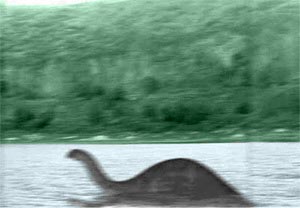
It seems rather peculiar to me that most cryptozoologists treat all reports of Sucuriju Gigantes as equivalent when in fact they are not. Percival Fawcett is the common source for much of what we know about giant anacondas and yet even he made distinctions between different types.
http://en.wikipedia.org/wiki/Giant_anacondaGiant anacondaFrom Wikipedia, the free encyclopedia

The green anaconda, Eunectes murinus, is the largest anaconda species. Females are bigger than their male counterparts.
Reports of giant anacondas date back as far as the discovery of South America when sightings of anacondas upwards of 50 meters (150 feet) began to circulate amongst colonists and the topic has been a subject of debate ever since among cryptozoologists and zoologists.
Anacondas normally grow to sizes of 6 metres (20 ft),[1][2] and 250 kilograms (40 stone) in weight.[3] Although some python species can grow longer,[3] the anaconda, particularly the Green Anaconda, is the heaviest and largest in terms of diameter of all snakes, and is often considered the biggest extant snake in the world.[1][3] It is not uncommon for a fully grown anaconda to attack and kill a jaguar or caiman. The lengthiest reputably-measured and confirmed anacondas are about 7.5 meters (25 feet) long. Lengths of 50-60 feet have been reported for this species but such extremes lack verification and too add lack of large prey to support a super-large snake. The longest specimen measured by a scientist measured roughly 35 feet long but this claim remains unverified.[4]
[This is once again erring on the conservative side. Claims of up to 40 feet long as measured by a scientist have been made but remain unverified. That is a bit more than "Roughly 35 feet" which I imagine means to report the same specimens-DD]
The first recorded sightings of giant anacondas were from the time of the discovery of South America, when early European explorers entered the dense jungles there and claimed to have seen giant snakes measuring up to 18 metres (59 ft) long.[5] Natives also reported seeing anacondas upwards of 10.5 metres (34 ft)[5] to 18 metres (59 ft).[1] It is unquestionable that anacondas above 7 metres (23 ft) in length are rare; the Wildlife Conservation Society has, since the early 20th century, offered a large cash reward (currently worth US$50,000) for live delivery of any snake of 9 metres (30 ft) or more in length, but the prize has never been claimed despite the numerous sightings of giant anacondas. In a survey of 780 wild anacondas in Venezuela, the largest captured was 5 metres (16 ft) long, far short of the length required.[6]
A specimen measured in 1944 exceeded this size when a petroleum expedition in Colombia claimed to have measured an anaconda which was 11.4 metres (37 ft[actually, a bit over 38 feet-DD]) in length, but its claim has never been proven.[7] Scientist Vincent Roth also claimed to have shot and killed a 10.3 metres (34 ft [34 and 1/3feet long]) specimen, but like most other claims it lacks sound evidence. Another claim of an extraordinarily large anaconda was made by adventurer Percy Fawcett. During his 1906 expedition, Fawcett wrote that he had shot an anaconda that measured some 19 metres (62 ft [63 and 1/3 feet-DD]) from nose to tail.[8] Once published, Fawcett’s account was widely ridiculed. Decades later, Belgian cryptozoologist Bernard Heuvelmans came to Fawcett's defence, arguing that Fawcett's writing was generally honest and reliable.[9]
Historian Mike Dash [Following Heuvelmans] writes of claims of still larger anacondas, alleged to be as long as 45 metres (148 ft)[
OR MORE],[10] with some of the sightings supported with photos (although those photos lack scale). Dash notes that if reports of a 18 metres (59 ft) anaconda strains credulity, then a 120 feet long specimen is generally regarded as an outright impossibility.[10]
 Sucuriju Gigante, Scale Mockup. Colour is stated to be a sort of chestnut brown.-In an earlier blog we reviewed the photos and found them to be unreliable. Fawcett, however, is otherwise thought to be reliable. He also spoke of other reports from other areas and this part is often overlooked. After mentioning the measurements of the one his men had shot, he continues, “Such large specimens as this may not be common, but the trails in the swamps reach a width of six feet and support the statements of Indians and rubber pickers that the anaconda sometimes reaches an incredible size dwarfing that shot by me. The Brazilian Boundary Commission told me of one exceeding eighty feet in length!” In another place, he also told of another species of snake that could be found in Araguaya and Tocantins basins, known as the Dormidera (the sleeper or The Snorer) from the loud snoring noise it makes, which is said to be black in variety and much larger.It seems to me that some sightings of what is called The Mysterious Beast in Paraguay, AKA the Barking Snake, are based on that same Black Boa, and possibly it is responsible for some of the trails and trenches ascribed to the Minhocao [For which see Tim Dinsdale in Monster Hunt]. It is a very thick snake according to all accounts, but surprisingly although estimates of its length run up to eighty feet long, it seems not much longer than an ordinary anaconda. It is supposed to be responsible for the six-foot-wide trails seen in the jungles and it has been witnessed through clear water to be about that thick when measured against a canoe. Even allowing for some exaggeration, it is at least twice as thick as the more common Anaconda.
 The Black Boa.
From True Authority website, quoting earlier authors:
Snakes are some of the most feared creatures on earth. Long and legless, fast and flexible, they strike fear into the hearts of those unaccustomed to their presence. Like all reptiles, they are covered with scales, but unlike most lizards, snakes possess a thin, forked tongue, and along with having no true eyelids, they lack external ears. It doesn't come as a surprise, then, that most people are afraid of them, yet as a general rule, there is little to be afraid of. Not all snakes are venomous, and of the 3,000 species around the world that are, only about 15% are considered poisonous to humans.[1]
There is, however, something else to fear besides venom.
The largest snakes on earth are the reticulated python and the anaconda, both of which can grow to a length of 33 feet (10m) and weigh up to as much as 550 pounds (250kg). Case in point: they may not be poisonous to you, but they can easily kill you.[2]
The Anaconda
The focus of this article is, of course, the anaconda. In the boa family, the anaconda is a constrictor. That is, it kills its prey by squeezing. What is known as the common anaconda inhabits the rivers of northern and Amazonian South America, east of the Andes. There is also the yellow anaconda which lives in southern South America, but it is much smaller, reaching lengths of about only 10 to 13 feet (3 to 4m). Anacondas don't lay eggs as many others snakes do, instead giving birth to live young.[3]
While the anaconda is also known as the "water boa," it spends a great deal of its time basking in the sun. Here, outside of the water, it is considered less dangerous, with its weight not being as well supported (for larger specimens). Still, inside or outside of water, they will hunt, though not necessarily in the sense of pursuing their prey. Anacondas are opportunistic hunters, like the crocodile, and typically will wait for their prey to come to them. That's not to say one won't slowly advance towards you if interested, but they rather prefer the surprise attack, being content to wait patiently close by. Simply put, anacondas are ambush experts.[4]
The Giant Anaconda: Fact Or Fiction
We now come to the fundamental question. How big do anacondas get? Science as we know it answers this question ... around 30 feet (though some acknowledge 37 feet). Is this answer, however, in the final analysis, the answer? Could larger anacondas, or any type snake for that matter, still be alive and well deep in the heart of South America's rainforests? Is such a notion even possible?
Such a notion is quite possible, though to most experts, improbable. Regardless, some believe that anacondas surpassing 30 to 40 feet do exist out in the wild, and they first look to history for their evidence.
History Of Reports
Percy H. Fawcett (Sources 5 and 6)
For over a hundred years, explorers and local natives have reported various encounters with large serpents in the Amazon, the most notable of which comes from Percy H. Fawcett. An officer of the Royal Engineers, Fawcett was commissioned in 1906 to survey the Rio Abuna and Acre rivers by the Royal Geographic Society. During his explorations, he recorded the following incident:
"We were drifting easily along on the sluggish current not far below the confluence of tigor and the Rio Negro when almost under the bow there appeared a triangular head and several feet of undulating body. It was a giant anaconda. I sprang for my rifle as the creature began to make its way up the bank, and hardly waiting to aim, smashed a .44 soft-nosed bullet into its spine, ten feet below the wicked head. At once there was a flurry of foam, and several heavy thumps against the boat's keel, shaking us as though we had run on a snag.
"We stepped ashore and approached the creature with caution. As far as it was possible to measure, a length of 45 feet lay out of the water and 17 feet lay in the water, making it a total length of 62 feet. Its body was not thick, not more than 12 inches in diameter, but it had probably been long without food."
When evaluating the legitimacy of one's testimony, history, character and overall trustworthiness must obviously be carefully considered. Fawcett was somewhat of a paradox. He was known as a scrupulous, matter-of-fact military man who recorded events exactly as they occurred ... or, at least, as he saw them. Yet, he was also characterized as a dreamer, leading expeditions in search of lost jungle cities of wealth unimaginable.
If we think about it, however, these two descriptions don't necessarily contradict one another. Being a dreamer does not automatically make one any less down-to-earth or detailed in what actual events occur in their lives. In fact, Fawcett encountered and recorded other snakes of reasonable size during his explorations, including a 7-foot long poisonous "Bush Master" that nearly killed his companion.
In any case, though Fawcett's team did not have an actual measuring device with them, he estimated the snake to be roughly 62 feet in length and a foot in diameter. Giving him a healthy 10 foot margin for error, the snake would still have been far larger than any specimen measured today. Unfortunately, because the gigantic snake was too large and heavy for he and his men to carry out of the jungles, they were forced to leave it behind.
Of course, this story is the subject of ridicule to most zoologists, especially when considering the ratio of length to width. Surely such a long snake would have been thicker, even if it had been "long without food." In the end, Fawcett either blatantly lied or told the truth. [It is also possible that the snake was a foot thick up near the head and the largest part of the belly was not measured. Snakes are not the same thickness all the way through and its greatest thickness could well have been greater than a meter at normal girth-DD]
Bernard Heuvelmans
He's known as the "Father of Cryptozoology", whose research in the field of cryptozoology was described by one critic as "based on rigorous dedication to scientific method and scholarship" and whose findings were "respected throughout the scientific community." He is Bernard Heuvelmans (1916-2001), famous author of the book On The Track Of Unknown Animals, which has sold over a million copies in various translations and editions.[7]
Heuvelmans himself claimed to see the giant anaconda while with a group of Frenchmen and Brazilians, and recorded his encounter in the following:
"We saw the snake asleep in a large patch of grass. We immediately opened fire upon it. It tried to make off all in convulsions but we caught up with it and finished it off. Only then did we realize how enormous it was. When we walked around the whole length of its body it seemed like it would never end. What struck me was its enormous head, a triangle about 24 inches by 20. We had no instruments to measure the beast, but we took an arms length of string and measured it about one meter by placing it on a man's shoulder and extending it to his fingertips. We measured the snake several times and each time we got a length of 25 strings. The creature was well over 23 meters (75 feet) long." [5]
 [This one might be less than 75 feet but is probably on a par with Fawcett's killed snake. There is probably no way you can consider a mismeasure that would make it come out less than 50 feet reasonably-DD]
Again, nothing more than hearsay to the scientific community, who are only interested in tangible evidence (understandably).
Victor Heinz
He claimed to have had two encounters with the beast, the first being on May 22, 1922 near the town of Obidos on the Rio Negro on the Amazon River. Father Victor Heinz saw what appeared to be an enormous snake in the water, likely the anaconda, whose visible portion was at least 80 feet long and as thick as an oil drum. His second encountered occurred in 1929 at the mouth of the Rio Piaba, near Alemquer. Below the surface of the water, two bluish lights appeared, which he at first mistook for the lights of a steamer. Later he was told that the sucuriju (giant anaconda) lived their, and that he had seen the snake's eyes. It's interesting to note that other reports mention blue, glowing eyes as well.[8]
Final Thoughts
There are a number of other encounters that could be touched upon, but most are far too general and lack acceptable documentation. Some, in fact, even give claim to specimens of up to 120 feet in length. Photos also exist, but none reveal anything conclusive (see Futility Of Photographs). The giant anaconda, therefore, still remains a hidden animal, best known as a cryptid.
Of all cryptids, however, the giant anaconda is arguably the most likely to be a reality. When speaking of the largest possible size of the anaconda, one passage in Heuvelmans book, On The Track Of Unknown Animals, is of particular interest:
"American herpetologist Thomas Barbour, the great Brazilian expert Dr. Afranio do Amaral of the Institute at Butantan, and Dr. Jose Candido de Melo of the Rio de Janeiro Zoo all agree on forty-five feet." [7]
Such reveals that not all experts believe the anaconda's maximum size to be 30-37 feet. A 45-foot snake would indeed be a large snake, and would certainly qualify one for the label giant anaconda. So, in a real sense, the giant anaconda does exist; we seemingly just have to find it. But until we do, whether she be 80 feet, 60 feet, or 40 feet, we'll still always be left to wonder whether or not she's really, really out there.
References:
1. The Merck Manual, Sec. 23, Ch. 308, Bites and Stings,
.
2. Microsoft Encarta Encyclopedia 2005 Reference Library Premium (DVD), article: ‘Snake’.
3. Microsoft Encarta Encyclopedia 2005 Reference Library Premium (DVD), article: ‘Anaconda’.
4. Unexplained Mysteries, Seeking The Giant Anaconda,
.
5. Cryptozoology.com, Aaron Justice, Sucuriju Gigante, http://www.cryptozoology.com/cryptids/anaconda.php>.
6. The UnMuseum, Big Snakes, .
7. Loren Coleman & Jerome Clark , Cryptozoology A-Z, Fireside Books , 1999.
8. Giant Anacondas, .