Plug

Member of The Crypto Crew:
http://www.thecryptocrew.com/

Please Also Visit our Sister Blog, Frontiers of Anthropology:

http://frontiers-of-anthropology.blogspot.com/

And the new group for trying out fictional projects (Includes Cryptofiction Projects):

http://cedar-and-willow.blogspot.com/

And Kyle Germann's Blog

http://www.demonhunterscompendium.blogspot.com/

And Jay's Blog, Bizarre Zoology

http://bizarrezoology.blogspot.com/
Showing posts with label Chupacabras. Show all posts

Monday, 10 March 2014

The Crypto Crew Chupacabras Update

The Crypto Crew posted a link to a new attack supposedly by the "Chupacabras". Here is the link:
http://www.thecryptocrew.com/2014/03/over-90-sheep-found-dead.html

And here is the original article:

Mexico: Chupacabra Attack Kills 97 sheep


chupacabra attacks

 La Paz| Almost 100 sheeps have been found dead and strangely mutilated on a ranch in the mexican provine of California Alta, in what seems to be the latest chupacabra attack in the region.  All animals were discovered dead, each with three puncture wounds in the chest area and completely drained of blood.
The chupacabra ( translated literally as “goat sucker”) is rumored to be a nocturnal carnivorous creature that inhabits parts of the Americas, with the first sightings reported in Puerto Rico. No specimens have ever been captured or killed, but hundreds of eyewitnesses have reported encountering the creature.
The name comes from the animal’s reported habit of attacking and drinking the blood of livesock, especially goats, throught a process similar to vampiric bats or blood leeches. Thousands of attacks have been reported over the last decades from the southern United States to Venezuela, leaving tens of thousands of farm animals dead.
Over the last two years, alleged chupacabra attacks have multiplied in Mexico, with over 12 000 anamals dead in a similar fashion. The increase in the number of attack is most likely linked to the increased invasiveness of human activity inside the creatures natural habitat.

- See more at: http://worldnewsdailyreport.com/mexico-chupacabra-attack-kills-97-sheeps/#sthash.tvVdqX7V.dpuf

It will be interesting to see if there are any associated sightings pof the Devil Bats (or Chupabats)

Tuesday, 10 September 2013

Chupacabra Mystery Solved

http://news.discovery.com/animals/pets/chupacabra-mystery-solved.htm

Old news by now but worth repeating

Chupacabra Mystery Solved

Oct 22, 2010 02:05 PM ET //
Halloween stories about the ghostly "chupacabra" circulate every year, but now scientists have solved the mystery surrounding this legendary animal.
Instead of being vicious, fanged creatures that supposedly drink the blood of livestock, chupacabras turn out to be wild dogs inflicted with a deadly form of mange, according to University of Michigan biologist Barry OConnor.
(Scientists believe legendary chupacabras monsters are actually coyotes with severe cases of mange, like the animal pictured here. Credit: Dan Pence)
 
The myth about chupacabras, also known as goatsuckers, started after reports of livestock attacks in Puerto Rico and Mexico, where dead sheep were discovered with puncture wounds, completely drained of blood. Similar reports began accumulating from other locations in Latin America and the U.S. Then came sightings of evil-looking animals, variously described as dog-like, rodent-like or reptile-like, with long snouts, large fangs, leathery or scaly greenish-gray skin and a nasty odor. Locals put two and two together and assumed the ugly varmints were responsible for the killings.
OConnor, however, and other scientists conclude that an 8-legged mite that burrows under the skin of coyotes can give these animals the "chupacabra" look.
He explains that the mite responsible for the extreme hair loss seen in "chupacabras syndrome" is Sarcoptes scabiei, which also causes the itchy rash known as scabies in people. Human scabies is an annoyance, but not usually a serious health or appearance problem, partly because our bodies are already virtually hairless and partly because the population of mites on a given person usually is relatively small—only 20 or 30 mites.
Humans have likely evolved natural defenses for this mite over the years. When we began to domesticate dogs, we likely spread the mites to them. When the mites then transfer to wild dogs, such as foxes, wolves and coyotes, the victims appear to be less able to fight them off.
"Whenever you have a new host-parasite association, it's pretty nasty," said OConnor, a professor of ecology and evolutionary biology and a curator in the U-M Museum of Zoology. "It does a lot of damage, and mortality can be relatively high because that host species has not had any evolutionary history with the parasite, so it has not been able to evolve any defenses like we have."
In these unfortunate animals, large numbers of mites burrowing under the skin cause inflammation, which results in thickening of the skin. Blood supply to hair follicles is cut off, so the fur falls out. In especially bad cases, the animal's weakened condition opens the door to bacteria that cause secondary skin infections, sometimes producing a foul odor. Put it all together, and you've got an ugly, naked, leathery, smelly monstrosity: the chupacabras.
But what then explains the "goatsucker" livestock attacks?
"Because these animals are greatly weakened, they're going to have a hard time hunting," OConnor said. "So they may be forced into attacking livestock because it's easier than running down a rabbit or a deer."
Wild dogs aren't the only ones to suffer from deadly mites. Mite-infected squirrels often become roadkill because they are weak and less able to scurry away from cars. In Australia, the "chupacabra" mite is killing off wombats.
"(Wombats) presumably got the mites from dingoes, which got them from domestic dogs, which got them from us," he explained.
 
 
Itch Mite

Street Dog infected  with Sarcoptic Mange, Bali
 

Sarcoptic mange

See also: Scabies
Sarcoptic mange, also known as canine scabies, is a highly contagious infestation of Sarcoptes scabiei canis, a burrowing mite. The canine sarcoptic mite can also infest cats, pigs, horses, sheep and various other species. The human analog of burrowing mite infection, due to a closely related species, is called scabies (the "seven year itch").
All these burrowing mites are in the family Sarcoptidae. They dig into and through the skin, causing intense itching from an allergic reaction to the mite, and crusting that can quickly become infected. Hair loss and crusting frequently appear first on elbows and ears. Skin damage can occur from the dog's intense scratching and biting. Secondary skin infection is also common. Dogs with chronic sarcoptic mange are often in poor condition, and in both animals and humans, immune suppression from starvation or any other disease causes this type of mange to develop into a highly crusted form in which the burden of mites is far higher than in healthy specimens.

Saturday, 22 June 2013

Argentinian+ Chilean NeoDinosaur, South American Apes + Chupabats

As recounted in a number of media articles from 2004, several different motorists driving along the main road linking Iquique and Arica, through the Atacama Desert, have reported witnessing an extraordinary bipedal creature over 6 ft tall[or long], with sharp teeth and three-toed footprints, which has been variously likened to a velociraptor or even a ‘dinosaur kangaroo’
In the words of one eyewitness, Hernan Cuevas: “A weird animal looking like a dinosaur with two legs and huge thighs crossed the road in front of my car”. Not surprisingly, the local authorities were, and remain, very puzzled.
This has also been called the local type of Chupacabras, elsewhere also compared to a reptilian kangaroo or a small dinosaur. The three-toed tracks incidentally turned out to be condor (vulture) tracks upon investigation in one specific instance. So we really don't have a good idea what the tracks of the reptilian creature are like.

Condor or Vulture tracks reported as "Chupacabras"
One of the 2002 press releases said that Cupacabras from the Atacama desert was "Los 'chupacabras' capturados medirían un metro y 20 centímetros de estatura, tendrían piernas de velocirraptor, su desplazamiento sería en zig-zag, contaría con rasgos humanoides en el rostro y su cuerpo se asemejaría a un mandril".[The captured Chupacabras stands 48 inches tall and has the hind legs like a Velociraptor, it runs a zigzag path, has humanoid features of the body (the arms?) and a face like a mandrill (Baboon-which is to say something like a dogs head but uglier)] NASA has denied any involvement and the event has been taken to be a hoax but based on descriptions of reports coming out of the area: so the overall description is probably close enough, but we need not insist on such details as the creatures' face resembling that of a mandrill.
The initial, uncirculated reports of the "Mountain Boomers" in the Southwest and Texas compared the creature's size and shape to this Charles R Knight reconstruction of an "Ornitholestes"

 
At the same time, reports of other creatures also being called Chupacabras are continuing in the area. There was and is a general confusion between the types.

More Chilean News items from the early 2000s:
http://paranormal.about.com/science/paranormal/library/blnews600.htm
 LIVE ONES?
• Chupacabra Eggs Found? Witnesses in Chile continued to come forward last
week with more about the reputed clash between Chilean Army troops and three
Chupacabras on or about May 9. Two witnesses claimed that the Chilean troops
returned with large eggs, which they reportedly obtained from a "nest" in
the Atacama Desert, not far from the Radomiro Tomic mine. According to the
newspaper La Cuarta, "Three specimens of Chupacabra, mythical creatures of
apelike characteristics who drink animal blood, were captured in northern
Chile by an expedition spearheaded by NASA and were taken back to the United
States, according to researchers of the subject. The president of the
Ovalvision Chile research group, Cristian Riffo, told La Cuarta that the
creatures were the result of genetic research by NASA using terrestrial
creatures and space entities. Several of the hybrid creatures escaped from a
secret base and propagated themselves in the southern United States, Mexico
and Puerto Rico where they were given the name Chupacabras. Riffo maintains
that in the Chilean case, the Chupacabras fled from the Atacama Desert where
where the U.S. agency is trying to replicate the conditions of a voyage to
the planet Mars. Chupacabra news is coming fast and furious from Chile. The
latest items include the following:

Between June 12 and June 15(2000?), residents of Maria Elena, a farm community 140
kilometers (84 miles) west of Calama, found mysterious clawed footprints in
the fields. "Identical to the footprints found at the (Radomiro Tomic) mine"
at the time of the reported capture, said radio talk show host Pablo
Aguilera, with the prints "highlighting their large shape and the sharpness
of the claws."

The newspaper Diario La Estrella reported, "Guards of a security company in
the sector claim to have witnessed a strange entity on the prowl, and while
they were unable to see it entirely, stated that it moved at considerable
speed."

An area resident, Miguel O., claimed that his nephew, who is in the Chilean
Army, was on guard duty at the Radomiro Tomic mine and saw one of the
creatures. "Between May 9 and May 11," Miguel O. said, his nephew "while
standing guard with his regiment, he had a chance to see a specimen of the
so-called Chupacabras and immediately called his superior. The strange
creature took prodigious leaps and bounds and, at one point, gave the
impression of floating on the air. He described it as 1.2 meters tall,
half-hairy and hunched over
 [This is perhaps the monkey or ape creature. The subsequently found eggs might not have been laid by the "Chupas" I this case, the creatures could have been gathering them up and eating them-DD]
" After gearing up, an army patrol went out into
the desert, Miguel said. "The most surprising thing is that the patrol
returned with several ‘eggs' found at the location where the creatures were
taken by surprise. He added that the patrol managed to kill two and capture
one, that the creatures were subsequently removed by NASA personnel from the
area." Commenting on Miguel O.'s statement, Pablo Aguilera, host of Radio
Pudahuel's morning show, said, "The hole discovered in the area could well
be a ‘nest' the creature was making to deposit its young." [Source: UFO
Roundup by Joseph Trainor]

THE RAMPAGE:
• Chupacabras Go on the Rampage in Chile. Less than three weeks after the
reported capture of three Chupacabras at the Radomiro Tomic mine nea Calama,
a new wave of Chupacabra incidents swept Chile. On June 4, 2000, during the
early morning hours, a Chupacabra slaughtered 14 chickens in a backyard in
Talcahuano, a port city five miles north of Concepcion, which was the site
of many Chuapcabra incidents during May. On June 7 at 4 a.m., another
Chupacabra attack took place in Concepcion while Julio Reyes and his wife,
Carmen Andrade, were still asleep. They suddenly heard a loud noise coming
from their home's backyard. "The light outside the henhouse was on," Carmen
said. "I saw the monster flapping his [bat?] wings fiercely while the hens were
crowing - something they never do at this time. That's when I saw the white
one running toward the back. Bobby [the family's terrier watchdog] came out
to take a look, but when he saw the back gate, through which the hens had
fled, he refused to follow and remained standing still." Around 7 a.m., the
couple discovered what had transpired. Their three hens and one rooster were
found dead, completely torn to shreds, as if they had been ripped open at
the chest cavity and scattered in a 33-foot radius. On June 9, at 11:45
a.m., a caller to Chile's Radio Pudahuel reported a recent Chupacabra attack
in the city of Antofagasta. Accordiung to the caller, he was asleep in his
bedroom, and the cat started making noises, waking him up. That's when they
saw the alleged Chupacabra. He says that when it saw them, the creature took
off at high speed. He says it destroyed their car and it killed the cat.
Afterward, the witness reportedly found deep scratches, "made by its claws,"
in the doors and fenders of his car. [Source: UFO Roundup by Joseph Trainor]

The claims continued and continued to grow more elaborate:
Excellent report. At the time I saw him completely. Today it is amazing of course see it again. Among the many theories I have similar data, but other sobering, to see if you can be of help, or more of the same. they metabolize the blood, that is these entities that consume the blood of animals. Like any predator draw their nutrients from there. 's kind of experimental animal, alien, of course, I agree that are made ​​by grises. Para that to see how human beings react to an ecological catastrophe, indicate some theories. weight these bugs, 55 kgs., height 1.20, color greyish, short coat volume, round head with 3 bump on the forehead, ears cat has legs or limbs with 3 fingers. Displacement: Advance of 8-10 meters. Every 10 meters, leaves a mark, I mean get jumps of 10 meters high, big eyes, small nose, no tail, hearing like a small dog. Arms like monkeys. Low frequency hearing, humanoid type figure as a mandrill, 3 fingers (plus thumb?) prehensile, intelligence of a child of seven years, fear of man, lemur vision, supports 18-degree cold, and up to 40 (Centigrade) degree heat, (Heavy fur) protection in their back, is hybrid, lives in trees, foliage or in caves in semi warm, defecates like sheep, your urine is strong as ammonia, in open ground reaches 60 kilometers per hour, has morph every two years, changes its structure, grows wings [the description has shifted to the bat reports], can fly. were paired, there are males and females, with adult males will grow three horns, works as rodent is active at night, it communicates with its space(?) for Low Power-frequency. As they arrived, there are theories that indicate that gray craft, which landed once in the Gran Chaco, Argentina, hence is north of chile despazaron were four ships, in the eyes of the salty, the other near Pucon, the other in ice fields and the last in the area of the Torres del Paine. And this part may sound fantastic but can not be ruled. Each ship brought 100 of these entities experimentation, leaving it in a systematic way along chile. There other theories that suggest that they are an experiment to see how the gray man(Alien) reacts to invasion a larger scale, this can be much but could not be excluded. During the year 2009-2010, could appear again. emit a low- utiizan frequency, which only animals and listen to paralyze or numb because instill fear. Some define it as an "biological entity extraterrestrial genetic hybrid" EGBEH. They are outsiders, not land, not man-made, are manufactured by the grays, like, well, abduct animals, they take, the cross, and the breed as a genetic hybrid form. This information is extracted from a conversation that once took place in a radio station in Santiago, and I can not remember someone did get me for years, do not know if it's true or not, but I think by now beside the point, what strikes me attention, at least those who study these topics are the small details.

Tocopilla, Chile. Date: June 18 of 2000. 12:00 AM.
Source: Miami UFO Center © 2006 sanchezocejov@bellsouth.net
 
The Eyewitnesses (Who preferred not to be identified by name but were interviewed on tape) were on the beach having a party (a cookout I presume) said the creature had long dark furry hair, long arms with hands below the knees, big round eyes, with a long snout and mouth shaped like an animal muzzle. The creature approached one of them making several guttural sounds, as if it was trying to communicate with the young man.(begging for food?) Moments later, it placed its right hand on the young man's left shoulder, leaving a green stain on his sweater, which they described as the same color as marine algae. The Bigfoot-like creature soon left, as it disappeared into the dark. (I do not find any UFO mentioned in the original report, presumably the artist just added that in)
In this case the "Bigfoot" bears a strong resemblance to the De Loys Ape in outline. 
 
Chilean Villagers Describe An Alleged Capture Of A Chupacabras
Source: Ovnivision Chile. Bulletin dated January 26, 2011     
 
Chilean law enforcement agencies have conducted an apparent successful operation to capture the legendary chupacabras creature in the small village of Huasco, Third Region of Chile.
 
Due to the constant animal deaths in the area, the community of Huasco had been very worried. Recent attacks on domestic animals have created panic and fear among local residents. Numerous reports of these attacks have prompted Customs officers of the area to conduct special operations in an effort to capture the so-called chupacabras. The purpose of the operation was to avoid new animal slaughters.
 
According to several eyewitnesses, police and customs officers were seen conducting searches and chasing an animal that was finally captured in a cave. "Local residents heard gunshots during the intense pursuit in the nearby village of O,Higgins, said Darwin Godoy, a local ufo and "chupacabras investigator.
 
Finally, the group of officers finished their search in a local cave, where they captured what appeared to be a strange giant bat. "According to descriptions, the creature was about 80 centimeters in height and it had a wingspan of approximately 1.7 meters, said Godoy. [ About 32 inches long with a wingspan of 5'8" which makes a good estimate for the Chupabat or Chonchon. The body of such a bat is a rounded mass perhaps a foot long.] 
 
The cave where the alleged capture took place is located near the thermoelectric power plant of Guacolda, just south of Huasco. Several of the eyewitnesses were employees of the electric power plant. Residents that live nearby the local cemetery also witnessed the operative.
 
Translation by Mario Andrade
Special thanks to Rodrigo Cuadra from T.O.C. Online Magazine


Sunday, 17 March 2013

Chupabat "Ahool" and Chupa Update

This illustration turned up on the "30 Day Cryptozoology Art Challenge" labelled as an Ahool. The Ahool is a flat-faced giant bat that is a biped on the ground, as large as a very small child. This is on the ither hand a pretty good depiction of a Chupabat (Giant False Vampire Bat) moving stealthily on the ground as a quadruped with its wings folded up. The ears are slightly too long and the snout is a mite short, but either way is not much.

http://guardtristan.tumblr.com/post/29711060200/the-30-day-cryptozoology-art-challenge-day

The fur (Body hair) on this species is usually described as longer and scruffy on the back, but that does not mean that it is always in that state, and the hair on the back might not be very clearly seen from this angle. Incidentally, one of the other "Chupacabras" I saw on my photo search was actually a "Devil Monkey", being a very large but mostly mummified male rhesus monkey's body. And I have this "Chupacabras" skull that is the large iguana lizard sort, sent in to my email some weeks back:

 
I can see how that might look like a "Dinosaur" skull to somebody.

Thursday, 14 March 2013

Chupacabras Updates

From Global Warming and Terraforming Terra site:

El chupacabras, the gargoyle bat of R. Kline


Spanish Chupacabra Update
Posted: 12 Mar 2013 12:00 AM PDT


This is a translation from Spanish language sources. I must say that there is a lot of material from the Spanish language press that I do wish to access in my many areas of interest. In this update, Puerto Rican gargoyle from twenty years ago has reappeared which effectively suggests that there is a native population generally avoiding contact. Geographically, it is accessible to Central American comparables.

Otherwise other creatures are out there to sow confusion. These could be even other types of unidentified vampire bats. What is clear is that local reports and local populations do tend to meet the test of conforming evidence. Nocturnal predators are showing up globally who have generally maintained a low profile through sheer fear of humanity.

These are all large creatures with large areas of influence and thus a low population density. They have mostly been identified in the past through rare sightings which is why we always seem to have a prospective name.

Unfortunately, mankind has stopped significantly harvesting in the wild and the result is that these often very dangerous creatures are no longer receiving clear lessons on just how dangerous we are. There surely can be nothing more edifying that a pack of dogs sending either a black bear or a cougar up a tree and for a man to come along with a rifle or bow to finish the job.

Without the human hunting pressure, natural carnivores will want to exploit our farm animals. It is not a real crisis yet, but it will lead in time to active commercial harvesting in order to suppress the threat. Again that treat need not target the rare treat as to educate. These animals are not stupid.

Beast on the Move: The Chupacabras Returns

By Scott Corrales


The Puerto Rican media approached the subject of the paranormal predator again in 2012, when reporter Yaritza Santiago wrote an article for El Nuevo Dia about the entity’s return to the scene, this time in the island municipality of Vieques. “A strange wild animal prowls the verdant fields and communities of this island municipality. This is the only way to explain the discovery of dead horses, hens and rabbits in situations that terrified Viequenses have ascribed to a panther that allegedly escaped from an American tourist’s possession. Others say it is a jaguar; still others speak of the return of the Chupacabras, whose existence they do not question for a second.”


Thirty chickens met an untimely demise on the property of José Martínez and his wife Jeami in Barrio La Hueca. The couple had gone off to a birthday party on the previous night, returning home an hour before midnight. They went to bed and Mr. Martínez woke up at half past five in the morning to feed the family animals. In cold glow of his flashlight, José was startled to find the roosters dead in their cages, with deep puncture marks on their backs, drained of blood. The couple told reporters that they had not heard any abnormal sounds in the night.


José, 26, and Jeami, 21, described the massacre of their animals as “a battlefield” where the unknown assailant had operated at leisure. She remained convinced that the perpetrator was none other than the mysterious being that spread fear throughout Puerto Rico during her childhood. “It wasn’t a dog. I think it could be the Chupacabras.”


Reporters from El Nuevo Dia found “sort of animal print” at the location as well as poultry carcasses and metal cages scattered around the premises. Mr. Martínez filed a complaint with the municipal police, which in turn referred the case to the Civil Defense and Emergency Management Bureau. Police chief José Belardo, however, was unmoved by the carnage at the Martínez household, citing a lack of specific evidence or physical proof. He did, however, manifest to El Nuevo Día’s reporters his awareness of a “radar image” of a strange creature taken by a U.S. Marines radar, and that fear among the island’s population was quite real. Unlike Mayor “Chemo” Soto’s gallant efforts to capture the Chupacabras in the mid-90s, law enforcement on Vieques was not planning any grand gestures.


On main island of Puerto Rico, news organizations were covering the “gargoyle”that supposedly haunted the vicinity of Guánica, the city with the magnificent bay on the Caribbean Sea. This nightmarish vision had attacked not only animals, but allegedly humans as well. Its patterns of attack resembled those of the Chupacabras, but not exactly the same entity. “Some identified it with the Chupacabras, but others believe it was a different creature, a sly and sinister one, using the ruins and tunnels of the [abandoned] Central Guánica sugar mill as its lair,” wrote Pedro Bosque in an article for El Nuevo Dia. It was in this warren of half-flooded, weed-choked tunnels that the skeletons of its victims were reportedly found.


Despite its predilection for lovely Guánica, the “gargoyle” had reportedly been seen in Lajas and San Germán, communities in southwestern Puerto Rico that acquired notoriety in the late ‘80s and throughout the 1990s as paranormal hotspots. And unlike those relatively distant years, eyewitnesses were reluctant to share their names with the media, particularly when it came to the attacks on humans.

These incidents were discussed in hushed tones. One witness interviewed by the press claimed seeing injuries on a man’s belly, produced by an“
animal with large wings” whose claws had torn at his flesh “to the extent that his fat could be seen.” The unnamed witness spoke soberly of seeing the victim – nicknamed -lift his t-shirt to display the wounds received in his own backyard.


Police officer Miguel Negrón, on the other hand, admitted to hearing “a loud sound of flapping wings” while patrolling the abandoned sugar mill. Was an unknown avian taking off from the rusted cranes of the old mill? According to the officer, the “gargoyle” had been described by some as a very large bird reeking of sulfur or rot (hydrogen sulfide?), feeding on live animals such as dogs, cats and horses by exsanguination.

[ this is a renewal of earlier clearly observed gargoyles around twenty years ago from this island. ]

Four Thousand Miles Away


While the Chupacabras staged a return to Puerto Rico, its sinister kin were making news in Chile, where the national media latched on to a story that was as sensation as it was bizarre: while attacking a henhouse in Paine, on the outskirts of the city of Santiago, the predator had allegedly suffered what was described as a “miscarriage”.


Cristián Solís was sleeping peacefully when the frantic clucking of his hens woke him up at four o’clock in the morning. He ran outside to find fifty dead hens, arranged in circles, presenting no visible injuries, but without a drop of blood in their carcasses. Shocked and dismayed though he was, Solís was bowled over by what he found next.


He described the find as “
embryos of something I had never seen before”. Describing them as miniature dinosaurs measuring some 30 centimeters long, they had hairy backs, thick, hard tails with sharp tips, arms shorter than their bodies, suggesting bipedal motion.“They were rather horrible,” he was quoted as saying. “I think the dead hens were attacked by the mother of these embryos, who must’ve had a miscarriage due to the strain of the attack.”


The specimens were turned over to SAG (the notorious Agriculture and Wildlife Service that hindered research into the Chilean mutilations wave of the year 2000). The ministry reported that it had been unable to determine the species to which the specimens belonged as they were“too dehydrated to be properly analyzed.”


Chupacabras activity had gone into abeyance for a number of years in these latitudes, with the most recent cases dating to 2007, when reports of attacks in world-famous Viña del Mar appeared in the press.

During the month of May of that year, the Ugalde family had its own close encounter with the unknown at four a.m., when a loud noise woke up the entire household – the sound of something very large and heavy suddenly landing on the roof, dragging its wings. The chickens behind the family property erupted in chaotic noises, extinguished one by one.


According to an article in the La Estrella newspaper, Mrs. Ugalde ran out into the darkness to save her poultry farm and face the unknown intruder. "I went to the backyard and
I saw it. It was like a large bird, standing about a meter, with the bearing of a dwarf. It has feathers, wings and left footprints like those of a goat.It was looking for food, and I think it must've been hungry," she explained. The entity had already broken the henhouse door and helped itself to the farm animals. Upon being surprised by the woman, it flew off toward the hills.


Seven hens were lost that evening, and the family did not hesitate to place a call to the Carabineros (the Chilean state police) to report the attack. "They told us it was that (the Chupacabras) and that they had never seen anything like it. They were overwhelmed as well," Mrs. Ugalde added.


When the strange animal passed over the roof and reached the backyard, it broke the henhouse door and extracted the birds one by one, for a total of seven. When he was surprised by the homeowner, the Chupacabras took off, flying toward the hills.

Argentina, Chile’s neighbor on the opposite side of the towering Andes Cordillera, was not free from these strange attacks and sightings. In March 2007, El Ciudadano (www.elciudadano.net) reported on seven mutilated and exsanguinated bulls in Santiago del Estero, decrying the fact that farmers and ranchers had automatically leaped to ascribing responsibility for the killings to the Chupacabras. It is true, however, that there are significant differences between Chupacabras attacks and the “traditional” cattle mutilations, characterized by their fine incisions and the removal of certain internal organs, as was the case in the Santiago del Estero incidents.


A Mystery in Spain


On 23 February 2013 – as this article was being written – news arrived from Spain regarding a bizarre goat mutilation in the northwestern region of Galicia, specifically in the town of Fene. The story, which appeared in La Voz del Ferrol, described the mutilation and exsanguination of the goat as the work of “parties unknown”. The animals owners, understandably irate, ascribed responsibility to a“satanic cult”, stressing that “a number of people must have been needed to carry away all of the goat’s blood.”

No mention of involvement by the Chupacabras, of course, but a reminder of the long and silent history of encounters with the paranormal predator that have occurred in Spain since the ‘80s, resulting in the deaths of thousands of animals. Traditionalists blame wolves, especially in the Pyrenaic region between France and Spain, but reports and investigations carried out by the judicial system invariably mention the presence of aberrant entities, sometimes described as mandrills, baboons, or giant canids.


We must defer to the extensive work carried out by Ramón Nava Osorio and members of his Instituto de Investigaciones y Estudios Exobiológicos (IIEE) whose Chilean branch – spearheaded by Raúl Núñez – has become known to readers of INEXPLICATA over the years.


In March 1996, writes Nava Osorio, a shepherd in northern Spain by the name of Guillermo Miral Cordesa had an unexpected encounter with a strange animal as he led his flock from one mountain slope to another. “That day,” explained Miral, “I had left the flock on high and was headed downhill with two magnificent dogs. I descended quietly and normally and suddenly found myself confronted by an animal I had never seen before, and whose description I’d never heard from other shepherds. It was neither a wolf nor a dog.
It looked like a huge dog, an unknown mixture, but it’s an unknown creature in the end. Neither a mastiff nor a wolf….I cannot describe its eyes, but I did focus on the enormous width of its muzzle (describing it as flat and nearly square), and for that reason I can tell you it wasn’t a wolf. It was an unknown animal with large flat ears; its fur was grey and spotted, with abundant short hair. A short tail, large paws and looking like a dog, yet not a dog. It didn’t run. It took two impressive leaps and vanished.”


While clearly a predator, the entity did not growl or bear its teeth. Miral’s own dogs followed the intruder, only turn back after traversing a brief ten meters’ distance.


In his study on the Iberian mutilations phenomenon, Chupacabras: Un Verdadero Expediente X, Miguel Aracil explores the strange simiots which have been a constant feature of Catalan legend since medieval times. The simiots are described as "strange, hairy creatures having semi-human features" and a group of woodsmen were attacked by one such entity a few decades ago: the hairy monster engaged in an orgy of destruction, smashing vehicles and forestry equipment, even hurling logs at the terrified tree-cutters (similar behavior has been reported in cases occurring in suburban Maryland during the 1970's). Although Spain's Guardia Civil looked into the matter, they conveniently "cannot remember", as Aracil notes rather dryly in his treatise. A number of armed posses were formed to explore the environs of Peña Montañesa (Huesca) where the events occurred, but "nothing was ever found, perhaps due to the large number of immense caves in the area, and the rough terrain." Medieval statues of the simiots depict them as devouring children or being trodden down by the Holy Mother: while he does not offer specifics, the author mentions that these supernatural entities were allegedly responsible for slaying entire herds of animals and on certain occasions were even responsible for some attacks on humans. Could the simiots have cousins across the ocean?


Navia Osorio contributes a “high strangeness” detail to the situation that raises the stakes: the possibility that the anomalous entity (or IEA, the Spanish acronym for “Spontaneous Aggressive Intruder”) had been brought along by a human or humanoid presence, unleashed at selected locations. Also in October 1996, José Miguel Trallero, a member of the IIEE, appeared on a local television program in the town of Barbastro to discuss the mutilation crisis. In the wake of the broadcast, a local woman approached him to tell him about a sighting near Barbastro’s shrine of Pueyo: she had seen two figures, described as “atypical”, with a very strange dog between them. The two figures had “greyish skin” and their arms were longer than usual.


Conclusion

If reality resembled the world of fiction more closely, monsters would be put down with the finality of Lieutenant Ripley purging the hideous alien xenomorph out of an airlock, consigning it to vacuum of space. The sense of finality and justice delivered by a wooden stake through the undead heart of a cinematic vampire imparts catharsis, but we find none of that with the monsters and visions that persistently manifest themselves in our reality. After eighteen months of depredations in West Virginia in 1966-67, the Mothman disappeared into legend and the uneasy dreams of those whose encounters changed the course of their lives. Hunters and scientists emerge from forays after the elusive Bigfoot with little to show for their efforts, save the tell-tale strands of hair and plaster casts that have become a trademark of their avocation.


The same can be said for the Chupacabras. The protean creature manifested for the first time in Puerto Rico in the mid-90s, followed by a rash of sightings throughout Latin America, each time described a little differently than before. Media burnout and the trivialization of the subject by popular culture – the cascade of t-shirts and bumper stickers, rap and ranchero songs, cheap plastic memorabilia sold in marketplaces – resulted in a loss of interest in the creature’s exploits in Brazil and Chile later that decade.

But the Chupacabras keeps coming back like a prize fighter, unmindful of the fatuous pronouncements of skeptics, efforts at fitting it into the UFO totem-pole by researchers bent on seducing the media once more, their prize a conference invitation or the lure of a television show. The demon is triumphant.

["Simiot" means "Monkey-like" and at one time seems to have been a different concept of the same Wildmen common elsewhere including the Basque Basajaun. However, the quadruped that slays whole herds of livestock is much more like the "Phantom Puma" category and suspicion falls on illegally introdued foreign big cats, initially as pets but eventually released into the wild.

And yes, we know from the onset that we are dealing with more than one species of vampire bats: the known fossil vampire bats are only a few inches long with wingspans of only a foot or two in life.]

Friday, 7 December 2012

Chupacabras Drawing From Facebook


I came upon this drawing of a Chupacabras creature on a Facebook group and I immediately  recognised it as one of the better attempts to convey the type. Here is my comment I made at that time:
 
Dale Drinnon BTW, I really like this chupacabras you drew: it is very likely what one of the living animals the reports are describing seriously looks like, without the sensationalistic exaggerations that usually go with reports of the type. Mind if I post it on my blog and did you want to make a statement to go with that?

Reply from Andy Finkle:

Please share away Dale. Thanks for asking! Just put the name Andy Finkle there somewhere in your blog. I do not have a statement about it, it isn't based on a[ny individual] sighting or anything. I just wanted to make it reptilian with hind legs that are more mammalian in structure. Nothing too absurd (not that I do not enjoy absurd too). Thanks.
First thing I noticed that its posture had its legs stretched out long, body arched like a cat, and its body puffed up. Chameleons and some other lizards do that as a defensive bluffing posture

The elbows bent and the tail curled around was like this Basilisk lizard. Like the Basilisk lizard, the Chupacabras sees to have at least one flap (and probably two) at the back of its head. The  could be a "Fin" like the Basilisk has only more jagged, but actually it is usually described as a row of spines and hence is more like the usual kind of iguana in that. The spines are likely longer in the males.
The Basilisk lizard also runs on its hind legs the way a Chupacabras does. The Chupacabras is very much larger than the basilisk, with the body the size say 1 foot to 18" at the shoulders on all-fours, 3 feet tall up and running and the whole length 6 to 8 feet long,  and the really big ones twice that size.
That is going strictly by the descriptions and is the approximate size range as Komodo dragon

Friday, 2 November 2012

ChupaBats in Texas, and More on Big Bats

 While doing a photosearch re colour photo indicated above turned up as an unue creature from Texas. It was an anonymous piece of artwork used to  illustrate Kark Shuker's blog about an unusual "batman-big bird creature" seen in 1976:
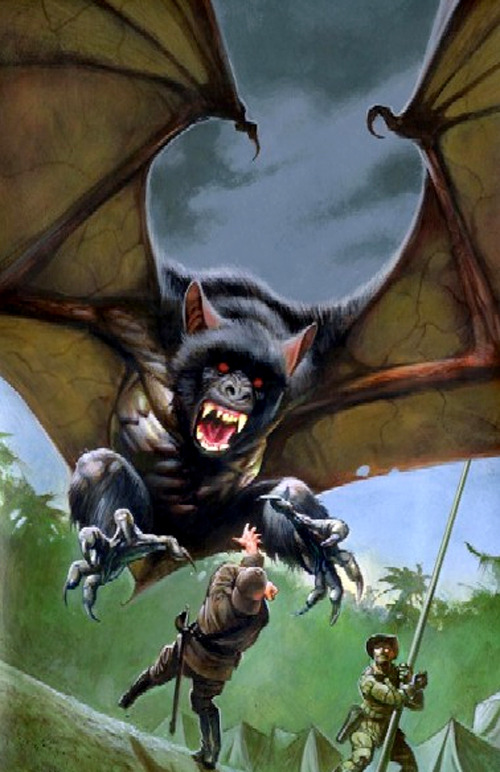
"Sitting in his mother-in-law's backyard at Raymondville, Texas, on the evening of 14January 1976, Armando Grimaldo suddenly heard a strange whistling, and a sound that reminded him of flapping bats' wings - a highly pertinent comparison, as it turned out. For just a few seconds later, he was attacked by a man-sized monstrosity with the face of a bat or monkey, a pair of large flaming eyes but no beak, dark, leathery, unfeathered skin, and a pair of huge wings yielding a massive 10-12 ft wingspan (i.e. twice that of any known species of bat). Swooping down at the terrified man, the creature snatched at him with its big claws, but, happily, Grimaldo was able to flee inside before his aerial attacker had inflicted any serious injuries. Nevertheless, his encounter was just one of several on file from this particular region of Texas during early 1976, all documenting sightings of a similar entity

 
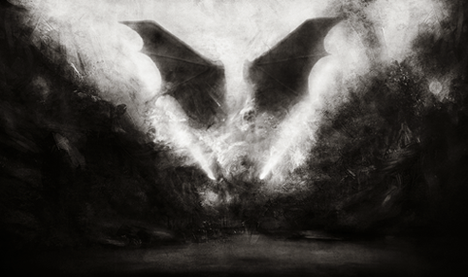
As soon as I saw the illustration I saw theresemblance to my reconstruction for the Chupabat, a giant False Vampire bat reported the size of a medium-sized dog when running on all fours on the ground, and with a wingspan as large as the largest known bats or even a moderate-sized eagle; six or seven, maybe even as much as eight feet ( ten or twelve feet would be closer to half again than to double the size) which is said to predate upon livestock occasionally in Mexico and Central America, so finding one in Texas or New Mexico would not be too unusual. The real resemblance in the illustration is with the shape of the head. The black and white illustration shown above is clip art of the known (Smaller) False Vampire bat. A scaled-up version could easily have fanged canies more than an inch long.


 "Chupacabras-like depradations occur in the Southwest USA on occasion and could be linked to such Chupabats or Gargoyle Bats. Sheep mutilations, victims severely wounded and gutted without leaving much evidence of spilled blood on the ground, are reported from the 4 Corners region of New Mexico and thought to have been done by a large ChupaBat such as implicated in similar cases in Mexico: JC Johnson 1 year ago
Typical protocol in this situation,- the tribe insists that all of the animals be put down in case of rabies. No other recourse I'm afraid. The injured sheep were being shot as we were leaving the scene.

JC Johnson 1 year ago We don't know for sure what did this

1stofer 1 month ago in playlist More videos from cryptofourcorners sounds like the jersey devil

Heyoka Ha 2 months ago Very peculiar indeed. The hoof (foot) prints were in pairs, that is what you mean by bipedal? In any of the sheep injured, Was there any indication that the blood could have been taken first and then the animal attacked again? I am thinking there was more than one of these creatures.

brjames06 4 months ago lmao!!.. @ 3:05.. the shit didnt come out... [Ordinarily when an animal is slaughtered, the bowels dump]

OziBushMysteries 4 months ago thats not 'horse shoe prints ' i'd have to tell u? [Jersey Devil prints? the footprints were irregular ovals and I could not tell what they were. I would guess they were blurred sheep tracks]

The example above was from August 2011: the one below is from April 2010

Special thanks to JC Johnson for pointing out the videos.

Mixed in with the other reports of Giant bats are reports of an even larger but flatfaced bat, also seen in Texas in 1976. They seem to be a northen extension of the American equivallent of the Ahool, in Mythology known as Camazotz.

Monkeyfaced "Big Bird" of Texas 1976. Obviously the artist is confused about the arms and the legs and the wings. They have drawn a birdlike instead of a batlike body plan A policeman seeing one of these creatures hiding in the branches described the face as looking like that of a gorilla

Ahool

The Ahool is the latest addition to the InCryptid Field Guide!
 
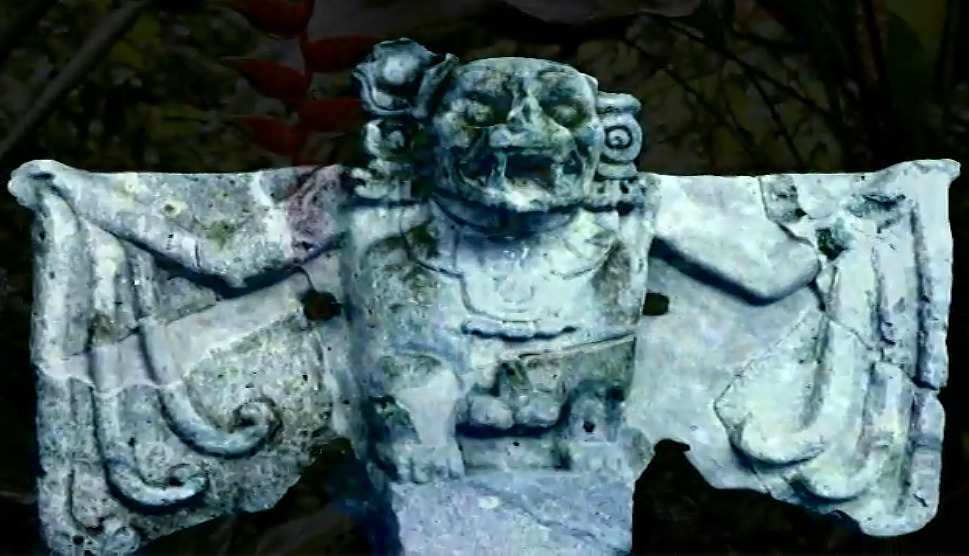
    Mayan "Death Bat"
  1. Cave Demons and Giant Bat-like CreaturesLarge bat-like creature sighting in California
  2. Normally, only UFO and extraterrestrial sightings are reported to MUFON but on Saturday, June 5, 2010 an interesting account of a bat-like creature, purported to have been seen near Lodi, California was reported:

    MUFON Case 23617
    2010-05-14 at 02:45
    Lodi, California

    “I had taken my dogs for a run early in the morning - about 2:30 on May 14th 2010. I was southeast of Lodi on Live Oak Road where the road to the winery intersects. There are outside lights and I saw something crouched in the road which I thought at first was a coyote eating something. Then it stood up and was about 4 1/2 feet tall so I knew it wasn’t a coyote. It stooped back down and appeared to gather up whatever it had been eating; gave a little hop and soared away over the grapevines in an up down, up down motion. The wings sort of glistened in the light and did not seem to have feathers. I thought it looked like a gigantic bat, but have never heard of a bat that big. The dogs seemed to be frightened and jumped into the car. I was so amazed at what I saw.”
  3. What are they?
  4. According to mainstream science, the world’s biggest bat is the Bismark flying fox, an animal that never gets larger than six feet from wingtip to wingtip. According to cryptozoology, mainstream scientists might be wrong. Many sightings from seemingly reliable people suggest that this might not be the case.
  5. Giant Bat People or Just Giant Bats of Lore?
  6. Sightings of mysterious human-sized bats have been reported in all corners of the world. They are described as having black or gray fur, a monkey-like face, clawed feet and a 10-15 foot wingspan.
  7.  


  8. In Brazil they are called “bat people.” The rainforests of Java echo the cries of a bat creature called the “Ahool” because of its distinct “a-hool” vocalization.

    The island of Java, not very far from the Bismark flying fox’s home of New Guinea, is supposed to harbor this cryptid bat with a twelve-foot wingspan. The Ahool eats fish and has gray fur and a flattened face with huge black eyes, with its head overall looking like a monkey’s head. It is not attributed with supernatural powers, and seems like such a plausible animal that it has drawn the attention of naturalists. If a giant bat lived anywhere, the dense rainforests of Java would be a likely place.

    In Vietnam they are known as “night flyers.” These winged humanoids are generally 5 feet tall with eerie feminine features. They are known to swoop down on their victims and attack several times.

    Another plausible place for an undiscovered giant bat to live is Cameroon, a country in Africa where scientists have reported seeing a very similar bat. This creature is apparently called the olitiau by locals. It also has a twelve-foot wingspan with thin membranous skin and a monkey-like face, but its fur is pure black. The beings are described as terrifying to look upon, with what looks like a mixture of human or monkey and bat-like features in the face. Long, wild, disheveled, hair around the head, much like a mane, with pitch black fur covering the entirety of it’s body. The body of the fearsome creature stands about the size of a human being upon clawed feet and it’s teeth which can clearly be seen, are razor sharp, pointed daggers. It is regarded with a great deal of superstition and fear. It is not improbable that both of these bats might have monkey-like faces. Bats have a notoriously wide variety of head shapes, and many known species have heads resembling different animals such as foxes, dogs, lemurs or even horses!

    Another possible African giant bat is the kongamato, which has also been interpreted as a pterosaur by some people. This creature is not quite so large, has reddish fur, and has a long snout instead of a flattened face. Madagascar, a large island just off the coast of Africa, has tales about a bat called the fangalabolo, with a wingspan larger than 5 feet, bigger than any other bat known to live in Madagascar.

    The Guiafairo of Senegal in West Africa is described as a giant bat that is very smelly and often manages to terrify people by making its way indoors. It is hated very much, and its name translates to “the fear that flies by night.” The Guiafairo is mentioned in Karl Shuker’s “The Secret Animals of Senegambia” in the November 1998 issue of Fate Mag where it is described as having a human face and is said to be able to appear behind locked doors.

    The mlularuka of Tanzania is perhaps the most tame and ordinary of undiscovered African bats. Like known species of giant bats, it is a fruit-eater and thus is mainly spoken of as a pest to agriculture. It is described as being the size of a dog.

    Other giant bat reports sound less plausible and shade off into an area where it is nearly impossible to separate the few facts that might exist from the masses of folklore and the paranormal that these alleged facts are buried in. One such creature is the sasabonsam from Ghana in Africa. Depicted in folklore as a bearded human with bat wings, the one known body (which has sadly disappeared, along with the only photograph of it) was described as being far less human than the legends say. It was an animal like a huge bat, with a twenty-foot wingspan and stiff black-and-white spotted fur. It had huge teeth and heavy ridges over its eyes.

    The Indonesian orang-bati is even more mythical. These human/bat monsters live in an extinct volcano on the island of Seram and abduct children. Still, some researchers working in the field of cryptozoology think that a real bat may be hiding behind these fantastical tales.

    Giant vampire bat reports are generally kept separate from giant bat reports, mainly because the giant vampire bat is large for a vampire bat, but still medium-sized when compared to bats in general.

    In Mexico, an ancient Mayan cult worshiped the “death bat.”

    Around 100 B.C., a peculiar religious cult grew up among the Zapotec Indians of Oaxaca, Mexico. The cult venerated an anthropomorphic monster with the head of a bat, an animal associated with night, death, and sacrifice. This monster soon found its way into the pantheon of the Quiché, a tribe of Maya who made their home in the jungles of what is now Guatemala. The Quiché identified the bat-deity with their god Zotzilaha Chamalcan, the god of fire.
  9.  

 
Gouache on paper. Cryptozoology assignment. Marissa Louise.


  1. 121
    Ahool
    The ahool is a legendary giant bat, or by other accounts, a pterosaur or flying primate. Named for its distinctive call “A-hool”, it is said to live in the deepest rainforests of Java. It is described as having a monkey/ape-like head with large dark eyes, large claws on its forearms approximately the size of an infant, and a body covered in gray fur. Possibly the most intriguing and astounding feature is that it is said to have a wingspan of 3 m 10 ft. This is almost twice as long as the largest known bat in the world, the common flying fox.
     
     
  1. The Island of Java, formed mostly as the result of volcanic activity, is the worlds 13th largest island, and the 5th largest island of Indonesia. Java is one of the most densely populated regions on earth and with a population of roughly 124 million is also the most populated island in the world. It is because of this overpopulation that the rainforests of Java have all but disappeared in recent times, the Gunung Halimun National Park is one of the last remaining stretches of lowland forest on the island. What remains Java’s once great rain forests supports a wide array of wildlife including over 23 mammal species, over 200 bird species, over 500 forms of plant life and according to the native population of the forests is the home to a large unidentified winged creature known as the Ahool.
  2. The Ahool, named after its call, a long ahOOOooool, is said to be a bat like creature, and is described as the size of a one year old child with a gigantic wing span of roughly 12 feet. It is reported to be covered in short, dark grey fur, have large, black eyes, flattened forearms supporting its leathery wings and a monkey like head, with a flattish, man like face. It has been seen squatting on the forest floor, at which times its wings are closed, pressed against the Ahool’s body, its feet appearing to point backwards. It is thought that the Ahool is a nocturnal creature, spending its days concealed in caves located behind or beneath waterfalls; its nights spent skimming across rivers in search of large fish upon which it feeds.
  3. One account of the Ahool occurred in 1925 when naturalist Dr. Ernest Bartels, son of noted ornithologist M.E.G. Bartels, was exploring a waterfall on the slopes of the Salek Mountains when a giant unknown bat, the Ahool, few directly over his head. Two years later in 1927, around 11:30 pm, Dr. Ernest Bartels encountered the Ahool again, this time he was laying in bed, inside his thatched house close to the Tjidjenkol River in western Java, listening to the sounds of the jungle when he suddenly heard a very different sound coming from almost directly over his hut, this loud and clear cry seemed to utter, A Hool!

    Grabbing his torch Dr. Bartels ran out of his hut in the direction the sound seemed to be heading. Less than 20 seconds later he heard it again, a final A Hool! which floated back towards him from a considerable distance downstream. As he would recall many years later, he was transfixed on the sound, not because he did not know what produced it but rather because he did, the Ahool.
  4. At one time, Bartels had suggested that perhaps the creature was not a bat, but some type of bird, possibly a very large owl, but this theory did not sit well with others and was greeted with passionate denials by his friends, who assured him in no uncertain terms that they were more than capable of distinguishing a bat from a bird.
  5. Bartels accounts of the Ahool were passed down to cryptozoologist Ivan T. Sanderson by Bernard Heuvelmans, and after much research Sanderson concluded that the Ahool is a form of unclassified bat. Sanderson took special interest in the Ahool because he too had met with such a creature, but not in Java, his encounter took place in the Assumbo Mountains of Cameroon, in western Africa. Sanderson thought that the Ahool could be an Oriental form of the giant bat like creature he witnessed in Africa; this creature was known by the African natives as the Kongamato.
  6. Some researchers have suggested that the Ahool may be a surviving population of pterosaur, a flying reptile thought to have gone extinct around the time of the dinosaurs, some 65 million years ago. Indeed the description of the Ahool does match what we currently know about pterosaur species, including large forearms supporting leathery wings. The majority of investigators seem to agree however that the Ahool is more than likely a form of unknown giant bat, looking to the creatures reported facial features as evidence against the flying reptile theory. A third, less popular theory, also based on the reported facial features of the Ahool is that this beast may be the worlds first reported case of a flying primate.
  7. Regardless of which theory you may subscribe to it may only be a matter of time before we find out exactly what the Ahool is. With the continued destruction of Java’s rainforests the Ahool’s habitat continues to shrink which may lead to more encounters with the creature by modern man as we encroach further on its home. Unfortunately the destruction of the Ahool’s home may also lead to its extinction before we even get a chance to fully understand its identity.
  8. The Evidence
  9. There is currently no physical evidence to suggest the existence of a creature like the Ahool living in the rainforests of Java.
  10. The Sightings
  11. In 1925, naturalist Dr. Ernest Bartels, son of noted ornithologist M.E.G. Bartels, was exploring a waterfall on the slopes of the Salek Mountains when a giant unknown bat, the Ahool, few directly over his head.
  12. In 1927, around 11:30 pm, Dr. Ernest Bartels encountered the Ahool again. Bartels was laying in bed, inside his thatched house close to the Tjidjenkol River in western Java, listening to the sounds of the jungle Bartels suddenly heard a very different sound coming from almost directly over his hut, this loud and clear cry seemed to utter, A Hool!

  13. From Wiki:

    The ahool is a flying cryptid, supposedly a giant bat, or by other accounts, a living pterosaur or flying primate.

    Like many cryptids, it is not well documented, and little reliable information - and in this case, no material evidence - exists. Named for its distinctive call A-hool (other sources render it ahOOOooool), it is said to live in the deepest rainforests of Java.

    It is described as having a monkey/ape-like head with large dark eyes, large claws on its forearms (approximately the size of an infant), and a body covered in gray fur. Possibly the most intriguing and astounding feature is that it is said to have a wingspan of 3 m (10 ft). This is almost twice as long as the largest (known) bat in the world, the common flying fox.

    According to Loren Coleman and Jerome Clark [Quoting Sanderson], it was first described by Dr. Ernest Bartels.

    Bartels published regular accounts of his work while exploring the Salak Mountains on the island of Java.

    One speculation on its existence by the cryptozoologist Ivan T. Sanderson is that it might be a relative of Kongamato in Africa. Others have suggested it were a living fossil pterosaur, on account of its supposedly leathery wings. As is known today, most pterosaurs seem to have had wings that were covered with a downy fluff to prevent heat loss; this may or may not have been necessary in a tropical environment depending on these animals’ metabolism. On the other hand, there might be an entirely mundane explanation:

    Two large earless owls exist on Java, the Spotted Wood-owl (Strix seloputo) and the Javan Wood-owl (Strix (leptogrammica) bartelsi). They are intermediate in size between the Spotted Owl of North America or the Tawny Owl of Eurasia, and an eagle owl (horned owl), being 40–50 cm (16–20 in) long and with a wingspan of perhaps 1.20 meters (4 ft). Despite this discrepancy, wingspans are usually overestimated[verification needed]in flying animals not held in hand (see also Thunderbird), especially by frightened observers.

    Size nonwithstanding, the Javan or Bartels’s Wood-owl seems an especially promising candidate to resolve the ahool enigma: it has a conspicuous flat “face” with large dark eyes exaggerated by black rings of feathers and a beak that protrudes but little, and it appears greyish-brown when seen from below. Its call is characteristic, a single shout, given intermittently, and sounding like HOOOH!

    Like most large owls, it is highly territorial in breeding season and will frighten away intruders by mock attacks from above and behind. Its flight, being an owl, is nearly completely silent, so that the victim of such sweeps usually becomes aware of the owl when it is homes in snarling and with outstretched talons (held at “breast” height to the observer), and would just have time to duck away. The Javan Wood-owl is a decidedly rare and elusive bird not often observed even by ornithologists, and hides during day. It is found in remote montane forest at altitudes of probably around 1,000-1,500 meters, and does not tolerate well human encroachment, logging and other disturbances.

    From its appearance and behavior, the Javan Wood-owl matches the characteristics of the ahool surprisingly well, despite the cryptid at first glance giving the impression of a mammal. Observer error due to the circumstances of being dive-bombed in a remote gloomy forest by a fierce snarling and clawing bird may well account for the apparent discrepancies. Notwithstanding, the wood-owls of Java are not generally mentioned in cryptozoological discussions of the ahool, and most authors of cryptozoologial works seem to be entirely unaware of the birds’ existence.

    Be that as it may, it is not resolved how well the owls are known to locals, especially the local name - if any - and whether they are present in locations of ahool reports would seem to be highly relevant.