Plug

Member of The Crypto Crew:
http://www.thecryptocrew.com/

Please Also Visit our Sister Blog, Frontiers of Anthropology:

http://frontiers-of-anthropology.blogspot.com/

And the new group for trying out fictional projects (Includes Cryptofiction Projects):

http://cedar-and-willow.blogspot.com/

And Kyle Germann's Blog

http://www.demonhunterscompendium.blogspot.com/

And Jay's Blog, Bizarre Zoology

http://bizarrezoology.blogspot.com/
Showing posts with label Forensic Reconstructions. Show all posts

Monday, 17 February 2014

New Elasmotherium Reconstruction


Recently there was a discussion amongg some Cryptozoologists on Facebook and the subject of Elasmotherium came up. One of the other particpants  submitted a reconstruction he had found but it had a problem: the animal's neck was too short for the head to reach the ground. It could not have grazed and would have starved. I took the image and added a longer neck, long enough to reach the ground and voila! I came up with the completely new reconstuction presented here for the extinct rhinoceros and Unicorn candidate Elasmotherium.

Tuesday, 11 December 2012

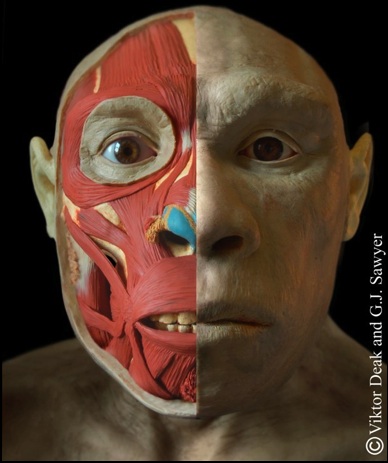
Face of the Hobbit

Real-Life 'Hobbit' Face Revealed


Date: 10 December 2012 Time: 09:35 AM ET


Researchers have revealed what the face of a controversial ancient human nicknamed "the Hobbit" might have looked like.
"She's not what you'd call pretty, but she is definitely distinctive," said anthropologist Susan Hayes, a senior research fellow at University of Wollongong, New South Wales, Australia. The female doesn't have feminine-looking big eyes and she's lacking much of a forehead.

With a background in forensic science, Hayes was able to flesh out the face of the 3-foot (90 centimeter) tall, 30-year-old female based on remains that were uncovered in the Liang Bua cave on the remote Indonesian island of Flores in 2003. To come up with this facial depiction, Hayes uploaded information from 3D imaging scans of the skull into a computer graphic program and also looked at portraits by paleo-artists of the Hobbit, finding these earlier interpretations were skewed toward monkey features; her examination, meanwhile, suggested modern features were more accurate, according to the Sydney Morning Herald.

The 18,000-year-old skeleton, officially known as Homo floresiensis, gets its nickname from its squat stature. The Hobbit would have weighed between 66 and 77 pounds (30 and 35 kilograms). Since the discovery, scientists have debated whether the specimen actually represents an extinct species in the human family tree, perhaps a diminutive offshoot of Homo erectus, a 1.8-million-year-old hominid and the first to have body proportions comparable to those of modern Homo sapiens. [See Images of Homo Floresiensis]

 
The path Hayes took to reach her facial approximation.
CREDIT: University of Wollongong
Critics have argued that the remains could have belonged to a human with microcephalia, a condition characterized by a small head, short stature and some mental retardation. But a 2007 study — which revealed that the Hobbit's brain was about one-third the size of a modern adult human's brain — found that its brain region ratios were inconsistent with those characteristic of microcephalia. "In our view we dispensed at that point with the microcelpahy hypothesis," said Florida State University anthropologist Dean Falk, in 2009 when a skeleton cast of H. floresiensis went on public display for the first time at Stony Brook University on Long Island. "It's not just that their brains are small; they're differently shaped. It's its own species."
Also in 2007, work by Matthew Tocheri, an anthropologist at the National Museum of Natural History in Washington, D.C., and colleagues found the female Hobbit's wrist bones matched, in shape and orientation, those of non-human apes; they looked much different from the wrist bones of Neanderthals (Homo neanderthalensis) and modern humans, also pointing to a new species.
The Hobbit face was unveiled at the Australian Archaeological Conference being held from Dec. 9-13 at the University of Wollongong.
Hayes, who prefers the term "facial approximation" to "facial reconstruction" for her work, said she was pleased with results.
"She's taken me a bit longer than I'd anticipated, has caused more than a few headaches along the way, but I'm pleased with both the methodological development and the final results," the researcher said in a statement.
Her work has yet to be published in a peer-reviewed scientific journal.
Follow LiveScience on Twitter @livescience. We're also on Facebook & Google+.


While I applaud Susan Hayes' attempt, it seems to me she has missed something.

This ius the midface area of the face on the Hobbit skull, the part sometiimes refered to as the "Mask". It is used in some systems of classifiucation because it is an area that has little adaptive stress to change and remains unaltered in several lineages over long periods of time.

 This is Australopithecus afarensis, an early and rather primitive Australopithecine.
The Mask area of the bridge of the nose, eye sockets and the shape of the bony structures
around them is much the same in all of the Australopithecines,
 and is also much the same in the Flores Hobbit
 
Homo habilis, an advanced species of Australopithecus, the male is on the Left and the female is on the Right
 Homo erectus, the next step us: our own genus with a much larger braincase. The face however remains very similar in this species.
 

The shape of the facial "Mask" area is most like Homo habilis, and most like the female of the species in this case.


Comparing the Hobbit facial Mask area with all of the others

Comparing the area with early "Archaic Homo sapiens" and the shapes are much less similar. this is mostly because the braincase is so much larger and higher that the vertical and the temple area does not force so much of a "Gabled roof" effect to the eyesockets at about where the brow ridges start.
 

Sunday, 11 November 2012

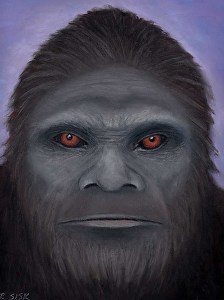
Sasquatch: The Encounter

http://rebekahsisk.fineartstudioonline.com/works/986027/sasquatch-the-encounter

Sasquatch: The Encounter

The Art of Rebekah Sisk

Sasquatch: The Encounter

Sasquatch: The Encounter
Pastel on Paper
12" x 9"
Sold
Sasquatch: The Encounter by Rebekah Sisk Pastel ~ 12" x 9"
This painting was featured on the CBS Sunday Morning News program which aired Nov. 11, 2012. You can view the video and see the painting here: https://www.youtube.com/watch?v=zF5YzheVyQA.

This painting was also discussed in the Bigfoot Field Reporter. You can read about the Executive Producer of the Lord of the Rings, Mark Ordesky, who purchased this painting: http://bigfootfieldreporter.com/wordpress/2012/10/24/exists/. He is currently filming a bigfoot movie titled "Exists" with Eduardo Sanchez, director of the Blair Witch.

Limited Edition prints of this piece, "Sasquatch: The Encounter" are available by clicking the button below:

(831)375-9663
 
As on other occasions I endorse and promote portraits of Bigfoot which I think are authentic and close to what the originals probably looked like (Based on my prior experience with what the witnesses say). This portrait falls into that category. 
--Best Wishes, Dale D.

Friday, 19 October 2012

Bigfoot Portrait Sculpture on Facebook


Recently I made friends on Facebook with a man on Facebook and he makes Bigfoot representational sculpted busts. I thought his work was quite good and so I thought I should share them on this blog. Three examples are below. They show a lot of individual character.


Once again I thought the best fit was with the known skulls and reconstructions of Heidelberg man
 as shown in examples below. Some Heidelbergers were known to grow over six foot six and possibly as much as seven feet tall, although many were nearer to more average heights for Modern men.


Recent head reconstruction of Heidelberg man below, made from one of the Atapuerca skulls.


Two different reconstructions of Heidelberg Man showing how human-like and/or how ape-like it is possible they looked in life.


Reconstruction of Heidelberg Man compared with the so-called "Iceman." The first drawing has the hair combed upwards and held up by a crude dressing, something which was done by primitives more recently.
 If the modern ones we call Bigfoot still do this, that could account for any sort of weird head shape the witnesses might be reporting

Tuesday, 14 August 2012

Tale of Two Bigfoot Busts


Alexa Evans just posted this photo of a Bigfoot head reconstruction that she had created on Facebook (above) and within minutes a reply was sent in by Jefferey Gonzalez: "News!!!!!!!!!!!! This is about the size of the head of Bigfoot that left the impression on my driver side window of my truck. " Which I assume is good independant confirmation of the accuracy of the model


When Alex had sent in her reconstruction I said immediately that I should put it on my blog together with the similar reconstruction of the Sasquatch (immediately above), primarily from the West Coast evidence and particularly referencing the head shown in the Patterson/Gimlin film. While the two models are not directl comparable (One is a male and the other is a female, and the scale is not quite the same in both photos) we can see pretty easily that the Eastern Bigfoot type is a "Big Cave Man" ewith a large head and large facial features; while the Sasquatch of the Pacific coast area is a physically larger creature, but with a smaller head (both relatively and absolutely measured)
 So I said "Put the two together and people should see immediately there are two different things"

This is another demonstration I did earlier, shown below: this sample of Bigfoot heads from different illustrations that has been going around the internet for a while. In this cae I have re-sorted them. The ones on top have noticeably more pointed heads, smaller proportionate cranial capacities, a more apish look overall and shoulder muscles that seem to flow right into the base of the skull without much of a neck. The ones below tend to have lower and rounder heads with proportionately larger braincases and faces with bigger features, and somewhat more in the way of having necks. On the negative side, a couple of them have much too short of a nose and much too long of an upper lip, which would be the artist's fault. People often describe the second series creatures as looking like "Cavemen" and the last one on this chart bears a striking similarity to the comic strip character Alley Oop.


Best Wishes, Dale D.

Sunday, 25 March 2012

Homo Sapiens Heidelbergensis: Big Daddy Is Still Around


Since Tyler Stone has divided the Wildmen category up into a larger Homo (sapiens) heidelbergensis morph and a more normal-sized  Homo (sapiens) neanderthalensis morph, and I basically was endorsing him on that I should add some further comments about that larger fossil type in connection to the possible identity for the EASTERN Bigfoot (Reconstruction of Heidelberg or Mauer man is on the left, probable inspiration for religious tract shown at top)


Above is a comparison of "Rhodey" an East Coast Bigfoot, artwork by Thomas Finley. I recognised a resemblance to a certain H. heidelbergensis reconstruction, pasted them together as a comparison and sent back a copy to him. There are probably dozens of such comparisons that could be made. This is in reference to the Eastern Bigfoot and not the West Coast Sasquatch.

I have an elaborate and thorough discussion on the over-arching category of Marked Hominids pos and then reposted here, and that category would include the Eastern Bigfoot types under discussion:
http://frontiersofzoology.blogspot.com/2011/08/cfz-repostdissection-of-and-discussion.html
As it says in that article (and as Tyler Stone has specified more  recently) there seems no good reason to make separate species for both the large-morph and small-morph Wildmen, although they both go back to well-known fossil fossil forerunners.

Below is a Geographic chart I made up combining two different reference pieces on Heidelbergensis. The area was first colonised by Homo ergaster=Homo erectus and then Heidelbergers replaced erectus. In Europe, it is not demonstrated if erectus was ever present in any quantities to speak of, most of the remains of the period are Heidelbergers. Late examples of "Peking Man" also show striking similarities to Heidelbergers and it seems the population was in the process of a changeover from one to the other. First H erectus and then H heidelbergensis persisted longest in the Orient.

The Eastern Bigfoot is most like the fossil human Homo (sapiens) heidelbergensis, also known as "Archaic Homo sapiens" The reconstruction on the left is much like the Iceman and similar to some of Ivan Sanderson's reconstructions of this type. The skeletons at the right show how heidelbergensis was unusually large among the human ancestors, as also shown in the hominid "Lineups" such as the series of skeletons shown below. Homo (sapiens) heidelbergensis individuals were often six feet six at full height. Sis foot six would be about the Russian common estimate in height for the Boreal Bigfoot, two meters in height: because the Americans are not used to the metric system they will more usually say seven fet tal on average, which is also probably not as precisely correct for that reason . Their pelvises were also enormous, much larger than in modern humans


Australopithecus,Paranthropus,Homo erectus,Homo heidelbergensis,Homo neanderthalensis,H sapiens
http://cuadernosdealfonsosalazar.blogspot.com/2009_11_01_archive.html


Homo heidelbergensis, the Ceprano Skull various views. See the longer article at bottom of this posting.
Type Specimens for Homo heidelbergensis: below, the reconstructions
http://en.wikipedia.org/wiki/Homo_heidelbergensis

Homo heidelbergensis ("Heidelberg Man", named after the University of Heidelberg) is an extinct species of the genus Homo which may be[1] the direct ancestor of both Homo neanderthalensis in Europe and Homo sapiens.[2] The best evidence found for these hominins date between 600,000 and 400,000 years ago. H. heidelbergensis stone tool technology was very close to that of the Acheulean tools used by Homo erectus


Morphology and interpretations
Both H. antecessor and H. heidelbergensis are likely to be descended from the morphologically very similar Homo ergaster from Africa. But because H. heidelbergensis had a larger brain-case — with a typical cranial volume of 1100–1400 cm³ overlapping the 1350 cm³ average of modern humans — and had more advanced tools and behavior, it has been given a separate species classification. The species was tall, 1.8 m (6.0 ft) on average, and more muscular than modern humans. Males may have weighed 100 kg (220 lb). According to Professor Lee R. Berger of the University of Witwatersrand, numerous fossil bones indicate some populations of H. heidelbergensis were "giants" routinely over 2.13 m (7 ft) tall and inhabited South Africa between 0.5 million and 300,000 years ago.[3][Including the Kabwe population/former "Rhodesian Man", but some European populations are thought to have been on a par with them. Emphasis added-DD]

Social behavior

Recent findings in a pit in Atapuerca (Spain) of 28 human skeletons suggest that H. heidelbergensis may have been the first species of the Homo genus to bury their dead.[4]
Some experts[5] believe that H. heidelbergensis, like its descendant H. neanderthalensis, acquired a primitive form of language. No forms of art or sophisticated artifacts other than stone tools have been uncovered, although red ochre, a mineral that can be used to create a red pigment which is useful as a paint, has been found at Terra Amata excavations in the south of France.

Language The morphology of the outer and middle ear suggests they had an auditory sensitivity similar to modern humans and very different from chimpanzees. They were probably able to differentiate between many different sounds.[6] Dental wear analysis suggests they were as likely to be right-handed as modern people.[7]
H. heidelbergensis was a close relative (most probably a migratory descendant) of Homo ergaster. H. ergaster is thought to be the first hominin to vocalize[5] and that as H. heidelbergensis developed more sophisticated culture proceeded from this point.

Evidence of hunting

A number of 400,000-year-old wooden projectile spears were found at Schöningen in northern Germany. These are thought to have been made by H. erectus or H. heidelbergensis. Generally, projectile weapons are more commonly associated with H. sapiens. The lack of projectile weaponry is an indication of different sustenance methods, rather than inferior technology or abilities. The situation is identical to that of native New Zealand Māori, modern H. sapiens, who also rarely threw objects, but used spears and clubs instead.[8]

Divergent evolution


Homo heidelbergensis: Steinheim skull replica
Because of the radiation of H. heidelbergensis out of Africa and into Europe, the two populations were mostly isolated during the Wolstonian Stage and Ipswichian Stage, the last of the prolonged Quaternary glacial periods. Neanderthals diverged from H. heidelbergensis probably some 300,000 years ago in Europe, during the Wolstonian Stage; H. sapiens probably diverged between 200,000 and 100,000 years ago in Africa. Such fossils as the Atapuerca skull and the Kabwe skull bear witness to the two branches of the H. heidelbergensis tree.
Homo neanderthalensis retained most of the features of H. heidelbergensis after its divergent evolution. Though shorter, Neanderthals were more robust, had large brow-ridges, a slightly protruding face and lack of prominent chin. With the possible exception of Cro-Magnon Man, they also had a larger brain than all other hominins. Homo sapiens, on the other hand, have the smallest brows of any known hominin, are tall and lanky, and have a flat face with a protruding chin. H. sapiens have a larger brain than H. heidelbergensis, and a smaller brain than H. neanderthalensis, on average. To date, H. sapiens is the only known hominin with a high forehead, flat face, and thin, flat brows.[and the characteristic drastic reduction of body hair-DD]
Some believe that H. heidelbergensis is a distinct species, Some believe it is only the earlier form of Homo sapiens,  and some that it is a cladistic ancestor to other Homo forms sometimes improperly linked to distinct species in terms of populational genetics.
Some scenarios of survival and descent include Those supporting a multiregional origin of modern humans envision fertile reproduction between many evolutionary stages and homo walking,[9] or gene transfer between adjacent populations due to gene passage and spreading in successive generations.

Discovery


Replica of the type specimen from Mauer
The first fossil discovery of this species was made on October 21, 1907, and came from Mauer where the workman Daniel Hartmann spotted a jaw in a sandpit. The jaw (Mauer 1) was in good condition except for the missing premolar teeth, which were eventually found near the jaw. The workman gave it to Professor Otto Schoetensack from the University of Heidelberg, who identified and named the fossil.
The next H. heidelbergensis remains were found in Steinheim an der Murr, Germany (the Steinheim Skull, 350kya); Arago, France (Arago 21); Petralona, Greece; and Ciampate del Diavolo, Italy.

Boxgrove Man

In 1994 British scientists unearthed a lower hominin tibia bone just a few miles away from the English Channel, along with hundreds of ancient hand axes, at the Boxgrove Quarry site. A partial leg bone is dated to between 478,000 and 524,000 years old. H. heidelbergensis was the early proto-human species that occupied both France and Great Britain at that time; both locales were connected by a landmass during that epoch. Prior to Gran Dolina, Boxgrove offered the earliest hominid occupants in Europe.
The tibia had been gnawed by a large carnivore, suggesting that he had been killed by a lion or wolf or that his unburied corpse had been scavenged after death.[10]

Sima de los Huesos


One of hundreds of handaxes found at Boxgrove
Beginning in 1992, a Spanish team has located more than 5,500 human bones dated to an age of at least 350,000 years in the Sima de los Huesos site in the Sierra de Atapuerca in northern Spain. The pit contains fossils of perhaps 28 individuals together with remains of Ursus deningeri and other carnivores and a biface called Excalibur. It is hypothesized that this Acheulean axe made of red quartzite was some kind of ritual offering for a funeral. Ninety percent of the known H. heidelbergensis remains have been obtained from this site. The fossil pit bones include:
  • A complete cranium (skull 5), nicknamed Miguelón, and fragments of other crania, such as skull 4, nicknamed Agamenón and skull 6, nicknamed Rui (from El Cid, a local hero).
  • A complete pelvis (pelvis 1), nicknamed Elvis, in remembrance of Elvis Presley.
  • Mandibles, teeth, and many postcranial bones (femurs, hand and foot bones, vertebrae, ribs, etc.)
Indeed, nearby sites contain the only known and controversial Homo antecessor fossils.
There is current debate among scholars whether Sima de los Huesos is H. heidelbergensis, or another hominin that doesn't fit in the direct line from H. antecessor to H. neanderthalensis.

Suffolk, England

In 2005 flint tools and teeth from the water vole Mimomys savini, a key dating species, were found in the cliffs at Pakefield near Lowestoft in Suffolk. This suggests that hominins can be dated in England to 700,000 years ago, potentially a cross between Homo antecessor and Homo heidelbergensis.[11][12][13][14][15]

See also

References

  1. ^ Mounier,Aurélien; François Marchal and Silvana Condemi "Is Homo heidelbergensis a distinct species? New insight on the Mauer mandible" Journal of Human Evolution Volume 56, Issue 3, March 2009, Pages 219-246 [1]
  2. ^ Rightmire, G. P. (1998). "Human Evolution in the Middle Pleistocene: The Role of Homo heidelbergensis". Evolutionary Anthropology 6 (6): 218–227. doi:10.1002/(SICI)1520-6505(1998)6:6<218::AID-EVAN4>3.0.CO;2-6. http://www.archeo.uw.edu.pl/zalaczniki/upload23.pdf.
  3. ^ The Naked Scientists: Science Radio & Science Podcasts, Our Story: Human Ancestor Fossils. November 2007
  4. ^ The Mystery of the Pit of Bones, Atapuerca, Spain: Species Homo heidelbergensis. Smithsonian Institution. Retrieved December 15, 2011.
  5. ^ a b Mithen, Steven (2006). The Singing Neanderthals, ISBN 978-0-674-02559-8
  6. ^ Martinez, I., L. Rosa, J.-L. Arsuaga, P. Jarabo, R. Quam, C. Lorenzo, A. Gracia, J.-M. Carretero, J.M. Bermúdez de Castro, E. Carbonell (July 2004). "Auditory capacities in Middle Pleistocene humans from the Sierra de Atapuerca in Spain". PNAS 101 (27): 9976–9981. doi:10.1073/pnas.0403595101. PMC 454200. PMID 15213327. http://www.pubmedcentral.nih.gov/articlerender.fcgi?tool=pmcentrez&artid=454200.
  7. ^ Lozano M, Mosquera M, de Castro J, Arsuaga J, Carbonell E. (2009). Right handedness of Homo heidelbergensis from Sima de los Huesos (Atapuerca, Spain) 500,000 years ago. Evolution and Human Behavior 30:369–376. doi:10.1016/j.evolhumbehav.2009.03.001
  8. ^ Schwimmer, E.G. "Warfare of the Maori." Te Ao Hou: The New World, #36, Sept 1961, pp. 51-53. [2]
  9. ^ Was Homo heidelbergensis in South Asia? A test using the Narmada fossil from central India Book Series Vertebrate Paleobiology and Paleoanthropology Series Book The Evolution and History of Human Populations in South Asia Publisher Springer Netherlands DOI 10.1007/1-4020-5562-5 Copyright 2007 ISBN 978-1-4020-5561-4 (Print) 978-1-4020-5562-1 (Online) Part Part I DOI 10.1007/1-4020-5562-5_7 Pages 137-170 Subject Collection Humanities, Social Sciences and Law SpringerLink Date Tuesday, May 22, 2007 [3]
  10. ^ A History of Britain, Richard Dargie (2007), p. 8-9
  11. ^ Parfitt.S et al (2005) 'The earliest record of human activity in northern Europe', Nature 438 pp.1008-1012, 2005-12-15. Retrieved 2011-04-16.
  12. ^ Roebroeks.W (2005) 'Archaeology: Life on the Costa del Cromer', Nature 438 pp.921-922, 2005-12-15. Retrieved 2011-04-16.
  13. ^ Parfitt.S et al (2006) '700,000 years old: found in Pakefield', British Archaeology, January/February 2006. Retrieved 2008-12-24.
  14. ^ Good. C & Plouviez. J (2007) The Archaeology of the Suffolk Coast Suffolk County Council Archaeological Service [online]. Retrieved 2009-11-28.
  15. ^ Tools unlock secrets of early man, BBC news website, 2005-12-14. Retrieved 2011-04-15.

Further reading

  • Sauer, A. (1985). Erläuterungen zur Geol. Karte 1 : 25 000 Baden-Württ.. Stuttgart.
  • Schoetensack, O. (1908). Der Unterkiefer des Homo heidelbergensis aus den Sanden von Mauer bei Heidelberg. Leipzig: Wilhelm Engelmann.
  • Weinert, H. (1937). "Dem Unterkiefer von Mauer zur 30-jährigen Wiederkehr seiner Entdeckung". Z. F. Morphol. U. Anthropol XXXVII (1): 102–113.
  • Rice, Stanley (2006). Encyclopedia of Evolution. Facts on File, Inc..
  • Homo heidelbergensis - The Smithsonian Institution's Human Origins Program


Geneology chart for hominids. The Neanderthals in Europe are part of what has been called "The Neanderthal stage" or "Neanderthals (sensuo lato)", including the Heidelbergers, a rather more old-fashioned classification. At the same time as Neanderthals were in Europe, the different populations in Africa and the Orient were parallels but differentiated from them. They are now called persisting H. heidelbergensis, lighter orange on the chart, and Neanderthals are only  one variety, nested within the larger general species.) since the prior name of that species or subspecies was by priority neanderthalensis (with the 'h' included), that species or subspecies is quite properly referred to as the Neanderthals. You may make the distinction between that and Neandertals, proper, if you prefer , The Neandertals or Classic Neandertals are a form isolated Ice-Age Western Europe and really one extended family, Only a couple tens of thousands of years old at the time the more modern types of  Hns appeared on the scene in Europe and replaced them. It is therefore not surprising that they were more diverged and unique than their contemporaries in other parts of the world.


Heidelberg Man 'Ceprano' Demonstrates That 'Peoples is Peoples'

from the May 17, 2011 eNews issue
http://www.khouse.org (visit our website for a FREE subscription)


An older member of the Heidelberg Man family may have related to both Neanderthals and modern Homo sapiens, according to a recent study in the journal for the Public Library of Science. The skull cap of a man known as "Ceprano", found near Rome in1994, has been determined to be a member of Homo heidelbergensis rather than a separate species. According to popular evolutionary theory, various human fossils represent separate groups that evolved from ape ancestors millions of years ago. According to the Bible, all human beings descended from the first man Adam, but most were wiped out during the time of Noah save for the strains that survived through Noah's three sons and their wives. The recent research on Ceprano offers evidence that ancient human groups were not as distinct as once thought, and that there are links between the humans who lived in Africa and those who lived in Europe.

Silvana Condemi , Director of Research at the National Center of Scientific Research (CNRS) in the laboratory of anthropology at the University of Marseille, has conducted extensive research on the Ceprano skullcap. Condemi and her colleagues compared Ceprano to 42 African and Eurasian fossils, as well as to 68 modern humans, and found characteristics that convinced them that Ceprano was an older form of H. heidelbergensis, and that H. heidelbergensis was a well-traveled human group. Ceprano's skull bore similarities to a wide range of other human skulls – skulls from early humans in both Africa and Europe.

"Considering other fossils that can be lumped together with Ceprano in H. heidelbergensis, we can hypothesize that the 'Ceprano-morphotype' was very tall, with a strong mandible (jaw) and small teeth," Condemi told Discovery News.

Ceprano's identity has proved controversial since the skullcap's discovery in 1994. It has been considered a late Homo erectus, an ancestor of H. heidelbergensis, or even a completely new species called Homo cepranensis. Condemi and company argue that Ceprano, while bearing some archaic characteristics, may actually be an ancestor of both the Neanderthals in Europe and modern humans in Africa.

According to current evolutionary theory, the first members of the Homo genus, H. habilis first showed up between 1.4-2.5 million years ago, followed by H. erectus about 1.8 million years ago. After that came H. heidelbergensis approximately 350,000 years ago and finally modern humans just 150,000 years in the past.

The most popular view of human origins – Out of Africa II "Replacement" theory - is that Homo sapiens came out of Africa between 100,000 and 200,000 years ago and replaced other humans, like the Neanderthals, largely without intermingling.
[Successive waves acing multiregional populations, such as Milford Wolpoff hypothesizes. Wikipedia image.]
[Note that Neanderthals are only one local specialization out of the more widespread H. heidelburgensis horizon]


An alternate hypothesis popularized by Milford H. Wolpoff rejects the idea that different human groups are genetically separate. Wolpoff's multiregional origin of humans hypothesis posits that there is only one human species, from archaic forms like H. erectus and H. neanderthalensis to modern humans. Wolpoff and other proponents of multiregional origin argue that the evidence from fossils and genetics points to the human race as a single species that developed different characteristics as its individual populations spread throughout the globe, adapting to different environments. Even though the populations were separated by geography, they all maintained some of the same genes.

Wolpoff's position has some good evidence to back it up. Studies have shown that H. neanderthalensis and H. erectus were not as separate from modern humans as previously thought. In 2006, researchers analyzed the DNA of a Neanderthal from a cave in Croatia, and determined that it was 99.5 percent identical to modern human DNA. In 2008, researchers at the Max Planck Institute of Evolutionary Anthropology were able to identify 60 percent of the Neanderthal genome and demonstrated that 1-4 percent of non-African human DNA came from Neanderthals.

Studies on mitochondrial DNA have claimed to show that Neanderthals were not direct descendants of modern humans. However, the Lake Mungo 3 skeleton found in Australia, an anatomically modern human, also has different mtDNA than humans today. While ancient humans like the Neanderthals and their smaller cousin H. erectus [see the May 10, 2011 eNews] may have (mostly) died out, they were just as human as any of us.

Ceprano, while previously thought to have been a separate species, now appears to be a cross between ancient Europeans and Africans, supporting Wolpoff's position that all human gene pools are linked.

"We can hypothesize that particular environmental conditions during the Middle Pleistocene may have favored the expansion of H. heidelbergensis and contacts between populations," explained Condemi. "The gene flow was never completely stopped between Old World populations."

Paleontologist Chris Stringer of the Natural History Museum, London, agreed with a number of Condemi's conclusions. He told Discovery News, "I have long argued that Homo heidelbergensis represented our common ancestor with the Neanderthals about 400,000 years ago, and the Ceprano fossil, with its newly-determined late date, is well-situated chronologically to be part of this common ancestral group."

While these scientists look at these issues through evolutionary eyes, their views correspond to the Biblical position that all human beings are ultimately related. If all of humanity but Noah and his family were wiped out, we should expect to see a variety of human groups in the fossil record, but only a relatively thin strain surviving to the present day.
Related Links:
Walk Tall, Ginger Ninjas - Your Neanderthal Blood Is Worth Bottling - The Sydney Morning Herald
Multiregional, Not Multiple Origins - American Journal Of Physical Anthropology
Heidelberg Man Links Humans, Neanderthals - Discovery News
Neanderthal: 99.5 Percent Human - Live Science
The Continuing Story of Neandert(h)al Man - Centrum voor Recht and ICT
Human Origins: Apes or Adam? - May 10, 2011 - Koinonia House eNews