Plug

Member of The Crypto Crew:
http://www.thecryptocrew.com/

Please Also Visit our Sister Blog, Frontiers of Anthropology:

http://frontiers-of-anthropology.blogspot.com/

And the new group for trying out fictional projects (Includes Cryptofiction Projects):

http://cedar-and-willow.blogspot.com/

And Kyle Germann's Blog

http://www.demonhunterscompendium.blogspot.com/

And Jay's Blog, Bizarre Zoology

http://bizarrezoology.blogspot.com/
Showing posts with label Loren Coleman. Show all posts

Saturday, 8 March 2014

Tote-Up Review

The following is my assessment of some of the Cryptid categories as given in the basic standard Cryptozoology. * indicates a category I consider to be of interest and a potential new species not catalogued by science, and the categories I would strike from the list are also indicated.  To make it easier to read I have also colour-coded it and purple indicates the Cryptid categories, black background and red print indicates the ones I would drop out

,,,,,,,,,,,,,,,,,,,,,,,,,,,,,,,,,,,,,,,,,,,,,,,,,,,,,,,,,,,,,,,,,,,,
Bernard Heuvelmans Sea Serpents:

*Long Necked A 30-60-foot (9-18 m), long-necked, Plesiosaur-shaped Cosmopolitan animal.
*"Megalotaria" an uncatalogued Walrus-sized sea lion (as a separate spinoff category)  

Super Eels: A group of large and possibly unrelated eel-shaped fishes. 
Partially based on the "Leptocephalus giganteus" larvae (Which includes two unrelated kinds also)
*"Megaloconger" the 30 foot long kind (as a separate spinoff category) 
*"Titanoconger" the 60-100 foot (18-30 m) long kind (as a separate spinoff category) 

*Marine Saurian: A 50–60-foot (15–18 m) sea crocodile,
 *Mosasaur (or Pliosaur) 60-100 foot (18-30m) long (as a separate spinoff category) 

VOID CATEGORIES:

Merhorse  A 60-100 foot (18-30 m), medium-necked, large-eyed, horse-headed pinniped. Maned and often has whiskers.   

Many-Humped  A 60–100-foot (18–30 m), medium-necked, long-bodied archaeocete. It has a series of humps or a crest on the spine like a sperm whale's

Super Otter A 65–100-foot (18–30 m), medium-necked, long-bodied archaeocete that resembles an otter. It moves in numerous vertical undulations

Many Finned  A 60–100-foot (18–30 m), short necked archeocete. It has a number of lateral projections that look like dorsal fins, but turned the incorrect way.

Yellow Belly: A very large, 100–200-foot (30–61 m) yellow-and-black-striped, tadpole-shaped creature. Dropped. (Could still count as a larger form of whale shark)

Father-of-all-the-turtles: A giant turtle. Dropped.
 .
Loren Coleman and Patrick Huyghe (Additional Categories)

Mystery Cetacean: A category of uncatalogued whale species including
   *Unknown porpoises and dolphins
   *Double finned whales and dolphins,
   *Dorsal finned sperm whales,
   *Unknown beaked whales,
   *Unknown orca,
   *Walrus-tusked whales and others. 
Mystery Sirenian:
   *surviving Steller's sea cow
   *and possible African freshwater dugongs 
*Giant Beaver 
   *Giant Otter (as a separate spinoff category) 
*Mystery Monitor
   *Mystery Iguana (as a separate spinoff category)
*Mystery Sharks

Mystery Manta (Possibly known species)
Mystery stingrays (as a separate spinoff category) (Possibly known species) 

 Mystery Salamander (Known species)
Big Fishes (Sturgeons, alligator gars, pikes, catfishes, paddlefish and others)  (Known species)     

Giant Octopus, Octopus giganteus or Otoctopus giganteus:   (VOID)
*Northern Colossal Squid (as a separate spinoff category) (Possibly a new species)

VOID CATEGORIES:

 Classic Sea Serpent: A quadrupedal, elongated animal with the appearance of many humps when swimming. Essentially a composite of the many humped, super otter, and super eels types. The authors suggest Basilosaurus as a candidate (Standing Wave)

Waterhorse: A large pinniped, similar to the long necked + merhorse. Both of their eyes are rather small. They are noteworthy for being behind both salt and fresh water sightings.
(Maned, horned, with prominent ears and beards, one prominent shoulder hump and occasional cloven hoofprints when they come ashore=Swimming Moose)

Cetacean Centipede (the Many-finned SS)  (Row of Dolphins or small whales)

                         
Loren Coleman and Patrick Huyghe (Abominable Snowmen Categories)

1. *Neo Giant (Reverts to possible Gigantopithecus after Krantz)
    *Subgiant (Tropical Africa)> (Possible robust Australopithecus sp)
2. True Giant (VOID) (Reverts to possible Gigantopithecus after Krantz,ie, included in Neo Giants)

3. Marked Hominid (a Homo sapiens variety) (Known species)
4. Neanderthaloid (a Homo sapiens variety) (Known species)
5. Erectus Hominid (a Homo sapiens variety) (Known species)
6. Proto Pygmy (a Homo sapiens variety) (Known species)

7. Unknown Pongid (Generally Orangutan varieties) (Known species)

8. Giant Monkey
    (>*Isnachi in the New World) 
9. Merbeing >
     (Chupacabras) (VOID) +
    *?Freshwater Monkeys after Tyler Stone
    *?Merfolk (Basically allowed to stand)
               
Ivan T Sanderson Abominable Snowmen: Legend come to Life

 Of Sanderson's four categories, only the *Neo-Giants remain as an open category (as above), and in this category we follow Heuvelmans' example and defer to Grover Krantz.

Bernard Heuvelmans, On the Track of Unknown Animals


Contents
4Nittaewo, the Lost People of Ceylon91
5Orang Pendek, the Ape-Man of Sumatra119
6The Not So Abominable Snowman (All possible Orangutans)143


7The Surrealist Dinosaur of New Guinea (Hoax)
                                                            > *Giant Monitors
219
*8The Incredible Australian Bunyips  (> Seals )
                                                             and > *Giant Monitors,
                                                              *Giant "Demon Ducks"
226
9The Queensland Marsupial Tiger251
*10The Moa, a Fossil that May Still Thrive
                                                  *Small Turkey-sized Moa
                                                  *Medium Emu-like Moa
                                                  *Large Moa like Dinornis
262
11Waitoreke, Impossible New Zealand Mammal (Probable imported otter)293


12The Patagonian Giant Sloth > * Equatorial Forest Ground sloths301
*13The Giant Anaconda (*Sucuriju Gigante)
 and Other Inland 'Sea-Serpents' (*Dormador or Black Boa)
338
14Apes in Green Hell (Possible Apes: Mono Rey
                                                     *And Mono Grande)
363


15The Mammoth of the Taiga (Possible Survival but Possibly Now Extinct)397


16Three Large Pygmies: the *Forest Rhinoceros (African Unicorn),
 the Water Elephant  (Forest elephant, known species)
and the Spotted Lion (Lions are a known species)
427
17The Nandi Bear, an East African Proteus (+Possible Unknown Brown Bear possibly involved, Brown bears are a known species)445
18Mngwa, the Strange One  (Possibly a giant Golden Cat in Mottled phase)495
*19The Little Hairy Men (*Gracile Australopithecus)503
*20The Dragon St George Did Not Kill (*Giant Monitor Lizard
                                                        *Unknown Robust Crocodile
                                                        *Unknown Giant Otter)
520
21Kongamato, the Last Flying Dragon  (Possible Freshwater Stingray)582


*22 *Vorompatra (>Lesser Elephant Bird),
*Tratratratra, (4 Possible Giant Lemur Survivals) etcetera

Sunday, 8 December 2013

More Longneck Reconstruction Comparisons 2

water_horse_by_giniwolf-d4sazyp
Traditionally the Water Horse is an animal found near the water that looks like a horse. It looks pretty much EXACTLY like a horse but a little "Off" or "Deformed" and it can have such features as "Devilish" cloven hooves.
http://en.wikipedia.org/wiki/Water_Horse
http://en.wikipedia.org/wiki/Kelpie

The Water Horse from Wikipedia
It is my contention that the legend of the Water Horse was merely and Naturalistically a description of the moose (or elk in Europe) in suppost of this I have shown clear illustrations  of moose or elk from Scotland n the 700s and in the 1700s. It is also my contention that the symbolic "Pictish Beast" also shows a moose. Later on as the elk got rarer the stories took on more of a mystic and mythological slant, but reports of the creature continued in tradition on into modern times. At present there are some parts of the world where elk are still called "water horse" and "water cow"


The Long-necked Plesiosaur is a different creature and has a different mythology, as a "water Dragon", but more especially as a "sea serpent." It might seem that there is too great of a difference between the two for there to be any confusion, but in fact, a big moose has a body that is nearly comparable in size to a moderate-sized Plesiosaur such as the reports describe: 
 
But it is because we have a tradition in Cryptozoology that conflates the two, many authors have created a composite category for Freshwater monsters that they call Water Horses. Below is the illustration from Loren Coleman and Patrick Huyghe's book The Field Guide to Lake Monsters, Sea Serpents, and Other Mystery Denizens of the Deep(2003) under the heading "Water Horse":
 
(The female is supposed to be above and the male below)
However, the sizes given are extracted from sightings at sea (and they admittedly include accounts where the wake was not distinguished from the creature making the wake and so the estimated length as given is really the length of the wake in such estimates. In freshwater accounts the creatures are makedly smaller and Peter Costello's In Search of Lake Monsters suggests that the estimated length sould be shortened to up to 20 feet long for females and up to 30 feet long for males: Roy Mackal in The Monsters of Loch Ness similarly downsizes the size estimates to comparable lengths. These estimates for the length can be commonly downsized to 15 to 20 feet long as given by some authors and as specified in several sightings, especially those seen on land. At that point, the size estimates are low enough to plausibly be comparable to the sizes for elk or moose. Hence the comparison below. More importantly, the specifications of the head are that it is precisely the size and shape of a moose's head, and with several features specific to moose anatomy that are not found in seals.


In the case of Jay Cooney's Water horse illustration at Bizarre Zoology, the equivalent of Colemans' model  is  the creature in the artwork posted below:
 
 
The skull of the animal featured has some freatures which are shared with the skulls of moose and NOT with seals, and these include complete bony eye sockets and long low nostrils  projecting in front of where the teeth are (The front part of both jaws would be broken off). Both features are completely different from seals and in fact they ARE features as specified in the reports. The eyes are supposed to be situated high up on the head with definite bony sockets projecting around them, and the nostrils are at the tip of the long and overhanging snout, with the nostrils being very large and round when they are open. Furthermore this is the type of Sea serpent snout that is stated to have whiskers on it: this is stated by Pontoppidian and carried forward by Oudemans, who repeats him
(The Great Sea Serpent 1892, pages 135 for Pontoppidian and 141 for Oudemans)


This is essential the same comparison for Coleman's Water Horse and the moose as repeated for Cooney's version (The artist is Thomas Finlay, who does excellent work, and in this case he is merely illustrating what he has been told to illustrate) 
 
Below some of the characteristically mooselike features of the reports are pointed out, and this includes the ears and nostrils of an ungulate-basically belonging to a land animal and not well adapted to life at sea. The hump on the back at shoulders and hips is indicated, the upper parts of the limbs are alsi indicated, and the rear edge of the rear "Flipper" has the contour of the moose's hind leg": the end of the flipper also resembles a cloven hoof (Costello said "3-pronged" but he definitely included reports of cloven hooves when he said that) The tail is even somewhat indicative of a moose's tail and the "Beard" is indicated as part of the moustache when in the reports (such as in the case of Ogopogo) the beard definitely means the bell at the moose's throat. Several reports also include moose antlers, but most often the initial antler spikes in velvet.


As regards the length of the neck, the reconstruction which Cooney has is nowhere near as long as the reports Heuvelmans says are specifically Longnecks  but instead the length of the neck is comparable to the Merhorse category, which he considered to be separate. See the comparisons above and below


The length of the Longnecks neck is its most outstanding characteristic and it is comparably long in the presumably male Longnecked "Merhorse" (In the illustration below the mane is recognized as a fleshy material and it is called a "fin") In these cases, when the neck is in a vertical aspect to the water, the body is NOT stretched out horizontally behind it but it is presumably held at some angle approaching vertical in the water. In such cases the degree of underwater drag of the creature holding it in place relative to the wave action at surface is also noted "As if it was dragging a sea-anchor"
 
 
I have recently left some remarks pertaining to these matters at Jay Cooney's blog:
 

The portions underwater are inferable from indications at the surface and for the most part these proportions are consistent with one another over the past 250 years or more, and at scattered locations the whole world over, in many reports made independently from one another

 In this case the proportions of the Cuba Sea Serpent are compared to the general composite model. The Cuba SS was seen briefly all out of the water at one time when it breached.
 
Umfuli SS, after Captain Cringle

And I had also remarked that the proportions of the Umfuli SS wre also about the normal proportions with the head+ neck and the trunk each being about 15 feet long (NB some reproductions of the Captain's drawing also indicate specifically Plesiosaurian features of the head)

Cooney's model for Longnecks + Merhorses is compared below to the sections from the Cuba SS sighting specifically. This does not indicate the limbs although the witness noted that the creature's anatomy indicated where the foreflippers and hindflippers would be situated. I consider the neck profile drawn by the Captain in this case to be very much exemplary as showing the features of all the best and most accurate descriptions, and the head neck and body as shown to be well streamlined .


Below once again is my general-overall reconstruction identikit for the Longnecked Sea Serpents or Water Dragons generally, and with the specific Water Horse (Moose) reports subtracted. This is the outcome of several local statistical surveys based on In The Lake of The Sea Serpents and In Search of Lake Monsters done in the 1970s and I consider this model to be in good agreement with the creature models proposed by Dinsdale and Sanderson, and somewhat less to Gould's and Mackal's  versions of the Loch Ness Monsters and in the general ball park of agreeing with Oudemans' and Heuvelmans' models with allowances. When you get to the point of comparing Oudemans' and Heuvelmans' reconstructed models there are some very obvious conflicts in the reconstructions which are not in agreement with the reports and must needs be accounted for. This is all summarized from earlier blog postings which have discussed the matter before.

The tail is seen when diving and is then described as being divided into three  parts the third "Lobe" being the actual tail itself, or possibly only two "Prongs" will be reported" Costello has reports in either category and the "Snollygaster" (Among others) is also said to have this three-lobed tail.


And, just for good measure, here is that Plesiosaur illustration again, shown to scale with the Scottish version of the Master-Otter for scale
(Presumably the same as Burton's Monster otter. Illustration by Tim Morris on Deviant Art)

Thursday, 12 September 2013

Eastern Bigfoot, New Demonstrations


A facebook Friend of mine sent me photos of a variety of casts he hasd made in the Midwestern part of the US (mostly in Ohio I think. I selected two that I thought were exceptionally representative of the "Ape" (Swamp Ape/Wood Ape) and more humanlike (Actually Neanderthaloid) tracks out of the dozen or more examples that were on display. Both kinds are called Skunk Apes in Florida and Brush Apes (etc) in Texas. I also added drawings of the equivalent foot bottoms for an actual ape and a human being, from a textbook illustration that went on display on this blog a while back. I hoped to get a better impression of the "Long and thin" types of ape footprint which more closely resembles an orangutan's foot.

Here is a selection of the Unknown apes from around the Pacific rim All of them seem to be just variations on the orangutan and derived from the ground-dwelling "Fossil Pongo" that inhabited China about the same time as Gigantopithecus. The fate of their classification in general depends on decisions regarding some of the samples that we already have. If the Yeti DNA samples, Orang Pendek hair samples, Yeren samples and even the "Fossil Pongo" are all classified in the same species as the commoner orangutans, we will not have a Cryptozoological situation, we will only have an expanded range for a known species. At present tis is a quandary.
             .
 
Neanderthal as Wildman from "Yowie Hunter"
 Our other problem is that the "Hairy Cavemen" such as the Neanderthals turn out have interbred with us and so they were the same species as the rest of us. Furthermore at some point in the development of our species, the hairless tropical mutant form at some point broke out into the territory of the more cold-adapted Northern forms of our species and predominated over them. The situation follows this  mock-up:
  And presumably this is the end result of the "out of Africa"movement.

But that means that the hairy wildmen that persist in pockets of wilderness worldwide (and which includes both pygmy, normal-sized, and giant variations) Is only another kind of people. That was my conclusion made decades ago and Im sticking to it. The problem is that these "Hairy Primitives" (as Ivan Sanderson called them) are also not Cryptozoological subjects they are a known species
(Below is what could be called a cosplay for "Old Yellow-top, a Canadian example of the more manlike Eastern Bigfoot.)

The Tote-Up

http://forteanzoology.blogspot.com/2010/08/dale-drinnon-mystery-primates-tote-up.html
Coleman et al, in The Field Guide to Bigfoot... also gives nine categories, thus:
1. Neo-Giants, (=)
2.* True Giants (Gigantopithecus),


3.x  Marked Hominid, (=)
4.x  Neandertaloid, (=)
5.x  Erectus Hominid, (=)
6.x Proto-pygmy,

7.x*  Unknown Pongid,
8.x * Giant Monkey,
9. Merbeing,

-out of which I discount as separate categories the true giants, marked hominids, Neandertaloids, erectus hominids and proto-pygmys, and the last four of these on the grounds that they are not only probably variants of one species, but that species is most likely not separable from Homo sapiens. I retain the categories neo-giants, unknown pongid, giant monkeys and allow the mer-beings but also keep that category as a questionable status. [There is a good chance that many if not most sightings in the Unknown Pongid and Giant Monkey categories are of animals in known species and the categories are also invalid for that reason]

In this case, the categories unknown pongid, giant monkey and merfolk are NOT unified categories representing a single cryptid as a single species per category. The categories are thus also invalid as formulated. However, in each of those categories I have also eliminated some candidates such that the unknown pongids of Africa are removed from unknown status - they are very likely displaced or unusual chimpanzees and gorillas. The remaining Asiatic and American pongids are all mostly like orangutans and do form a recognisable sequence, although they may not belong to the same species ... By the same token, ALL of the giant monkeys are very likely merely outsized monkeys of known species, except for the South American Isnachi. It should be noted that it was a major error to make one category for both Old World and New World monkeys in the same group.


ADDITIONAL:
My Friend Jeffrey Patterson on Facebook has a collection of some pretty recognizable faces found in so-called "Blobsquatch" videos. One of the recent ones he has sent to me has that distinctive "Caveman" look: it is an Ohio "Grassman"


I told him that one was clear enough I could probably recognize him if I should see him again.
And another one from a 2008 video posted on YouTube is a clear profile of a young ape:
 
And I am very nearly 100% certain both of these are exactly what they seem to be at first glance. They are the more humanlike and more apelike versions of the Eastern Bigfoot, Swamp Ape, Skunk Ape or Wood ape. And typical of both categories over much of Asia, Australia, North America and South America. And neither of them are really at all mysterious when you come right down to it.

Wednesday, 11 September 2013

The 'Merfolk-Chupacabras' of Coleman/Hughe Field Guide as Compared to Tyler Stone's Freshwater Monkeys

Quoting from an online review of Loren Coleman's opinion of "Merbeings"

 Cryptozoologist Loren Coleman and Fortean researcher
Patrick Huyghe devote a whole chapter to "Merbeings,"and summarize a
number of actual "Merbeing" sighting reports, in The Field Guide to
Bigfoot and Other Mystery Primates (Anomalist Books, 2006). Coleman
and Huyghe list the "Merbeing" as the ninth and last of their nine basic
categories of  possibly real unknown primates sharing our planet
with us, including also the Neo-Giant (including the "classic" or
"standard" North American Bigfoot/Sasquatch and Himalayan Yeti), True
Giant, Marked Hominid, Neandertaloid, Erectus Hominid, Proto-Pygmy
(including Sumatra's Orang pendek and Flores Island's  Ebu gogo),
Unknown Pongid, and Giant Monkey. They further subdivide the "Merbeing"
into two distinct subtypes, a more fishlike, fully aquatic sea-going
marine variety including the traditional "Mermaids" of Western legend,
and a bipedal semi-aquatic freshwater variety including the Latin
American Chupacabras, Japanese Kappa, Madagascar Kalanoro,
and North American "Lizard-men."

"The Merbeing, or water creature," Coleman and Huyghe note at the
beginning of their "Merbeing" chapter in The Field Guide to
Bigfoot..., is "perhaps the most traditional of all the undiscovered
nonhuman primates" (Loren Coleman & Patrick Huyghe, **The Field Guide
to Bigfoot and Other Mystery Primates**, p. 37). "Perhaps
surprisingly," however, "the Mermaids and Mermen of ancient lore are
still being seen today," though in seemingly far fewer numbers than
formerly. Yet this group of aquatic beings "ranges far beyond the
Merpeople of yore" and also includes creatures like "the Sea Ape of the
Bering Sea, the scaly-looking but actually hairy and misnamed Lizard
Men, and the fiery-eyed Latino phenomenon known as the Chupacabras."
Likewise, "Asians have been aware of their Kappa and other Merbeings
for centuries" (Coleman & Huyghe, The Field Guide to Bigfoot..., p. 37).

Merbeings, Coleman and Huyghe note, "appear to come in two varieties,"
marine and freshwater. The "marine subclass" is "distinguished by a
finlike appendage," while the freshwater subclass is "characterized by
an angular foot with a high instep and three pointed toes." The
Chupacabras, Kalanoro, and "Lizard Man" freshwater merbeings are
"often found venturing onto land" and are "far more aggressive and
dangerous, being carnivorous," than the "calmer" marine type** (Coleman
& Huyghe, The Field Guide to Bigfoot, p. 37).
[Personally I do not count the Kalaorno, either]

Merbeings vary in height, according to Coleman and Huyghe, from dwarf to
human-sized. Their bodies are "strong, bit not stocky or bulky." Marine
Merbeings have smooth skin, sometimes with a very short "fur," while the
freshwater type sometimes has patchy hair growths that appear "like
leaves" or "scaly," giving a reptilian impression responsible for the
popular name "Lizard Men." In both types, the hair is often "maned,"
though "some exhibit almost complete hair cover, especially in the
Chupacabras kin." Merbeings generally have oval or almond-shaped
eyes, "perhaps due to their watery origins." These "mostly nocturnal
creatures" have a "singsong vocalization," which has been "reported
almost universally from Eurasia to Africa" (**Coleman & Huyghe, The
Field Guide to Bigfoot, pp. 37-38).
**Coleman and Huyghe  suggest a relationship of the freshwater Merbeings--the
Chupacabras, Kappa, "Giant Frog", and "Lizard Man" types--to the
"prosimians" (primitive primates) known as the loris and potto,
especially the potto. Freshwater primates, they point out, often display
a row of spikes along their backs, a "rather unknown but not[?Completely] unknown
feature among primates." In the potto, a cat-sized African loris, the
spines of the last neck vertebra and first thoracic vertebra penetrate
the skin and are capped with horny spines. When the potto is threatened,
the spines stand up so that a predator can't bite it on the neck.
Also--while freshwater Merbeings appear to be three-toed, the potto has
an enormous big toe pointing in the opposite direction from its third,
fourth, and fifth toes, and a vestigial second toe reduced to a lump
bearing a cleaning claw. "So much for primates not having weird digits
and spines on their backs," they remark **Coleman & Huyghe, The Field
Guide to Bigfoot..., p. 38).*

*The "whole body of lore on Merbeings," Coleman and Huyghe believe,
"appears to have basis in reality and is not all myth," as "Credible
sightings have occurred." On the other hand, they feel, the "increased
activity or visibility of the _/chupcabras/_" and the decreased reports
of oceanic Mermaids and Mermen may "signal a shift toward the successful
survival of the more aggressive freshwater, land-oriented sublass" of
Merbeings. Sightings of Louisiana's "scary, triple-toed Honey Island
swamp monster," Canada's "three-fingered and three-toed Thetis Lake
monster," South Carolina's "similarly digited Scape Ore Swamp Lizard
Man." and the Latin American Chupacabras suggest that "the most
dangerous Merbeing variety is presently at the head of its class."
**(**Coleman & Huyghe, The Field Guide to Bigfoot_, p. 38).

I find that Tyler Stone's revision of the Freshwater Monkey category was constructed as a substitute for Coleman and Huyghe's freshwater Merbeing. the Fit is usually good enough, but the understanding about the Chupacabras in particular needs more clarification. My impression is that we have identified the "Freshwater Merbeing" pretty well but it is NOT what is being sighted and called a "Chupacabras." and there is a question about how frequently they are called "Swamp Monsters" and/or  if the "Lizardmen" really belong with the rest of the sightings of basically smaller creatures. I have been finding more sightings of the "Thetis Lake Monster" types in other lakes in British Columbia as well, so there is evidently indirect indication that the tradition does exist locally and some of the sightings could be legitimate at Thetis Lake. The Freshwater monkeys do NOT have spines but they have longer hair on the head and back, called a mane, and locks of it can stick together  to be called spines or scales

http://frontiersofzoology.blogspot.com/2011/08/freshwater-monkeys.html
http://frontiersofzoology.blogspot.com/2012/02/freshwater-monkeys-and-other.html
http://frontiersofzoology.blogspot.com/2011/12/more-freshwater-monkeys-sprites.html
http://frontiersofzoology.blogspot.com/2012/03/chaneques.html
http://frontiersofzoology.blogspot.com/2012/03/some-speculations-on-freshwater-monkey.html

Europe: Watersprites and Goblins
 
Kittelsen_TheWaterSprite

Japan: Kappas

NWCoast Area and S Alaka: Kushtaka the Otter Man 

 
 Chaneques, Mexico

 
"Baby Chupacabras" as produced bya Japanese Toy company
 
Honey Island Swamp Monster, possible adult male with fully dry fur fluffed up


Macaque monkey going swimming
Some modern macque monkeys do go in for wading
 and swimming, and they can and do find food in there
 
 And for reference again the Line-up of the types to scale (Paste-up and editing by Dale D)


Monday, 29 April 2013

Native Portrait of Surviving Native North American Lion?

A Native painting made before the end of the Civil War in what is now the Southwestern part of the USA which possibly represents the Native Lion (Surviving La Brea Lion or Panthera leo atrox) is found at: SOURCE

Here is the painting:

San Ildefonso Pueblo Painting of Lion and Avanyu

 Tony Pena
  • Category: Paintings
  • Origin: San Ildefonso Pueblo
  • Medium: Watercolor on Paper
  • Size: 6-1/4" x 10-1/2" image; 15-1/2" x 19-5/8" framed
  • Item # 25276
  • Price: $1,500.00

The only reference I have found for San Ildefonso Pueblo artist Tony Pena is a Laura Gilpin photograph of him wrapped in the Chief White Antelope blanket that was found on the body of Chief White Antelope after the infamous Sand Creek Massacre in 1864. The blanket resides at the School for Advanced Research in Santa Fe.
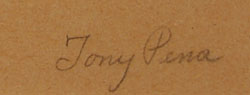
Tony Pena signatureThe Gilpin photograph is published in full color on the cover of Quiet Triumph, Forty Years with the Indian Arts Fund, Santa Fe. The booklet was published by Amon Carter Museum of Western Art, Fort Worth, in 1966, on the occasion of an exhibition of the collection of The Indian Arts Fund of the School for Advanced Research.

Pena is not listed in any of the standard reference books of Native American painters at my disposal. Antonio Pena, the husband of Juanita Pena, was a painter of her black-on-black pottery, and it is possible that this painting is by him as he signed his name as Tony on her pottery.
The subject matter of this painting is quite interesting in that it features a lion straddling an Avanyu (water serpent)—one creature being [presumably] native to New Mexico and the other certainly not native. I am aware of another painting by Tony Pena of a similar subject. Both paintings came from the collection of former Santa Fe resident and dealer Richard M. Howard.
The painting is signed Tony Pena in lower right but not dated. It is in original excellent condition and is beautifully matted and framed.
Provenance: ex. coll. Richard M. Howard, Santa Fe

  • Category: Paintings
  • Origin: San Ildefonso Pueblo
  • Medium: Watercolor on Paper
  • Size: 6-1/4" x 10-1/2" image; 15-1/2" x 19-5/8" framed
  • Item # 25276
  • Price: $1,500.00

I mention this because there are other more recent sightings in supposrt of such a creature as listed by Mark Hall, Loren Coleman (Mysterious America) and others.

Although this is interestng it is not strictly Cryptozoological, since the lion species is known to be still living in other parts of the world. Also, there is also rock art ( there are Petrogyphs) which may mean to show such an animal and I am told one of the names for it was "Buffalo Lynx" (or really big and robust kind of a lynx, in the Native conception)
--Best Wishes, Dale D.

Saturday, 27 October 2012

Extreme Expeditions The Debate Continues

Statement from Extreme Expeditions through Lori Simmons
 (Who is a Friend of mine on Facebook):


I stand by our research 100% This was my father's discovery and his research area of 28 years, were the team and I researched and I visit on a regular basis. For us the activity that we experienced is truly mind shocking. It takes you ou...
t of everything you have ever believed in. This is an area that I'm continuing to build the trust with them. If your in their area they will let you know they are there if they want you to know...They obviously felt comfortable with the team being there with me. We experienced activity during the entire 10 days we were there. When I got home I felt like I just got back from Mars... I know as a researcher you have to keep an open mind because anything is possible. Throwing tomatoes is one thing but slander is another ballgame!
See More

It’s a shame that people have resorted to personal defamation of character with regards the images we posted recently from our last expedition.

We don’t mind that people have a variety of opinions, that’s why we put the images out there, but when people start to post images that openly attack your character and integrity, then that’s a step in the wrong direction or perhaps I am taking it too se...


riously?

Adam and I have been all over the world these last 14 years, and have sacrificed a great many things to indulge this curiosity in unknown animals, but we have always been honest and open about our findings or lack of, and those that know us will vouch for this. We’ve brought back whatever evidence we can to try and help explain away the mysteries and always submitted this to experts in their field, accepting their analysis - all we have ever said we are is field researchers – the science and clarification – we leave to others.

So, coming back from the States, we kept to the same tack we always have, to freely share our images and research, once anything that stands out from the norm has been analysed. Forgive us that we set up a camera in camp to capture any night-time wildlife, that the many other cameras that we placed on trails and deep in the forest captured nothing suspicious. We didn’t set it up with the intention of capturing anything other than raccoons (which we never saw) or any other kind of forest denizen. When we found something on a photo that wasn’t one of the team - that wasn’t someone in a sleeping bag as neither of the people outside that night had baffles or hoods to keep them over their heads, that wasn’t one of the two people on the team that smoked - one snored happily all night, every night, the other on that night was asleep on the ground who, if he had woken up for a smoke at 2:30 in the morning, I’m sure he would have remembered and shared it with the team when we all tried figuring out what the image was on camera – we couldn’t explain it away. But it certainly made us think and discuss it. Enough to get it analysed by people who could come to no confirmed conclusion so we, (now I personally realise), naively, thought – “this would be good to share with the community to see what they think.” – and that was our only and ever intention.

People will always have their opinion and we respect that – we could say a hundred times – “it’s not one of the team in a sleeping bag” – but someone will say a hundred times that it is. There is no issue with that, we have said we don’t know what it is, that we were in an area known for Bigfoot activity, but we certainly know that it isn’t one of the team or a wandering person in our camp. That’s OUR opinion.

People have done their own independent research into it and spent hours analysing it since its release, others have just said “sleeping bag” and left it at that. Either way – to us it’s just an interesting image that isn’t one of the team that we wanted to share.

What I personally feel is a step too far is people creating elaborate explanations for the picture and releasing character defaming images, when they haven’t even had the decency or professionalism to get in touch, to find out our side, to find out what else we did or didn’t do.

Hoaxing? Personally – I couldn’t be bothered and certainly am not interested – I do this for my own curiosity, not for the attention or the appraisal of others – and then I wouldn’t even know where or how to start – I would rather have gone to the States, experienced some of the area, got a feel for the legends and come back with no evidence – as it is – we came back with an interesting image, and I came back having nearly lost an eye and I’m still receiving medical attention 6 weeks later.

Sandy
Extreme Expeditions Ltd


Bigfoot Evidence 1

The Full Disclosure: Extreme Expeditions Photographs


World's only 24/7 Bigfoot News Blog: Encouraging readers to draw their own conclusions from the
evidence and arguments.


Editor’s Note: This is a post by Bigfoot Evidence contributor, Damian Bravo. You can join his Facebook group, Sasquatch Lives?.

The Extreme Expeditions Group gives full disclosure and Exclusive of more Photos and Info from the Supposed Strange Figure Sighting on SEP 4th, 2012 to Bigfoot Evidence. (The Debate rages on)

Read More

Bigfoot Evidence 2

Saturday, October 27, 2012


Michael Merchant Really Doesn't Want To Believe Adam Davies Or Lori Simmons


Was it a mistake for the Extreme Expeditions team to release the trailcam photographs? Cryptozoologist, Adam Davies and researcher, Lori Simmons must feel extremely frustrated right now, and we don't blame them. Just this morning, Loren Coleman pulled an article from Cryptomundo titled, "Davies Expedition’s Alleged Hoax", suggesting the "creature" photo is fake: "Extreme Expedition's #Sasquatch is supposedly a FAKE! #Silliness #Stupidity". Coleman wrote the following as the reason why it was removed:
 
Read More

Tuesday, 20 March 2012

Mystery Primate Omnibus, Part Deux

[Tyler Stone had done a reclassification of Mystery primates worldwide, basically an attempt to reconcile my clasification and Sanderson's With Loremn Coleman/Patrick Huyghe/and Harry Trumbore's Field Guide to Bigfoot (etc) version. Tyler also asked for my evaluation and opinion on it. So in order to do that I shall be reprinting his version and replacing the illustrations. -DD]
http://titanoceratops.blogspot.com/2012/03/mystery-primate-omnibus-sort-of.html

Monday, March 12, 2012

The Mystery Primate Omnibus (Sort of) (Part Deux)

Having looked at the primate classification schemes proposed by Ivan Sanderson, Mark Hall, Loren Coleman and Patrick Huyghe, and Dale Drinnon, I have tried to create a classification scheme that encompasses all of their ideas and puts the animals into proper groupings. In this case, I think Sanderson's original classification is the most accurate, but that each one made after adds important sub-groupings, which I've included here. They are sorted from "most manlike" to "least manlike" in the style of Sanderson. Alright, here goes nothing.
Comparison by Dale Drinnon of four basic cryptid primate types, including my Freshwater Monkey!
Image from frontiersofzoology.com

[Below, a series of skeletons for the basic types of hominids: Gracile and Robust Australopithecines, Homo erectus (Third from Left) Heidelberg (Hs heidelbergensis, third from Right), Neanderthaler (Hs neanderthalensis, second from Right) and modern Homo sapiens at far right. Heidelbergers were sometimes even taller than  modern humans on the average and did regularly reach two meters tall: this drawing makes the Heidelberger skeleton probably way  too thin and even the arms too short. Neanderthals and Heidelbergers are at least conspecific to each other, and many experts say that both are only forms of Homo sapiens anyway]
I: WILDMEN
Maurice Burton's Neanderthals, comparable to the Central Asian Almas


Reconstructions for Homo heidelburgensis, comparable to reports of the Chuchunaa and such. Actually the Western European Neanderthalers are best thought of as a localised and specialised variant of the more generalised and cosmopolitan species H. sapiens heidelbergensis: the comparable "Neanderthaloids" of Africa and East Asia are  now all supposed to be heidelbergensis.


Drawings for Eastern Bigfoot, the most familiar North American form of Wildman. At Left, drawing of a sighting feom Georgia and at Right a close-up reconstruction of the face.

Male and Female Wildmen, reconstructions for H. heidelbergensis
These are usually man-sized and have hairy, human-like bodies and faces, large eyes, long head hair and beards, and calloused pads on their hands and knees. They either go naked or wear clothing made from bark or animal pelts. They variously leave tracks that are shod or barefoot. While all are members of the genus Homo, they appear to come in two basic types.
Neanderthaloids, after Coleman and Huyghe, reside in mountain forests and taiga throughout Eurasia and Eastern North America (although some may be present in South America) and are locally known as Trolls, Chuchunaas, Barmanus, Almases, Wildmen, Yeren, Bushmen, Wendigoes, and Eastern Bigfeet. They are 5-7 feet tall with robust features. They range from being culuturally destitute, making only basic stone tools and using fire, to quite advanced, building primitive huts, using fire-steel, and creating complex tools from stone and wood. They frequently wear animal pelts to keep warm, and are often seen hunting big game. All of their features suggest that they are surviving Neanderthals.
 [Actually, they are in two size categories basically, one standard-human size or between 5 and 6 feet on the average, some local populations taller and some local populations shorter. These are the Almas types. the Subarctic population tends to be larger, AVERAGING at about 6'6" (Asiatic references) or 7 feet tall (American references): they CAN be reported as up to 8 or 9 feet tall-DD] 


Erectus Hominins, again borrowed from Coleman and Huyghe, are restricted to Southeast Asia and Australia, where they are variously known as Wildmen, Nguoi Rungs, Batututs, Sedapas, and Yowies. While generally man-sized, dwarf versions exist in Indonesia. They use primitive tools like clubs, but do not appear to have the ability to use fire. While the other Wildman category belongs to Homo sapiens, and are thus the same species as us, most Erectus Hominins seem to be descended from Homo erectus. There is, however, a possibility that some Indonesian types may refer to survivals of Homo floresiensis. [Dale does not see the distinction as being forced upon us and counts these in along with the other Wildmen]


II: AUSTRALOPITHECINES
[Above, Witness' drawing of the Hominid Orang Pendek. To the right, comparison of Heuvelmans' Hominid Orang Pendek to a dwarfed Solo Man, with a regular human for scale.-DD]
After reanalysis, most of Sanderson's Proto-Pygmies appear to be small versions of the Wildman category; the creatures in this group are all that survives. They are restricted to Central Africa and are below average human size. They are covered in hair, communicate with hoots and whistles, and do not appear to use any tools. There are two basic types:
Gracile Australopiths are known locally as Agogwes, Sehites, and  Kakundakaris. They are generally 4-5 feet tall and have graceful builds, often being mistaken for human pygmies. They appear to be a species of Australopithecus.

Robust Australopiths are known locally as Kikombas, Muhalus, Ngolokos, and Apamandis. Like the Gracile Australopiths, they average 5 feet tall but extremely robust. They appear to be a species of Paranthropus. [The fossils are comparable in size to Neanderthals but with a greater degree of sexual dimorphism-DD]

III: NEO-GIANTS

Top illustration contrasting Sasquatches to Bears. The Alaskan Sasquatches are even bigger. Below that is my amended deomonstration of what the skeleton must be like (Left below, not to scale )

The name, borrowed from Sanderson, is fitting; it literally means "New Giant," and they are basically a recent incarnation of the giants of folklore. This type is basically the same as Sanderson's Neo-Giants, and includes elements of Hall's, Huyghe's, and Coleman's "True Giants," which in this case are considered identical to Sanderson's group. They are seen in Central Asia and North America, where they are known as Bigfeet, Sasquatches, Dzuh-tehs, Gin-sungs, and Bear Men. They are 6-10 feet tall and have extremely muscular builds, often being compared to upright gorillas. Their hair is dark black in young animals, brown in adults, and silvers with age; there is an up-curled fringe of hair that comes off their brow ridge. The head is small and conical. They are most famous for their footprints, which are gigantic and human-like. They communicate with wild, animal-like shrieks. They are not known to use tools, although they often throw rocks at people. They appear to be descended from Gigantopithecus blacki.
IV: UNKNOWN PONGID

Dale's charts from earlier blog postings showing the similarity of Yetis to ordinary orangutans


Again borrowed from Coleman and Huyghe, these are unknown apes seen throughout the world which leave distinctive tracks with opposed big toes. They come in three principal types:
  1. Sivapithecines are seen throughout Asia and North America and are known locally as Yetis, Meh-tehs, Teh-lmas, Yeren, Hibagons, Orang Pendeks, Boogers, Napes, and Skunk Apes. They are generally man-sized and look like chimps, orangutans, and gorillas. Their fur ranges from black and brown to red and orange. The Asian forms appear to be related to the ground-dwelling ape Sivapithecus, while those in North America are probably related to fossil teeth labelled "Hesperopithecus." While these are commonly thought of as being pig teeth, only a few actually resemble pig teeth. The others may be genuine North American Apes.
  2. "Parapongo" is a name coined by Dale Drinnon for creatures from South America called Mapinguaris and Mono Reys, which look like orangutans and leave bottle-shaped footprints. They are not the same species as Indonesian orangutans, but rather share a common ground-dwelling ancestor and have since convergently evolved to live in the trees.
  3. American Siamangs are seen in South America, where they are often confused with "Parapongo." These creatures are known locally as Mono Grande, Didi, Isnachi, and Negroes of the Water. They are described as man-sized black apes with lanky bodies, making them look like giant siamangs, to which they appear to be closely related. They appear to be members of the species Ameranthropoides loysi, described from a specimen shot in 1920 in Venezuela. While commonly called a hoax, it may actually be genuine.

V: MERBEING


Merbeings are a group of macaque monkeys which have adapted to an aquatic existence. Males possess long manes and beards. They are seen worldwide and come in two basic types:
  1. 1. Marine Monkeys are (or were) seen in oceans worldwide and are the Mermaids, Mermen, Sirens, etc. of folklore. They have long, dolphin-like tails and four limbs; the front legs are mobile and have human-like hands, while the back legs only remain as claspers used during mating. They often sit out on rocks in shallow water, and their oily hair requires constant grooming. They appear to be descended from long-tailed macaques which took to living in the water and evolved a muscular tail with flukes as a result.
  2. Freshwater Monkeys are seen in swamps and river systems in Europe, Southeast Asia, and North America, where they are locally known as Brownies, Goblins, Sprites, Nixes, Kappas, Kijimunas, Puckwudgies, Frog Men, Lizard Men, and Swamp Monsters. Eurasian ones are generally pygmies, while North American ones are more often man-sized. They have webbed feet and hands, and fur which clumps together to look like scales. They have five-toed feet, but two of these toes are vestigial and don't show up in tracks, leaving three-toed footprints instead.

VI: AMERICAN BABOON?

      [ Above, reconstructed Devil Monkey from Deviant Art: Below, Dale D's interpretation as a coyote. This might not seem like such a striking match at first but several features are noted in common and the tracks left behind in some cases DO seem to be coyote (or Wild Dog) tracks. The category is best thought of as "Chupacabras With The Hair Still On"-DD]

I am including this as a possible category to explain certain sightings of "Werewolves" and "Dogmen" throughout North America. The identification is problematic, as there appear to also be regular Neo-Giants, Marked Hominin Wildmen, and an unknown species of bear involved as well. If the category is genuine, then they are essentially man-sized baboons which frequently walk upright and have dog-like heads and tails. They are often seen scavenging carrion along the sides of roads.
[They do not frequently walk upright but they can stand up and leap from a vertical posture. And the last listed traits are more likely ordinary dogs. Primates do not have pricked ears or brush tails, and the Devil Monkeys are digitigrade, like dogs but not like Primates-DD]
UPDATE: after doing some more research, I have come to the conclusion that the "Marked Hominin" and "Neanderthaloid" Wildman sub-types are simply cultural variations of the same animal. Thus, I have dropped the Marked Hominin sub-type and combined it with the Neanderthaloid. I also see where there could be confusion: this is not an original list. It is my attempt to combine the lists of others in a way that makes sense and is accurate for the animals being described. Likewise, these categories aren't meant to symbolize one species, but rather is a simple way to sort different species into basic categories based on physical and behavioral characteristics. To prevent confusion, here is a list to show the total number of species present.
Wildmen (two, possibly three species)

Neanderthaloid [Including both H.s. heidelbergensis and H.s. neanderthalensis variants]
Erectus Hominin
?H. floresiensis?

Australopithecines (two definite species)
Gracile
Robust

Neo-Giants (two probable species)
Asian
American

Unknown Pongids (four species)
"Yeti"
"Skunk Ape"
Parapongo
American Siamang

Merbeings (three species)
Marine [Cosmopolitan]
Freshwater (Eurasian)
Freshwater (American)

American Baboon (one possible species)

Out of this list, however, Neanderthaloids, Erectus Hominins/H. floresiensis, and the Asian Neo-Giants appear to represent species known from the fossil record. On the other hand, Gracile and Robust Australopithecines, "Skunk Apes," and American Neo-Giants are all probably new species of known genera. This means that they all qualify as being known in one way or another. Thus, only the "Yeti," Parapongo, American Siamang, all the Merbeings, and the American Baboon are completely unknown, and likely all represent new species and genera, if not new families

-In summary, I think Tyler is probably very close to the truth but I prefer to make a few more simplifications above and beyond his version. I very likely would not have phrased it the same way.
Below another amended "Lineup" meant to represent the Gracile and Robust Australopiths at far Left, A Solo Man Wildman representing the "Homo erectus" category because some sources say that the Solo fossils represent the latest erectus specimens: this one is at the small size but the category would als be responsible for Yowie sightings at small, medium and large sizes. I do not count this as a separate species. In the middle is the medium-sized Almas Wildman, most likey a Neanderthaler and next over, second from the Left is the Larger-sized variant of this, comparable to Heidelbergers. At the far Right is Homo sapiens, a recent refugee from tropical Africa which has the novel distinction of having lost most or all of the body hair, unlike any of the others.  Best Wishes, Dale D.