Plug

Member of The Crypto Crew:
http://www.thecryptocrew.com/

Please Also Visit our Sister Blog, Frontiers of Anthropology:

http://frontiers-of-anthropology.blogspot.com/

And the new group for trying out fictional projects (Includes Cryptofiction Projects):

http://cedar-and-willow.blogspot.com/

And Kyle Germann's Blog

http://www.demonhunterscompendium.blogspot.com/

And Jay's Blog, Bizarre Zoology

http://bizarrezoology.blogspot.com/
Showing posts with label Elephant Seals. Show all posts

Monday, 17 February 2014

Caddy Video from Lake Monsters Facebook page


This picture was posted at the Facebook Lake Monsters page as intended to show what the "Caddy" creatures in the Kelly video taken in Alaska were supposed to look like. I immediately said that the image exactly resembled the head of an elephant seal


The resemblance to an elephant seal was close enough that not only was the trunk and mouth of the creature exactly like an Elephant seal's, the distinctive peak at the back of the head was shown.

The creator of the image said that all they were doing was showing that the creature in the footage resembled the Naden Harbour "Cadborosaurus" and thus they had added the corresponding head overlaid on the still from the video. That may have been his purpose but the resulting resemblance may be more important than expected.

Once again, I did not make this image showing the head assumed to belong on the Alaskan video, all I did was to point out the resemblance to an elephant seal's head: I am merely presenting it here because it might actually be important in breaking this case. I am only taking responsibility for running it here, not for creating the image.

Tuesday, 16 October 2012

Alternative "Lake Monster" Types of North America


Bear Lake Monster
The Bear Lake Chamber of Commerce made an online statement about their local monster as follows:
        Our website would not be complete without the story of our Bear Lake Monster. The story was written in 1868 by Joseph C. Rich and was sent to the Deseret News Newspaper. It goes as follows:
Bear Lake Monster "The Indians have a tradition concerning a strange, serpent-like creature inhabiting the waters of Bear Lake, which they say carried off some of their braves many moons ago. Since then, they will not sleep close to the lake. Neither will they swim in it, nor let their squaws and papooses bathe in it.

Now, it seems this water devil, as the Indians called it, has again made an appearance. A number of our white settlers declare they have seen it with their own eyes. This Bear Lake Monster, they now call it, is causing a great deal of excitement up here. S. M. Johnson at South Eden was riding along near the Lake the other day when he saw something a number of yards out in the lake which he thought was the body of a man. He waited for the waves to wash it in, but to his surprise, found the water washed over it without causing it to move. Then he saw it had a head and neck like some strange animal. On each side of the head were ears, or bunches the size of a pint cup. He concluded the body must be touching the bottom of the lake. By this time, however, Johnson seems to have been leaving the place so rapidly he failed to observe other details.

The next day three women and a man saw a monstrous animal in the lake near the same place, but this time it was swimming at an incredible speed. According to their statement, it was moving faster than a horse could run.

On Sunday last, N. C. Davis and Allen Davis of St. Charles; Thomas Sleight and James Collings of Paris, with six women were returning from Fish Haven when about midway from the latter place to St. Charles, their attention was suddenly attracted to a peculiar motion of waves on the water about three miles distant. The lake was not rough, only a little disturbed by the wind. Mr. Sleight ways he distinctly saw the sides of a very large animal that he would suppose to be not less than 90 feet in length. Mr. Davis doesn't think he was any part of the body, but is positive it must not have been less than forty feet in length, judging by the waves it rolled up on both sides of it as it swam, and the wave it left in the rear. It was going south, and all agreed it swam with a speed almost incredible to their senses. Mr. Davis says he never saw a locomotive travel faster, and thinks it made a mile a minute. In a few minutes after the discovery of the first, a second followed in its wake, but seemed much smaller, appearing to Mr. Sleight about the size of a horse. A larger one followed this, and so on until before disappearing, made a sudden turn to the west a short distance, then back to its former track. At this turn Mr. Sleight says he could distinctly see it was of a brown color. They could judge somewhat of the speed by observing known distances on the opposite side of the lake; and all agree that the velocity with which these monsters propelled themselves, was astounding. They represent the waves rolling up on each side as about three feet high. This is substantially their statement as they told me. Messengers Davis and Sleight are prominent men, well known in the country, and all of them are reliable persons, whose veracity is undoubted. I have no doubt they would be willing to make affidavits to their statements.

Was it fish, flesh. or serpent? Amphibious, of just a big fib, or what is it? I give up, but live in hopes of some day seeing it."

The Deseret News ran the story July 31, 1868. Great excitement followed. A news staff member during the next month quizzed many Bear Lake people and found hardly a person who doubted it.

However, the inevitable skeptics did appear on the scene. [The Wikipedia article states: "The myth originally grew from articles written in the 19th century by Joseph C. Rich, a Mormon colonizer in the area, purporting to report second-hand accounts of sightings of the creature. However, he later recanted the stories.[citation needed]-The all-important statement now being made that the allegation that the stories were recanted is itself unsubstantiated!-DD]

        The Indians had taken a great deal of interest in stories of the monster and claimed that their ancestors told them about a monster. They were telling some pretty good-sized stories about the creatures.

In 1874, a traveler named John Goodman came through the Bear Lake Valley. He described an Indian legend about two lovers whom, upon being pursued by some of their fellow tribesmen, plunged into the lake and were changed by the Great Spirit into two large serpents. However, this is just a legend.

The description of the Monster was the following: A creature with a brown-colored body, somewhat bigger in circumference than a man, anywhere from 40 to 200 feet long [Typo for "Anywhere from 20 to 40 feet long"in standard accounts, a much more modest range!]. Its head was shaped like a walrus without tusks or like an alligator's, and the eyes were very large and about a foot apart. It had ears like bunches, about the size of a pint cup. It had an unknown number of legs [usually 4], approximately eighteen inches long, and it was awkward on land, but swam with a serpent-like motion at a speed of at least sixty miles an hour. No one ever described the back part [tail end]of the animal since the head and forepart was all that was ever seen. The rest was always under water.
Make believe? No one knows for sure. Come on up to Bear Lake and find out for yourself.
Found on recent Google photo searches and matched against their most likely real-life counterparts: the "Bear Lake Monster Model 1" is at top and "Bear Lake Monster Model 2" shown to thr Left. Model 1 seems to be something like Collossal Claude wandered inland along the Columbia and Snake river systems, and Model 2 is the "Canadian Alligator" or "Ooogiboogies"-reported in British Columbia and the High Rockies area ofMontana (Waterton lakes district) as well as more familiarly in California where they are more regularly recognised to be akin to the Giant salamanders of Japan and China. The second reconstruction drawing comes from Animal Planet: http://animal.discovery.com/tv/lost-tapes/bear-lake-monster/


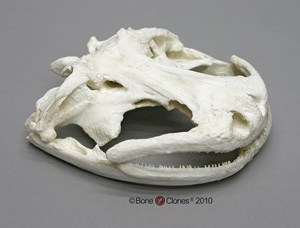
Chinese Giant Salamander Skull BC-122

 Although the giant salamanders do have numerous small sharp-pointed teeth (Skull shown at left) the teeth are made out to be more formidable in the reconstruction drawing.
The Animal Planet description states: 
 
MAKING OF A MONSTER: Since its first reported sighting in 1868, the Bear Lake Monster has been a source of pride for locals in a small Idaho town. A Mormon colonizer, Joseph C. Rich, published a series of articles in the Desert Evening News claiming locals had seen a monster on the lake. Witnesses gave differing descriptions of the monster; some compared it to a [tuskless]walrus, while others described it as a large reptile or crocodilelike creature. Rich later recanted his stories, but the legend of the Bear Lake Monster prompted an influx of tourists hoping to catch a view of the lake beast.
NEW SIGHTINGS: Well over a century later, in 2002, a new report of a sea monster living in Bear Lake surfaced. Brian Hirschi, a local business owner recalled seeing two humps just above the water's surface while out on his boat one summer day. Hirschi said the humps disappeared, and then he suddenly felt his boat move. The monster reappeared right next to his boat and Hirschi came eye to eye with a creature he described as having "dark [blackish]green, slimy skin and beet red eyes." As quickly as the monster appeared, it disappeared. Bear Lake residents weren't sure what to make of Hirschi's tale, but they all agreed on one thing: The Bear Lake Monster continues to be good for business.
[Italics added for emphasis by DD]

explore more

bear lake monster videoVIDEO: Myth or reality? Get a closer look at the Bear Lake Monster.

ON TV: Check the Lost Tapes Episode Guide for air dates.

Earlier on, I was willing to grant that there had been authentic "Creature" sightings but that they were actually of known animals. The "Fact" that Joseph Rich had allegedly recanted seemed to account for all of the earlier, first-publicised reports. But still given that some of the accounts were spot-on for an elephant seal: a tuskless walrus-like beast some 20 feet long with four flippers. And there were some authentic accounts that came along later that were recorded by Rangers in the area but written off as mistaken views of swimming elk leaving the "String-of-Buoys" effects in their wakes.
Allowing for some exaggeration, many of the Lake Monsters of Washington and Oregon sound like Elephant seals and they are often compared to Hippopotamuses in appearance. Thuis includes not only "Big Wally of Wallowa lake, the Monster of Upper Klamath Lake, sightings on the Cloumbia river itself, and in Crescent Lake, also compared to "colossal Claude" and discudded in the same articles.John Kirk in the book In The Domain of Lake Monsters, on page 163, speaks of a description of what sounds like a definitel large pinneped carcass found far inland by a trapper in the earlies, no definite location cited.This in turn cited Strange Northwest as its source.

Map I-various kinds of Water Monsters-most are of or are similar to known species: giant Salamanders and
Lizards are possible new unknown species but of genera otherwise well-known. Reports and locations
Are very widely scattered over large slices of territory and there are not many reports in any one locatiom

Map II -Eastern generalised areas for "Canadian Alligators", "Giant Hellbenders", and the Giant-Pink ones on the Eastern coast-Evidently the Eastward extensions of the same species that are Canadian Alligators (Pitt Lake Alligators) and the Californian Giant salamanders of the Far West. There could be Alaskan ones too , but that part is unconfirmed


 Zemoguani, painted kiowa medicine lodge, collected by James Mooney, 1891-1904
 
Some of the water monsters and "Serpents" spoken of by the Navajo and Kiowa are also probably Alligator gars similar to the ones which must live at Walker Lake and at associated areas. Some of these creatures are traditional and are represented on prehistoric pottery and on petroglyphs. The Mimbreno design on the lower Left shows that these large fishes were thought to transform into human beings and to walk on land.


Unknown Giant Lizard preparing to pounce on Goth Girl. By Angelia Mclean, Colorado
This would be the "Faux-Alligator" again by the way the feet look-In Colorado, their young are said to lurk in trees
http://angeliamclean.blogspot.com/

Terracotta plaque from Northern Mexico, looks to be two iguanas of very large size mating and with a human figure pastered over on top of it, which does not match (white square area, I have removed more of the mass over the middle of the figure where it did not match because I could not make out what it was and it looked foreign to me.Iguanas are important in Mythology of Central America and representations of giant iganas keep turning up every now and then. The surface of this plaque matches  some of the older pottery types in texture and the facial features of the creatures also matches later representations of the giant Iguana lizard types.from both Mexico and also Northern South America (Colombia) But the human figure (if that is what it is) is of a different style and it looks to me like it is pasted on (It also has a much smoother surface)

Tuesday, 21 August 2012

Some More Notes on Cadborosaurus 2


The previous article on "Cadborosaurus" appeared on this blog in April and it included a pretty good summany and general overview on reports in the category:
http://frontiersofzoology.blogspot.com/2012/04/some-more-notes-on-cadborosaurus.html

"An American Sea Serpent" in the 1800s-much like Caddy in the early reports.
There is a strong tendancy to think of Caddy as still being in these proportions,
compare to the long-necked and long-tailed drawing next following

1934 – Sea Serpent Found Near Pender Island

Historical Archives. A giant sea serpent was spotted off Pender Island in 1934. Named “Amy”, the Cadborosaurus was seen by Cyril B. Andrews and 11 companions. The serpent reared 12 feet of her body out of the water – only 10 feet from Andrews’ boat. It then proceeded to swallow a wounded duck that Andrews was trying to retrieve.
According to the Reading Eagle newspaper in an article dated January 10, 1934, Amy had been reported at regular intervals over several weeks. But this wasn’t the only time the giant sea serpent had been spotted lurking around Vancouver Island. Among many reported sightings, legends of the serpent date back hundreds of years.

View Newspaper Article
The most recent sightings of this creature have taken place at Qualicum Beach and Victoria respectively in November and December of 2006. [Source]

http://en.wikipedia.org/wiki/Cadborosaurus_willsi

These Sketches by Wilfred Gibson are some of the better ones for showuing the Plesiosaurian form and how the neck works, the way the neck goes from side to side like a boom is described both on the Eastern coast of the USA and at Lock Ness, and there is the suggestion that when the creature swallows a duck, you can make out the shape of the bird sliding down the thin skin of its throat. These are strong indicators the witness was not making it up.

Cadborosaurus willsi

(from Wikipedia)
“Cadborosaurus willsi”, nicknamed Caddy, is an alleged sea serpent reported to be living on the Pacific Coast of North America. Its name is derived from Cadboro Bay in Victoria, British Columbia, and the Greek root word “saurus” meaning lizard or reptile. Reports describe it as being similar in form and behavior to various popularly named lake monsters such as “Ogopogo” of Okanagan Lake in British Columbia and to the Loch Ness Monster of Scotland.
There have been more than 300 claimed sightings during the past 200 years, including Deep Cove in Saanich Inlet, and Island View Beach, both like Cadboro Bay also on the Saanich Peninsula, also British Columbia, and also at San Francisco Bay, California.
Cadborosaurus willsi is said by witnesses to resemble a serpent with vertical coils or humps in tandem behind the horse-like head and long neck, with a pair of small elevating front flippers, and a pair of large webbed hind flippers fused to form a large fan-like tail region that provides powerful forward propulsion.
In 1992 Ed Bousfield, retired Research Associate at the Royal Ontario Museum, Toronto, and the Royal British Columbia Museum in Victoria, and Paul LeBlond, professor at the Department of Oceanography, University of British Columbia (Vancouver), announced some startling pieces of evidence – three photos, taken in 1937 on the flensing platform of a whaling station at Naden Harbour in the Queen Charlotte Islands, that depict a large serpentine carcass. Retrieved from the stomach of a sperm whale Physeter macrocephalus, the carcass is about 3 m long, long-bodied, and appears to have a camel-like head and a fluked tail. It obviously struck the whalers as unusual, otherwise they wouldn’t have gone to the trouble of setting it up on crates or photographing it. Suggestions that it is an elephant seal or baleen whale don’t seem realistic in view of certain of its features.

Related Links

http://www.bcscc.ca/cadborosaurus.htm
http://www.qsl.net/w5www/caddy.html

The most common Caddy sighting is actually a standing wave pattern. Here you can see through the water on the two end humps, proving they are made of water (they are not empty loops, there is a sheen on them


Artwork by Pristichampsus (Tim Morris) amended by DD to show the "Mane" and "Jagged spines on the back"
The "Mane" is meant to exaggerate the vertical height of the creature visually and thus make t look larger to its rivals: ordinarily the creature without the "Mane" has a more elongated appearance

Caddy [George Eberhart, Mysterious Creatures, 2002]

Sea Monster of the coast of British Columbia, Canada.
Etymology: Name popularized if not coined October 11, 1933, byVictoria (B.C.) Daily Times editor Archie H. Wills after repeated sightings in Cadboro Bay, British Columbia. Short form of Cadborosaurus, coined at the same time.
Variant names: Amy, Cadborosaurus, Edizgiganteus (after Ediz Hook Light, Washington), Haietluk, Klamahsosaurus (on Texada Island), Penda (after Pender Island).
Scientific name: Cadborosaurus willsi, proposed by Edward L. Bousfield and Paul H. LeBlond in 1995. [Name not accepted by the scientific community and considered invalid generally]

Sea Serpent (Haietluk) by Native artist Butch-paired fins on one side equated to limbs on the other side
This is essentially a "one-way" depiction of a Sisiutl


Physical description: Serpentine body that forms many humps or loops. Length, 16–100 feet. Diameter, 2 feet 6 inches–8 feet. Light brown to black. Small head resembles a sheep, horse, giraffe, or camel. Eyes in the front of the head. Small ears or horns. Pointed tongue. Two rows (upper and lower) of fishlike (Spiky) teeth. Mane or fur on back of neck sometimes reported. Neck is 3–12 feet long, about as thick as an arm or a man's waist. One pair of front flippers seen, rear ones sometimes indicated. Back some- times appears serrated, sometimes smooth. Flat tail sometimes fluked or formed from  back flippers. Behavior: Does not appear to undulate when it swims. Fast swimming speed, clocked at 40 knots. Breathes in short pants. Makes whalelike grunts and hisses. Feeds on herring, salmon, and ducks. Distribution:British Columbia seacoast, especially around Cadboro Bay and the Strait of Georgia.

Significant sightings: A crew member of the ship Columbia under American fur trader Capt. Robert Gray was the first to report a Caddy sighting in 1791. Osmond Fergusson watched a 25-foot animal with a long neck near the Queen Charlotte Is- lands, British Columbia, on June 26, 1897. In September 1905 or 1906, Philip H. Welch saw a brown animal with a 6- to 8-foot neck from a distance of 100 yards away in Johnstone Strait. It had two bumps on its head that were 5 inches high and rounded on top. F. W. Kemp and his wife and son watched an 80-foot maned animal while they were sitting on the Chatham Island beach, British Columbia, on August 10, 1932. On September 23, 1933, Dorothea Hooper and a neighbor observed a serpentine animal with a serrated back [oarfish?]cavorting in Cadboro Bay about 400 yards distant. It created a commotion in the water as it swam out to sea. Maj. W. H. Langley and his wife were sailing in Haro Strait on October 1, 1933, when they heard a loud grunt off Chatham Island. They saw the back of a huge, dark-green creature with serrated markings on the top and sides. Charles F. Eagles sketched a 60-foot animal that he saw in Oak Bay on October 14, 1933. It had crocodile-like spines on its neck. On December 3, 1933, Justice of the Peace G. F. Parkyn of Bedwell Harbour was one of twelve people watching from Pender Island as an animal with a large, horselike head and neck gulped down a duck that had just been shot by Cyril Andrews. In 1936, E. J. Stephenson and his wife and son watched a yellow-and-bluish, 90-foot-long, 3-foot-thick animal crawling over a reef into a lagoon on Saturna Island. A Canadian naval officer was fishing in an open boat off Esquimalt Harbour in November 1950 when a 30-foot Caddy appeared and created a heavy wash. It swam with an undulating motion using large flippers on either side. It snapped its teeth together once before it dived after twenty-five seconds. On February 12, 1953, R. D. Cockburn, C. P. Crawford, and Ron Loach saw an animal with three humps off Qualicum Beach for five minutes. Two other men got into a boat and rowed within 20 feet, but it submerged and reappeared 100 yards away. Its head was dog- shaped and had two horns. In late November 1959, David Miller and Al- fred Webb came within 30 feet of an animal with a 10-foot neck sticking straight up out of the water off Discovery Island. It had coarse brown fur, red eyes, and small ears. Mechanical engineer Jim M. Thompson was fishing off Spanish Banks, Vancouver, in January 1984 when an 18- to 22-foot serpentine animal surfaced about 100 feet away. It had a giraffelike head with small stubby horns and floppy ears. In May 1992, music professor John Celona saw a multihumped animal about 25 feet long while sailing. Students Damian Grant and Ryan Green were swimming across Telegraph Bay in May 1994 when they saw a 20-foot animal with two humps.


"Caddycarcass" taken from the belly of a whale-
More likely yet another basking shark skeleton as in
the other "Caddy" carcasses illustrated above it.

. A 10- to 12-foot carcass of apparently a young Caddy was removed from the stomach of a sperm whale, photographed, and displayed for a while at Naden Harbour whaling station in 1937. The photo shows it stretched out on packing cases. It was about 10 feet long, with a camel-like head, traces of flippers, and a paddling tail. The carcass was allegedly shipped off to the Field Museum in Chicago, but there is no record of its arrival. A 16-inch-long juvenile Caddy was caught in a net by William Hagelund in 1968 off De Courcy Island, but it was thrown back. It had spiny teeth, a saw-toothed ridge of plates along its backbone, and a bilobate tail. A soft, yellow fuzz covered its undersides.

Possible explanations: (1) The Northern sea lion (Eumetopias jubatus) can appear serpentine in the water but only grows to about 10 feet 6 inches long. (2) The Northern elephant seal (Mirounga angustirostris) is found in British Columbian waters in the nonbreeding season, but it only measures up to 16 feet long and does not have an elongated neck. (3) A surviving basilosaurid type of archaic whale, suggested by Roy Mackal and Karl Shuker. Some basilosaurids were serpentine, grew up to 80 feet long, and lived in the Late Eocene, about 42 million years ago. They had a tail fluke, but it’s unknown whether it was used primarily for propulsion or steering. They are mainly known from the eastern United States and Egypt but may have been worldwide in distribution. (4) An evolved plesiosaur, suggested by Edward Bousfield and Paul LeBlond. This group of long-necked marine reptiles swam with paddlelike limbs and had a body length that varied from 6 to 46 feet. Plesiosaur fossils are found continuously from the Middle Triassic, 238 million years ago, to the Late Cretaceous, 65 million years ago. (5) A decaying Basking shark (Cetorhinus maximus) might account for the 1937 Naden Harbour carcass. These sharks take on a remarkably plesiosaur-like appearance due to the differential decomposition rates of their gill slits and lower tail fluke. A 30- foot carcass found in November 1934 by Hugo Sandstrom on Henry Island turned out to be a Basking shark. (6) Some kind of decapod (crayfish or lobster) has been suggested by Aaron Bauer and Anthony Russell as an explanation for Hagelund’s juvenile Caddy capture in 1968. [More recently Naish et al have shown this to be most likely a pipefish]

Sources: “Yachtsmen Tell of Huge Sea Serpent off Victoria,” Victoria (B.C.) Daily Times, October 5, 1933, p. 1; “The Loch Ness Monster Paralleled in Canada,” Illustrated London News 184 (January 6, 1934): 8; “A Canadian ‘Monster,’” Illustrated London News 185 (December 15, 1934): 1011; Ray Gardner, “Caddy, King of the Coast,” Maclean’s Magazine 63 (June 15, 1950): 24, 42–43; D. Mattison, “An 1897 Sea Serpent Sighting in the Queen Charlotte Islands,” B.C. Historical News 17, no. 2 (1964): 15; Paul H. LeBlond and John Sibert, Observations of Large Unidentified Marine Animals in British Columbia and Adjacent Waters (Vancouver, Canada: University of British Columbia, Institute of Oceanography, June 1973); William A. Hagelund, Whalers No More: A History of Whaling on the West Coast (Madeira Park, B.C., Canada: Harbour, 1987); Frederic C. Howay, ed., Voyages of the “Columbia” to the Northwest Coast, 1787–1790 and 1790–1793 (Portland: Oregon Historical Society, 1990), p. 249; Penny Park, “Beast from the Deep Puzzles Zoologists,” New Scientist 137 (January 23, 1993): 16; Jessica Maxwell, “Seeing Serpents,” Pacific Northwest 27 (April 1993): 30–34; Mike Dash, “The Dragons of Vancouver,” Fortean Times, no. 70 (August-September 1993): 46–48; Edward L. Bousfield and Paul H. LeBlond, “An Account of Cadborosaurus willsi, New Genus, New Species, a Large Aquatic Reptile from the Pacific Coast of North America,” Amphipacifica 1, suppl. 1 (1995): 3–25; Paul H. LeBlond and Edward L. Bousfield, Cadborosaurus: Survivor from the Deep (Victoria, B.C., Canada: Horsdal and Schubart, 1995); Aaron M. Bauer and Anthony P. Russell, “A Living Plesiosaur? A Critical Assessment of the Description of Cadborosaurus willsi,” Cryptozoology 12 (1996): 1–18; Darren Naish, “Another Caddy Carcass?” Cryptozoology Review 2, no. 1 (Summer 1997): 26–29; Paul H. LeBlond, “Caddy: An Update,” Crypto Dracontology Special, no. 1 (November 2001): 55-59

Alaskan Sea Monster film


McCormick Composite drawing of "Caddy" Witness Sketches


Two more composites illustrating once again how a witness could mistake an elephant seal as a "Cadborosaurus" if they thought the tail end was more elongatedvelmans lists one definite mistaken view of an Elephant seal as "caddy", but perhaps as many as a quarter of the sightings could be such seals. Mooses swimming at sea (in the strait near Vancouver) are also frequent causes of confusion.

Friday, 4 May 2012

'Little Gold Sea Monster' No Longer Alone

At one poit at the CFZ blog I showed my redrawing of a photograph from the book South American Indian Mythology (Larousse) from my local library: I redrew it because I could find no comparable photographs of the artifact anyplace else. The object was one of a pair cast in gold, said to represent the "Sea-serpent" ancestors of the local Indians at Lake Maricaibo, Venezuela (which is not a lake but is a very large bay.) At the time I published this at the CFZ originally, I had already identified this with the Huilla of those parts (because of its vertical undulation and three-toed track) and identified it as one of the "Water Horses" of the coastal regions of South America. I identified the creatures as the source of the Elephant seals reported by Roy Mackal to visit Florida and White River in Arkansas (leaving suppoedly three-toed tracks as incomplete prints of its flippers) and stated by him to come from the coasts of Costa Rica and Nicaragua. (In Search of Hidden Animals, 1981)

Huilla
Freshwater Monsterof the West Indies.
Etymology: Huilla is a common name for the
Anaconda (Eunectes murinus) in South America.
Physical  description:  Serpentine.  Length,
25–50 feet. gray or green. Scaly. Horselike head.
Behavior: Amphibious. Swims swiftly by flex-
ing  its  body  into  arches.  Migrates  from  one
body of water to another. Emits a high-pitched
whistle.
Tracks: Three-toed.
Distribution: Ortoire River, Trinidad.
Sources: Edward L. Joseph, History of
Trinidad (London: A. K. Newman, 1838);
John O. Brathwaite (letter), Strange Magazine,
no. 18 (Summer 1997): 2.

Wihwin
SEA MONSTER of the coast of Central America.
Etymology: Mískito (Misumalpan) word.
Physical description: Horselike. Sharp teeth.
Behavior: Goes ashore in the summer.
Distribution: Atlantic coast of Nicaragua and
Honduras.
Source: Hubert Howe Bancroft, The Native
Races of the Pacific States of North America
(New York: D. Appleton, 1875), vol. 3.
[Three-toed tracks also reported in the region]

The original Little Gold Sea Monsters of Caribbean South America
As redrawn by Dale D as accurately as possible


Now while on a photo search I find this very odd artifact from Texas found while a dam project threatened an archaeological site with flooding, and it is obviously some sort of large blunt-nosed seal looking like a walrus or an Elephant seal (the latter more likely because it has no tusks). The only "Known" seal from the area was the Caribbean monk seal, which is much the same bodily conformation as the common seal and looks nothing like this:nor yet are there supposed to be any sea lions or fur seals in the area. This object was found in a child's collection of odd stones and bric-a-brac, presumably dating to the 1700s in a Spanish plantation known to have existed in the area at one time, but there were older Indian artifacts found in the area and among the child's collection. So there is no direct dating but it scarcely matters-there were supposed to be no large seals in Texas at the time or for any postglacial phase before that, nor yet any way of explaining how the people there ever came to know of such things as large seals that looked like this.

More recently there have been photographs which resembled elephant seals in the Caribbean, and in White River, Arkansas (the latter according to Mackal)

Wednesday, 14 March 2012

Mythical Monster Seals of Chile

THE Cuchivilu [Babel Fish Translation]
The Cuchivilu is one being with the upper body in the form of pig. Very robust, with long fangs and bulging eyes, the bottom is a very thick snake. He lives in marshy places, always by the sea, buried in the mud, leaving only its nose into the air to breathe. Man's presence irritates. They say that the female can give birth up to 12 Cuchivilus and teats with which feeds are arranged in his spine. Generally, in the early days of the pups, she gives them their favorite foods, which are exclusively oysters and clams in growth stage. This mythological creature is hated by fishermen, and who know him as the destroyer of fish weirs, chilotes system used for hoisting the fish. On the beach have a fence made of sticks, woven baskets and close together as each other, so just be possible that the sea water to drain or seep. This pen is shaped like a horseshoe, and its opening is located toward the earth, so the pen remains covered by high tide and low tide, are caught quantities of fish and seafood then easily collected in the Chiloe available in baskets. This is an ingenious way to fish, which is also utilized by The Cuchivilu, which appears in the pens destroying it, completely. Snares fish and seafood to your appetite satiated while removing the sand with its snout, like any pig of the inhabitants of the land. It is detected by the grunts and leaves the unmistakable imprint therefore not reused again that poultry considering since then, for fear of scabies in the sand leaving the body of this animal. But, some pens to be repaired again after a while and "cleaned" using a special ceremony called "Chepu", which is removed the spell. http://mitologiadechiloe.blogspot.com/2008/06/el-cuchivilu-plumaaguada-el-cuchivilu.html

If there is such a thing as a Southern Walrus it might also be called by the name of Cuchivilu as being  a tusked "Sea-Pig." There is some confusion in the mythological sea-creatures off of Chile and it is possible that the tusks are also referred to as "Horns"
From ThinkQuest:
THE CUCHIVILU
In many sites of Chiloe's province, a special and easy way of fishing is still used. In the beach a semicircular fence of branches is made open to the land. This fence is called Corral de Pesca. When the tide is high, the fish weir is covered by water, and when the tide is down, the fish that came close to the beach are trapped in the fish weir. From time to time a monster called Cuchivilu appears from the sea. This monster has half a body of pig and half snake. This animal comes into the fishing fish weir to destroy it, and eats the fish inside it. With this visit the site will become cursed, and a fish will never become trapped again inside of it. But there is a way to detroy the witchcraft : a magical ceremony called Cheputo.

--The actual creature the Cuchivilu is based on is the Elephant seal. the number of the young. the number of the teats and their arrangement are spurious inventions. The part about their destroying fish weirs and eating the fish is apparently true. The creatures are depicted as flipperless "Snakes" and then again with flippers, as on the stamp. The part about the flippers is true. A male Southern elephant seal is shown to scale with a human below.
Camahueto
It has the form of a short leaden calf fur and bright with a horn in the middle of the forehead. He lives in rivers and swampy lagoons into adulthood that achieves at twenty-five years, then migrate to the sea destroying everything in its path.
When he discovers his presence hire a witch to a kelp rope so Lacee and remove the horn to make it a gentle lamb.
With the grindings of the male Camahueto horn prepare potions to cure various diseases, as well as restore the vigor and sexual potency in men.

The Camahueto
http://mitologiadechiloe.blogspot.com/2008/06/el-camahueto.html


The Camahueto  (PEN, 0.55 X0, 75 ctms.)
The Camahueto is known as The Unicorn prodigious. This fabulous animal has a shiny coat, short and leaden looks like a vigorous calf and its most precious ornament is a golden horn that grows on the forehead. This mythical creature is something special. His birth took place in the depths of the earth and in some cases, on top of a hill near the sea. Then it is found in the lakes or rivers muddy and later, when it reaches its development, on the twentieth or twenty-five years, migrates its way with its powerful horn which will make a huge trench in the earth in its journey towards the sea, where dwell forever. Destroy everything in its path causing great damage to property and sembradíos.Hace appeared on full moon nights. Emerging from a river or a lake, its coveted horn shine like gold in the light of the moon. Seek him with ambition, because this animal is credited with healing powers, witches being macho and the only ones who can give chase. To do so use a rope made of seaweed and they will succeed only on land, but never at sea. To capture and be holders of the horn, warlocks and Machis enjoy unlimited power to use the powers of the scrape of it as beneficial or malevolent. Camahueto is said, the sea is very powerful and large vessels rammed and makes them disappear into the depths with all hands. At cortársele his horn with a machete (in the hands of a gun or warlock), the mythical animal is transformed into a meek and docile calf and stop damage to farmers. Who encounter a Camahueto and is slightly injured by his horn, will, insurance, health and much luck for life.
--The Camahueto is the mythical land-unicorn which develops into the sea-unicorn or Southern Narwhal. Incredibly, the latter one may actually be the real animal, and its long twisted tusk "Horn" is magical and used in the same was as the narwhal of the North.Karl Shuker suggests that the
Southern Narwhal is a survival of the tusked whale Odobenocetops. Eberhart says that the name ordinarily means the Sea-Elephant, which is unusual because it seems the elephant seal is a different mythological creature (see above) There is also an intermediate form of the creature, and since the Camahueto is known as the Sea-Calf, there is also the corresponding name Sea-Cow (Which might be the "Horned or tusked" sea creature all over again according to Austin Whittall)


The Millalobo present a shiny coat of gold, hence its name, and the ability to change the shape of your face. This mythological creature is said can not speak and only communicates through a kind of bleating like sea lion, but even so, the meaning of their bleating is easily comprehensible to humans. Legend has it that the view Caicai, found a being to his liking, and how after his battle with tenten wanted to delegate power to someone, Millalobo was chosen for that office The Millalobo lives in the sea floor, with his wife huechula and the three children of both the Pincoya,The Pincoy, and the siren chilota[All of them Merfolk]Who assist with the task of managing the seas.
Product of the great work that is mastering the seas, the Millalobo is subordinate to a number of mythological sea creatures to do different jobs, which range from plant and care for the development of shellfish and fish, to manage the marine climate, in addition to guiding and care for the dead that produces the sea
Sea creatures are evil, they should also pay their respects.

http://library.thinkquest.org/C005968F/acuaticos/eng/cuchi2.htm
THE MILLALOBO
The Millalobo lives in the deepest sea. He became pregnat under the command and protection of the waters spirit Coicoi-vilu, by a pretty woman and a seal. That happens when the waters invaded the Chiloé lands.

He's like a big seal, with a mix of man and fish face. The superior half body looks like man, and the rest like seal. His skin is covered by short and shining gold pelt, this is the reason of his name Millalobo or Golden Seal.

He lives with la Hunchula. She's the daugther of an old machi called la Huenchur, and when the weather conditions are good, Millalobo and Huenchula go out the sea to lonely beaches looking for the pleasure of sun rays.

Millalobo, was nominated by Coicoi-Vilu, like master of seven seas and he is the supreme boss of every creature in the waters. His power is like Neptune power from greek mitology.

Like sea master, he gives some missions to several water creatures, they obey his commands like seeding fish and seafood, watching the growing and multiplication of sea creatures, and controlling the tide and storms. He commands abo the actions of malefics creatures like la Vaca Marina [The Sea Cow], el Cuero, el Cuchivilu and el Piuchén.

With Huenchula Millalobo hase tree sons : la Pincoya, la Sirena y el Pincoy. They like good sons obey Millalobo and make important missions in the wide domain of their mighty father.
--The Millalobo appears to be simply the mythologized version of the ordinary sea-lion. Interestingly it is also supposed to be associated with the oceanic Merfolk under several different names, which are listed as its offspring
El Pincoy, the Chilean Selkie (were-seal)
Below, his sister and mate, La Pincoya, the Chilean Mermaid (Delacruz on Deviant Art)


Monday, 27 February 2012

Dead Bunyip Preserved in Outline

There was a dry creek bed in Australia where the Aboriginies say that a Bunyip had died and to commemmorate the event, thet forever afterward maintained its outline in the surface of the dry creek bed
http://www.nla.gov.au/exhibitions/bunyips/html-site/evidence/challicum.html

The bunyip was rarely found in traditional Aboriginal art. Surely this omission is highly significant?

It is surprising to find that the bunyip has almost no established image in Aboriginal art. Perhaps this is because it was so rarely seen and so terrible to approach? Aboriginal belief in the evocative power of such an image may also have discouraged them from drawing any outline of their fears.
There is one major exception. At an unknown period in the Dreaming, a creature which the local Aboriginal people believed to be a bunyip died on the banks of Fiery Creek near Ararat in Victoria.
The experience was so remarkable that the Djapwurrong people constructed an outline around the carcass in order to preserve its shape. Spears were dug into the ground around it and the turf was later removed to create a sacred site. The Djapwurrong people returned each year to renew this outline.
It was there in 1840 when white settlers arrived and was first sketched in the mid-nineteenth century. By this time the outline was about nine metres long and its shape had become distorted and rather enigmatic. Viewed from one direction it looked like an emu; from another, it looked like a seal.
It was named the Challicum bunyip after a nearby station. The area finally returned to nature and the outline of the bunyip faded from sight

In this case I think it is self-evident the Bunyip had been a large seal much like an elephant seal:

More on Bunyips later, I think I am going to run a mini-series on them.


Also recognisably a bigmouthed elephant seal with "Dog teeth"


The elephant seal's drooping nose is sometimes described as a beak and the eyes of the seal can glow green like a dog's eyes do in certain lights. Bunyip image from Karl Shuker.