Scott Mardis made some remarks about this comparison:

Scott Mardis As far as anyone can confirm, there are no sturgeon in Loch Ness.Adrian Shine has theorized that it's possible that an occasional Baltic sturgeon may blunder into Loch Ness for a time and then go out again, leaving a slew of "Nessie " sightings in it's wake.Large ocean sturgeon have been caught in the Moray Firth, which is adjacent to Loch Ness.Seals can get in and out of Loch Ness despite the canal system, so maybe it's possible a sturgeon could get in and out, as well.Big sturgeons can leap over boats.Perhaps they can jump canal walls.The Alastair Dallas " Nessie" is so different from the Plesiosaur-like Nessie sightings that maybe something atypical was seen.Sturgeons don't spawn in Loch Ness, but perhaps an abberant individual might go on to rocks to either scratch it's belly to remove parasites or feed on fish roe attached to rocks.
Scott Mardis http://www.glaucus.org.uk/Sturgen2.htm


Darren Naish I've been planning to cover the Dallas 'sighting' at Tet Zoo for some time, partly because I love monster accounts that include a lot of anatomical detail :) But I haven't because Alastair Dallas junior (son of the A. Dallas who created the pic) has only ever given permission for use of the pic to Dick Raynor - not to anyone else. And I would need to procure permission before using it on my blog. Mike Dash showed the pics at Weird Weekend a few years ago, but I still need to be careful. Mike in fact has done an extraordinary amount of research on Dallas and his connection with the (in)famous McRae film. Dick Raynor discusses both cases here: http://www.lochnessinvestigation.org/McRae.htm

BMLSS Fish information page: Atlantic Sturgeon
[The type of sturgeon which would be the most likely one to appear at Loch Ness-DD]
In reply to this, Darren Naish replied in a Cryptozoological forum:
Darren Naish Here is the comment I sent Scott yesterday on the Dallas issue... Dallas's very detailed account - he claimed to watch the monster for some time (enough time for him to and get his drawing pad and draw it from life), and from c. 100 ft away - referred to a bristly mane, three dorsal fins, 'sensory horns' on the head, wattles, round eyes. It was 32 ft long, was sucking weed off rock. What I'm getting at is... there's so much detail here that it either (1) describes a wholly new species of big vertebrate, or (2) is a hoax. It doesn't seem reasonable to me to reinterpret it as an inaccurate account of a seal, sturgeon, or any real animal. Dallas was known for being a teller of tall tales.
Dale Drinnon It seemed like a reasonable enough depiction of a sturgeon at the first posting, but I was uneasy about certain aspects of the report and especially that the sighting was supposedly in 1936 but this was the first I had heard of it; with Darren's clarification in the last message, I'm willing to write it off as a hoax. It COULD have been a stray sturgeon, but presumably the witness would have to be describing it badly and doubling the dimensions to make that explanation sound likely.
Darren Naish I've been planning to cover the Dallas 'sighting' at Tet Zoo for some time, partly because I love monster accounts that include a lot of anatomical detail :) But I haven't because Alastair Dallas junior (son of the A. Dallas who created the pic) has only ever given permission for use of the pic to Dick Raynor - not to anyone else. And I would need to procure permission before using it on my blog. Mike Dash showed the pics at Weird Weekend a few years ago, but I still need to be careful. Mike in fact has done an extraordinary amount of research on Dallas and his connection with the (in)famous McRae film. Dick Raynor discusses both cases here: http://

www.lochnessinvestigation.org
This is of necessity a story without an ending. The beginning is shrouded in m...
ystery, and the middle is confused. This is not even the definitive version of it, as new, or old, material may yet come to light. It is not an area of research where I expend much effort, but as I may have a contribution...
[After which there is an extended discussion between Dale and Scott]
Scott Mardis http://www.lochnessproject.org/adrian_shine_archiveroom/papershtml/loch_ness_surgeon_sturgeon.htm
The main players are a Dr McRae, who had worked in London but retired to the Highlands of Scotland, and the Kirkcudbright landscape artist Alastair Dallas. It would appear from the story that the the doctor had a practical interest in cinematography. Mr Dallas was a widely travelled landscape artist with a wide circle of friends. After the "new" road along the north-west shore of Loch Ness had been completed he contacted the main contractors, Carmichaels, with a view to a commission to record the works. Unfortunately, the commission had already been awarded, but due to the original artists preference for sweeping curves over straight lines, Mr Dallas was later invited to the contractors offices and given the commission by the proud builder of the straight roads. It was during this commissioned work that the sketch is believed to have been made. Mr Dallas the artist died in 1983, but I am indebted to his family for the background information given here. One interesting point made was that Alastair Dallas invariably carried a camera, and field glasses, to help him in his work, and the question naturally arises, - " If he had time to make the sketches, why didn't he just take a photograph?" As a professional photographer I know only too well that one does not always carry the entire contents of one's tool-kit... One carries what one expects to need. As a landscape artist, a telephoto lens may not have been an essential item.
.... Following my [Dick Raynor's] meeting and interview with him on behalf of the continuing investigation, a friend visited Alastair Dallas and was told a rather different story. In this version there was only one film by Dr McRae, but Mr Dallas himself had had a sighting, and had made some sketches. A copy of this drawing was given to the friend, who passed it on to me in October 1975. As attempts to pursue the alleged film failed, it might be useful to study the sketch. In comparing the detail of the "Loch Ness Monster" to photographs of sturgeons I found a number of points of correspondance which however were not as strong of a presentation as they could have been because I was lacking some of the necessary exactly equivalent views. The front-on view in particular, and yet that is one of the more obviously fishlike drawingsscrepancy between the front-on and profile views in that the profile shows the sucking mouth at the end of the snout whereas the head-on view seens to show some bit of snout projecting in front of the mouth, with the sucking mouth recessed underneath. Since outstanding disparity in the comparison of the profile to a sturgeon, the profile view is probably mistaken on this point. The head-on view indicates two "Sinuses" in front of the mouth but undreneath the head and the underside view of the sturgeon does also show that. The eyes were said to be shut; more than likely they were "Cloudy" fish-eyes and hard to make out for that reason. Their placement on the sides of the head seems to be near enough true for the sturgeon. ectoral fins hang down directly behind the head, where they should be positioned.In the profile view of a spiracle high up at the back of the head, a dent in front of the eye and a more obvious nostril positioned anteriorly to that, all of which correspond to the openings on a sturgeon's face. The rounded "Jowl" represents the gill-cover and confirms that we are indeed dealing with a type of a fish here. Thead is anguklar enough that it is reasonable to expect it is armoured there, and there is a higher medial ridge shown which corresponds to the central line of scutes on a sturgeon's back. It would appear that the back fins are roughly correct but that the pectoral fins are represented twice, in two different positions: perhaps the witness was confused by the part of the body lying awash and just possibly he had a brief view of the pelvic fins: he said the creature had "no rear fins" And it seems important that Dallas drew an unequal divided vertical twofinned fishtail only there were times when he drew it lying sideways instead of standing up vertically: having a vertical two-lobed fishtail where the top lobe is much longer than the bottom one is diagnostic of a sturgeon.




It would be churlish, in view of all the recent additional information, to allow the sixtieth anniversary of the naming of the Loch Ness 'Monster' (Anon., 1933 - attributed to Mr. Alex Campbell)to pass entirely unremarked.For most people, certainly the majority of the casually interested members of the general public, the famous 'Surgeon's Photograph' of 1934 probably represents their idea of the archetypal Monster.Certainly this well-known photograph has figured in numerous publications over the past sixty-odd years, and a serious investigation and assessment of the photograph was published in the centenary (1988) volume of the Scottish Naturalist (LeBlond and Collins, 1988).
Acoustic Assessment of Fish Size
One consequence of the introduction of more quantifying acoustic techniques - in situ target strength measurement in particular , was the discovery that the great majority of pelagic fish in Loch Ness belonged to a very small size group, which were not caught prior to the trawling methods recently described (Shine, Martin and Marjoram, 1993).Therefore there was a tendency to 'scale' large sonar echoes against gill-netted individuals of 20-30 cm, which in reality represented only a small proportion of the population.This imposes a further revision upon assessment of sonar contacts which are strong in relation to the surrounding fish echoes.
Estimates of 'Monster' Population
Sheldon and Kerr (1972) first attempted estimations of theoretical 'Monster' population density based on fish biomass.They used the morphoedaphic index (total dissolved solids/mean depth), devised by Ryder (1965), to estimate the fish population.Lacking genuine Loch Ness information, however, data was used from the northern basin of Loch Lomond.For Loch Ness, a fish standing stock of between 0.55 and 2.75 kg/ha was calculated, or between 3.135 and 15.675 tonnes in total.
On-site acoustic estimates of resident pelagic fish in Loch Ness now range from 3.1 kg/ha (Shine, Martin and Marjoram, 1993) to 4.23 kg/ha (Kubecka, Duncan and Butterworth, 1993), or between 17 and 24 tonnes in total, as compared to 300
Vol 105, The Scottish Naturalist: Postscript: Surgeon or Sturgeon? p272
to 400 kg/ha in the upper River Thames (current acoustic estimate - Dr. J. Kubecka, pers. comm.).These estimates exceed those of Sheldon and Kerr, and may be accounted for by allochthonous organic inputs.Before hopes are raised too high, however, it should be borne in mind that predators upon this biomass should not amount to more than approximately a tenth of the gross weight. Thus we have available a total of approximately two tonnes of 'Monster', but this two tonnes may not be as great as it at first seems.For example, it would be equivalent to scarcely half the weight of a 36-ft (13 m) Whale Shark Rhinocodon typus. In fact, two tonnes divided into an absolute minimum viable population of, say, ten creatures, would give an individual weight of only 200 kg.
In fish terms this could be equivalent to a Sturgeon Acipenser sturio 2.8 m in length (Maitland and Campbell, 1992: 92).The above pelagic biomass estimates are somewhat academic since they do not include migratory Salmon Salmo salar or Sea Trout Salmo trutta, which may swim too close to the surface or too close inshore to be surveyed efficiently by acoustics.For the same reason the littoral fish habitat, which is richer than the pelagic, is not included since some of the fish, and all benthic fish e.g. Eels Anguilla anguilla, would be too close to the bottom to be detected.Nevertheless, it is now scarcely possible to argue a case for a population of resident 'Monster' predators.
Fish the Most Likely Candidates
After dismissing the classic Monster photographs, Shine and Martin (1988) concluded that if, among the many recorded explanations for sighting reports, large unusual creatures were indeed involved, then fish would be the most likely candidates.This was based upon the facts that Loch Ness, as a proven refuge for cold-water Ice Age relict species, was one of the last places on earth likely to be favoured by reptiles, Jurassic or otherwise.Since there are no known marine amphibia, these could not, like almost all the other vertebrate inhabitants of the loch, have made their way up the river from the sea.Finally, any mammals should long ago have advertised their presence while breathing.
The largest aquatic animal to have been recognised in Loch Ness is the Common Seal Phoca vitulina (Williamson, 1988), some of which occasionally enter the loch, presumably in pursuit of migrating Salmon, and could have caused some sighting reports.Salmon, the largest recorded fish in the loch, migrate inland to spawn but do not feed in fresh-water, and this habit may perhaps provide a clue to another, much larger, possible candidate which could have contributed to the Loch Ness controversy.
Vol 105, The Scottish Naturalist: Postscript: Surgeon or Sturgeon? p273
Resident Predators
A problem with a theoretical population of hitherto unrecorded predatory fish is that fish reproduction, whether by egg-laying or live-bearing, gives rise to relatively large numbers of small juveniles developing independent of parental care.It seems unlikely that these would have avoided capture by fishing over the years, either by towed lure or from the beach.They would also have had to evade the netting and trawling programmes described in Shine, Kubecka, Martin and Duncan (1993), let alone decades of illicit Salmon netting.
It is not inconceivable, however, that along with the Salmon and the Common Seal, Loch Ness might have played host to another visitor.
A Sturgeon?
The possibility of the afore-mentioned Sturgeon actually being responsible for the beginnings of the tradition, and for some sighting reports since then, is quite attractive.Sturgeons would not necessarily be immediately recognised as fish.They are very large, have a long upturned snout, and a dorsal fin set well back towards the tail (Figure 1a, 2K) (Gould, 1934: 136).
In 1987 a Sturgeon, eleven feet (3.35 m) long and weighing 900 lbs (408 kg) was found dead, floating in Lake Washington near Seattle, U.S.A., where stories of a 'Monster' had circulated (Albuquerque Journal, 7th November 1987).No-one would suggest, however, that Sturgeons would even begin to enter the reckoning, against the huge multi-humped manifestations of the 1930s ascribed by Baker (Observer, 26th August 1962), to boat wakes, or to many other reports.There is no one answer to the question of the Loch Ness Monster.
Sturgeons are cold-water northern hemisphere fish of very large size (up to >3.0 m) and of unusual appearance.They would be independent of the food resources, since, before entering the loch in order to spawn, they would cease feeding.Moreover, since Sturgeons are such rare visitors to British rivers, any which did succeed in passing the two weirs on the River Ness would be very unlikely to find mates.After a lonely vigil off one of the river mouths they would presumably leave again without issue, save, perhaps, for some interesting sighting reports.
Vol 105, The Scottish Naturalist: Postscript: Surgeon or Sturgeon? p275
Gould's Early Investigations
In November 1933 Lt.-Commander R.T. Gould (1934: 30) listened to the account of Mr. John McLeod, who, some 20-30 years previously had seen, at the mouth of the River Moriston beneath the lowest fall, a creature with a "head like an eel and a long tapering tail".This is how a Sturgeon might appear from above.Another witness, Miss K. MacDonald, spoke of a "crocodile"-like creature, 6-8 feet long, ascending the River Ness and heading for the Holm Mills weir, in February 1932 (Gould, 1943: 38).Rather more recently, in 1993, Mrs Marion MacDonald described to the author an experience at the Fort Augustus Abbey harbour.She saw what she first thought was a log, because of a distinctive 'scaly' bark pattern, but which then developed a wake and moved off to submerge, while she called her family. After she had sketched her impression (Figure 2, 8K) she was shown an illustration of a Sturgeon's bony plates, and considered the pattern to be reminiscent of what she had seen.
For and Against a Sturgeon
Anyone, of course, can assemble sighting reports to support a pet theory, and this one is brought forward mainly to show that, even in the absence of significant food resources, the largest freshwater fish in existence could possibly have been seen at intervals in Loch Ness.Given the large number of other causes behind sighting reports (Binns and Bell, 1983; Campbell, 1986), these intervals could be very long indeed.
There is, however, a great deal more to the Loch Ness Monster than scientific probabilities, and the greatest argument against the Sturgeon or, more importantly, against any species of fish, is the long neck reported (Figure 1b, 7K), although such reports are more rare than is generally realised.It should be borne in mind that the first report of a long neck was when the "nearest approach to a dragon or prehistoric animal" lurched its way across the hot tarmac in front of the Spicer's motor car in July 1933 (Inverness Courier, 4th August 1933).This unprecedented behaviour has never been reported since.Prior to this, the beast was usually considered to be an unusual fish; Inverness Courier, 8th October 1868 ("a huge fish"), Northern Chronicle, 27th August 1930 ("a fish.....or whatever it was") and Scottish Daily Express, 9th June 1933 ("a mystery fish").
Errors of Identification Undoubtedly, some 'long-necked' reports originate from water birds, such as Mr. Alex. Campbell's sighting (Gould, 1934: 111), although this was subsequently revised as the archetypal plesiosaur (Witchell, 1975: 55).Some large long-necked animals have indeed been seen swimming in the loch.The author is aware of five
Vol 105, The Scottish Naturalist: Postscript: Surgeon or Sturgeon? p277
instances when such animals have subsequently been identified as swimming deer. On three occasions, photographs were taken (Figure 3).It has been suggested by Burton (1961: 130-138) that some sightings, including some influential ones, could be due to such errors.
Experiments with Human Perception It is now well understood that human perception consists of much more than just image, retina and memory.In contrast to 'hard' evidence, such as photographs, however, it is very difficult to assess sightings evidence because it is not usually possible to stand beside the witness.An exception to this is if an incident is contrived.
Mr. Richard Frere gives an account (Frere, 1988: 175) of standing at a busy lay-by and, through a little theatrical behaviour, drawing attention to the turbulence caused by some trawler wakes.Reactions included sightings of various humps, long dark bodies, side flippers, and a thrashing tail.A drawing produced by a child showed a plesiosaur.
On a less spectacular scale, members of the Project have also stood beside volunteer eye-witnesses, who were asked to observe an object surfacing and submerging.All were aware that we were contriving the incident, and it therefore seems possible that impressions were inspired less by pre-conceived Loch Ness Monster stereotypes than by concepts of the mechanism in the equipment.However, the results of this rather 'conservative' experiment (Figure 4, 17K) are of some interest, since 31% of the 36 observers retained impressions at some variance with the 45 cm straight-sided post they had actually seen at a range of approximately 150 m.
Given that variation exists between image and perception in such prepared observers, it seems likely that individuals, sighting unrecognised objects on Loch Ness, may well have their perceptions influenced by the well-known Monster stereotypes.It is certainly the case that the wider impression of events, as disseminated and recorded by the media, may bear little relationship to what was actually seen.For example, in a recent case Miss Edna MacInnes was widely reported as having seen a creature with a "giraffe-like" neck (Aberdeen Press and Journal, 25th June 1993).When interviewed later she denied this, and stated that she had used the word "giraffe" in the context of conveying the sense of movement which the object made.Her drawing appears in Figure 5 (12K).
Vol 105, The Scottish Naturalist: Postscript: Surgeon or Sturgeon? p281
Some Conclusions
Burton (1961: 91) suggested that gas such as methane could bring decaying vegetation, perhaps including branches resembling necks, to the surface.In the main, the Project's work has shown little gas production in deep Loch Ness sediments.There are two exceptional areas, however; one is a small area in Urquhart Bay, and there is a larger one off Fort Augustus, where great quantities of organic material accumulate and emit gas continuously during the summer.On one occasion (Figure 6, 19K colour chart), gas was detected from a source as deep as 97 m, which remained active for two weeks.It seems that vegetable debris, including branches, could break the surface in this particular 'Monster spot'.
The morals of this story are two-fold.Firstly, large creatures may plausibly be witnessed in Loch Ness, whether or not science discovers sufficient red-herrings with which to feed them.On the other hand, the types of creatures suggested by science should not be over-ruled simply because they do not fit all witness perceptions.
Those who find the author's attempts to modify the status of the very long-necked sightings unsatisfactory, may take comfort from the 'Surgeon's Photograph', standing guard over popular expectations for some sixty years, and confounding any science to take itself too seriously.
References
Anon.(1933).Strange spectacle on Loch Ness.What was it?(From a correspondent).Inverness Courier, 2nd May 1933.
Binns, R. and Bell, R.J.(1983).The Loch Ness Mystery Solved.Shepton Mallet, Somerset:Open Books.
Burton, M. (1961).The Elusive Monster.London:Hart Davies.
Campbell, S.(1986).The Loch Ness Monster.The Evidence.Wellingborough, Northamptonshire:Aquarian Press.
Frere, R. (1988).Loch Ness.London:John Murray.
Gould, R.T.(1934).The Loch Ness Monster and Others.London: Geoffrey Bles.
Kubecka, J., Duncan, A. and Butterworth, A.J. (1993).Large and small organisms detected in the open waters of Loch Ness by dual-beam acoustics.Scottish Naturalist, 105: 175-193.
Vol 105, The Scottish Naturalist: Postscript: Surgeon or Sturgeon? p282
Leblond, P.H. and Collins, M.J. (1988).The Wilson Nessie photograph: a size determination based on physical principles.Scottish Naturalist, 100: 95-108.
Maitland P.S. and Campbell, R.N.(1992).Freshwater Fishes of the British Isles.New Naturalist Library, No. 75.London: Harper Collins.
Ryder, R.A. (1965).A method for estimating the potential fish production of north-temperate lakes.Transactions of the American Fisheries Society, 94: 214-218.
Sheldon, R.W. and Kerr, S.R. (1972).The population density of Monsters in Loch Ness.Limnology and Oceanography, 17: 746-798.
Shine, A.J. and Martin, D.S. (1988).Loch Ness habitats observed by sonar and underwater television.Scottish Naturalist, 100: 111-199.
Shine, A.J., Martin, D.S. and Marjoram, R.S.(1993).Spatial distribution and diurnal migration of the pelagic fish and zooplankton in Loch Ness.Scottish Naturalist, 105: 195-235.
Williamson, G.R.(1988).Seals in Loch Ness.Scientific Reports of the Whales Research Institute, No. 39 (March 1988).Tokyo, Japan.
Witchell, N. (1975).The Loch Ness Story.London: Penguin Books.
Received July 1993
Mr. Adrian J. Shine,
Loch Ness and Morar Project,
Loch Ness Centre,
DRUMNADROCHIT,
Inverness-shire
IV3 6TU.

www.lochnessproject.org
Dick Raynor's Loch Ness Investigations page mentions the version of the drawing dated 1936 in connection to the alleged films taken by Dr. MacRae in the 1930s and reported by F. W. Ted Holiday in his book The Great Orm of Loch Ness. [All the italicised print is copyrighted by Dick Raynor in 1980 and renewed 2000: I am deliberately NOT quoting the more sensitive material on the page]
Loch Ness Research with Adrian Shine, the Loch Ness Project reference site for ...
general scientific information concerning the exploration of Loch Ness and investigation into the Loch Ness Monster Controversy edited by Adrian Shine.
Dale Drinnon OK, I am satisfied as to the reconciliation of the dates now: only there seems to have been a general confusion over the description Dallas was giving about the supposed film and his own supposed sighting: several details seem to have crossed over from the one and to the other including the "Bristly Mane" (Not really in evidence in the sketch and supposedly a feature of the film)
·
Scott Mardis My understanding is that Dallas' sighting is a totally different event from the alleged film, only that Dallas was supposedly a custodian of the McCrae film.
Dale Drinnon Yes my understanding is that there are two different things, the film and the sighting BUT the description which Darren quoted above confounds the two. Maybe that was Dallas' fault. maybe the interview was not so clear as it should have been...at any rate I'm focusing on the obvious similarity of the artwork to a sturgeon and calling it a sturgeon (Your original presentation here) and worrying about the contradictory elements later, if it becomes necessary to do so.
Darren Naish Hi all - I don't have time to discuss the interesting/complicated links between the McRae and Dallas stuff... if you have time, answers are here... http://www.youtube.com/watch?v=5IAKpNKhiRo [The video is included below]
Dale Drinnon It is my impression that Dallas originally mis-remembered and misreported both versions in an original composite report. the substance of which is now lost but which Holiday collected and passed along, compounding the problem with (it seems) his own mistake stating there had been two films involved. After which, at a later interval, Loch Ness Investigation people contacted Dallas and he said "No, what Holiday said was a mistake..." and retold the story again, only probably adding some more to the confusion while trying to correct the garbled text, but only garbling things further, perhaps because he was misunderstood by interviewers once again but also more probably because his memory was confused once again.
Dale Drinnon Basically, none of that matters. There may well have been a film of a Scottish sea serpent locked away in a vault at one point, but it was possibly a kind of a pinniped since Dick Raynor noted seal-like features in the description. I'm OK with that. Dallas seems to have seen a large sturgeon in Loch Ness in the 1930s, that's what seems to be the important thing we can investigate here, and the sketches show some interesting features including what look to be hallmarks of sturgeon anatomy in roughlty the proper relative placement on the upper surface, and I'm working on comparison views to show that part now. This seems interesting and the specific anatomical correspondance is good-but it is considerably less so for the ventral surface which was presumably not witnessed as accurately. On the whole the earlier sketch would seem to be the more misleading one with more inaccuracies, the 1974 rougher sketch seems a better impression. The more elaborate sketch also dates from 1974 and is an art object alleging that it shows the original sketch, and supposedly reproduces a 1936 drawing as a lithograph. There are a couple of questions as to its accuracy which arise from that circumstance also
Dick Raynor's Loch Ness Investigations page mentions the version of the drawing dated 1936 in connection to the alleged films taken by Dr. MacRae in the 1930s and reported by F. W. Ted Holiday in his book The Great Orm of Loch Ness. [All the italicised print is copyrighted by Dick Raynor in 1980 and renewed 2000: I am deliberately NOT quoting the more sensitive material on the page]
The main players are a Dr McRae, who had worked in London but retired to the Highlands of Scotland, and the Kirkcudbright landscape artist Alastair Dallas. It would appear from the story that the the doctor had a practical interest in cinematography. Mr Dallas was a widely travelled landscape artist with a wide circle of friends. After the "new" road along the north-west shore of Loch Ness had been completed he contacted the main contractors, Carmichaels, with a view to a commission to record the works. Unfortunately, the commission had already been awarded, but due to the original artists preference for sweeping curves over straight lines, Mr Dallas was later invited to the contractors offices and given the commission by the proud builder of the straight roads. It was during this commissioned work that the sketch is believed to have been made. Mr Dallas the artist died in 1983, but I am indebted to his family for the background information given here. One interesting point made was that Alastair Dallas invariably carried a camera, and field glasses, to help him in his work, and the question naturally arises, - " If he had time to make the sketches, why didn't he just take a photograph?" As a professional photographer I know only too well that one does not always carry the entire contents of one's tool-kit... One carries what one expects to need. As a landscape artist, a telephoto lens may not have been an essential item.
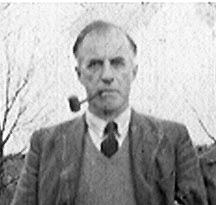 |
| Alastair Dallas |
.... Following my [Dick Raynor's] meeting and interview with him on behalf of the continuing investigation, a friend visited Alastair Dallas and was told a rather different story. In this version there was only one film by Dr McRae, but Mr Dallas himself had had a sighting, and had made some sketches. A copy of this drawing was given to the friend, who passed it on to me in October 1975. As attempts to pursue the alleged film failed, it might be useful to study the sketch. In comparing the detail of the "Loch Ness Monster" to photographs of sturgeons I found a number of points of correspondance which however were not as strong of a presentation as they could have been because I was lacking some of the necessary exactly equivalent views. The front-on view in particular, and yet that is one of the more obviously fishlike drawingsscrepancy between the front-on and profile views in that the profile shows the sucking mouth at the end of the snout whereas the head-on view seens to show some bit of snout projecting in front of the mouth, with the sucking mouth recessed underneath. Since outstanding disparity in the comparison of the profile to a sturgeon, the profile view is probably mistaken on this point. The head-on view indicates two "Sinuses" in front of the mouth but undreneath the head and the underside view of the sturgeon does also show that. The eyes were said to be shut; more than likely they were "Cloudy" fish-eyes and hard to make out for that reason. Their placement on the sides of the head seems to be near enough true for the sturgeon. ectoral fins hang down directly behind the head, where they should be positioned.In the profile view of a spiracle high up at the back of the head, a dent in front of the eye and a more obvious nostril positioned anteriorly to that, all of which correspond to the openings on a sturgeon's face. The rounded "Jowl" represents the gill-cover and confirms that we are indeed dealing with a type of a fish here. Thead is anguklar enough that it is reasonable to expect it is armoured there, and there is a higher medial ridge shown which corresponds to the central line of scutes on a sturgeon's back. It would appear that the back fins are roughly correct but that the pectoral fins are represented twice, in two different positions: perhaps the witness was confused by the part of the body lying awash and just possibly he had a brief view of the pelvic fins: he said the creature had "no rear fins" And it seems important that Dallas drew an unequal divided vertical twofinned fishtail only there were times when he drew it lying sideways instead of standing up vertically: having a vertical two-lobed fishtail where the top lobe is much longer than the bottom one is diagnostic of a sturgeon.
 |
| Atlantic Sturgeon, record maximum approx 14 feet in both Europe and in North America |
 |
| Vertically-leaping sturgeon, known to be mistaken for a "Periscope" sighting on ocasion, Very large sturgeons can leap up to 10 to 15 feet high "Periscopes" according to some reports |

 |
| Dead Atlantic Sturgeon, found recently in Manhattan, NYC. |
Postscript: Surgeon or Sturgeon?
Loch Ness and Morar ProjectIt would be churlish, in view of all the recent additional information, to allow the sixtieth anniversary of the naming of the Loch Ness 'Monster' (Anon., 1933 - attributed to Mr. Alex Campbell)to pass entirely unremarked.For most people, certainly the majority of the casually interested members of the general public, the famous 'Surgeon's Photograph' of 1934 probably represents their idea of the archetypal Monster.Certainly this well-known photograph has figured in numerous publications over the past sixty-odd years, and a serious investigation and assessment of the photograph was published in the centenary (1988) volume of the Scottish Naturalist (LeBlond and Collins, 1988).
Acoustic Assessment of Fish Size
One consequence of the introduction of more quantifying acoustic techniques - in situ target strength measurement in particular , was the discovery that the great majority of pelagic fish in Loch Ness belonged to a very small size group, which were not caught prior to the trawling methods recently described (Shine, Martin and Marjoram, 1993).Therefore there was a tendency to 'scale' large sonar echoes against gill-netted individuals of 20-30 cm, which in reality represented only a small proportion of the population.This imposes a further revision upon assessment of sonar contacts which are strong in relation to the surrounding fish echoes.
Estimates of 'Monster' Population
Sheldon and Kerr (1972) first attempted estimations of theoretical 'Monster' population density based on fish biomass.They used the morphoedaphic index (total dissolved solids/mean depth), devised by Ryder (1965), to estimate the fish population.Lacking genuine Loch Ness information, however, data was used from the northern basin of Loch Lomond.For Loch Ness, a fish standing stock of between 0.55 and 2.75 kg/ha was calculated, or between 3.135 and 15.675 tonnes in total.
On-site acoustic estimates of resident pelagic fish in Loch Ness now range from 3.1 kg/ha (Shine, Martin and Marjoram, 1993) to 4.23 kg/ha (Kubecka, Duncan and Butterworth, 1993), or between 17 and 24 tonnes in total, as compared to 300
Vol 105, The Scottish Naturalist: Postscript: Surgeon or Sturgeon? p272
to 400 kg/ha in the upper River Thames (current acoustic estimate - Dr. J. Kubecka, pers. comm.).These estimates exceed those of Sheldon and Kerr, and may be accounted for by allochthonous organic inputs.Before hopes are raised too high, however, it should be borne in mind that predators upon this biomass should not amount to more than approximately a tenth of the gross weight. Thus we have available a total of approximately two tonnes of 'Monster', but this two tonnes may not be as great as it at first seems.For example, it would be equivalent to scarcely half the weight of a 36-ft (13 m) Whale Shark Rhinocodon typus. In fact, two tonnes divided into an absolute minimum viable population of, say, ten creatures, would give an individual weight of only 200 kg.
In fish terms this could be equivalent to a Sturgeon Acipenser sturio 2.8 m in length (Maitland and Campbell, 1992: 92).The above pelagic biomass estimates are somewhat academic since they do not include migratory Salmon Salmo salar or Sea Trout Salmo trutta, which may swim too close to the surface or too close inshore to be surveyed efficiently by acoustics.For the same reason the littoral fish habitat, which is richer than the pelagic, is not included since some of the fish, and all benthic fish e.g. Eels Anguilla anguilla, would be too close to the bottom to be detected.Nevertheless, it is now scarcely possible to argue a case for a population of resident 'Monster' predators.
Fish the Most Likely Candidates
After dismissing the classic Monster photographs, Shine and Martin (1988) concluded that if, among the many recorded explanations for sighting reports, large unusual creatures were indeed involved, then fish would be the most likely candidates.This was based upon the facts that Loch Ness, as a proven refuge for cold-water Ice Age relict species, was one of the last places on earth likely to be favoured by reptiles, Jurassic or otherwise.Since there are no known marine amphibia, these could not, like almost all the other vertebrate inhabitants of the loch, have made their way up the river from the sea.Finally, any mammals should long ago have advertised their presence while breathing.
The largest aquatic animal to have been recognised in Loch Ness is the Common Seal Phoca vitulina (Williamson, 1988), some of which occasionally enter the loch, presumably in pursuit of migrating Salmon, and could have caused some sighting reports.Salmon, the largest recorded fish in the loch, migrate inland to spawn but do not feed in fresh-water, and this habit may perhaps provide a clue to another, much larger, possible candidate which could have contributed to the Loch Ness controversy.
Vol 105, The Scottish Naturalist: Postscript: Surgeon or Sturgeon? p273
Resident Predators
A problem with a theoretical population of hitherto unrecorded predatory fish is that fish reproduction, whether by egg-laying or live-bearing, gives rise to relatively large numbers of small juveniles developing independent of parental care.It seems unlikely that these would have avoided capture by fishing over the years, either by towed lure or from the beach.They would also have had to evade the netting and trawling programmes described in Shine, Kubecka, Martin and Duncan (1993), let alone decades of illicit Salmon netting.
It is not inconceivable, however, that along with the Salmon and the Common Seal, Loch Ness might have played host to another visitor.
A Sturgeon?
The possibility of the afore-mentioned Sturgeon actually being responsible for the beginnings of the tradition, and for some sighting reports since then, is quite attractive.Sturgeons would not necessarily be immediately recognised as fish.They are very large, have a long upturned snout, and a dorsal fin set well back towards the tail (Figure 1a, 2K) (Gould, 1934: 136).
In 1987 a Sturgeon, eleven feet (3.35 m) long and weighing 900 lbs (408 kg) was found dead, floating in Lake Washington near Seattle, U.S.A., where stories of a 'Monster' had circulated (Albuquerque Journal, 7th November 1987).No-one would suggest, however, that Sturgeons would even begin to enter the reckoning, against the huge multi-humped manifestations of the 1930s ascribed by Baker (Observer, 26th August 1962), to boat wakes, or to many other reports.There is no one answer to the question of the Loch Ness Monster.
Sturgeons are cold-water northern hemisphere fish of very large size (up to >3.0 m) and of unusual appearance.They would be independent of the food resources, since, before entering the loch in order to spawn, they would cease feeding.Moreover, since Sturgeons are such rare visitors to British rivers, any which did succeed in passing the two weirs on the River Ness would be very unlikely to find mates.After a lonely vigil off one of the river mouths they would presumably leave again without issue, save, perhaps, for some interesting sighting reports.
Vol 105, The Scottish Naturalist: Postscript: Surgeon or Sturgeon? p275
Gould's Early Investigations
In November 1933 Lt.-Commander R.T. Gould (1934: 30) listened to the account of Mr. John McLeod, who, some 20-30 years previously had seen, at the mouth of the River Moriston beneath the lowest fall, a creature with a "head like an eel and a long tapering tail".This is how a Sturgeon might appear from above.Another witness, Miss K. MacDonald, spoke of a "crocodile"-like creature, 6-8 feet long, ascending the River Ness and heading for the Holm Mills weir, in February 1932 (Gould, 1943: 38).Rather more recently, in 1993, Mrs Marion MacDonald described to the author an experience at the Fort Augustus Abbey harbour.She saw what she first thought was a log, because of a distinctive 'scaly' bark pattern, but which then developed a wake and moved off to submerge, while she called her family. After she had sketched her impression (Figure 2, 8K) she was shown an illustration of a Sturgeon's bony plates, and considered the pattern to be reminiscent of what she had seen.
For and Against a Sturgeon
Anyone, of course, can assemble sighting reports to support a pet theory, and this one is brought forward mainly to show that, even in the absence of significant food resources, the largest freshwater fish in existence could possibly have been seen at intervals in Loch Ness.Given the large number of other causes behind sighting reports (Binns and Bell, 1983; Campbell, 1986), these intervals could be very long indeed.
There is, however, a great deal more to the Loch Ness Monster than scientific probabilities, and the greatest argument against the Sturgeon or, more importantly, against any species of fish, is the long neck reported (Figure 1b, 7K), although such reports are more rare than is generally realised.It should be borne in mind that the first report of a long neck was when the "nearest approach to a dragon or prehistoric animal" lurched its way across the hot tarmac in front of the Spicer's motor car in July 1933 (Inverness Courier, 4th August 1933).This unprecedented behaviour has never been reported since.Prior to this, the beast was usually considered to be an unusual fish; Inverness Courier, 8th October 1868 ("a huge fish"), Northern Chronicle, 27th August 1930 ("a fish.....or whatever it was") and Scottish Daily Express, 9th June 1933 ("a mystery fish").
Errors of Identification Undoubtedly, some 'long-necked' reports originate from water birds, such as Mr. Alex. Campbell's sighting (Gould, 1934: 111), although this was subsequently revised as the archetypal plesiosaur (Witchell, 1975: 55).Some large long-necked animals have indeed been seen swimming in the loch.The author is aware of five
Vol 105, The Scottish Naturalist: Postscript: Surgeon or Sturgeon? p277
instances when such animals have subsequently been identified as swimming deer. On three occasions, photographs were taken (Figure 3).It has been suggested by Burton (1961: 130-138) that some sightings, including some influential ones, could be due to such errors.
Experiments with Human Perception It is now well understood that human perception consists of much more than just image, retina and memory.In contrast to 'hard' evidence, such as photographs, however, it is very difficult to assess sightings evidence because it is not usually possible to stand beside the witness.An exception to this is if an incident is contrived.
Mr. Richard Frere gives an account (Frere, 1988: 175) of standing at a busy lay-by and, through a little theatrical behaviour, drawing attention to the turbulence caused by some trawler wakes.Reactions included sightings of various humps, long dark bodies, side flippers, and a thrashing tail.A drawing produced by a child showed a plesiosaur.
On a less spectacular scale, members of the Project have also stood beside volunteer eye-witnesses, who were asked to observe an object surfacing and submerging.All were aware that we were contriving the incident, and it therefore seems possible that impressions were inspired less by pre-conceived Loch Ness Monster stereotypes than by concepts of the mechanism in the equipment.However, the results of this rather 'conservative' experiment (Figure 4, 17K) are of some interest, since 31% of the 36 observers retained impressions at some variance with the 45 cm straight-sided post they had actually seen at a range of approximately 150 m.
Given that variation exists between image and perception in such prepared observers, it seems likely that individuals, sighting unrecognised objects on Loch Ness, may well have their perceptions influenced by the well-known Monster stereotypes.It is certainly the case that the wider impression of events, as disseminated and recorded by the media, may bear little relationship to what was actually seen.For example, in a recent case Miss Edna MacInnes was widely reported as having seen a creature with a "giraffe-like" neck (Aberdeen Press and Journal, 25th June 1993).When interviewed later she denied this, and stated that she had used the word "giraffe" in the context of conveying the sense of movement which the object made.Her drawing appears in Figure 5 (12K).
Vol 105, The Scottish Naturalist: Postscript: Surgeon or Sturgeon? p281
Some Conclusions
Burton (1961: 91) suggested that gas such as methane could bring decaying vegetation, perhaps including branches resembling necks, to the surface.In the main, the Project's work has shown little gas production in deep Loch Ness sediments.There are two exceptional areas, however; one is a small area in Urquhart Bay, and there is a larger one off Fort Augustus, where great quantities of organic material accumulate and emit gas continuously during the summer.On one occasion (Figure 6, 19K colour chart), gas was detected from a source as deep as 97 m, which remained active for two weeks.It seems that vegetable debris, including branches, could break the surface in this particular 'Monster spot'.
The morals of this story are two-fold.Firstly, large creatures may plausibly be witnessed in Loch Ness, whether or not science discovers sufficient red-herrings with which to feed them.On the other hand, the types of creatures suggested by science should not be over-ruled simply because they do not fit all witness perceptions.
Those who find the author's attempts to modify the status of the very long-necked sightings unsatisfactory, may take comfort from the 'Surgeon's Photograph', standing guard over popular expectations for some sixty years, and confounding any science to take itself too seriously.
References
Anon.(1933).Strange spectacle on Loch Ness.What was it?(From a correspondent).Inverness Courier, 2nd May 1933.
Binns, R. and Bell, R.J.(1983).The Loch Ness Mystery Solved.Shepton Mallet, Somerset:Open Books.
Burton, M. (1961).The Elusive Monster.London:Hart Davies.
Campbell, S.(1986).The Loch Ness Monster.The Evidence.Wellingborough, Northamptonshire:Aquarian Press.
Frere, R. (1988).Loch Ness.London:John Murray.
Gould, R.T.(1934).The Loch Ness Monster and Others.London: Geoffrey Bles.
Kubecka, J., Duncan, A. and Butterworth, A.J. (1993).Large and small organisms detected in the open waters of Loch Ness by dual-beam acoustics.Scottish Naturalist, 105: 175-193.
Vol 105, The Scottish Naturalist: Postscript: Surgeon or Sturgeon? p282
Leblond, P.H. and Collins, M.J. (1988).The Wilson Nessie photograph: a size determination based on physical principles.Scottish Naturalist, 100: 95-108.
Maitland P.S. and Campbell, R.N.(1992).Freshwater Fishes of the British Isles.New Naturalist Library, No. 75.London: Harper Collins.
Ryder, R.A. (1965).A method for estimating the potential fish production of north-temperate lakes.Transactions of the American Fisheries Society, 94: 214-218.
Sheldon, R.W. and Kerr, S.R. (1972).The population density of Monsters in Loch Ness.Limnology and Oceanography, 17: 746-798.
Shine, A.J. and Martin, D.S. (1988).Loch Ness habitats observed by sonar and underwater television.Scottish Naturalist, 100: 111-199.
Shine, A.J., Martin, D.S. and Marjoram, R.S.(1993).Spatial distribution and diurnal migration of the pelagic fish and zooplankton in Loch Ness.Scottish Naturalist, 105: 195-235.
Williamson, G.R.(1988).Seals in Loch Ness.Scientific Reports of the Whales Research Institute, No. 39 (March 1988).Tokyo, Japan.
Witchell, N. (1975).The Loch Ness Story.London: Penguin Books.
Received July 1993
Mr. Adrian J. Shine,
Loch Ness and Morar Project,
Loch Ness Centre,
DRUMNADROCHIT,
Inverness-shire
IV3 6TU.