
The Enfield Horror: [Prairie Ghosts site]
The vast reaches of forest and open fields of
southern Illinois, combined with the sparse population in some areas, seem to
invite weirdness that might not occur in cities and more crowded locales. In the
most southern portions of the region, the Shawnee National Forest covers miles
and miles of territory. The acres of forest seem almost untouched by man and
some believe that strange things occasionally pass through here, unseen by human
eyes.
This southern portion of the state is sometimes referred to as the
“Devil’s Kitchen”, a designation left behind by the Native Americans and the
early settlers to explain strange sights and sounds like unexplained balls of
light, apparitions, screams in the night and various other unsettling types of
phenomena. The Native Americans often considered such sites as “sacred” but the
settlers usually believed them to be “cursed”, or at least well avoided. The
idea that such locations were linked to the "Devil" was the first thought that
crossed the minds of the bible-reading, god-fearing folks and they promptly set
about to do two things. They learned to avoid these strange and haunted places
and secondly, they gave names to the spots to alert other visitors and settlers
of the dangers of the area. In the case of the Devil’s Kitchen, just about
anything is possible, from ghosts reports to mystery animals and weird monster
sightings.
Perhaps strangest monster reports to ever take place in
Illinois began in April 1973 in the small town of Enfield. This tiny community
in southeastern Illinois became the scene of bizarre happenings for a short
period of time and while the case has largely been forgotten today, it remains a
part of the high strangeness of the region.

Henry McDaniel of Enfield
almost became the first man to be arrested because of the Enfield Horror. White
County Sheriff Roy Poshard Jr. threatened to lock McDaniel for telling folks
about the weird events that took place at his home in April 1973, but McDaniel
stuck by his story and his initial report would begin what became a nightmare
for the small town. According to McDaniel, he was at home on the evening of
April 25 when he heard a scratching on his door. When he opened it, he couldn't
believe his eyes! "It had three legs on it," McDaniel swore, " as short body,
two little short arms coming out of its breast area and two pink eyes as big as
flashlights. It stood four and a half to five feet tall and was grayish-colored.
It was trying to get into the house."
Needless to say, McDaniel was not
letting it in and he quickly retrieved a pistol. He kicked open the door and
opened fire. After his first shot, McDaniel knew that he had hit it. The
creature "hissed like a wildcat" and scampered away, covering 50 feet in three
jumps. It disappeared into the brush along a railroad embankment near the
house.
McDaniel quickly called the police and Illinois state troopers who
responded to the call found tracks "like those of a dog, except they had six toe
pads." The tracks were measured and two of them were four inches across and the
third was slightly smaller. [These are composite tracks of more than one footprint superimposed, most likely dog tracks and nothing to do with the sighting-DD]
Investigators soon learned that a young boy,
Greg Garrett, who lived just behind McDaniel, had been playing in his yard about
a half-hour before. Suddenly, the creature had appeared and attacked him.
Apparently though, it just stepped on his feet, but this was enough to tear the
boy's tennis shoes to shreds. Greg had run into the house, crying
hysterically.
On May 6, Henry McDaniel was awakened in the middle of the
night by howling neighborhood dogs. He looked out his front door and saw the
monster again. It was standing out near the railroad tracks. "I didn't shoot at
it or anything," McDaniel reported. "It started on down the railroad track. It
wasn't in a hurry or anything."
McDaniel's reports soon brought publicity
to Enfield and prompted the threats from the county sheriff, but it was too
late. Soon, hordes of curiosity-seekers, reporters and researchers descended on
the town. Among the "monster hunters" were five young men who were arrested by
Deputy Sheriff Jim Clark as "threats to public safety" and for hunting
violations. This was after they had opened fire on a gray, hairy thing that they
had seen in some underbrush on May 8. Two of the men thought they had hit it,
but it sped off, moving faster than a man could.
One more credible
witness to the monster was Rick Rainbow, who was then the news director of radio
station WWKI in Kokomo, Indiana. He and three other persons spotted the monster
near an abandoned house, just a short distance from McDaniel's place. They
didn't get much of a look at it as it was running away from them, but they later
described it as about five feet tall, gray and stooped over. Rainbow did manage
to tape record its cry. The wailing was also heard by eminent researcher Loren
Coleman, who also came to try and track down the creature. He also heard the
sound while searching an area near the McDaniel home.
A short time later,
the sightings ended as abruptly as they began. No explanation was ever given as
to what this bizarre monster may have been, where it may have come from, or
where it disappeared to. Some had surmised that perhaps it was connected to UFO
activity that was also reported in the general area at the time - but we will
never really know for sure!
From:
http://www.prairieghosts.com/enfield.html
-Much is made of the detail that the creature was supposed to have three legs. There were multiple sightings by several individuals, but so far as I can tell, only McDaniel said anything about it having three legs, a tail, or anything which might be mistaken for a third leg.Other observers added the detail that it was also covered in hair. To continue from here on with "Cryptozoologist's" page on the subject:
http://www.myspace.com/the_cryptozoologist/blog/532070394
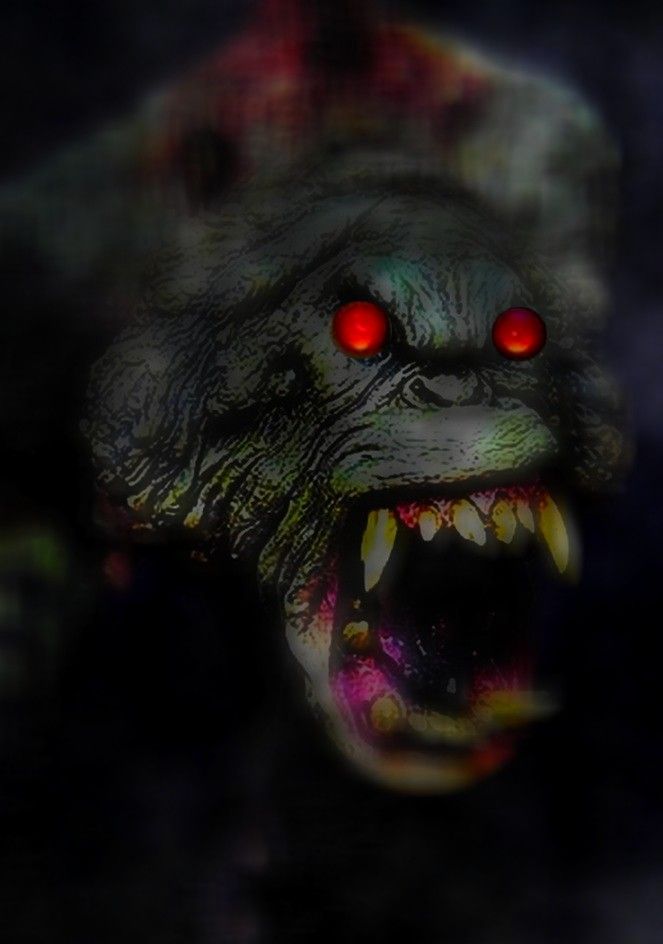
.....
If McDaniel believed that his encounters with the unknown were a thing of the past, he would soon realize that he was sadly mistaken, when, on the eve of May 6, he was startled awake in the dead of the night by the howling of some neighborhood dogs. McDaniel's pulled himself out of bed, once again claimed his firearm, and — with what must have been great trepidation — opened his front door.
This time his encounter with this creature would not be so intimate. He claims he watched the thing at some distance, languidly negotiating the trestles of the railroad tracks near his home:

"I saw something moving out on the railroad track and there it stood. I didn't shoot at it or anything. It started on down the railroad track. It wasn't in a hurry or anything."
As is always the case with astounding events such as this, it wasn't long before the press got wind of the weirdness and came out in full force, but it wasn't until McDaniel's second report that the media frenzy truly kicked into overdrive.
White County Sheriff, Roy Poshard Jr., was so perturbed by this sudden influx of press and curiosity seekers (not to mention the alarm that was settling in on the locals) he threatened to incarcerate McDaniel if he didn't stop inciting panic by spreading his wildly terrifying tale.
To make matters worse, well armed posses of amateur "monster" hunters began patrolling the area near the L&N railroad track sightings. It was on one such expedition that five young men allegedly had a run in with a creature identical to the one that Garret and McDaniel encountered — with the notable addition being that they described the thing as being "hairy."
The men discovered the beast hiding in the underbrush and proceeded to open fire on it, but (much like in the McDaniel case) their bullets were unable to cause mortal injury and the monster bolted off at a speed that the eyewitnesses surmised was greatly in excess of any that a human being could achieve.
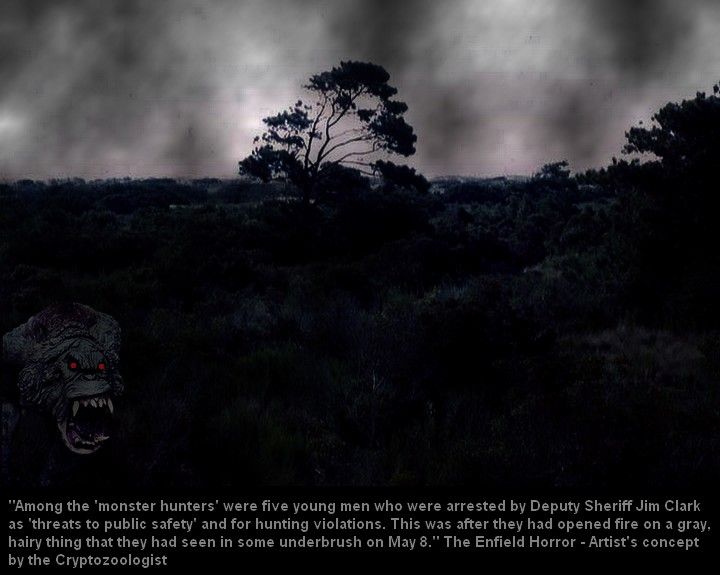
The final eyewitness to this improbable creature was Rick Rainbow, the news director of radio station WWKI in Kokomo, Indiana. He and three other unnamed individuals claimed to have seen a gray, stooping, 5-foot tall entity lurking outside an abandoned house not far from the Garret and McDaniel's homes.
Although they did not have nearly as close (or for that matter as harrowing) an encounter as the previous sets of witnesses, Rainbow and his crew did manage to do one thing the others had not — tape record the monster's disturbing scream.
It was then that noted cryptozoologist, Loren Coleman, arrived on the scene to investigate the eyewitnesses claims as well as the sound recording. Coleman also heard the haunting cry of the creature while searching an area where eyewitnesses claimed to have seen the thing:

"I traveled to Enfield, interviewed the witnesses, looked at the siding of the house the Enfield Monster had damaged, heard some strange screeching banshee-like sounds, and walked away bewildered."
In the July, 1974 edition of Fate Magazine, Loren Coleman and Jerome Clark featured the Enfield Horror in an article entitled: "Swamp Slobs Invade Illinois." Coleman even chronicled discussing this intriguing case with famed paranormal investigator—as well as bestselling author of The Mothman Prophecies—John A. Keel, in his book: Mothman and Other Curious Encounters.

"This reminds me of my exchange with Keel… in 1973, when we were discussing the new reports out of Illinois, from Enfield. On April 25, 1973, Mr. and Mrs. Henry McDaniel returned to their home and Henry had an encounter with a thing that looked like it had three legs, two pink eyes as big as flashlights, and short arms on a four-and-a-half-feet tall and grayish-colored body, along the L&N rail-road tracks, in front of his house."
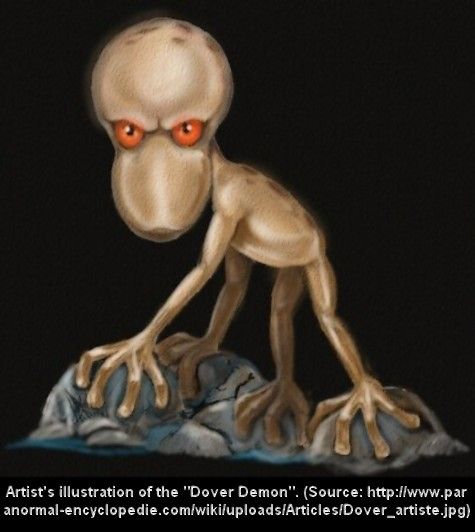
Years later, Coleman would contrast his Enfield investigation with another he conducted regarding a legendary, unclassified creature that many assume was also from out of this world—a melon-headed monster known as the "Dover Demon":
"(The Enfield Horror) was my case investigation. It was much different than the Dover Demon, however, and was more like a combo phantom kangaroo, "Devil Monkey" and "Swamp Ape" situation." [Emphasis added by DD]
It should also be noted that between the years of 1941 and 1942, in the sleepy village of Mt. Vernon (less than 40 miles away from Enfield) there was a similar spate of encounters involving an anomalous "leaping" beast that terrorized the local populace and was reputedly responsible for numerous animal deaths in the region. Eyewitnesses claimed that the Mt. Vernon Monster was vaguely baboon-like (hence the "Devil Monkey" analogy) and able to leap 20 to 40[?]-feet in a single bound.
Is it possible that the Enfield Horror, whatever it may be, is working on 30 year cycle? While there are no reputable accounts of the creature hailing from the 21st century, one cannot entirely count out the possibility that the thing is a long slumbering anatomical oddity that rears its head every so often to feed on animals and terrify locals.
Whatever this creature is or is not, it has not been reported in almost 40 years. That, however, does not mean that it's not still lurking in the shadows of some old train yard, waiting to return to scratch on another door in the wee hours of the night.
[Cryptozoologist's Note: Ever since the events mentioned here took place, there has been speculation that the Enfield Horror was either an alien life form or even some sort of demon. As a scientist who is also well-versed in the metaphysical, it is my opinion that the majority of alien/UFO sightings or encounters can be explained by natural or manmade objects/activities. Those that cannot, I believe, are the result of supernatural manifestations. Since the Enfield Horror appears to have been, at the very least, frightened off by gunfire or possibly even wounded, and since the creature was observed at times going about mundane activities, which would seem meaningless for a supernatural being to be engaged in, I am of the opinion that it was neither alien nor demon, but some sort of bizzare, unknown, but entirely corporeal creature, possibly even a genetic mutation of some sort. But as I said, that is just my opinion. I leave it up to you, the reader, to draw your own conclusions.]
RESOURCES
http://americanmonsters.com/site/2010/03/enfield-horror-illinois-usa/
http://www.prairieghosts.com/enfield.html
--I have heard it suggested that the claim of "Three legs" is a garbling of an original statement the creature had "Three toes". My impression of the matter at this point is that if the suspicious and likely spurious third leg is dropped out of the description, we once again have one of Tyler Stone's freshwater monkeys, and one which comments on the American Monsters message board compared to the Loveland Frog.It is covered with grey hair that can be shaggy on the back, but which can also be seen as wetted down and thus "Slick and Slimy".The grey colour is what is elsewhere described as "Silvery" on occasion, presumably when it is being seen as more reflective. Interesting is the included feature of "Leaping" in such reports, something on the level of a human athlete's broad jump (I queried the statement of "40 feet in a single leap" in the description above because I did not think it was a valid estimate) There are several species of lemurs in Madagascar which travel bipedally on the ground-by leaping and it seems that these FW-Monkeys also have that great leaping ability for making dives into the water: other occasions such as the Loveland Frog case do mention that it can jump a pretty good distance off a bridge or whatever. Assuming a partial description stemmong from a combination of poor viewing conditions and the agitated wstate of the winess, and a confused description resulting from it, it could actually be one of the same things. The sightings from the 1940s were included in Ivan Sanderson's book, along with the passage on the "Little Red Men of the Delta"[=Pukwudgies?] And the "30 year cycle" would only be an artefact of the reports on file that are recognised to be the same type. When you count other sightings in different pigeonholes, the reports are far more common than it might seem at first.
The Strangeark Checklist of North American Cryptids includes under the heading of Primate:
1)Anthropoid ape-like animal Reported from North
American swamps
and bottomland hollows. Heuvelmans
1986; Coleman 1983; [Sanderson, IvanT, 1969 and 1970, under
the name "Abominable Swamp Slobs"]
Primate-like:
Dover "demon" Reported from Dover,
Massachusetts Coleman 1983
Primate-like:
"Devil Monkey" Reported sporadically from eastern U.S.;
ex. Virginia
Primate-like: Aquatic ape-like animal
Reported off eastern Maritime
provinces, Canada [and] Great
Lakes Arment 2004
So now it becomes a good idea to mention Devil Monkeys.
http://animal.discovery.com/tv/lost-tapes/meet-the-creatures/devil-monkey.html

WHAT'S A DEVIL MONKEY?: The United States and Canada aren't home to any modern-day primates, which makes the appearance of a giant monkey-like creature in rural areas even more bizarre to those who've seen it. Dubbed the devil monkey, this primate-looking beast reportedly has pointed ears, a baboon- or doglike snout, a bushy tail and only three toes on each of its narrow feet. Ranging in height between 3 and 8[?-Coleman and Huyghe field guide reads 6] feet (0.9 and 2.4 meters) tall, this strange monkey gets around on all fours and travels by jumping. Devil monkeys are supposed to be aggressive, especially toward dogs and humans, and by most accounts, they are carnivorous and feed on livestock. This fearsome monkey makes a wide range of evil-sounding noises, including hoots, whistles and screams.
MONKEYING AROUND: According to George Eberhart, author and cryptid expert, the devil monkey can be found in British Columbia and the Appalachian Mountain region of the United States. One of the first reported sightings occurred in 1959 when a "monkeylike creature" rushed the car of a couple driving down a rural road in Virginia. A second encounter happened soon after, when two nurses reported that a similar creature tore the top off of their convertible. Other sightings have occurred as recently as 2001, when a giant black monkey was seen nine different times over the course of two weeks in rural New Hampshire.
POSSIBLE EXPLANATIONS: Some people think devil monkeys could be feral monkeys that have been released into the wild or escaped from research facilities, such as the ones that broke free in Florida due to Hurricane Andrew in 1992. While that's possible, Cryptozoologists Chad Arment and Mark A. Hall suggests devil monkeys could actually be a surviving species once thought to be extinct, like a fruit-eating spider monkey originating from Brazil, or a large baboon that lived 650,000 years ago in East Africa.
-The last sentence betrays a flaw in the construction of the category: the same animal cannot possibly be related to New World Monkeys in one part of its range (South America) and Old World monkeys in another part (Africa): the category must be unnecessarily lumping different sorts of monkeys together. And the description speaks of a three-toed foot while the illustration shows the opposed big toe. Still, the illustration is probably also a better and more objective depiction of Tyler Stone's Freshwater Monkey seen clearly and in good detail than any of the "Wierd" observations would lead the casual reader to believe. The type here should be tailless or have only a stump of a tail: a longtailed monkey would be something else. and checking with Coleman and Huyghe's field guide on the different three-toed tracks, the "Swamp Monster" tracks have sharp toes/claws at [8 to] 10 inches long while the three-toed "Devil Monkey" tracks are rounded at the toes (claws not showing?) and range from twelve to fifteen inches in length. The latter tracks match Momo, the Fouke Monster and the Midwest Frogfoot-probably the Scrape Ore "Lizardman" would have left something similar, except the hoaxers decided to make up one of their own instead. The average of all the tracks is just about a standard-sized human foot. I also imagine the flipper-like feet are disproportionately large to the creature in comparison to the usual human proportion of length of footprint to height: a 15 inch track need not have belonged to an excessively large creature, although perhaps that is the basis for the estimate of "Eight feet tall": there also could be some skidding and slipping in some of the longer tracks. The average of the reports is at 4 1/2 feet tall, usually reports say in the range of 4-5 feet tall, and there is a sizeable minority of reports which say "greater than human" size. One trackway in Northern Louisiana showed three ovoid (toes not discernable) tracks in the middle of a muddy bed of a drained pond-but with the next nearest tracks 20 feet distant. Here we would have confirmation of another one of those 20 foot broad jumps.
Best Wishes, Dale D.
ADDENDUM: [From Mysterious Creatures (2002) both of the following categories are composites defined broadly enough to be only of limited value in determining any Zoological identities, but on the other hand both entries do include most of the pertinent data involved]
George Eberhart under Devil Monkeys:
Devil Monkey
Large, sometimes-tailed Primate of North America.
Etymology: Name coined by Mark A. Hall.
Variant names: Giant monkey, Nalusa
Falaya.
Physical description: Height, 3–8 feet. Light
brown to black hair. Pointed ears. Baboonlike
or doglike muzzle [NB: Descriptions of "Baboonlike" faces also mean Chimpanzeelike, includes Bulldoglike, both as specified by the witnesses involved-DD]. Strong chest. A blaze of
white fur from neck to belly. Short forelegs with
claws. Muscular hind legs. Large feet. A long tail
is sometimes reported, alternately described as
black and bushy or hairless.
Behavior:Sometimes walks bipedally, at other
times quadrupedally[and can leap long distances-DD]. Aggressive toward dogs
and humans. Emits a wide range of hoots, calls,
screams, and whistles. Said to kill livestock and
small game.
Tracks: Three rounded toes, with regular
spacing between. Length, 12–15 inches.
Distribution: British Columbia; Appalachian
Mountain region of the United States.
Significant sightings: Early one morning in
1959, a monkeylike creature rushed at the car of
a couple driving down a rural road near Saltville,
Virginia. It chased the vehicle for a short while,
grabbing at it with its front paws. Later, they
found three long, deep scratches in the metal
from the front door to the rear. Around the same
time, the animal apparently ripped off the con-
vertible top of a car driven by two nurses.
After midnight on June 26, 1997, Debbie
Cross saw a strange animal outside her rural home
near Dunkinsville, Ohio. It was 3–4 feet tall,
hairy, and with long arms and a short tail. As it
moved away from her, it walked on its knuckles.
A giant black monkey was spotted in rural
Danville, New Hampshire, on September 9,
2001, and on at least nine other occasions over
a two-week period.
Present status: Distinctions between North
American Apes, Devil monkeys, Hairy Bipeds,
and Bigfoot are nebulous and possibly arbitrary.
In general, North American Apes are tailless
and primarily quadrupedal, and they resemble
chimpanzees; Devil monkeys are tailed and resemble baboons[or macaques-DD] ; Hairy Bipeds cover a wide
range of descriptions from apes to wildmen and
even paranormal entities; Bigfoot is a robust,
tall hominid with a range that seems restricted to
the Pacific Northwest. Loren Coleman even
notes certain similarities with Phantom Kangaroo reports and suggests that juvenile Devil
monkeys may resemble kangaroos [which is really stretching the definition!-DD].
Possible explanations:
(1) Feral pet monkeys have formed breeding
colonies, especially in Florida. A group of
Squirrel monkeys (Saimiri sciureus) live in
Broward County’s Hugh Taylor Birch State
Park, and Rhesus monkeys (Macaca
mulatta) became well established around
Silver Springs after they were first released
into the wild in Marion County during the
filming of Tarzan movies in 1933. Rhesus
monkeys are also known in Jack Kaye Park
in Fort Lauderdale. A few of the 500
monkeys uncaged in 1992 by Hurricane
Andrew from research labs, private owners,
and the Miami Metrozoo are probably still
living and breeding in the Everglades. Some
officials believe Capuchin monkeys (Cebus
spp.) are forming troops in south Florida. A
free-roaming group of Japanese macaques
(Macaca fuscata) was brought to Dilley,
Texas, in 1972 to save the animals from
destruction in Kyoto, Japan, where they are
regarded as a nuisance; in 1980, the
monkeys became the property of the South
Texas Primate Observatory and were
confined for behavioral research at a ranch
there. But in the late 1980s, their enclosure
fell into disrepair, and several escaped. The
monkeys have roamed the south Texas
brush ever since, their population swelling
to more than 600 by 1995. However, none
of these colonies are in areas where Devil
monkeys have been reported.
(2) Surviving Protopithecus brasiliensis (or
related species), an extinct, fruit-eating
spider monkey from the Late Pleistocene of
eastern Brazil that was twice as large as any
extant species, suggested by Chad Arment.
(3) Surviving Theropithecus oswaldi, a large
baboon that lived 650,000 years ago in East
Africa and is the ancestor of the modern
Gelada baboon (T. gelada), suggested by
Mark A. Hall. The male was roughly the
size of a female gorilla and weighed 250
pounds. A ground dweller, this animal was
too big to live in trees and could not use its
long forearms for swinging.
Sources: Chad Arment, “Virginia Devil
Monkey Reports,” North American BioFortean
Review 2, no. 1 (2000): 34–37, http://www.
strangeark.com/nabr/NABR1.pdf; Chad
Arment, “Devil Monkeys or Wampus Cats?”
North American BioFortean Review 2, no. 2
(2000): 45–48, http://www.strangeark.
com/nabr/NABR4.pdf; Loren Coleman,
Mysterious America, rev. ed. (New York:
Paraview, 2001), pp. 184–187.
Hairy Biped
A humanlike or apelike Entityof North Amer-
ica, possessing some of the characteristics of
Giant Hominids or North American Apes.
Etymology: Coined by Jerome Clark as a
catchall term for humanoids reported in the
midwestern and eastern United States and
Canada.
Variant names: Big hairy monster (BHM),
Billiwack monster (in southern California),
Booger, Buenafoot (in southern California),
Cannibal Giant, Dwayyo, Eastern bigfoot,
Fluorescent Freddie, Goatman, Goonyak (in
Vermont), Grassman (in Ohio), Lake Worth
Monster, Manbeast, Manimal, Momo, Old
slipperyskin (in Vermont), Old yellow top (in
Ontario), Ole woolly, Orange eyes (in Ohio),
Precambrian Shield man, Taku he
(Dakota/Siouan, “what’s that?”), Wejuk (in
Vermont), Wood devil, Wookie, Woolly
booger, Yeahoh (in Kentucky).
Physical description: Not as uniform as the
Bigfoot of the Pacific Northwest, though al-
ways covered with hair and walking on two legs
(hence its name). It’s difficult to generalize traits
from reports that might have multiple causes,
but some of the following features are usually
present. Height, 4–9 feet, though sizes up to 12
feet are mentioned. Hair or fur is reddish-brown
to black, often described as 6–8 inches long.
Often distinctly lacking in facial features, but a
catlike face is occasionally reported. Red, or-
ange, yellow, or green glowing eyes. Flat, broad
nose. Pointed ears. Werewolflike fangs. Mane.
Long arms. Hands are sometimes clawed. Long
legs.
Behavior: Primarily nocturnal. Usually has an
awkward, bipedal gait but sometimes runs on all
fours. Said to be able to swim. Occasionally seen
with young. Reported calls are moans, grunts,
howls, high-pitched shrieks. Strong, putrid odor
like decaying flesh or rotten eggs. These crea-
tures are sometimes ascribed such paranormal
features as invulnerability, transparency, insub-
stantiality, invisibility, and the ability to disap-
pear instantaneously. Appears to show interest
in and have no fear of human dwellings. Dis-
likes cars and dogs, which often react with great
fright. Sometimes associated with unidentified
flying object (UFO) sightings.
Tracks: Anywhere from two- to six-toed.
Three-toed are perhaps commonest and have
been reported from the South, the Midwest,
Pennsylvania, Maryland, and southern California. Length, up to 14 inches. Stride, up to 5
feet. Hair samples have been found.
All primates have five toes. Any Hairy biped
that leaves clear imprints showing anything less
than five toes constitutes an extreme evolution-
ary anomaly. Pentadactyly (having five fingers
or toes) is a common and primitive feature of
reptiles and mammals. However, it is not an es-
sential requirement, and many animals have
modified the plan: frogs only have four digits,
cows have two, horses have dropped all but one,
and snakes have gotten rid of legs altogether.
Most birds get by walking on only four (three in
front and one behind), while the Ostrich
(Struthio camelus) only has two. If three-toed,
humanlike bipeds really exist as flesh-and-blood
creatures and are not paranormal apparitions, it
would be most interesting to find out more
about their foot structure. Perhaps three toes is
better than five when you’ve chosen a swamp or
wetland as your habitat.
Habitat: Secluded areas, often forested wet-
lands or mountainous regions.
Distribution: Nearly every U.S. state and
Canadian province. Most sightings represent
only transient individuals.
A partial list of places where Hairy bipeds
have been reported follows:
Alabama—Choccolocco Valley, Town
Creek.
Arkansas—Center Ridge, Greene County,
Jonesboro, Leachville, Poinsett County, St.
Francis County, South Crossett, Springdale.
California—Antelope Valley, Borrego Sink,
Lytle Creek, Pearblossom, San Gorgonio
Mountains, Santa Paula.
Colorado—Green Mountain Falls.
Connecticut—Bristol, Crystal Lake Reservoir,
Winsted.
Delaware—Selbyville.
Georgia—Edison.
Illinois—Big Muddy River, Cairo, Center-
ville, Chittyville, Creve Coeur, East Peoria, Eff-
ingham, Farmer City, Kickapoo Creek, Murphysboro.
Indiana—Attica, French Lick, Galveston,
Hoosier National Forest, Knox County, Pike
County, Richmond, Rising Sun, Roachdale,
Sharpsville, Winslow.
Iowa—Clinton.
Kentucky—Albany, Leslie County, Trimble
County.
Labrador, Canada—Goose Bay.
Louisiana—Cotton Island, Honey Island
Swamp.
Maine—Durham.
Manitoba, Canada—Gypsumville, Steinbach,
Whiteshell Provincial Park.
Maryland—Calvert County, Churchville,
Dickerson, Harford County, Kingsville, Prince
George’s County, Sykesville.
Massachusetts—Bridgewater, Raynham Center.
Michigan—Byron, Charlotte, Dowagiac
Swamp, Fenton, Houghton Lake State Forest,
Lake City, Marshall, Mason, Mio, Monroe, Os-
coda County, Port Huron, Saginaw, Shiawassee
River, Sister Lakes, Tuscola County, Yale.
Minnesota—northern part of state.
Mississippi—Meridian, Winona.
Missouri—Louisiana, Pacific, Troy.
Montana—Monarch, Vaughn.
Nebraska—south of Lincoln.
Nevada—Nevada Test Site.
New Hampshire—Hollis, Salisbury.
New Jersey—Great Bear Swamp, High Point,
Middletown, Vineland.
New York—Burlington County, Ellisburg,
Morristown, Mount Misery, Richmondtown,
Sherman, Watertown, Whitehall.
Newfoundland, Canada—Trinity Bay.
North Carolina—Dismal Swamp, Tabor
City.
Ohio—Alliance, Brookside Park, Carlisle,
Coshocton County, Defiance, Eaton, Huron,
Kenmore, Kimbolton, Mansfield, Minerva,
Monroeville, Muskingum County, Newcomer-
stown, Point Isabel, Rome.
Oklahoma—Canton, Kiamichi Mountains,
Mountain Fork River, Nowata, Noxie, Tahle-
quah, Wann.
Ontario, Canada—Cobalt, Webequie, Wee-
nusk Indian Reservation.
Oregon—Conser Lake, Roseburg.
Pennsylvania—Allegheny County, Allison,
Beaver County, Bradford County, Buffalo
Mills, Chester County, Chestnut Ridge, Derry
Township, East Pennsboro Township, Edin-
boro, Fayette County, Gray Station, Indiana
County, Jeannette, Lancaster, Latrobe, Lock
Haven, Somerset County, Uniontown, West-
moreland County, Whitney.
Saskatchewan, Canada—Grand Rapids.
South Dakota—Standing Rock Indian Reser-
vation.
Tennessee—Charlotte, Flintville, Lascassas,
Knox County, Monteagle Mountain.
Texas—Bells, Caddo, Denton, Haskell,
Lamar County, Lake Worth, Newton County,
Paris, Peerless, Polk County.
Vermont—Chittenden, Hartland, Rutland
County, Williamstown.
Virginia—Colonial Beach, Middletown.
West Virginia—Cacapon Bridge, Davis,
Hickory Flats, Marlinton, Parsons.
Wisconsin—Benton, Cashton, Deltox
Swamp, Grafton, Granton, Jefferson, Medford.
Significant sightings: Riley W. Smith saw a
naked hairy man, about 6 feet tall, while picking
berries near Winsted, Connecticut, on August
17, 1895. The incident was the first of about
twenty that allegedly took place in western Con-
necticut and the Catskill Mountains of New
York over the next few weeks. Widely and pos-
sibly erroneously regarded as a hoax by newspa-
perman Louis T. Stone, the original incident
may have involved a bear.
An apelike, bipedal creature with a yellow
head and mane was seen by workers near the Vi-
olet Mine east of Cobalt, Ontario, in September
1906. In 1923, two prospectors saw a similar yel-
low-headed, black-haired animal eating blueber-
ries; they thought it was a bear until they threw
a rock at it, prompting it to get up and walk
away on two legs. Later sightings earned it the
nickname “Old yellow top.” The last sighting
was in August 1970 when Aimée Latreille, the
driver of a bus carrying twenty-seven miners, was
forced to swerve after he saw an apelike creature
with a light mane cross the road; the bus nearly
had a fatal crash down a nearby rock cut.
In August 1963, Harlan E. Ford and a friend
encountered a huge humanoid in Honey Island
Swamp near Slidell, Louisiana. It glared menacingly at them and ran away on two legs.
In May 1964, near Sister Lakes, Michigan,
Gordon Brown and his brother saw a hairy man
about 9 feet tall who made a whimpering sound.
Shortly afterward, three teenagers saw a 7-foot
creature with a black face running through the
underbrush in Silver Creek Township. Many
other witnesses came forth and were named in
extensive newspaper coverage.
A green, 10-foot-tall monster with glowing
red eyes was seen in March 1965 by teenagers in
the woods south of French Lick, Indiana. They
called it “Fluorescent Freddie.”
In 1965, two teenagers were chased from
their campfire by a 9- to 10-foot hairy creature
on the north slope of the San Gorgonio Moun-
tains, California.
On August 13, 1965, Christine Van Acker
and her mother were driving near Monroe,
Michigan, when a hairy, 7-foot giant stepped in
front of their car. Van Acker hit the brakes,
stalling the car, and the creature reached
through the open window and grabbed the top
of her head. The women’s screams and horn
honking apparently made it retreat.
On May 19, 1969, George Kaiser saw a man-
sized creature covered in black fur on his farm
near Rising Sun, Indiana. It made a strange
grunting sound, jumped over a ditch, and
swiftly ran down the road. Later, footprints with
three small toes and a big toe were found. A
greenish-white UFO was seen by a neighbor the
next night.
Odd, froglike noises woke up teenagers
Wayne Hall and Dave Chapman early on July
24, 1972, at the latter’s home near Crystal Lake
Reservoir in northwestern Connecticut. Look-
ing outside, they saw an 8-foot hairy creature. It
crossed a road and moved around in the shad-
ows near a horse barn. After forty-five minutes,
it crossed the road again and disappeared in the
woods by the lake.
On the night of April 22, 1973, William
Roemermann, Brian Goldojarb, and Richard
Engels saw a Bigfoot-like creature near the
Sycamore Flats campground in Big Rock
Canyon, Los Angeles County, California. It
chased their truck for about twenty seconds, its
long arms swinging in front of its chest. On re-
turning, they found many huge, three-toed
tracks.
In May and June 1973, an apelike creature
terrorized the area around Sykesville in Carroll
County, Maryland. Five-toed, 13-inch foot-
prints were found, separated by a stride of 6 feet.
On June 25, 1973, Randy Needham and
Judy Johnson were parked near a boat ramp on
the Big Muddy River near Murphysboro, Illi-
nois, when they heard a piercing cry that came
from the nearby woods. They looked up and
saw the sound came from a huge shape lumber-
ing toward them. The creature was about 7 feet
tall and covered with a matted, whitish hair.
Others saw and heard the same creature over the
next two weeks, and it reappeared in the sum-
mers of 1974, 1975, 1988, and 1989.
At 4:30 a.m. on September 2, 1973, Chester
Yothers woke up and saw a Bigfoot-like crea-
ture only 5 feet away outside his trailer near
Whitney, Pennsylvania, apparently looking at
the house next door. He woke his wife and
called the police, who arrived shortly afterward.
The monster was gone, but they found wet foot-
prints on the concrete and in the flower bed.
Dennis Smith and Jimmy Slate heard pound-
ing and shrieking noises in the woods next to
Overlook Drive, near Watertown, New York, in
the early morning of August 10, 1976. As the
sun was rising, they saw an erect, black hominid
walking down the road about two city blocks
away. When Smith yelled, the creature turned
around and ran in the opposite direction. Later,
two 15-inch-long tracks, trampled grass, and
some long hairs were found.
On May 18, 1977, two thirteen-year-old
boys were walking their dog near the historic
Roberts Covered Bridge south of Eaton, Ohio,
when the dog got frightened and they smelled a
rotten-meat odor. Turning around, they saw a
9-foot, apelike creature with dirty brown hair,
white eyes, and long arms; it chased them to-
ward the road. Both boys were terrified for
weeks after the incident. Two 14-inch, human-
like prints were found near Seven Mile Creek on
a nearby farm.
Some twenty-eight sightings of Bigfoot-like
creatures 6–9 feet tall were reported in wooded
areas around Little Eagle in the Standing Rock
Reservation in South Dakota from September
to November 1977. Numerous large footprints
were found, and high-pitched shrieks were
heard repeatedly. Cecelia Thunder Shield said
the being was tall with gray, shining hair and a
black face.
In January 1980, an employee of Reynolds
Electrical and Engineering Company saw a 6- to
7-foot hairy creature while driving along a high-
way at the northern end of the Nevada Test
Site. It disappeared in the sagebrush.
James Guyette saw a huge hairy humanoid
walking and swinging its arms along an inter-
state highway near Hartland Dam, Vermont, in
April 1984. It moved down the embankment
and headed west.
A woodsman of Gray Station, Pennsylvania,
was walking at the forest edge at dusk on December 13, 1986, when something threw a large
piece of wood at him. He looked up and saw a
hairy creature, standing 8–9 feet tall with wide
shoulders and long arms, blocking the path.
After a moment, it turned, stooped, and ran
into the woods.
Gary Lee Hayes was hunting near a tract of the
Houghton Lake State Forest, Michigan, on No-
vember 25, 1990, when he saw a tall, upright
creature moving on the crest of a nearby hill. It
had black hair all over its body and was 7 feet tall.
The creature walked down to a large beaver dam,
squatted down, stood up, then went back uphill.
Robert Toal found huge, human-shaped
tracks in the snow on his property in Kingsville,
Maryland, on the night of February 4–5, 1995.
Field investigators from the Baltimore-area
Enigma Project arrived a few days later and photographed the tracks, which were 20 inches
long, 11 inches wide, but only 1 inch deep in
the powdery snow. The tracks had an average
stride of 4 feet 10 inches in a straight line and
apparently passed through a 4-foot-high wire
fence. Since even humans weighing less than
200 pounds made deeper impressions in the
snow, the Enigma group thought these were the
full-body impressions of a much lighter animal,
possibly a jumping rabbit.
Early in the morning of March 28, 2000,
James Hughes was driving his newspaper route
near Grafton, Wisconsin, when he saw an 8-
foot hairy humanoid standing by the side of the
road. The creature was carrying something that
looked like a dead goat.
Human tracks 14 inches long and 5 inches
wide were found in early June 2001 on the
Weenusk Indian Reservation at the mouth of
the Winisk River on Hudson Bay, Ontario. The
stride measured 6 feet.
Present status: Distinctions between North
American Apes, Devil Monkeys, Hairy
bipeds, and Bigfoot are nebulous and possibly
arbitrary. In general, North American Apes
are tailless and primarily quadrupedal, and they
resemble chimpanzees; Devil Monkeys are
tailed and resemble baboons; Hairy bipeds cover
a wide range of descriptions, from apes to Wild-
men and even paranormal Entities; Bigfoot is
a robust, tall hominid with a range that seems
restricted to the Pacific Northwest.
Possible explanations:
(1) Many hoaxes, such as pranksters wearing
masks or suits. The Selbyville, Delaware,
swamp monster of 1964 was admittedly a
hoax perpetrated by a man in a monster
suit.
(2) Mentally unstable or homeless humans
living in the woods. This explanation may
have been especially true for nineteenth-
century reports.
(3) Misidentified American black bears
(Ursus americanus).
(4) Monkeys or apes escaped from zoos or
circuses.
(5) Entities associated with UFOs,
suggested by Stan Gordon and Don
Worley.
(6) Occurrences of Bigfoot outside its
traditional range in the Pacific Northwest.
The only comparative analysis of Hairy
biped data in eastern North America has
been done by Craig Heinselman, who
looked at 654 reports from fifteen eastern
and northeastern states between 1838 and
2001 and found few differences in height or
other narrowly selected physical
characteristics from the Pacific Northwest
Bigfoot. He arrived at a tentative
population estimate of 210–420 adult
individuals for all fifteen states.
Sources: Leonard Roberts, South from Hell-
fer-Sartin: Kentucky Mountain Folk Tales
(Lexington: University of Kentucky Press,
1955), p. 162; Indianapolis News, March 15–17,
1965; “Monster Season,” Newsweek, August 30,
1965, p. 22; Gene Caesar, “The Hellzapoppin’
Hunt for the Michigan Monster,” True, June
1966, pp. 59–60, 84–85; Ivan T. Sanderson,
“Wisconsin’s Abominable Snowman,” Argosy,
April 1969, pp. 27–29, 70; Warren Smith,
“America’s Terrifying Woodland Monster-
Men,” Saga, July 1969, pp. 34–37, 92–94; John
A. Keel, Strange Creatures from Time and Space
(Greenwich, Conn.: Fawcett, 1970); Jerome
Clark, “On the Trail of Unidentified Furry
Objects,” Fate 26 (August 1973): 56–64; Allen
V. Noe, “ABSMal Affairs in Pennsylvania and
Elsewhere,” Pursuit, no. 24 (October 1973):
84–89; Stan Gordon, “UFOs in Relation to
Creature Sightings in Pennsylvania,” in Walter
H. Andrus Jr., ed., MUFON 1974 UFO
Symposium Proceedings (Seguin, Tex.: Mutual
UFO Network, 1974), pp. 132–154; Jerome
Clark and Loren Coleman, “Swamp Slobs
Invade Illinois,” Fate 27 (July 1974): 84–88;
Berthold Eric Schwarz, “Berserk: A UFO-
Creature Encounter,” Flying Saucer Review 20,
no. 1 (July 1974): 3–11; Milton LaSalle,
“Bigfoot Sighting,” Pursuit, no. 40 (Fall 1977):
120–123; Mark A. Hall, “Contemporary Stories
of ‘Taku He’ or ‘Bigfoot’ in South Dakota as
Drawn from Newspaper Accounts,” Minnesota
Archeologist 37 (1978): 63–78; Jerome Clark
and Loren Coleman, Creatures of the Outer Edge
(New York: Warner, 1978); Mark A. Hall,
“Stories of ‘Bigfoot’ in Iowa during 1978 as
Drawn from Newspaper Sources,” Minnesota
Archeologist 38 (1979): 2–17; S. Stover, “Does
Maryland Have a Sasquatch?” INFO Journal,
no. 34 (March-April 1979): 2–6; Dennis
Pilichis, Night Siege: The Northern Ohio UFO-
Creature Invasion (Rome, Ohio: Dennis Pilichis,
1982); Bruce G. Hallenbeck, Bob Bartholomew,
and Paul Bartholomew, “Bigfoot in the
Adirondacks,” Adirondack Bits ‘n Pieces 1, no. 3
(Spring-Summer 1984): 21–26, 49–50, 58–61;
Mark Opsasnick, The Maryland Bigfoot Reference
Guide (Greenbelt, Md.: Mark Opsasnick,
1987); Mike Marinacci, Mysterious California
(Los Angeles, Calif.: Panpipes, 1988), pp.
84–86, 93–94; Mark Chorvinsky and Mark
Opsasnick, “The Selbyville Swamp Monster
Exposed,” Strange Magazine, no. 4 (1989): 6–8;
Michael T. Shoemaker, “Searching for the
Historical Bigfoot,” Strange Magazine, no. 5
(1990): 18–23, 57–62; David E. Philips,
Legendary Connecticut (Willimantic, Conn.:
Curbstone, 1992), pp. 175–177; Michael T.
Shoemaker, “The Winsted Wild Man
Revisited,” Strange Magazine, no. 11 (Spring-
Summer 1993): 30–31, 59; Joseph A. Citro,
Green Mountain Ghosts, Ghouls and Unsolved
Mysteries (Montpelier: Vermont Life, 1994), pp.
93–101; Michael A. Frizzell, “The Kingsville
Tracks,” INFO Journal, no. 74 (Winter 1996):
17–21; Loren Coleman, “Three Toes Are Better
than Five,” Fortean Times, no. 98 (June 1997):
44; Christopher L. Murphy, Bigfoot in Ohio:
Encounters with the Grassman (New
Westminster, B.C., Canada: Pyramid, 1997);
Christopher Kiernan Coleman, Strange Tales of
the Dark and Bloody Ground (Nashville, Tenn.:
Rutledge Hill, 1998), pp. 53–55; Don Keating,
“Active Sasquatch in Coshocton County,
Ohio,” North American BioFortean Review 1,
no. 1 (April 1999): 5, 41, http://www.
strangeark.com/nabr/NABR1.pdf; Dana
Holyfield, Encounters with the Honey Island
Swamp Monster (Pearl River, La.: Honey Island
Swamp Books, 1999); Keith Edwards,
“Wisconsin a New Home for Bigfoot?”
Milwaukee Journal Sentinel, April 4, 2000; Tim
Swartz, “The Hairy Ones,” Strange Magazine,
no. 21 (Fall 2000), on line at http://www.
strangemag.com; Ron Schaffner, “Retrospective:
Preble County, Ohio Incident,” Crypto
Hominology Special, no. 1 (April 7, 2001), pp.
50–58, at http://www.strangeark.com/crypto/
Cryptohominids.pdf; Francine Dubé, “Big
Footprints Stir Sasquatch Speculation,” National
Post (Canada), June 25, 2001; Joe Nickell,
“Tracking the Swamp Monsters,” Skeptical
Inquirer 25, no. 4 (July 2001): 15; Craig
Heinselman, “Eastern Sasquatch Analysis:
Potential Patterns or Dubious Data?” paper
presented at the Third East Coast Bigfoot
Researchers Meeting, September 22, 2001,
Delmont, Pennsylvania; Chester Moore Jr.,
“Monsterous Sounds: A Field Investigation of
Texas Bigfoot Vocalizations,” The Anomalist,
no. 10 (2002): 13–19.
--Among the other categories should be added the Lytle Creek Monster in the San Bernardino Hills, seen 1966, but with a more recent outbreak of "Monkey" sightings in the San Bernardino area in 2005-2010, often confused with rumors of escaped chimpanzees or such
http://www.pe.com/local-news/san-bernardino-county/san-bernardino-county-headlines-index/20111029-san-bernardino-lytle-creek-monster-had-short-reign.ece


 These vicious, marsupial-like primates have reportedly attacked humans across North America since 1934.
 Unlike the legendarily gorilla-like BIGFOOT or YETI, these creatures — which have been seen throughout the American South and Mid-West and as far North as Alaska — have been described as a shaggy, canine-faced baboon-like creatures with powerful, almost kangaroo-like legs, a trait they share with the South America’s notorious “goat sucker” the CHUPACABRA. [Devil Monkeys are indeed closest to one type of Chupababras-but WITH the hair still on! - DD]
 This ability to jump great distances — up to 20-feet according to some accounts — have led some to speculate that these animals may have something in common with the MYSTERY KANGAROOS that have been seen throughout the United States for decades. The suggestion is that those who think they’re seeing kangaroos from a distance are, in fact, spying Devil Monkeys.[This is an unwarranted assumption and misplaced kangaroos are automatically a more likely possibility than any currently-unknown species simply on the basis that we KNOW there are kangaroos and that they are frequently imported: see also the recent Kappas article concerning their appearance in Japan-DD]
 “(It had) light, taffy colored hair, with a white blaze down its neck and underbelly… it stood on two, large well-muscled back legs and had shorter front legs or arms.”
 In 1973, famed cryptozoologist and author LOREN COLEMAN investigated reports of three, black bushy-tailed “giant monkeys” that were said to have slaughtered livestock in Albany, Kentucky. Coleman mentioned the event in an interview with Animal Planet:
 According to the report, On January 12, 2006, an anonymous witness claimed that he and his family entered their Chicago home to discover what he asserted was a “devil-like creature violently attacking my 6 year-old labrador dog.”
 This unnamed observer also claimed that his neighborhood had been hereafter plagued with numerous reports of missing pets and even went so far as to state that there was an additional — as yet wholly unsubstantiated — account of yet another individual seeing an identical beast hanging from a local tree by its tail.
 While the aforementioned case may reek of a hoax, some investigators feel that there is an intriguing link between these vicious, new world primates and the still controversial DERIDDER ROADKILL photos — which appeared on the internet in 1996 — and seem to depict the CURIOUS CARCASS of an unidentified, baboon-like animal with canine features on a Louisiana road side.
 “As I sat there alone, gazing out at the rain, I noticed some movement to my left in a large field next to the property. This field is separated from the property by an old fence with scattered pine trees next to it… I turned to look and saw something, I honestly don’t know what, running extremely fast on all fours from the field towards our property.”
 “The snout was very cat-like… I was close enough to make out thick hairs on the face. I’m inclined to believe that these may have been whiskers. Once it stood, it kept its arms to its sides, much like a human, but slightly bent at the elbows. Its hands had identifiable fingers with noticeable claws.”
 The Choctaws told tales of the NALUSA FALAY, which they claimed were thin, black, humanoid beings — much like SHADOW PEOPLE — with beady eyes and long pointy ears. It was believed that Nalusa Falaya stalked their victims by sliding on their stomachs like a snake, which is, admittedly, a far cry from the bounding approach often accredited to Devil Monkeys.


It was small, like a lemur and it had a tail like a lemur, but it ran like a monkey. It just freaked me out.
Look up monsterquest: killer chimps on youtube.