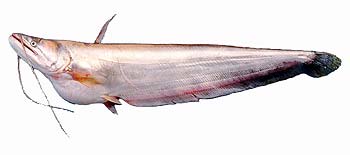
Left: Giant pangasius (Pangasius sanitwongsei) at hypothetical 2.75 m length. Source image
Piraiba (Brachyplatystoma filamentosum) at record 2.37 m
length. Source
image
Right: Wels (Silurus glanis) at record 2.78 m length. Source image
Soldatov's catfish (Silurus soldatovi) length unknown, portrayed at 2.5 m. Source image
Wallago (Wallago attu) portrayed at 2 m. Source image
Right: Wels (Silurus glanis) at record 2.78 m length. Source image
Soldatov's catfish (Silurus soldatovi) length unknown, portrayed at 2.5 m. Source image
Wallago (Wallago attu) portrayed at 2 m. Source image
Center:
And of course, a puny human at 1.74 m tall.
[Lord Geekington (Cameron McCormick) once wrote an exellent summary about what is taken to be reasonable in the stories of giant catfishes and since we are keen on the topic here, I thought it would be a good idea to qote the article for reference. As a rule of thumb, reports of giant catfishes at half again these lemngths atre just marginally possible, but ones twice the given lengths most probably are not. And that is being generous-DD]Tuesday, August 7, 2007
Megafishes: Catfishes
Dear Constant Readers,
Fortunately this is not a very obscure group of animals, so there is plenty of popular literature to go on. Well, for the basic information at least. The Wikipedia page on catfishes actually makes a decent primer (for once), but I'd recommend the Tree of Life page even more. This is a huge group of fish with over 3000 species and 36 families, one of which was described as recently as 2005. Apparently 1 in 4 freshwater fishes, 1 in 10 fishes, and one in 20 vertebrate species is a catfish. On the Palaeos catfishes are closely grouped with knifefish and electric eels* in the clade "Siluriphysi" which is defined partially by the re-evolution of electroreception. Click here to see their relative position in the colossal Teleost radiation. Aside from electroreception, catfishes often have a benthic habitat, scaleless skin, small eyes (reliant on tactile barbels, chemosensitivity, oflaction), an adipose fin, and so forth. Some however are covered in armor plates, have sucker mouths, breathe air, have spinous fins, drink blood, and even digest wood. The Tree of Life suggest modification of the upper jaw for barbels and locking fin spines are good synapomorphies, although Fishbase "remarks" on more technical characters. Phew.
*This species apparently can get over 2 meters in length, however it is not considered a "Megafish", perhaps due to its eel-like shape? At the Shedd Aquarium in Chicago, they did have a specimen there that did seem to be around 2 meters, so I don't think 2.5m is a "fish story".
Now there is no ambiguity as to what a "catfish" entails, I should discuss the more impressive members of the group, their contributions to the "Megafishes". Out of the 20 species of Megafishes, 6 of them were Siluriformes. Even more remarkably, 3 of these species live in the Mekong River of Southeast Asia. I should also mention that most catfishes are small to moderately sized (5-20 cm or 2-8") with some species reaching maturity at below 1 cm. This gives a roughly 300-fold length difference between the smallest and largest species, and perhaps a weight difference a million-fold or over. I'll leave ridiculous size differences for later, here are the Megafishes:
Family: Silururidae
This family is defined by a lack of an adipose fin and occasionally pelvic and dorsal fins, a very long anal fin, no nasal barbels, et cetera. As you can tell from the name, these are very archetypal catfish in appearance. While most of you familiar will be correct in assuming the wels (Silurus glanis) will be discussed, according to the Megafishes article in Science, there is another giant catfish in the genus.
Silurus soldatovi, Nikolskii & Soin, 1948
Northern Sheatfish
Soldatov's Catfish
Not even graced with a Wikipedia article, information is hard to come by for this species. There were journal articles on the genetics, reproduction, and eggs of this fish, but I could find nothing on morphology. This fish lives in the Amur river basin, so like the Chinese paddlefish, there is the problem of most information being in languages I can't begin to understand (Russian and Chinese). What is astounding is that the Science article gives it an incredible length of 4 m (13'), yet the Fishbase page gives a weight (from the same source) at an astoundingly low 40 kg (88 lbs) at the same length. Perhaps the source itself was composed of two different specimens...or it was just another "big fish" story. It is odd how warning bells didn't go off for the author for such jarring figures. This Chinese page has a picture of what does indeed seem to be a wels-sized silurid catfish, although exact size is difficult to determine...or if it actually is this species (see below...it also bears a resemblance to the Megamouth, oddly). Pages seemed pretty adamant about the size, but it will have to be regarded as large but unknown for now. Unsurprisingly the Science article mentions it was not evaluated by the IUCN, but is probably being threatened by harvest, habitat, and pollution. Given how people seem obsessed by large fish, I find it exceedingly odd how this species apparently slipped under the radar.
Silurus glanis, Linneaus 1758
Wels
At the exact opposite of the popularity spectrum (imaginary) is this large Eurasian species. Mercifully, I don't have to go digging through technical literature to find the basic information. I should note that uniquely among Megafishes, this species is not threatened and is in fact regarded as least concern by the IUCN. Fishbase even regards this as potentially being a pest species. So it looks like this is one Megafish we shouldn't be overly worried about. It is also worth mentioning that this species was capable of entering the saltwater Aral Sea (note...was); making it all the more mysterious why sturgeons weren't considered "Megafish". By looking at Fishbase, you probably would have noticed something very strange as far the reported size. It, the Tree of Life and Science all report an astounding 5 m maximum size with variously given weights (306 and 300 kg --- 327 in Wood, 1982). This is a rather widely cited figure, a fact which I find unfortunate. For once thing, the Science article reported a stingray of the same length at 600 kg...shouldn't that set off warning bells for both figures there? A wels that size should weight 7-800 kg or even more, but I don't think they ever got that big.
So, how big does the wels get?
Gerald Wood mentioned several claims of excessive size (200 kg is "normal"?!), but I trust Markus Bühler/Sordes much more on this subject. The Wels grows larger in Southern Europe (Wood has no claims from there) due to warmer temperatures and a lack of parasites; the world record is an Italian specimen that measured 2.78 m (9'1.5") and weighed 144 kg (317 lbs). Compare this to the record German specimen which was 2.47 m and 89 kg (8'1" and ~200 lbs)

You can even see a Youtube video (what isn't on there?) of a catfish of nearly the same size (I'm not sure from where).
I haven't found any specific average size figure for this species, but Wikipedia (translated from European articles) suggests 1.3 to 1.6 m, which would make a 2.7-something meter fish a genuine monster...and make larger sizes quite unbelievable. Perhaps before exploitation I could imagine some 3-meter leviathans roaming around, but 5 meters is stretching things far beyond credibility. Perhaps they were confused with sturgeons (like Chinese Paddlefish), or maybe like many of these claims they were exaggerations or fabrications. But as you can tell by the video, the wels is a monster that doesn't need exaggerating.
Wallago attu, Bloch & Schneider 1801
Great White Sheatfish
Ikan Tapah
That's right, the Sheatfish family has a third member of allegedly gigantic size and a representative from the Mekong river basin. Fishbase describes this sheatfish as being a large, predatory species capable of delivering traumatic bites to humans. This species dwells mostly in rivers and lakes (streams in flood season), but apparently can tolerate brackish water as well. They also aren't limited to Southeast Asia, and can be found in Pakistan and possibly Afghanistan as well. Giri et al (2002) describe this sheatfish as being a fairly good candidate for captive rearing since it grows fast and has palatable flesh. The wels, in comparison, tastes bad at large sizes and apparently has poisonous eggs. The size reported for this fish is somewhat confusing. Giri et al give a maximum length of 2 m and a weight of "more than" 45 kg (6'6" and 100 lbs), which is around 10 kg less than the non-Megafish Blue and Flathead catfish of America, for instance. This badly translated abstract gives a weight of 25 kg for a 2 meter catfish and this page shows a rather large looking catfish that weighs only 9 kg. It also reported a 2.4 m specimen weighing 18.6 kg, a length (not weight) repeated in Fishbase and Science. If a fish that long weighed 18.6 kg, then a 9 kg fish would have to be 1.9 m long (6'3"), and I don't think the fellow in the picture is pushing 8 feet tall. The Science article lists this fish as being "not evaluated", but Fishbase reports it being "near-threatened" in Western Ghats, India and "lower risk" elsewhere. I do not see why length should be a more important measure than weight when it comes to fish, so either the definition of a "Megafish" should be broadened or this low-risk fish should be excluded.
Family: Pimelodidae
Brachyplatystoma filamentosum, Lichtenstein 1819
Piraiba
Kumakuma
Yet another surprisingly poorly known species (to the public) of very large catfish. Petrere et al 2004 note that catfish over 1.6 m and 50 kg (5'3" 110 lbs) and are given the name "Piraiba" and there have been suggestion that smaller fish are in fact a different species. This species is a top predator of the Amazon River channel, mostly inhabits whitewater areas, and is migratory. Petrere et al note that this species used to make up a huge proportion of the catch in the Amazon (94% !) in 1977, but now makes up only5% of the total catch. This was apparently the most important fishery of any catfish, and the authors draw parallels to the over-exploitation of sharks in marine waters. In addition to over-exploitation, the breeding waters of this fish are being disrupted by mining and land degradation, although the location of breeding grounds (headwaters of the Amazon) are apparently not known with certainty. Oh yes, and this species is also capable of living in brackish water, specifically river mouths.
So obviously this can be a rather large fish, reported at being 3.6 m and 200 kg (11'10" and 440 lbs) in Science, although Fishbase once again demonstrates that the length and weight are from different sources. Gerald Wood, who normally simplifies these matters, instead confuses them greatly. He insists that B. filamentosum (lau-lau) is indeed the longest catfish in the Amazon, but there is a heavier species called the..."pirahyba" (Piratinga piraiba), hmm. This turned up a negative result on Fishbase, although there is a synonym (Piratinga piraaiba) that is awfully close. Wood reported that the latter "species" weighed 159 kg at 1.85 m (6'1" and 350 lbs) and was estimated at a maximum size of 2.1 m and 181 kg (7' and 400 lbs). The conversions are Wood's and not mine. It should also be noted that the figures are much heavier than what would be expected from Petrere's figure; it is normally the opposite of that and it is possible that these fish to get bulkier as they increase length. None other than Teddy Roosevelt related a tale of a 3 m catfish getting killed after attacking a canoe, but this is of course rather dubious. As for the actual species, none other than William Beebe caught specimens, the largest of which was 2.11 m without the tail measured and presumably about 2.4 m (8') with. Judging by the weights reported by the "pirahyba", it is possible that this or a similar sized specimen is responsible for the 200 kg figure. A 3.7 meter+ claim (Wood's figure differs) is probably not realistic for a pre-exploitation animal...and would dwarf every other Megafish at a presumed weight of over 1 ton/tonne. But don't worry, the largest species has yet to be covered...
Family: Pangasiidae
Now here's a problem: 2 different fish species in the same family are reported to reach the same size (3m and 300kg)! Now that the wels and the paraiba have been downsized, what is the largest species of catfish? Well, I never fully discounted the reported 4 m size of the Soldatov's Catfish, but let's assume it's an exaggeration. Considering that every single reported size by the Science article appears to be wrong, I don't think that would be unjust.
Pangasius sanitwongsei, Smith 1931
Giant Pangasius
Dog-eating Catfish
Like a few other species, this one seems seldom mentioned despite its apparently gigantic size. This one is "Data Deficient", but the Science article mentions that many locals are surprised that this fish even still exists. 2 meter specimens were no longer caught in Thailand by World War II, and it may very well be extinct there and going extinct in the Mekong River valley. This could be another "so long we hardly knew thee" situation as with the Chinese paddlefish. Fishbase oddly claims that this species is often referred to in popular material and textbooks, but this has to be confusion with the upcoming species. There are people who claim to be keeping this species in captivity under the name "Paroon shark", but I can't help but wonder if it is a different species in the same genus; perhaps P. hypothalamus. Selling one of the world's biggest species of freshwater fish sounds a bit improbable to me, and from experience I know that pet stores and dealers often don't go by orthodox taxonomy. So how big does this fish get? Zeb Hogan in a previous paper describes this species as getting "slightly less gigantic" than the next species, and gives a length of 2.75 m maximum (9 feet). It is not known to what size 300 kg is supposed to go with, or even if the fish can actually get this big at all. Due to a huge gap in information, it looks like this fish too will have to remain a mystery.
Pangasianodon gigas, Chevey 1931
Mekong Giant Catfish
Pa beuk
In the Guinness Book of World Records this is the biggest species of freshwater fish. There is quite unambiguous of a 2.7 m female that weighed 293 kg (~9' and 646 lbs) caught in 2005, although record keeping for the species has only been going on since 1981. Gerald Wood comments upon a source in the 20's claiming a size of 3 m (~10 feet) for this species, and this has been a generally accepted figure despite the dubious corresponding weight of 240 kg. The weight has normally been reported at 300 kg for this size, but---do I even need to say this?---it Fishbase shows it came from a different source. Fishbase also states that this fish can grow 150-200 kg in 6 years, apparently making it one of the fastest growing known fish as well. Wood also remarked that only 14 specimens were caught in 1974, and the population has been estimated to have fallen 80% in the last 13 years according to the IUCN! It is no surprise that this fish is regarded as "Critically Endangered".
So let's see what happens here. Once again we have a species that is critically endangered, so can we save it this time? Hopefully Zeb Hogan can draw even more publicity to this species and save it from the apparent fate of the Chinese paddlefish. But, what about the more obscure species. I never heard about Soldatov's Catfish until a few days ago and I only heard vague mentions of the giant pangasius, and after looking for information the situation was hardly better! I somewhat doubt the public is more aware of these species and their plight than I do, and it may already be too late. The giant pangasius appears to be in an even worse situation than the Mekong giant catfish, which is quite alarming. But then, according to Hogan, we really don't know anything about this species. While discovering new species is one thing, I think that knowing so little about described species is nearly as surprising.
There's still a lot I'm curious about regarding these catfish. How are they capable of getting so large anyways? The Pangasiids are certainly not typical looking or behaving catfish (e.g. predatory giant pangasius and herbivorous Mekong giant catfish), so is it something other than niche occupation? Do the old records actually indicate that these species "shrunk" with exploitation. Were there even large Pleistocene cousins? I always seem to have a lot of questions here.
I'm not certain if I'll do more Megafish or not. My summer and blogging-spree is coming to an alarming stop here. Dang.
-Cameron
Fortunately this is not a very obscure group of animals, so there is plenty of popular literature to go on. Well, for the basic information at least. The Wikipedia page on catfishes actually makes a decent primer (for once), but I'd recommend the Tree of Life page even more. This is a huge group of fish with over 3000 species and 36 families, one of which was described as recently as 2005. Apparently 1 in 4 freshwater fishes, 1 in 10 fishes, and one in 20 vertebrate species is a catfish. On the Palaeos catfishes are closely grouped with knifefish and electric eels* in the clade "Siluriphysi" which is defined partially by the re-evolution of electroreception. Click here to see their relative position in the colossal Teleost radiation. Aside from electroreception, catfishes often have a benthic habitat, scaleless skin, small eyes (reliant on tactile barbels, chemosensitivity, oflaction), an adipose fin, and so forth. Some however are covered in armor plates, have sucker mouths, breathe air, have spinous fins, drink blood, and even digest wood. The Tree of Life suggest modification of the upper jaw for barbels and locking fin spines are good synapomorphies, although Fishbase "remarks" on more technical characters. Phew.
*This species apparently can get over 2 meters in length, however it is not considered a "Megafish", perhaps due to its eel-like shape? At the Shedd Aquarium in Chicago, they did have a specimen there that did seem to be around 2 meters, so I don't think 2.5m is a "fish story".
Now there is no ambiguity as to what a "catfish" entails, I should discuss the more impressive members of the group, their contributions to the "Megafishes". Out of the 20 species of Megafishes, 6 of them were Siluriformes. Even more remarkably, 3 of these species live in the Mekong River of Southeast Asia. I should also mention that most catfishes are small to moderately sized (5-20 cm or 2-8") with some species reaching maturity at below 1 cm. This gives a roughly 300-fold length difference between the smallest and largest species, and perhaps a weight difference a million-fold or over. I'll leave ridiculous size differences for later, here are the Megafishes:
Family: Silururidae
This family is defined by a lack of an adipose fin and occasionally pelvic and dorsal fins, a very long anal fin, no nasal barbels, et cetera. As you can tell from the name, these are very archetypal catfish in appearance. While most of you familiar will be correct in assuming the wels (Silurus glanis) will be discussed, according to the Megafishes article in Science, there is another giant catfish in the genus.
Silurus soldatovi, Nikolskii & Soin, 1948
Northern Sheatfish
Soldatov's Catfish
Not even graced with a Wikipedia article, information is hard to come by for this species. There were journal articles on the genetics, reproduction, and eggs of this fish, but I could find nothing on morphology. This fish lives in the Amur river basin, so like the Chinese paddlefish, there is the problem of most information being in languages I can't begin to understand (Russian and Chinese). What is astounding is that the Science article gives it an incredible length of 4 m (13'), yet the Fishbase page gives a weight (from the same source) at an astoundingly low 40 kg (88 lbs) at the same length. Perhaps the source itself was composed of two different specimens...or it was just another "big fish" story. It is odd how warning bells didn't go off for the author for such jarring figures. This Chinese page has a picture of what does indeed seem to be a wels-sized silurid catfish, although exact size is difficult to determine...or if it actually is this species (see below...it also bears a resemblance to the Megamouth, oddly). Pages seemed pretty adamant about the size, but it will have to be regarded as large but unknown for now. Unsurprisingly the Science article mentions it was not evaluated by the IUCN, but is probably being threatened by harvest, habitat, and pollution. Given how people seem obsessed by large fish, I find it exceedingly odd how this species apparently slipped under the radar.
Silurus glanis, Linneaus 1758
Wels
At the exact opposite of the popularity spectrum (imaginary) is this large Eurasian species. Mercifully, I don't have to go digging through technical literature to find the basic information. I should note that uniquely among Megafishes, this species is not threatened and is in fact regarded as least concern by the IUCN. Fishbase even regards this as potentially being a pest species. So it looks like this is one Megafish we shouldn't be overly worried about. It is also worth mentioning that this species was capable of entering the saltwater Aral Sea (note...was); making it all the more mysterious why sturgeons weren't considered "Megafish". By looking at Fishbase, you probably would have noticed something very strange as far the reported size. It, the Tree of Life and Science all report an astounding 5 m maximum size with variously given weights (306 and 300 kg --- 327 in Wood, 1982). This is a rather widely cited figure, a fact which I find unfortunate. For once thing, the Science article reported a stingray of the same length at 600 kg...shouldn't that set off warning bells for both figures there? A wels that size should weight 7-800 kg or even more, but I don't think they ever got that big.
So, how big does the wels get?
Gerald Wood mentioned several claims of excessive size (200 kg is "normal"?!), but I trust Markus Bühler/Sordes much more on this subject. The Wels grows larger in Southern Europe (Wood has no claims from there) due to warmer temperatures and a lack of parasites; the world record is an Italian specimen that measured 2.78 m (9'1.5") and weighed 144 kg (317 lbs). Compare this to the record German specimen which was 2.47 m and 89 kg (8'1" and ~200 lbs)

You can even see a Youtube video (what isn't on there?) of a catfish of nearly the same size (I'm not sure from where).
I haven't found any specific average size figure for this species, but Wikipedia (translated from European articles) suggests 1.3 to 1.6 m, which would make a 2.7-something meter fish a genuine monster...and make larger sizes quite unbelievable. Perhaps before exploitation I could imagine some 3-meter leviathans roaming around, but 5 meters is stretching things far beyond credibility. Perhaps they were confused with sturgeons (like Chinese Paddlefish), or maybe like many of these claims they were exaggerations or fabrications. But as you can tell by the video, the wels is a monster that doesn't need exaggerating.
Wallago attu, Bloch & Schneider 1801
Great White Sheatfish
Ikan Tapah
That's right, the Sheatfish family has a third member of allegedly gigantic size and a representative from the Mekong river basin. Fishbase describes this sheatfish as being a large, predatory species capable of delivering traumatic bites to humans. This species dwells mostly in rivers and lakes (streams in flood season), but apparently can tolerate brackish water as well. They also aren't limited to Southeast Asia, and can be found in Pakistan and possibly Afghanistan as well. Giri et al (2002) describe this sheatfish as being a fairly good candidate for captive rearing since it grows fast and has palatable flesh. The wels, in comparison, tastes bad at large sizes and apparently has poisonous eggs. The size reported for this fish is somewhat confusing. Giri et al give a maximum length of 2 m and a weight of "more than" 45 kg (6'6" and 100 lbs), which is around 10 kg less than the non-Megafish Blue and Flathead catfish of America, for instance. This badly translated abstract gives a weight of 25 kg for a 2 meter catfish and this page shows a rather large looking catfish that weighs only 9 kg. It also reported a 2.4 m specimen weighing 18.6 kg, a length (not weight) repeated in Fishbase and Science. If a fish that long weighed 18.6 kg, then a 9 kg fish would have to be 1.9 m long (6'3"), and I don't think the fellow in the picture is pushing 8 feet tall. The Science article lists this fish as being "not evaluated", but Fishbase reports it being "near-threatened" in Western Ghats, India and "lower risk" elsewhere. I do not see why length should be a more important measure than weight when it comes to fish, so either the definition of a "Megafish" should be broadened or this low-risk fish should be excluded.
Family: Pimelodidae
Brachyplatystoma filamentosum, Lichtenstein 1819
Piraiba
Kumakuma
Yet another surprisingly poorly known species (to the public) of very large catfish. Petrere et al 2004 note that catfish over 1.6 m and 50 kg (5'3" 110 lbs) and are given the name "Piraiba" and there have been suggestion that smaller fish are in fact a different species. This species is a top predator of the Amazon River channel, mostly inhabits whitewater areas, and is migratory. Petrere et al note that this species used to make up a huge proportion of the catch in the Amazon (94% !) in 1977, but now makes up only5% of the total catch. This was apparently the most important fishery of any catfish, and the authors draw parallels to the over-exploitation of sharks in marine waters. In addition to over-exploitation, the breeding waters of this fish are being disrupted by mining and land degradation, although the location of breeding grounds (headwaters of the Amazon) are apparently not known with certainty. Oh yes, and this species is also capable of living in brackish water, specifically river mouths.
So obviously this can be a rather large fish, reported at being 3.6 m and 200 kg (11'10" and 440 lbs) in Science, although Fishbase once again demonstrates that the length and weight are from different sources. Gerald Wood, who normally simplifies these matters, instead confuses them greatly. He insists that B. filamentosum (lau-lau) is indeed the longest catfish in the Amazon, but there is a heavier species called the..."pirahyba" (Piratinga piraiba), hmm. This turned up a negative result on Fishbase, although there is a synonym (Piratinga piraaiba) that is awfully close. Wood reported that the latter "species" weighed 159 kg at 1.85 m (6'1" and 350 lbs) and was estimated at a maximum size of 2.1 m and 181 kg (7' and 400 lbs). The conversions are Wood's and not mine. It should also be noted that the figures are much heavier than what would be expected from Petrere's figure; it is normally the opposite of that and it is possible that these fish to get bulkier as they increase length. None other than Teddy Roosevelt related a tale of a 3 m catfish getting killed after attacking a canoe, but this is of course rather dubious. As for the actual species, none other than William Beebe caught specimens, the largest of which was 2.11 m without the tail measured and presumably about 2.4 m (8') with. Judging by the weights reported by the "pirahyba", it is possible that this or a similar sized specimen is responsible for the 200 kg figure. A 3.7 meter+ claim (Wood's figure differs) is probably not realistic for a pre-exploitation animal...and would dwarf every other Megafish at a presumed weight of over 1 ton/tonne. But don't worry, the largest species has yet to be covered...
Family: Pangasiidae
Now here's a problem: 2 different fish species in the same family are reported to reach the same size (3m and 300kg)! Now that the wels and the paraiba have been downsized, what is the largest species of catfish? Well, I never fully discounted the reported 4 m size of the Soldatov's Catfish, but let's assume it's an exaggeration. Considering that every single reported size by the Science article appears to be wrong, I don't think that would be unjust.
Pangasius sanitwongsei, Smith 1931
Giant Pangasius
Dog-eating Catfish
Like a few other species, this one seems seldom mentioned despite its apparently gigantic size. This one is "Data Deficient", but the Science article mentions that many locals are surprised that this fish even still exists. 2 meter specimens were no longer caught in Thailand by World War II, and it may very well be extinct there and going extinct in the Mekong River valley. This could be another "so long we hardly knew thee" situation as with the Chinese paddlefish. Fishbase oddly claims that this species is often referred to in popular material and textbooks, but this has to be confusion with the upcoming species. There are people who claim to be keeping this species in captivity under the name "Paroon shark", but I can't help but wonder if it is a different species in the same genus; perhaps P. hypothalamus. Selling one of the world's biggest species of freshwater fish sounds a bit improbable to me, and from experience I know that pet stores and dealers often don't go by orthodox taxonomy. So how big does this fish get? Zeb Hogan in a previous paper describes this species as getting "slightly less gigantic" than the next species, and gives a length of 2.75 m maximum (9 feet). It is not known to what size 300 kg is supposed to go with, or even if the fish can actually get this big at all. Due to a huge gap in information, it looks like this fish too will have to remain a mystery.
Pangasianodon gigas, Chevey 1931
Mekong Giant Catfish
Pa beuk
In the Guinness Book of World Records this is the biggest species of freshwater fish. There is quite unambiguous of a 2.7 m female that weighed 293 kg (~9' and 646 lbs) caught in 2005, although record keeping for the species has only been going on since 1981. Gerald Wood comments upon a source in the 20's claiming a size of 3 m (~10 feet) for this species, and this has been a generally accepted figure despite the dubious corresponding weight of 240 kg. The weight has normally been reported at 300 kg for this size, but---do I even need to say this?---it Fishbase shows it came from a different source. Fishbase also states that this fish can grow 150-200 kg in 6 years, apparently making it one of the fastest growing known fish as well. Wood also remarked that only 14 specimens were caught in 1974, and the population has been estimated to have fallen 80% in the last 13 years according to the IUCN! It is no surprise that this fish is regarded as "Critically Endangered".
So let's see what happens here. Once again we have a species that is critically endangered, so can we save it this time? Hopefully Zeb Hogan can draw even more publicity to this species and save it from the apparent fate of the Chinese paddlefish. But, what about the more obscure species. I never heard about Soldatov's Catfish until a few days ago and I only heard vague mentions of the giant pangasius, and after looking for information the situation was hardly better! I somewhat doubt the public is more aware of these species and their plight than I do, and it may already be too late. The giant pangasius appears to be in an even worse situation than the Mekong giant catfish, which is quite alarming. But then, according to Hogan, we really don't know anything about this species. While discovering new species is one thing, I think that knowing so little about described species is nearly as surprising.
There's still a lot I'm curious about regarding these catfish. How are they capable of getting so large anyways? The Pangasiids are certainly not typical looking or behaving catfish (e.g. predatory giant pangasius and herbivorous Mekong giant catfish), so is it something other than niche occupation? Do the old records actually indicate that these species "shrunk" with exploitation. Were there even large Pleistocene cousins? I always seem to have a lot of questions here.
I'm not certain if I'll do more Megafish or not. My summer and blogging-spree is coming to an alarming stop here. Dang.
-Cameron