Plug

Member of The Crypto Crew:
http://www.thecryptocrew.com/

Please Also Visit our Sister Blog, Frontiers of Anthropology:

http://frontiers-of-anthropology.blogspot.com/

And the new group for trying out fictional projects (Includes Cryptofiction Projects):

http://cedar-and-willow.blogspot.com/

And Kyle Germann's Blog

http://www.demonhunterscompendium.blogspot.com/

And Jay's Blog, Bizarre Zoology

http://bizarrezoology.blogspot.com/
Showing posts with label Texas. Show all posts

Thursday, 14 November 2013

Sybilla Irwin Bigfoot Portrait on Blog

Wednesday, November 13, 2013

Bigfoot Sketch by Sybilla Christine Irwin

Sybilla Christine Irwin was kind enough to do a sketch for me. She took multiple still captures from the Bigfoot in the Laurels Video and created this wonderful sketch. I think this is spot on to what the old girl looks like. Over the past couple years of studying the video, it appears that the Bigfoot may be female. I and others who have studied the video think the Bigfoot has a "Old Woman" appearance. You can view more of Sybilla's fine work at:  Sybilla Irwin - Galleries


Actual Still Capture


Sybilla Irwin is a Facebook Friend of mine and I am a big admirer of her work. She is like Alexis Evans and one of the few artists that is seriously committed to the notion o showing Bigfoots as individuals. In this case I wanted to try some simple mechanical re-orientations of the photographic image (Some touch-up work was required to make the face as legible as before after re-orienting)
 

To me this face has a very distinctively Neanderthaloid facial structure

A sculptured face below


[Cover art for a story book about Florida Skunk Apes]
 
Sybilla Christine Irwin We're working on the 2nd book in the series now!
 
  • Dale Drinnon Hey this is great! I wish you luck on that, this is WAAAAYY more authentic than a lot of the stupidity that has been floating around lately. I mean its a kids book, but they really look like that and it seems the reddish ones are the littler ones of the bigger darker ones. Ivan Sanderson remarked on that in 1961
  • Sybilla Christine Irwin Yes...Ronie and I are committed to bringing some real insights we discover through research into our books. Thank you!
  •  

  • This is the listing for her book on Amazon Books:

    Monday, 14 October 2013

    From the Private Files of Jay "Bizzare Zoology" Cooney


    Jay Cooney notes: "Jesus Jr's alleged juvenile bigfoot print compared to a Neanderthal footprint from a cave floor and the tracing of a Neanderthal footprint. Almost perfect match!"

    These tracks seem well outside of the usual human range in breadth and they are noticed walking through cruel thorns and spines beyond what a human would consider going through. Jay also adds "please note that Jay made this comparison to point out an intriguing similarity, rather than to endorse any certain hypothesis."


    Jay BizarreZoo Cooney

    "Wow....although I don't put much stock in such photos I do have to say that compared to other 'blobsquatch' photos, Mark [Para]'s are fantastic! It really looks like there is something actually there rather than just a trick of light on foliage."

    The face in the lower picture does look pretty convincing and it is another "Caveman" type. Jay also added he thought the figure in the top photo could only be a boulder.

    SPECIAL UPDATE: Today is also Jay Cooney's birthday, please join me in wishing him the very best birthday today and many happy returns of the day!

    Wednesday, 24 October 2012

    Photographer snaps possible Texas bigfoot shots

    Photographer snaps possible Texas bigfoot shots

     
    Posted: Oct 21, 2012 10:55 PM EDTUpdated: Oct 21, 2012 11:27 PM EDT
    http://www.kltv.com/story/19876849/photographer-snaps-possible-texas-bigfoot-shots

    http://forteanzoology.blogspot.com/2012/10/cryptolinkphotographer-snaps-possible.html
    [Video does not transfer]
    [This was reprinted at the CFZ Blog yesterday: I am adding it on again here because it seems to me everybody is missing the point]


    There have been reported sightings of bigfoot in remote East Texas locations, and even near Dallas, and a photographer says he has proof that bigfoot may be closer than we think. The Dallas area photographer, who remains anonymous , was never a bigfoot believer by his own admission.
    "No, I've never seen one , never believed in one," he says.
    But a huge stone thrown at him in the woods one camping trip, with no one else around, changed his mind.
    "An object landed within ten feet of us that I know of no human being able to throw it that far. There was one about 10 foot tall. A family group drew in close, three of which got within 15 feet of me. It looked like something out of a Steven Spielberg movie, not human as I know it," he says.
    He shot images in Shelby county of something moving in the woods. Outside of Dallas he shot images of something large and hairy watching from the trees. But light and shadow can play tricks. East Texas bigfoot researcher Mike Hall and his team from Texla crypto zoological research examined the images to see if they have merit.
    "Some of the shots you can actually make out what looks like a pair of eyes. There is something there staring back at him taking video. There is something there, question is, what is it?," Hall says.
    One shot looking very similar to the Roger Patterson bigfoot film of 1967. A crest or conical ridge on what appears to be the head.
    "The cone looking head, in the still shot that's very compelling, something definitely moving across the brush just observing," says fellow researcher Larry Parks.
    The photographer is keeping his identity anonymous but did say he would be releasing more video evidence in the future.
    Copyright 2012
    KLTV. All rights reserved.

    To me this does NOT look like your typical Bigfoot, nor is the large bluntly rounded head resemble the creature in the Patterson film in the least. To me this looks exacly like a gorilla and for that reason I am classifying this sighting as a "Skunk Ape" rather than the more usual types of Bigfoot seen in the East or in the Far West.
    Best Wishes, Dale D.

    Saturday, 13 October 2012

    Texas Trackway By Way of Bigfoot Chicks

    http://bigfootchicks.blogspot.com/2012/10/bigfoot-chicks-team-member-investigates.html

    What I thought was especially interesting about this is that the tracks are almost exactly the same size as the tracks made by my own feet, although a 42 inch stride is a bit of a stretch even for me!

    Wednesday, October 10, 2012

    Bigfoot Chicks Team Member Investigates Tracks Found By Hardcore Outdoor Just A Few Days Ago


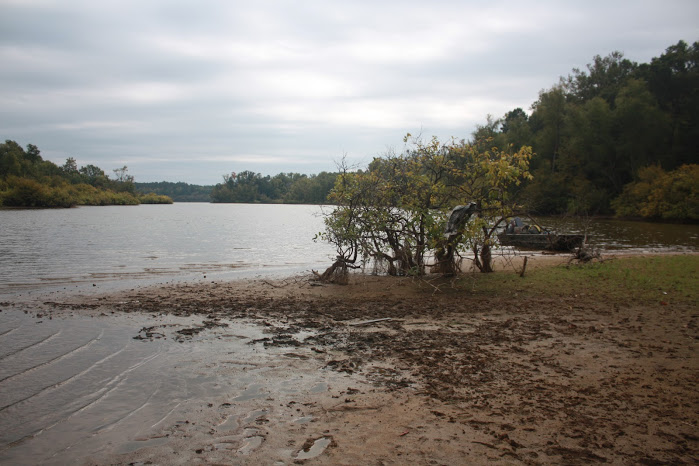
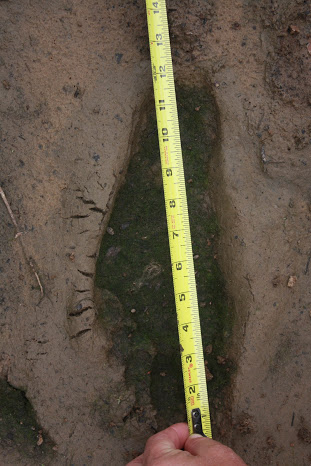
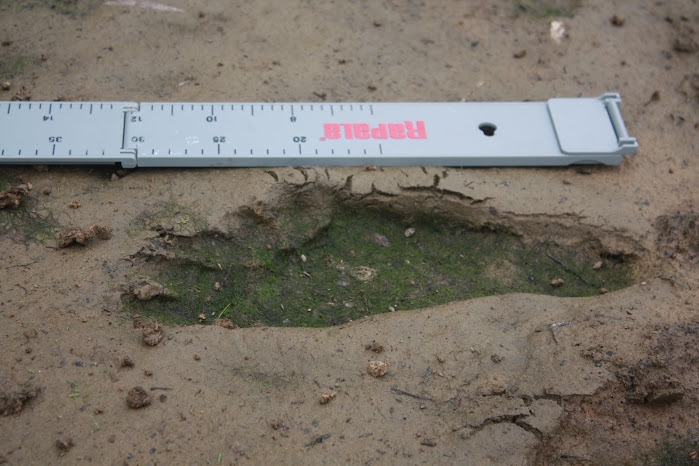
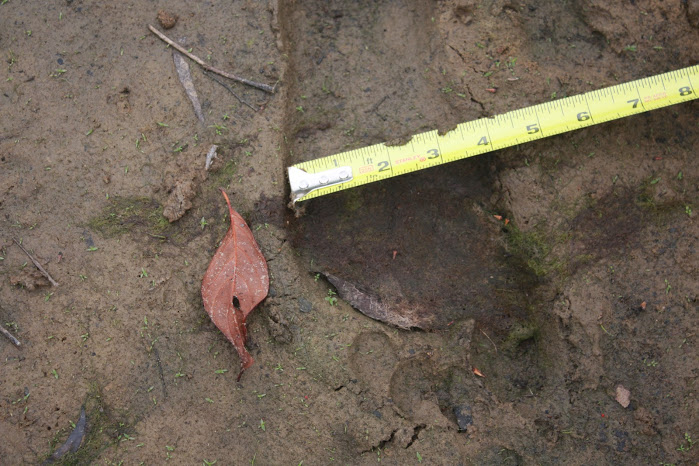
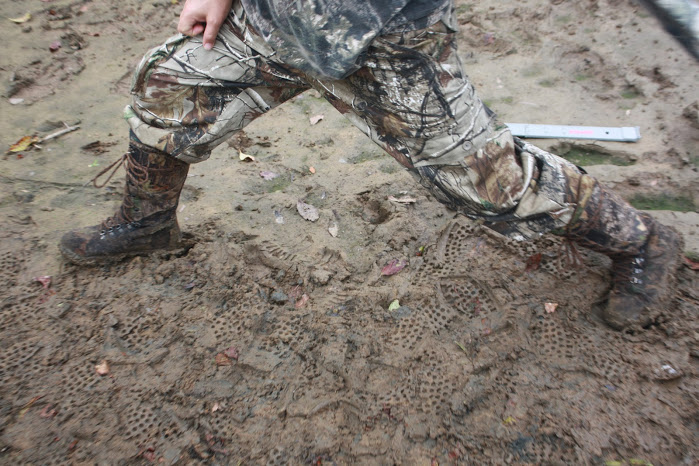
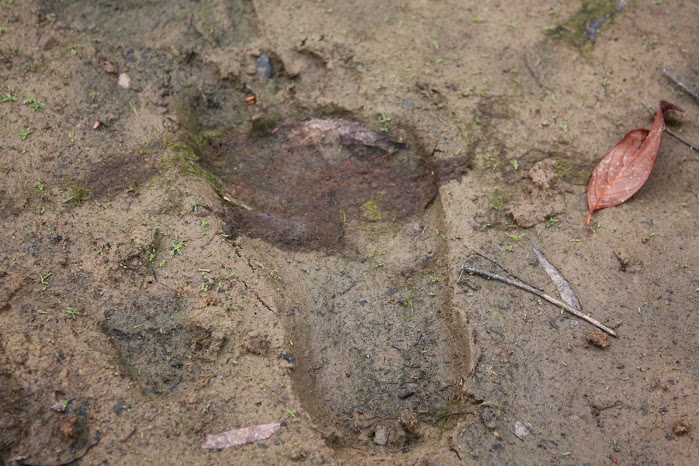
    You are probably familiar with the photo above as it has been circulating on various blogs as the latest track found just days ago by famed hunter and outdoorsman "Hardcore Outdoor". It was found in the middle of nowhere Texas in an area that could only be accessed by boat. Bigfoot Chicks team member, Rob Gaudet, went out this morning and met with Mr. Hardcore Outdoor and conducted a thorough investigation.


    The tracks appeared to be coming from the water to the shore.


    The area was remote and could only be accessed by boat.


    The tracks measured roughly 12 inches in length.


    They measured 3 inches at the heel and 4-5 inches at the ball of the foot.


    The stride was measured at roughly 42 inches.


    Mr. Hardcore Outdoor, who is said to be 5'10, had a difficult time matching the stride.


    Although the tracks are not extremely long, the impressions are quite deep.


    Given that this area is only accessible to humans by boat and the tracks hadn't been noticed when the outdoorsman had been there the day prior, investigators have a good argument for the track's authenticity.
    Kudos to Mr. Gaudet for taking quick action to follow up on this report!! Awesome pics!!

    Wednesday, 26 September 2012

    Texas Wood Ape Geographical and Ecological Distribution

    http://texasbigfoot.com/index.php/about-bigfoot/articles/67-ecological-patterns

    "North American Wood Ape" as posted by "The Naturalist", probably not intended seriously

    [There seems to be a Cryptid in Texas that is the exact equivalent of the Florida Skunk Ape as an ape. There is also one that is the exact equivalent of the more Neanderthal-like Skunk Ape. In this case the Texans are speaking of the more apelike kind.-DD]

    Support the TBRC

    Wood Ape Sightings: Correlations to Annual Rainfall Totals, Waterways, Human Population Densities and Black Bear Habitat Zones

    By Daryl Colyer & Alton Higgins

    In Texas, Oklahoma, Arkansas and Louisiana, anecdotes about huge, hairy, apelike creatures said to dwell in the deep woods and, occasionally, near the peripheries of rural communities, have accumulated for centuries. Many of these accounts were related by highly reliable and trustworthy individuals, people who had nothing to gain by telling their stories.
    Indeed, in many cases, these witnesses became the subjects of much ridicule, even among close friends and relatives. To the present day, most witnesses hesitate to share their incredible stories of seeing this strange, undocumented animal. Their reticence should come as no surprise given the treatment of the subject by the mass media and some mainstream scientists.
    There are many skeptics; their concerns are legitimate. Skeptics demand to know why no skeletal remains have been found; they want to know why no hunters have killed one, or why no driver has collided with one on a secluded country highway. Would not a large primate, skeptics ask, leave an undeniable, discernable mark on the environment in perhaps the same manner as mountain gorillas (Gorilla gorilla beringei)? Such questions are not invalid. Expecting skeptics to accept the likelihood of such a species existing beneath our proverbial noses may be asking just a tad too much. Nevertheless, the body of anecdotal accounts and accompanying evidence seems to indicate just such a possibility.
    Contrary to what some may assert, most hunters do not generally shoot at anything other than their intended game. While there are exceptions, most hunters will definitively identify their targets and normally just do not shoot at unknown or unidentified prey. That said, there have been a few scant reports of wood ape shootings; most were relayed through second hand sources. Further, most of those few reports that were related to shootings indicate that the shooters either missed or did not immediately bring the fleeing wood apes down.
    Skeletal remains are rarely found of any common, large, wild animal, so it should not be surprising that the skeletal remains of a wood ape are not readily available. The acidic forest soils and muddy river bottoms found in the preferred habitat for the wood ape tend to work in tandem with scavengers to quickly eliminate the remains of deceased animals. Finding a cougar (Puma concolor) carcass as a result of a natural death would probably be most analogous to finding a wood ape carcass, although the most conservative estimates of cougar population densities most certainly are far greater than even the most liberal estimates of wood ape population densities.
    There have been a few unsubstantiated reports of near misses of wood apes by drivers, and given the probability that many encounters go unreported, it is possible that a wood ape could have been hit and killed by a moving vehicle. However, realistically, given the probable rarity of these creatures along with their intelligence and caution, the odds of such an event occurring seem almost non-existent.
    There are some discernable signs that possibly indicate the presence of wood apes (thus the noticeable effect on the environment), however, the signs are easily disregarded by someone unfamiliar with purported wood ape behavior. For example, there are numerous reports of wood apes breaking branches, trees, and saplings, and to a lesser degree, constructing nest-like structures.
    Tree damage, possibly done for the purpose of marking trails or territory is discernable, but oftentimes hardly stands out among deadfall and ice or wind-broken trees. Most people would miss or casually dismiss such signs. It is unlikely that a typical wildlife biologist or anyone not knowledgeable on this subject, upon observing wood ape-related limb breaks, would ever suspect a wood ape as the culprit, even in the absence of any other readily apparent explanation. The characteristic twisting accompanying such breaks would appear to require enormous strength that can only be accomplished by something with hands. Nest-like structures, purportedly built by wood apes, have been found by researchers in areas of sightings.
    Another contention often heard is that the thousands of credible reports from throughout North America are, in one way or another, the products of human imagination. The contention is that many of the witnesses are intentionally lying about what they encountered and are actually themselves the perpetrators of hoaxes, or the witnesses are simply mistaken and are misidentifying what they saw or heard. Or, as the argument goes, many of the witnesses are simply victims of practical jokes and/or hoaxes. All evidence aside, it may seem more plausible to consider that there actually is an undocumented animal that is prompting thousands of reports than it is to believe in an unrelated series of hoaxed sightings and misidentifications.
    It should soon become evident to anyone who seriously and objectively delves into and studies the numerous credible sightings that many of the reports themselves are quite compelling. It is difficult to totally dismiss as fabrications all the reports that have accumulated from so many credible witnesses over so many decades.
    However, the essence of the research presented here does not focus on the validity of any individual report, but on the body of reports as a whole in order to ascertain any correlations and patterns that may exist. When one impartially studies the sum total of all the reports it becomes evident that there do indeed seem to be correlations and patterns that could be representative of a living species.
    Among these correlations, particularly in Texas, is the likelihood of sighting reports in areas with certain amounts of annual rainfall. The same pattern is also evident in the body of reports that originate in other states where there are divergent rainfall totals in different parts of each state, such as Oregon, Washington, Oklahoma, New Mexico, Montana, Colorado and California. (Conversely, in states with widespread abundant rainfall totals, such as Arkansas and Louisiana, a rainfall total/reported bigfoot encounters correlation is not evident). There is also a pattern of reported sightings along rivers, creeks or lakes. Reported sightings and human population densities seem to have some correlation, as does the distribution of alleged bigfoot sightings and areas viewed as suitable black bear habitat.
    John Green, journalist, author and renowned wood ape researcher, first touched upon the association of reported wood ape or "sasquatch" sightings and annual rainfall totals in his 1978 book Sasquatch: The Apes Among Us. Though the book was written nearly thirty years ago, the passage of time has not diminished its relevance. On the contrary, the increase of credible reports since that time has served to further validate Green’s thesis. He determined that eighty percent of the reported sightings and alleged footprint finds in North America occurred in areas receiving more than seventeen inches of annual rainfall.
    The darker counties are where the higher concentrations of credible reported encounters have occurred.
    The darker counties are where the higher concentrations of credible reported encounters have occurred.
    When this observation is applied to credible Texas reports and is represented on a map, discernable patterns seemingly indicative of a living species emerge. In Texas and Oklahoma, roughly ninety percent of the credible reports occur in areas that see at least thirty-five inches of rain per year, or in the eastern third of the state(s). Since the vast majority of Texas and Oklahoma reports are aligned with rainfall patterns, it is possible to dispute allegations of fabrication or mistaken identity. It is not rational to assume or propose that people living in areas with more than thirty-five inches of annual rainfall are more likely to submit a hoaxed report or misidentify what they saw than people living in areas with less than thirty-five inches of annual rainfall. While a few reports have originated in areas with lower amounts of rainfall, they appear to be sporadic and isolated, possibly due to a natural propensity of wildlife to use watercourses as travel routes; if the wood ape is a legitimate species, it makes perfect sense that it would also use watercourses as travel routes.
    From west to east, annual rainfall totals increase to as high as 70 inches in extreme eastern Louisiana.
    From west to east, annual rainfall totals increase to as high as 70 inches in extreme eastern Louisiana.
    While portions of far western Texas and Oklahoma are certainly semi-arid, the eastern sections of both states receive abundant annual rainfall. These areas are heavily forested and feature an abundance of waterways and lakes; they are very much ecological clones of the two neighboring eastern states of the region, Arkansas and Louisiana.
    The combined total amount of forestland in the four-state region equates to roughly 65,000,000 acres, or 100,000 square miles (the size of the state of Oregon). According to The Online Handbook of Texas, there are roughly 22,000,000 acres of forest in Texas alone; per the Arkansas Forestry Association, there are roughly 19,000,000 acres of forest in Arkansas; the Louisiana Forestry Association reports that there are 14,000,000 acres of forest in Louisiana; Oklahoma has approximately 10,000,000 acres of forest as indicated by the Oklahoma Department of Agriculture, Food and Forestry.
    There are 65 million acres of forestland in the four-state region, which is about 100,000 square miles, or the size of the state of Oregon.
    There are 65 million acres of forestland in the four-state region, which is about 100,000 square miles, or the size of the state of Oregon.
    While the forestlands of Texas, Arkansas, Louisiana and Oklahoma may be somewhat more parceled, or discontinuous, than northwestern forests, it is obvious that they are enormous in scope and depth, contrary to the misperceptions of some. Wildlife biologist Dr. John Bindernagel, who visited the region in 2001 and 2002, was struck by the richness and scope of the region’s forests, which are predominantly mixed deciduous, as opposed to the largely coniferous forests of the Pacific Northwest. Dr. Bindernagel recognized the value and productivity of deciduous forests in terms of wildlife habitat and he pointed out that large species of mammals living in the southern forests would almost certainly require smaller home ranges than in northern coniferous forests.
    Almost without exception, reported wood ape sightings occur near water. This is even true with the relatively few reports originating in the drier regions of Texas and Oklahoma, where wood apes are reportedly seen generally on or near waterways or lakes in thick brush or dense riparian vegetation. Most wildlife researchers and hunters would quickly reinforce the observation that many mammalian species often use rivers and creeks as travel routes. Since water is essential for the cycle of life, animals regularly congregate near or at least dwell primarily in areas featuring bodies of fresh water. Both Texas and Oklahoma have an abundance of rivers, creeks, swamps, reservoirs and lakes, particularly in their eastern regions. It is also reasonable for a large number of reported sightings to occur in or around swamps, river bottoms or bayous, since a reclusive, shy animal would find seclusion and sanctuary in such areas.
    When a river basins map is viewed with an overlay of reported encounters and an annual rainfall overlay, it becomes evident that most alleged sightings have occurred along waterways and lakes and in areas with thirty-five inches or more of annual rainfall. Many reported sightings in Northeast Texas have occurred in the Red River Basin along the Sulphur River or Red River and/or their adjoining reservoirs or creeks. Many reported encounters have also occurred in the Red/Sulphur River watershed in southeastern Oklahoma, southwestern Arkansas and Northeast Texas. Similarly, the Sabine River Basin, extending from Southeast Texas into Northeast Texas has also generated quite a few reports. In Oklahoma, the Canadian River Basin is not without its share of reported encounters. In Southeast Texas, in what is called the Primitive Big Thicket (encompassing the Sam Houston National Forest and the Big Thicket National Preserve area), the Neches River Basin, Trinity River Basin and San Jacinto River Basin have had many reports through the years as well as in recent times. In fact, Southeast Texas is the most prolific area in Texas for reports of bigfoot sightings. Likewise in Oklahoma, the most prolific area for reported encounters is also in its southeastern region. It should come as no surprise that the southeastern regions in both Texas and Oklahoma also receive the highest amount of rainfall for both states, with totals as high as sixty inches per year in spots.
    Although the East Texas river basins have generated far more reports, the Brazos, Colorado and Guadalupe basins have also had occasional reported sightings. These three basins average less than thirty-five inches of rainfall per year, but they typically have dense vegetation and trees in the riparian margins. Given that the vast majority of Texas and Oklahoma reports follows rainfall patterns and occurs along waterways, the notion that these reports are simply the result of the misidentification of known animals, wishful thinking, and/or deliberate fabrications seems flawed.
    There is yet another interesting correlation with the distribution of these sighting reports. For the most part it appears that most reported sightings in the four-state region occur in counties with lower human population densities. There are a few exceptions. However, 100% of the sightings reported from counties with higher populations still occurred in areas that were along the peripheries of or outside of the realm of human development (such as in Montgomery County, Texas, in the Sam Houston National Forest, an area of consistent reports). Actually, suitable wildlife habitat often exists close to urban and suburban areas. That being said, reported sightings that have occurred on the edge of small towns and larger cities are by far the exceptions.
    In fact, it seems that where human populations increase, reported wood ape sightings decrease. Where human populations decrease, reported ape sightings may increase. The reputed shyness of the wood ape is only further girded by this human population correlation. This observation is further enhanced by the inference from reports that wood apes are nocturnal, or at the very least, crepuscular. Not only do the reported sightings seem to suggest that wood apes live in areas of low human population densities, along waterways, and in areas of high annual rainfall, but they may be most active when humans are not, which is at night. The notion of fabrications and mistakes is unrealistic in light of these correlations.
    While Oklahoma, Arkansas and Louisiana have resident populations of black bears (Ursus americanus), there remains the question of whether or not the 12,000,000 acres of dense forest in East Texas can support even a small population of large omnivores such as the wood ape. After all, black bears no longer roam the Piney Woods of East Texas. But did black bears disappear from East Texas because of a shortage of suitable habitat? No, or so says the Texas Parks and Wildlife Department. Biologists conducted a black bear habitat suitability study in four areas of East Texas: the Sulphur River Bottom (51,000 acres), the Big Thicket National Preserve (97,000 acres), the Middle Neches River Corridor (247,000 acres), and the Lower Neches River Corridor (312,000 acres). The purpose of the study was to determine the suitability of habitat in East Texas for the black bear, a large omnivorous mammal. The study is relevant because there may be a correlation between purported wood ape and suitable black bear habitat. If an area is suitable for a large omnivore such as the black bear, it seems reasonable to posit that it is just as likely to be suitable for a small population of omnivorous wood apes.
    One part of the study dealt with food availability in summer and winter; all four areas scored very high. Biologists calculated a strong favorable rating for the availability of protection and concealment cover in all four areas. In the category of human/bear conflict zones, a less than favorable rating for the Big Thicket National Preserve was determined, but a moderately to strongly favorable rating was found for the other three areas.
    Overall, the study indicated that the most suitable region for bears among the four study areas was the Middle Neches River Corridor, followed in order by the Lower Neches River Corridor, the Sulphur River Bottom, and the Big Thicket National Preserve. All four areas have had an abundance of bigfoot sighting reports.
    Environmental suitability issues were also addressed by another group of scientists. While the curators of Chimp Haven in Northwest Louisiana probably do not spend too much time contemplating black bear habitat factors, they do devote much of their time discussing and evaluating primate habitat. According to their web site, Chimp Haven provides a permanent home for chimpanzees (Pan troglodytes) retired from biomedical research, the entertainment industry, and those no longer wanted as pets. Their new sanctuary, presently under construction, is planned to accommodate 300 chimpanzees, animals which may be the closest relatives of wood apes. Due to its ecology and climate, Chimp Haven curators believe that Northwest Louisiana is ideal primate habitat. Western Louisiana and East Texas are virtually ecological clones. It should come as no surprise that Northwest Louisiana was selected as the new site of Chimp Haven’s operations, given what we believe about wood ape habitat.
    In conclusion, several observations serve to dispel the notion that bigfoot sighting reports in Texas and Oklahoma are not the result of actual encounters. The reports, based on recent as well as older credible encounters, continue to accumulate and show no signs of abating. If one chooses to take the reports seriously and the apparent associated ecological patterns, as has been done in this paper, debates regarding the existence of this species are replaced by new issues such as those pertaining to ecology, distribution, behavior, and population densities.

    References

    Alley, J. Robert (2003). Raincoast Sasquatch. 351 pp. Hancock House, Blaine, Washington.

    Bindernagel, J.A. (1998). North America's Great Ape: The Sasquatch. 270 pp. Beachcomber Books. Courtenay, B.C., Canada.

    Chimp Haven.

    Distribution of Precipitation in Oklahoma map. Provided by the online Web Atlas of Oklahoma.

    Fahrenbach, W.H. (1997-1998). Sasquatch: Size, Scaling, and Statistics. Cryptozoology Vol. 13: 47-75.

    Garner, Nathan P. and Sean Willis. (1997). Black Bear Habitat Suitability in East Texas, featured in Wildlife Research Highlights, pages 18-19 (.pdf). Texas Parks and Wildlife Department, Austin, Texas.

    Gould Ecoregions of Texas map (.pdf). Provided by Texas Parks and Wildlife Department GIS Lab.

    Green, J. (1978). Sasquatch: The Apes Among Us. 492 pp. Hancock House Publishers Ltd., Saanichton, B.C., Canada.

    Natural Regions of Texas map (.pdf). Provided by Texas Parks and Wildlife Department GIS Lab.

    Natural Subregions of Texas map (.pdf). Provided by Texas Parks and Wildlife Department GIS Lab.

    Oklahoma Ecoregions map. Provided by the online Web Atlas of Oklahoma.

    Population of Oklahoma map. Provided by the online Web Atlas of Oklahoma.

    Precipitation in Texas map (.pdf). Provided by Texas Parks and Wildlife Department GIS Lab.

    Surface Hydrography of Oklahoma map. Provided by the online Web Atlas of Oklahoma.

    Texas River Basins, Major Bays and Streams map (.pdf). Provided by Texas Parks and Wildlife Department GIS Lab.

    Texas Sightings Database. TBRC Report Explorer. Texas Bigfoot Research Conservancy.

    The Vegetation Types of Texas map (.pdf). Provided by Texas Parks and Wildlife Department GIS Lab.

    Vegetation in Oklahoma map. Provided by the online Web Atlas of Oklahoma.

    Watersheds Across Oklahoma map. Provided by the online Web Atlas of Oklahoma.

    Wednesday, 12 September 2012

    4 Corners'Monster Lizard' Tracks

    MONSTER & ALLIGATOR TRACKS 2011-2012
    A discussion had started up whether certain "Giant Lizard" tracks could not just be made by alligators, even though they are not only found on dry land, it is usually dry dry land and often in mountainous areas. And after making some inquiries I have been given some definite statements from informants in Arkansas, Louisiana, Texas, Arizona and other areas stating that the creatures have tracks that are like alligator's tracks but are bigger in that the toes are longer and can spread out moreusually have five toes instead of four as the alligator has (I still feel that some leave some of the "Three-toed" tracks also, but they would be partial tracks. However the fingers or toes of the tracks are much stouter and longer than I had indicaed before. The silhouetted tracks above are from a witness' sketch and the jagged outlines are because of the necessary enlargement to make the comparison better. This witness says that these tracks are not alligator tracks but the creature which leaves them is comparable in size to an alligator, and that such tracks as these are represented as being alligator tracks from different internet sites. They clearly are not alligator tracks because the palm or sole of the footprint is more squared off in back and broader in the midfoot where the toes come off. The alligator's webbed toes are thinner and almost spidery-looking by comparison. This is the exact opposite of what I had expected (See photo of alligator trackway at bottom of this blog)

    The woman that gave me the drawing said that such tracks could be as much as a foot long (12"). the tracks of the small lizards incidentally had long streaks or tails to them but no tailmarks. These Monster Tracks nearly always show the undulating marks of a tail along with the footprints.

    I found a discussion on simlar tracks from Texas on the message board reposted below:


    http://wildtexas.com/talk/birds-wildlife/what-do-you-think-these-tracks-alligator-bear-3308.html

    
    What do you think these tracks are? Alligator? Bear?
    Hello!

    This morning our neighbor asked us to come view some strange tracks near their horse trough. She didn't know what they were, and we are not sure either. She thinks either alligator or bear. We live near a small private lake -maybe it has alligators? I thought I would just post these pictures and get more thoughts. Thanks in advance for your time and insight!

    Laura
    PS I am using the 'insert image' feature both with picasaweb and photobucket; however the "Preview" does not display the pictures so I am a little skeptical that they are coming across. Hope they do though!

    Picasa Web Albums - Alligator Bear 08aug09
    [Album has been deleted]


    happybooker 1 wrote: Re: What do you think these tracks are? Alligator? Bear?

    I think it's alligator. Use 'google images' and put in 'alligator tracks' & see if they look similiar.
    vettech 2112 wrote: Re: What do you think these tracks are? Alligator? Bear?
    not a gator. the claws are too long & straight plus the foot is rounded, not angled. possibly a bobcat, especially in you live in west or northwest Tarrant Co.

    Its also hard to gauge size by the pics. What I usually do is put a common object in the pic for reference - coins work great since pretty much everyone has a reference in their head for how big a quarter, a penny or a dime is.

    exesse wrote: Re: What do you think these tracks are? Alligator? Bear?
    chupacabra definitely!

    kattiwac said:  Re: What do you think these tracks are? Alligator? Bear?
    Those are prints of a horse coming to an abrupt stop. The horse is moving in the direction of the rounded edge. The rounded part near the bottom of the picture is the curved front of the hoof, the lines (that look like toes) were made by the jagged frog of the hoof sliding in soft mud. I see these in my horse pasture every time the trough runs over.

    David wrote:  Re: What do you think these tracks are? Alligator? Bear?
    I grew up in the swamps of south Louisiana. I can tell you for sure... dem ain't 'gator tracks!
     
     
    This is a track of a possible "Skinwalker" as posted recently by J.C. Johnson and coming from the Four Corners region. This track has also been explained as the track of a bear or an alligator, but it does not match either. I think this might be a similar giant lizard track but one where the five toes are not so distinct e toes as long, more than half the length of the track, and the toes do have distinct claws at the ends. The overall shape could match the outline of the Monster Tracks at this blog's top
     
    Below, some very clear alligator tracks for comparison
    (two photos of less-clear "Monster" tracks were discarded as being debatable)


    Sunday, 19 August 2012

    Another Bigfoot Comparison


    Last Friday or so, there was a posting on one of my Facebook groups reprinting the picture above anthe notice that "The one in the middle was the one that I saw" in Ohio, and this was joined by a similar statement from another member. I thought this was interesting because I had seen the chart before and discussed it then (I said I could not tell what distinction was meant to be shown between the two figures on the left)ther different member of the other group said that the middle one was the one THEY had seen, but in Texas. Sird witness had said that, I took a strong second look at the illustration, and I made the paste-up below:
    This pasteup compared the middle "Gigantopithecus" to the Iceman as represented by Bernard Heuvelmans, and it became apparent that a Gigantopithecus was not represented at all. The two recocnstructions had any number of similarities and the "Gigantopithecus" was far too human-like, especially its head and face. Between the two the browridge, height of the face as proportion to the full height, and form of the mouth were all close, and the noses are actually identical although the drawing styles tend to make that less obvious. The proportionate lengths of the arms and legs, and the shape of the hands and feet, werthe two, but more specifically both had the same oddly thickened forearms and thick wrists and ankles. I'm willing to call that Neanderthaloid from the comparison.

    The overall effect is also much like the individual creature known as Mecheny and reported n Siberia. Harry Trumbore has a different drawing of this but I prefer the original art shown here

    Tuesday, 29 May 2012

    More on Texas Bigfoot

    http://voices.yahoo.com/baby-bigfoot-evidence-cast-prints-sasquatch-11342564.html?cat=58

    This is one of my postings that kept disappearing when I was trying to post it. I have sent the request to author David Claer asking for permission to reprint these articles because our researches have tended to coincide and reinforce each other in other areas wheret overlap. I am going on ahead and reprinting here because I consider the evidence crucial in discussing the matter and because I am not only giving him all credit, I am also not gaining any financial profit by the reprinting and nor is anyone else. The H. heidelbergensis theory has incidentally been a strong contender since the 1990s in the literature at the time: but the feeling all along has been that it was a subspecies of Homo sapiens and the direct ancestor of the Neanderthals.

    "Baby" Bigfoot Evidence- Cast Prints from a Sasquatch Toddler

    Sasquatch Family Members Leave Hand- and Footprints in Texas Clay

    David Claerr
    , Yahoo! Contributor Network
    The vast ecosystem formed by the Red River watershed on the borders of Texas, Oklahoma, Arkansas and Louisiana affords a habitat comprised of many micro-climates with an incredible diversity and richness of plant and animal life. In many of the deep ravines where the creeks and waterways have cut through the the limestone cap rock, the vegetation has a nearly tropical aspect. Towering, ancient cypress trees form a canopy above the underbrush and thick hanging vines. These ravines are like a primordial oasis, seldom traversed by humans. Often in remote wildernesses, surrounded by thousands of acres of temperate woodlands and meadows. The ravines are a favored living quarters for the Sasquatch or "Bigfoot"
    From one of these ravines, a very significant group of footprints of a "Baby Bigfoot" were cast in plaster, along with a hand- and footprints from a more mature Sasquatch, most likely the juvenile's older sibling or mother. The prints, pressed into the fine clay of the creek bed are rare specimens, since not only are they from a rarely documented young juvenile, but the casts also retain detailed anatomical features that are not generally preserved in other types of soil.
    A record of this type of evidence is necessary for a more in-depth understanding of these beings, who are the closest living relatives of humans, as current, in-depth DNA results are expected to reveal. The popular misconception of the Sasquatch is one of a savage "monster"- a giant ape with limited intelligence, motivated by sheer instinct. The Sasquatch are far more complex, intelligent and social creatures, with a family structure and long-term relationships within their extended families and network of friends- which in very rare instances can include humans.
    [The photographs and diagrams included with this article (at upper right) can be selected by clicking on the numbers, and then enlarged by clicking on the thumbnail image that is displayed. Note that the images are copyrighted and cannot be legally copied or reproduced in print or on the internet without express permission of the author. Press release photos for linking to the article are available upon request.]
    The print casts are from a private collection, which I was given permission to examine and photograph. A few years prior to examining these casts, I had independently investigated the area where they were cast, and found abundant evidence of the Sasquatch in this region, as well as had confirmation by sightings. The owner of this collection and I had no previous knowledge of each other's activities and research.
    The cast print of the "baby" is most likely from a juvenile that would be equivalent to a human "toddler" a young Sasquatch who has just begun to walk upright. This individual would be larger in stature than a human of similar relative maturity, standing about 3 and a half feet tall. The accompanying footprints are of an individual, most likely female, probably about 6 foot tall, small for an adult female and possibly indicating an older sibling.
    The footprints have several distinguishing anatomical characteristics that differentiate them from human footprints. The most marked feature is the clearly delineated depression in the mid-foot on the outside edge opposite the arch. In a human foot, the bone structure in this area is rigid, and forms a continuous ridge from the ball of the foot to the heel. In the Sasquatch, the bone-joints and ligaments are flexible in the mid-tarsal region, which is evidenced in the resulting depression in the footprints. The mid-tarsal "break" as it is often referred to, enables the Sasquatch or Bigfoot to flex the foot and walk on the fore-foot.
    The ability to walk and run on the forefoot is an adaptation that affords increased mechanical leverage to the stride of the Sasquatch. In other prints that I have examined, as well as these, there are distinctly visible elements in the configuration of bone structure, tendons and musculature of the foot that reveal the bio-mechanical mechanism operating in the Sasquatch foot. (For more, related information, refer to the links to articles listed in the Resources section below.)
    The Sasquatch trait of displacing the weight to the forefoot results in other notable configurations in the bone structure of the foot. The foot of the Sasquatch is significantly broader across the ball of the foot in comparison to human proportions. Both of the cast footprints show not only the broad forefoot, but areas where the bone joints, the overlaying tissue pads and the calloused skin itself combine to form enlarged prominences in the prints.

    On the outside edge of the foot, in the bones supporting the "little" toe, (the fifth metatarsal, just above the mid-tarsal flexion) there is an enlarged bone prominence, thickened tissue pad, and thickly calloused skin. (Sasquatch also have an enlarged os perenium - a small oviod bone that only about 20% of modern humans possess, at the posterior end of the fifth metatarsal. It functions as a stress- and pressure-bearing reinforcement to the tendon.)
    On the opposite side of the forefoot, in the bones supporting the "big" toe, there is also an enlarged bone prominence, tissue pad and calloused area. (In this location, there are also two small ovoid bones, present in both humans and in the Sasquatch- the sesamoid bones-, which are connected only by tendons to the big toe. These bones are proportionately much larger in the foot of the Sasquatch- evidence of the increased weight distribution to the forefoot during ambulation.)
    Another element in the developmental anatomy of the Sasquatch that can be deduced from these prints in comparison to those of adults, is that the tapering profile of the foot from ball to heel indicates a progression to increased bipedalism from juvenile to adult. In the toddler, the heel is smaller and narrower, indicating more of a reliance on quadrupedal locomotion- crawling or scampering on four limbs. In fact, in large adult males, the bones of the heels (calcaneus) become very robust. In examining both cast and actual footprints in the field, I have noted there there is a discernible difference between male and female Sasquatch footprints. As with humans, Sasquatch are dimorphic- that is, males and females are different in general size and shape. Both the hands and feet of a female Sasquatch are more slender, or narrower in proportion of width to length.
    In the cast prints of the "Baby Bigfoot" there are also rarely documented fine anatomical details that mitigate against fraudulence. In the cast print picture above, there are clearly defined pressure ridges, mainly across the forefoot. These ridges are basically a rumpling of the outer layers of tissue and skin on the sole of the foot, formed as the foot flexes. In a series of actual footprints, the pressure ridges will change in size, shape and number, whereas in hoaxed prints, there are either no pressure ridges, or they remain identical from print to print. ( In fact in most prints, the soil consistency does not retain impressions of the pressure ridges.)
    A very significant element in this series of prints are the finely detailed dermal ridge patterns. Dermal ridges, also referred to as "friction" ridges, are the pattern of whorls or spiraling ridges that form the familiar "fingerprint" signature on hands and correspondingly, on toes of both humans and Sasquatch. ( In this case the dermal ridges pictured are from the print series of the more mature Sasquatch.) In the cast prints that I examined that have distinct dermal ridge patterns, the patterns have a very close correlation to human dermal ridge patterns, as seen in the pictured comparisons.
    One of the cast prints, pictured above is an even rarer specimen- it is the hand print from a sub-adult Sasquatch, possibly from the same individual that left the larger of the two footprints. The hand-print has many of the same characteristics as those seen in the cast hand-print of a much larger adult male. (Refer to the link in the resources section below for the article with that analysis.) The Sasquatch hand is typically broader in proportion to that of a human, and the individual bones are both flatter and straighter compared to a human's. The thumb is more widely offset. The main muscle groups in the hand are larger and more robust proportionately, as well. The palm of the hand is flatter, with typically thick, callused skin.
    In concluding this article, I would like to take the opportunity to comment on the nature of the Sasquatch. Evidence such as these footprints, as well as field observation by many researchers, indicate they they are beings with an emotional and intellectual capacity very close to those of human beings. They have close-knit families that love, nurture and care for their young. They have the ability to speak and converse, not only with each other, but also with humans. They are long-lived and well traveled throughout wilderness areas and traditional territories that are now being encroached upon by humankind. In light of these revelations, I am an advocate of the no-kill policy in regards to the Sasquatch or Bigfoot. The slaughter of one of these beings, with this type of fore-knowledge, would be an unconscionable act. The Sasquatch are very likely in the lineage ancestral to modern humans, and the killing of one, while aware of their true nature, would be ethically equivalent to the killing of one of our own fellow humans. [I emphatically agree-DD]

    Resources:
    Cast Print Fine Detail analysis:
    http://voices.yahoo.com/texas-bigfoot-cast-print-examination-4574275.html?cat=58
    Bigfoot Evidence in Texas:
    http://voices.yahoo.com/photos/compelling-evidence-bigfoot-texas-3171342.html?cat=4
    Sasquatch Cast Hand-print analysis:
    http://voices.yahoo.com/bigfoot-handprint-discovered-texas-6604970.html?cat=58
    Sasquatch Cast Print analysis #1
    http://voices.yahoo.com/i-analyzed-bigfoots-footprint-study-creatures-1377091.html?cat=70
    Bigfoot Bones: Sasquatch Skeleton:
    http://voices.yahoo.com/bigfoot-bones-sasquatch-skeleton-analyzed-compared-10977262.html?cat=58
    Origins of Bigfoot in the fossil record:
    http://voices.yahoo.com/the-origins-saquatch-bigfoot-10509269.html?cat=58
    The Red River Watershed System:
    http://www.lsus.edu/offices-and-services/community-outreach/red-river-watershed-management-institute/about-the-basin

    Comments made when notice of this article was posted by J.C. Johnson:

    David Lewis Carver We had baby prints where the little tike was clearly being held by mother and she let  Him/her down. Pretty cool
    Bob Durdella
    I found a nice 8 or 9 inch print 4 years ago at Salt Fork State Park in Ohio. Wasn't sure if it was human or not. I thought about casting it but didn't. I did take about 6 pictures of it. I had Dr. Esteban Sarmiento look at the pics and he ...thought it could be a juvy Squatch print. There are plenty of adult print cast in the 13 inch and up size. We need more examples of juvenile Squatch prints for study and comparison. I do have 4 castings of 9 inch prints I found. Sarmiento and Meldrum both looked at these and said they were human. I don't think they are because of all the other evidence and circumstances surrounding them.
     
  • Dale Drinnon That sounds like a good range of track sizes. And I think there are others that have said that some of the tracks start out as more human-like when small and young but less human-like as large and adult 
  • Bob Durdella
    When Dr Meldrum looked at my 4 print cast and said they were human he did say that there was a possibility they were juvy Squatch prints and that maybe they change in time as the Squatch matures. He said we don't know right now. He said the... same thing about some castings made by Jaime Avalos on one of the Monster Quest episodes featuring Jaime. This is why there is a need for more juvy Squatch print castings and pics. I look at and study every picture and casting that are posted of alleged juvy Squatch prints
  • Dale Drinnon I'm throwing my blog together now. Mind if I quote you on that?
  • Bigfoot Handprint Discovered In Texas

    Photographs and Comprehensive Analysis of the Bigfoot or Sasquatch Hand from Plaster Cast

    [All original work, photographs and drawings are copyrighted by David Claerr: I shall add one of my own additionally at the end because it amplifies the others in a different way]


    Dale D's addition: comparison of a Texas Bigfoot handprint to a Neanderthal hand skeleton, which appears to have much the same bony structure. I would imagine the Texas Bigfoot to be in the range of 7-7 1/2 feet tall by this comparison.

    In the dense woodlands of northeast Texas, near the town of Paris, there have been many recent reports of sightings of large, hairy, creatures that match descriptions of Bigfoot or the Sasquatch of the Pacific Northwest. Evidence of the creature's presence has been accumulating, including a few excellent plaster casts of its footprints. However, distinct hand-prints from any region are relatively rare, and the subject of this article is one of the best cast hand-prints on record to date. (Note that the images and diagrams can also be viewed in a convenient slide-show format by clicking on this link.)
    The cast hand-print is from a collection made by the late Mike Sells, who lived in the Paris area. (Mike passed away in 2008). I was given permission to closely examine and photograph the casts when they were on display at the first annual Bigfoot Festival in Lamar, Point, Texas on Nov. 7th, 2009. The collection was on loan from Mike's wife, Sandy, and it included several cast footprints and hand-prints, ranging from big males to females and small juveniles. Mike was an ardent outdoorsman who discovered evidence of the creatures on numerous occasions while exploring the woodlands, and while searching for Native American artifacts.
    The impression of the hand-print was made in sandy soil. The granular sand did not pick up fine detail, such as dermal ridges or finger-print whorls. However, the general contours of the hand, including the creases in the palm (also referred to as "life lines" in palmistry) are fairly distinct. Embedded in the cast is a peach pit.(The area around Paris is noted for its peach orchards, and there are many individual trees growing wild.) The pit is about 1 & 1/4 inches long, so it can be used as a scale.
    The hand-print is about 12 & 1/2 inches long, which would indicate a creature about 9 to 10 feet tall, based on the ratios used for humans [In Bigfoot the hands and feet are remarked upon as being proportionately outsized-DD].Using the biometric calculations used for estimating human weight, the creature would weigh from 500-600 pounds if the body type was within the "normal" range, and would likely be considerably heavier, assuming a very heavy-boned and muscular being.
    Despite the obvious similarity to a human hand, the cast print shows some notable differences in its configuration. First is the enormous size, which is nearly double the length of an average human hand, with a surface area about three times the size of a human's. The bone structure, which can be traced by the prominences or bulges at the joints, indicates bones which are more massive and blocky, with less curvature along the length than those of a human.
    The palm is larger in proportion to the fingers than that of a human, and has elongated metacarpal bones connected to the little finger and "ring" finger, which make the palm considerably more square than a human hand. The little and ring fingers are also proportionately longer and thicker than a human's. The thumb is splayed at a larger angle and is also comparatively more robust than that of a human. The massive bone structure indicates a creature with tremendous grasping power.
    The relative flatness of the palm, and the uniformity of the impression indicate thick, callused skin on the palm and fingers, due to frequent, habitual contact with rough surfaces and the lifting of heavy objects. There is a notably robust development evident in the main muscles of the hand, namely the pollicis group along the metacarpal of the thumb, and the digiti minimi group along the metacarpal of the little finger. These muscles are proportionally larger and wider by comparison to a human hand. The bio-mechanical configuration of the Bigfoot/Sasquatch hand would enable it to apply enormous pressure and torque on any object in its grasp.
    The dimensions of the cast Bigfoot hand-print indicate an individual whose size almost exactly matches that indicated by another specimen that I examined, an excellent cast Bigfoot footprint from the Paris area. The footprint, impressed into soft clay, has fine detail of dermal ridges, stress creases, and skin-folds at the joints as well as other anatomical features. The analytical article, photographs and diagrams can be found at this link.
    As a related note of interest, Mike Sells was featured in the movie "Bigfoot Lives" produced by Searching For Bigfoot Inc. "Bigfoot Lives" chronicles the research efforts of the SFBI team, headed by the renowned Tom Biscardi. The Searching for Bigfoot website link can be found listed in the Resources section below. [Unfortunately Tom Biscardi has subsequently become discredited-which does not reflect upon Mike Sells, David Claerr or anybody else in the business-DD]
    Resources:
    Slide Show of Cast Hand-print with Bone Structure Analysis : http://www.associatedcontent.com/slideshow/58844/bigfoot_handprint_discovered_in_texas.html?cat=58
    Slide Show of Cast Footprint with Analysis: http://www.associatedcontent.com/article/712585/i_analyzed_bigfoots_footprint_a_study.html?cat=70
    Slide Show with Fine Details in Closeup from Cast Footpprint: http://www.associatedcontent.com/article/2243755/texas_bigfoot_cast_print_examination_pg2.html?cat=58
    Searching for Bigfoot Website: http://www.searchingforbigfoot.com/


    http://voices.yahoo.com/i-analyzed-bigfoots-footprint-study-creatures-1377091.html?image=258265&cat=70

    -In this case although I think it is a perfectly legitimate cast, I feel the footprint shows a great deal of skidding at the heel and a curling of the toes which appear shorter and bunched up as a consequence.  Note the oddly turned-out little toe [specified in some Asiatic Almas tracks].


    Texas Bigfoot Cast Compared To Neanderthal Foot Skeleton. Next one Compares Baby Bigfoot Track to Adult. Footprint casts are from David Claerr and the adult track below has been mirrored but is to scale. Both comparisons are paste-ups done by Dale D.