Plug

Member of The Crypto Crew:
http://www.thecryptocrew.com/

Please Also Visit our Sister Blog, Frontiers of Anthropology:

http://frontiers-of-anthropology.blogspot.com/

And the new group for trying out fictional projects (Includes Cryptofiction Projects):

http://cedar-and-willow.blogspot.com/

And Kyle Germann's Blog

http://www.demonhunterscompendium.blogspot.com/

And Jay's Blog, Bizarre Zoology

http://bizarrezoology.blogspot.com/
Showing posts with label Japan. Show all posts

Monday, 21 July 2014

The Lake Monster of Japan’s Mt. Fuji

I am reposting this from another blog by request

fuji

The Lake Monster of Japan’s Mt. Fuji 

posted  July 21, 2014 by
 
Japan is a rugged, mountainous land filled with natural beauty. Perhaps the most well known example of this is the majestic and iconic Mt. Fuji, one of the country’s most famous and instantly recognizable landmarks. Rising up from Yamanashi prefecture, Mt. Fuji is the highest mountain in Japan, it’s majestic peak widely visible for miles around, even from the bustling metropolis of Tokyo.  The mountain, which is in fact a volcano, has been revered by the Japanese people for centuries. In addition to its stark beauty, Mt. Fuji is also known for its mysteries.
Fujigoko-Japan
Sprawled out in an arc under the northern shadow of the looming Mt. Fuji are The Fuji Five Lakes, also known in Japanese as “Fujigoko,” (literally, “Fujis’s five lakes”). The lakes were formed by previous eruptions of Mt. Fuji, when volcanic lava flows blocked and dammed up rivers and streams to create the lakes. These five lakes are Lake Kawaguchi, Lake Motosu, Lake Saiko, Lake Shoji (the smallest of the five), and Lake Yamanaka, which is the largest of the five and also the third highest lake in Japan. The Fujigoko are a popular travel destination for people all over Japan and are also allegedly home to a bizarre, water dwelling beast.
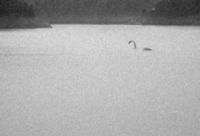
For years, these picturesque lakes have been the setting for a series of strange sightings of an unidentified creature in the water, which has been affectionately referred to as Mossie, モッシー” in Japanese, in an attempt to emulate the naming of its more famous Scottish cousin Nessie. Mossie is reported as being up to 30 metres in length, with a horny, bumpy back like an alligator or crocodile. Some reports have also mentioned a long dorsal fin like that of a shark, yet the majority of sightings have been simply of large, dark shapes swimming under the surface of the water, with no details visible. A good majority of the sightings have occurred at or near dusk, when the creature appears to be more active.
px13
Mt. Fuji’s lake monster first became widely known in the 1970s, when there was a rash of sightings of something large and unexplainable lurking in the depths of the lakes. The idea of a water monster roaming the waters at the foot of the famous Mt. Fuji captured the public imagination, and drew a lot of media attention at the time. People began to arrive in droves in order to not only bask in the beauty of the mountain and surroundings, but also in the hopes of catching a glimpse of the monster.
At the height of this lake monster fervor, boats descended upon the lake trying to find it, and one group of fishermen decided to try their hand at catching whatever the thing was. The fishermen spent days laying an elaborate system of sturdy nets on the hopes of ensnaring the creature, then laid in wait. Not long after, the nets were pulled up and were found to be completely shredded and ripped apart, much to the fishermen’s surprise. It was surmised that only something very large and strong could have done that much damage to the nets that were used.
Meanwhile, some of the boats scouring the lake came up with bizarre sonar readings of large moving shapes near the bottom. One boat captain claimed to have repeatedly picked up the sonar signature of an inexplicable dark form that he described as being around 25 meters in length. Other boats reported getting sonar hits on multiple unidentifiable shapes at the same time, which they described as almost a school of huge, eerie creatures that they insisted could not have possibly been schools of fish or geographical features.
One man, a Mr. Ken Yanoguchi, claimed to have had a very close encounter with the beast in the 1970s. While fishing on lake Saiko in his small boat, Yanoguchi reportedly bumped up against something in the water. Thinking it was a log, he went to investigate only to find a large creature of some sort lurking just under the surface with part of its back protruding from the water. The exposed part of the creature was described as black, slick, and rubbery looking. The rest of the creature had the appearance of an enormous fish or whale, and Yanoguchi himself even said that his first impression was of a whale, although he could not fathom why a whale should be out in one of the five lakes. The creature reportedly leisurely sunk beneath the water and was not seen again.
Plesiosaurus Migration
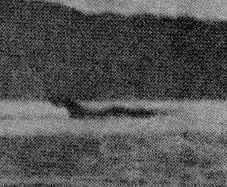
In the 1980s, sightings continued and the creature was even allegedly caught on film in October, 1987. A Mr. Yoneyama was out with three others taking pictures of the lake and its surroundings when they saw a surge of water out on the otherwise calm lake. Within this surge, they reported seeing 3 to 5 meters of the exposed back of something they could not identify, which was described as being rough like that of a crocodile. They were able to capture the animal on film, but the results are less than impressive, showing merely a dark shape and thus proving to be inconclusive. Sightings of the animal have dropped off in recent years, but a group in the village of Kamikuishiki has been investigating the Mossie phenomena since 2005.
Mossie has been sighted in more than one of Mt. Fuji’s five lakes, which could be explained by the unique geological features of the lakes, namely the fact that Lake Motosu is connected to Lake Saiko and Lake Shoji by a system of underground waterways that mysterious underwater creatures could use to travel back and forth between lakes. However, what can’t be readily explained is why an enormous lake monster should be here in the first place. The very nature of the lakes makes them an odd location for a lake monster to be found since the Fuji Five Lakes are not particularly ancient. It is thought that the volcanic activity that formed the lakes is very recent in geographical terms, with the lakes forming sometime during the 9th and 10th centuries. This makes it impossible for the creature to be some type of prehistoric animal trapped in the lakes millions of years ago.
The presence of a large, unidentified monster here is also further complicated by the fact that there are no rivers or natural drainage connected to the lakes either, so there is no possibility that something has travelled there from the sea through this route. In addition, many of the fish in the lakes were stocked, and there is no species of fish known there that even approaches a size large enough to cause the reports. These facts make it difficult to determine a biological possibility of  just what Mossie could be.
Many theories have been put forward. Ideas run the gamut from oversized introduced fish like the enormous wels catfish or sturgeon that have somehow been released into the lake. Sturgeon have indeed been introduced in some areas of Japan, but this is not known to have happened in the Fuji five lakes. As it stands, no species of fish known to inhabit the lakes even approaches the sizes reported for Mossie.
Wels catfish
Wels catfish
Regardless of the head scratching nature of the Fujigoko lake monster phenomenon, sightings of Mossie continue to occasionally come in to this day. Is there any chance that a large, unidentified creature is lurking somewhere in these lakes? Those who swear to have seen it say yes. Giant fish or unknown monster, perhaps one of these animals is swimming out there right now, cutting a path through the tranquil reflection of Mt. Fuji upon the water.

http://mysteriousuniverse.org/2014/07/the-lake-monster-of-japans-mt-fuji/

Tuesday, 15 April 2014

Creepy Crawly Cryptids of Japan

 
snake-japan

Creepy Crawly Cryptids of Japan

 
The world is full of accounts of mysterious creatures, monsters, and half-glimpsed, unknown beasts. These cryptids can instill a wide range of emotions in us such as awe, curiosity, and wonder. Yet then there are the ones that revolt us and make the hairs on the backs of our necks stand up; the ones that inhabit not only the remote places of the world, but our nightmares as well. These are the mysterious creatures that slither, skitter, scamper, and ooze forth from their dark lairs to terrify us.
Japan also has its share of such creatures. Within the forests, in the sewers, and even the ground below our feet, some things are said to lurk that truly make us shiver. Lets us delve into these shadowy places and see what horrors await us there.

Giant Snakes

When one thinks of giant snakes, the first image that comes up is most likely the dark jungles of the Amazon or the swamps of Africa, yet Japan too is home to numerous reports of giant snakes roaming the wilderness.
Pioneers have long reported encountering large snakes lurking in the wilds of Japan. Early settlers of remote, mountainous regions brought back accounts of snakes large enough to devour dogs, deer, and wild boar, and there were even occasional tales of doomed travelers being attacked by giant snakes. Peasants of some thickly wooded areas also spoke of a kind of large boa, which they called the uwaba-mi, or yamakachi.
In areas afflicted by the giant boas,  residents were known to carry some sort of weapon with them when venturing out alone, in order to ward off any giant snakes they might encounter. Allegedly, giant snakes were sometimes killed or even captured alive and displayed for money by enterprising villagers.
Samurai were known to investigate such stories, and on several occasions were said to find and kill these serpents. A few of these cases have become legends in their own right, but it makes one wonder whether these legends of samurai battling giant snakes have their roots in reality.

Accounts of mysterious, large snakes in Japan have existed right up to the modern day. Perhaps one of the best known modern cases of giant snakes in Japan comes from Mt. Tsurugi, located in Tokushima prefecture. This 6,413 ft peak lies within Tsurugi Quasi- National Park, and is the second highest mountain on the island of Shikoku.
Mt. Tsurugi is highly associated with paranormal phenomena and steeped in spooky stories. The area is known for its mysterious disappearances, magnetic anomalies, and spectres. It is also a UFO hotspot, with various strange lights seen in its skies. Among the many stories from the area, it is said there is also a man made pyramid somewhere beneath the mountain, with some going so far as to say it hold’s King Solomon’s treasure.  Interestingly, this treasure is supposedly guarded by a colossal snake that will kill any who approach.
Mt. Tsurugi
Mt. Tsurugi
If eyewitness accounts are anything to go by, this snake is far from mere legend. It has been allegedly encountered from time to time by campers and hikers in the area, and is reported to be in excess of 12 meters or even more in length. The mountain’s numerous unexplained disappearances are often blamed on the giant snake as it is said to be highly aggressive when encountered, and will attack unprovoked.
Reports of the snake abound. On May 26, 1973, forestry workers on Mt. Tsurugi came across a snake that was described as being as thick as a telephone pole, with shiny black scales and a white underbelly. According to the startled workers, around 5 meters (around 16.5 feet) of the snake was protruding from thick underbrush, and they estimated that the full length of the animal would have been a whopping 10 meters (33 feet) or more. The snake was reported to emit a loud chirping noise and piping cry before slithering away into the foliage.
This report caused widespread panic among residents, and some even reported seeing other snakes in the area that were estimated as being sizes of 8 meters (26 feet) to 11 meters (36 feet) long.
The following month, in June 1973, local officials responded to escalating fears by mounting a large scale expedition to try and find the source of these giant snake reports. Volunteers scoured the mountainside in the vicinity of the sightings, looking for any evidence at all for what people had reported seeing. They found no snake, but they did discover what appeared to be a track left by the creature.
The long track was 40 cm (around 16 inches) across and led through fallen weeds and flattened brush. Those who examined the track said it was undoubtedly that of a large snake of some kind.
The warrior Fujiwara Hidesato battling the giant centipede
Not long after, an enormous shed skin of a snake was also found in the vicinity by volunteers searching for the beast. Those who examined the skin estimated that it would have come from a snake about 8 meters (26 feet) long. The skin was collected, but later lost.
Bizarrely, a local museum claims to be in the possession of a jawbone measuring 34 cm (13 inches) wide, which it claims to be from the very same snake. Critics have pointed out that it is merely the jaws of a shark cleverly arranged to resemble a snake’s jaw.
Mt. Tsurugi is not the only mountain in Japan said to be the lair of giant serpents. Another mountain, Mt. Tateiwa, in Gunma prefecture, is also said to be inhabited by such creatures.
In addition to occasional reports from Mt. Tateiwa of snakes up to 10 meters (32 feet) long, a group of hikers on the mountain allegedly came across a discarded skin from a shedding snake, similar to the skin reportedly found on Mt. Tsurugi. When this skin was investigated, it was believed to have come from a snake that would have been at least 7 meters (23 feet) long.
Giant Snake
Other areas of Japan have had their own modern day giant snake encounters as well. On January 24, 1987, a 7 meter long snake was seen on a poultry farm in Kochi prefecture. The farmer, a Mr. Asakura Kayoko, reported hearing a commotion coming from one of his chicken coops. When he went to investigate, he found what he at first took to be a log inexplicably lying across the top of the coop. Closer inspection revealed it was in fact a huge snake in the process of eating one of his chickens, and apparently had already eaten several others. The farmer’s dogs ended up chasing the snake off of the property.
In Izu prefecture, a giant white snake reported as around 9 meters (29.5 feet) halted construction of a hotel when it appeared out of the surrounding wilderness. Construction workers continually spotted the beast lurking near the site, and were so frightened that they left and refused to return to work for several days. An inspection of the area turned up nothing, but this did little to allay the fears of the worker’s, who continued to stand by their story.
The jungles of the world are home to several species of truly enormous snakes, yet Japan has no native snakes even close to approaching these reported sizes. What is behind these reports? It remains a mystery.
57548_super-snake_u4otpkuoohegc34cxym6cgqbe3ncurxrbvj6lwuht2ya6mzmafma_610x457

Giant Centipedes

Japan is already well known for it’s very large centipedes, known as mukade, which can grown up to 20cm (7.9 inches) or more in length and eat everything from cockroaches to mice. These venomous centipedes are already large and scary enough as it is, yet these are occasional accounts of even bigger ones.
monsters_university_-_centipede
The Edo Period (1603 to 1867) produced many stories of giant centipedes said to be up to a meter (3.2 feet) in length. These centipedes were reported to be highly poisonous, with venom that could kill a grown man in minutes. On occasion, specimens were said to be exhibited in the various misemono side shows that were popular at the time.
Such stories are not confined to history. From the rural areas of Japan come modern reports of giant centipedes far larger than any currently known to exist. One such report comes from a farmer in Saga Prefecture, who was working on a woodpile one day in 1986 only to be horrified by an enormous centipede the man claimed to be 60cm (around 2 feet) in length, that came skittering out from under some logs. The farmer claims to have killed it with a rake, but later threw out the body in revulsion.
For most people, this is probably already an uncomfortably large size for a centipede, yet even larger ones have been reported. A group of campers in Nagano prefecture claimed to have heard an odd rustling one evening coming from one of their tents. Upon closer inspection, the noise turned out to be from a monstrous centipede claimed to have been around 2 feet in length. The creature was apparently startled and made a quick escape past the terrified campers, out of the tent, and into the forest.
Giant-Centipede
Such reports are rare, but chilling nonetheless. Is it possible that some unknown species of centipede even larger than the native ones resides in Japan? The largest currently known species of centipede in the world is the Peruvian giant yellow-leg centipede, also known as the Amazonian giant centipede (Scolopendra gigantea), which can reach up to a foot in length. Is there something even larger lurking in the wilderness of Japan?

Giant Earthworms

When looking for the sort of cryptids that really make our skin crawl, sometimes it is necessary to look not above the ground, but below it. One of the things that causes many people unease is worms.
There have long been tales of enormous earthworms surfacing from time to time in various areas of Japan. One of the hotspots for such accounts is Hyogo prefecture, on Honshu Island, which has many historical accounts of worms in excess of 1.5 meters (5 feet) long. One such account dates from the year 1712, in what was then known as Tamba province (now part of Hyogo prefecture).
The account describes a huge landslide that occurred in a village, after which 2 giant earthworms were found in the debris. One of these worms measured 1.5 meters (5 feet) in length, while the other was larger still, at 3 meters (10 feet) long. Another landslide that occurred in the same general vicinity allegedly unearthed a 4.5 meter (15 feet) long worm.
A more modern report from Mikata-gun, which is located in the mountains of Hyogo prefecture, dates from 1996 when a farmer uncovered an earthworm 1 meter (3.3 feet) long and 2cm (0.8 inches) thick while planting a tree on his rural property. It was the first time the surprised farmer had ever encountered such a large worm in all his years in the area.
Giant worms have been reported from other parts of Japan as well. In Okayama prefecture, one woman claimed to have seen a worm 3 meters (10 feet) long in a field that was being tilled. The worm had apparently been disturbed by the farming activity. Another farmer in the same prefecture brought up a still thrashing piece of a worm that had been hacked off during farm work. The piece is estimated to have come from a worm 3.5 to 4 meters (11.5 to 13 feet) long. The rest of the worm could not be located.
Slightly smaller worms measuring between 60cm (2 feet) to 1 meter (3.3 feet) have been reported from Okayama prefecture, Shikoku Island, the Izu peninsula, the Kii peninsula, and Nara prefecture as well.
170839
Perhaps the strangest report comes from Fukuoka prefecture, on the island of Kyushu. In 1997, a Mr. Ou Sato and his friend spotted something odd near the side of a river that they at first took to be a hock of ham someone had discarded. Thinking this to be a bit unusual, the two approached to get a better look. On closer inspection, they found the mysterious object to be a tubular piece of flesh, 30 cm (1 foot) long and 20 cm (8 inches) in diameter, with thin, glistening wet skin. There were clear grooves encircling it like those of an earthworm’s segments, and the color was described as brown like “a bursting sausage.” There was no evidence of the object possessing bones of any kind.
Both ends of the curious piece were ragged and torn, leading the two men to estimate that it was obviously a piece from the carcass of a much larger animal. The witnesses’ impression was that it originated from a gigantic earthworm, which they estimated the full length as being perhaps 10 meters (33 feet) or more. Unfortunately, due to the slimy and slightly decomposing nature of the find, they left it where it lay.
Indeed, the world is home to many species of giant earthworm, the largest being the Australian Gippsland earthworm (Megascolides australis), which is native to small areas in Victoria, Australia, and can reach lengths of up to 3 meters (9.8 feet). Is one such monstrous worm inhabiting the depths of the Earth beneath our feet in Japan?
Australian Gippsland earthworm

Subterranean Giant Rats

Tokyo is a mega city thrumming with the tireless activity of millions of souls. Yet under the bustling streets, throngs of people, and non-stop traffic, lies another world that most people never give much thought. Under the metropolis of Tokyo is a dark world of countless miles of vast warrens of tunnels, sewage pipes, and abandoned subway routes. These sprawling subterranean labyrinths are creepy enough as it is, yet somewhat more menacing when considering what may call them its home.
Like many large cities, Tokyo is infested with rats. They are everywhere. Above and beyond the usual vermin, there have  been accounts throughout the years from under the neon lit streets  of Tokyo that speak of rats far larger than normal. Sporadic accounts from sewer workers have described rats that are the size of dogs lurking in this dark netherworld of tunnels under the city.
Artwork by roadkillblues at Deviant art
One such account was told by a tunnel worker who described seeing something rummaging through a pile of refuse. The worker took the creature to be a cat at first, and could not figure out why a cat should be down in such a deep part of the tunnel system. He went closer to investigate and that was when the thing turned to him and revealed itself to be a very large, cat sized rat. The worker described how it showed no fear as it sniffed the air and leisurely sauntered off into the darkness.
Another report describes a group of workers doing routine maintenance work when they shone a light on a rat they explained as being as big as a medium sized dog. The startled workers shouted out in surprise, whereupon the creature hurried away. One of the workers had the feeling the thing was injured, as it seemed to exhibit a limp.

Various other reports have similarly described rats the size of cats or dogs roaming sewer systems and unused subway tunnels. Such accounts have spawned theories of genetic mutations caused by chemicals or radiation. However, one rat expert has said that since their growth plates don’t fuse properly after puberty, even common black rats have the potential to grow to frighteningly large proportions if they live long enough and have access to enough resources. Could one get as large as the ones in these reports with enough time and food?
rat
What is lurking in the tunnels under Tokyo’s streets? Is it a new species? Mutated monster rats? Figments of the imagination? Whatever they are, it may be wise to keep an eye to the dark corners of the streets when in Tokyo.
Snakes, worms, rats, bugs, these are the creatures that haunt the corners of our imagination.  What sorts of creepy beasts scurry about there in the dim corners of the world? It seems that there may be some mysteries that some may not be sure they want to know the answers to.
 

Sunday, 15 December 2013

Mermaid Photo?

From Mulder's World on Facebook, Yesterday:

Alleged Antarctic Creature


 This photo is one of two taken by a Japanese fishing crew in the Antarctic ocean.

Historically called a "Ningen" by the Japanese, it is said to resemble a giant human and similar to the mythical Mermaid. Unlike... the storybook mermaids, these creatures are extremely ugly and have been reported to attack smaller fishing boats.

 Credit: yuku.com
 
[If this is true the stories are about "Mermen" and not mermaids per se. I have a small file of similar reports made off of California. However the second photo of this set shows a beluga whale and photoshop is suspected in this one-DD]

Tuesday, 3 December 2013

Kusshi


Jay Cooney was not aware of this Lake Monster before and so he sent me the article

Kusshi: The Mystery of Lake Kussharo

 By Brent Swancer

What is lurking in the waters of Japan’s Lake Kussharo?
An unknown creature, known affectionately as “Kusshi” in an attempt to emulate Loch Ness’ “Nessie,” has long been sighted in Lake Kussharo, in the nothern island of Hokkaido, Japan.

Lake Kussharo is located within Akan National Park in eastern Hokkaido and derives its name from the Ainu word “Kuccharo,” which means “The place where a lake becomes a river and the river flows out.”

It is a caldera lake, formed in the crater of a volcano long ago, and is notable for being the largest lake of this kind in Japan as well as the 6th largest lake in the country overall.


It also boasts the largest island in a freshwater lake in Japan, the islet Nakanoshima, which is in fact a composite volcano. Lake Kussharo is massive for a caldera lake, being approximately 57 km in circumference and reaching depths of 117.5 meters.

Kusshi is reported as being between 10 and 20 meters in length (30 to 60 ft), and the most commonly cited coloration is a dark brown. The neck is of a moderate length, and humps are sometimes mentioned. The head of the creature is said to look somewhat like that of a horse, only larger, with silver eyes, and is sometimes described as having two protrusions like giraffe horns on top. A few reports mention the creature making strange grunting or clicking noises. Interestingly, many witnesses report having felt distinctly uneasy, disturbed, or “icky,” upon seeing the creature.
One very interesting characteristic of Kusshi is the high speeds at which it reportedly can move. In 1974 footage was taken of a mysterious creature moving across the lake at breakneck speed. In Sept, 1974, a group of 15 witnesses reported being surprised by a large, somewhat triangular shaped animal with shiny skin like glistening scales, moving under the surface of the water with the speed of a motorboat. In 1988, a Mr. Takashi Murata was riding in a motorboat and reported being paced by a large animal at a distance of 15 meters away, which he described as having a dark back that looked like that of a dolphin. The animal followed him for a time, keeping up with the fast boat, before disappearing beneath the water.
(The front of this object does have the right conformation to be the prow of a boat)

Lake Kussharo’s alleged lake monster first came to widespread publicity during the 1970s due to a number of high profile sightings. In 1972, a man reported seeing an object that looked like a “boat turned upside down,” swimming quickly through the water. In August of 1973, a group of 40 middle school students on a field trip, as well as their teachers, spotted the creature not far from shore. In July, 1974, another famous case was reported by a Mr. Wada, a farmer who sighted a large, dark animal with several humps at intervals of 4 meters apart. The farmer watched the creature for some time before it submerged with a huge swell of water and a splash.


These sightings and many others like them brought attention to the lake, which culminated in an active search for the animal. For one month in Sept 1974, TV crews, boats equipped with fish finder sonar, and teams of divers explored the lake. These efforts produced some interesting results. Some of the sonar equipped boats reported finding large images at depths of 15 to 20 meters and a TV crew from the Hokkaido Broadcasting Company actually managed to catch footage of the alleged creature. Over the years, Kusshi has been photographed and filmed on several occasions, including as recently as 1990.
Kusshi continued to be sighted throughout the 70s and beyond, sometimes by large groups of people. In May, 1976, Kusshi was sighted by a group of 22 tour bus passengers and their driver. As recently as 1997, a group of firefighters spotted a strange animal swimming 100 meters offshore, which they estimated as being 20 meters long, with a dorsal fin and banded markings. Another sightings was made by tourists in 2002, and reports occasionally pop up to this day.
Although media attention made Kusshi famous in the 1970s, it would be a mistake to think that this was the first indication of something strange or unknown in the lake. The Ainu people who inhabit the area have long told of giant snakes that inhabit the lake. Pioneers coming to the area during the Meiji era also told of seeing these creatures, which were said to attack and eat deer whole. These stories have a long tradition among locals in the area. During the 40s and 50s, there were quite a few sightings of Kusshi as well, although these never did gain the attention that the 1970s sightings did.
So what could Kusshi be?
Lake Kussharo is itself not particularly a good habitat for aquatic life. The area is well known for its hot springs and volcanic activity, and volcanic gases bubbling up beneath the surface render the water of the lake highly acidic. In addition, a 1938 eruption in the area created a large amount of sulphur which found its way into the water. The conditions are not ideal for fish. Those that do thrive in the lake are species that are resistant to acidic water conditions, such as the introduced rainbow trout, and most fish in the lake congregate near inflowing streams which dilute the water. This limits the potential food supply and makes conditions difficult for a large animal.

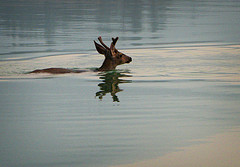
One hypothesis is that swimming deer or other animals are behind the sightings. A swimming deer could perhaps fit in with some aspects of Kusshi reports, especially the general shape and presence of horns sometimes mentioned.


Another idea is that swimming horses could be the culprit. Kusshi’s head is often described as being horse like, and the creature has even been mistaken for a horse on at least one occasion. In July, 1975, a forestry worker saw what he at first thought was a horse swimming in the lake until he noticed that it was much larger than a horse as it came closer. The creature then dove below the surface not to be seen again. Could a horse or deer be behind these reports? It is an interesting idea, but the sizes reported for Kusshi are much larger than these animals and we are still faced with the reports that describe these creatures moving at high speeds.
Some point to the culprit as possibly being misidentified schools of fish such as rainbow trout, sockeye salmon, or Sakhalin taimen (Hutcho perryi), which is found in Hokkaido and is one of the oldest and largest species of salmon.[Note, if there are enough big fishes around to impersonate a large monster, why in the world is anybody saying there are not enough fish for a real monster to eat?-DD] It is something to consider, but would do nothing to explain the head and neck seen in many reports. Still another, more unconventional explanation, is that Kusshi could be some sort of giant slug[A theory that was briefly in vogue for Loch Ness also. It is mechanically impossible going by the laws of physics-DD]. Kusshi has been attributed to misidentifications of motorboats as well.
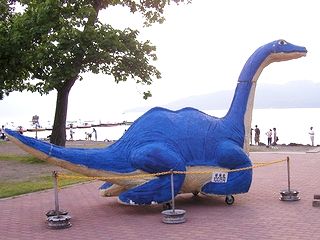
There are those that have even used the surviving plesiosaur theory, and there is even a model of Kusshi found at the lake that most certainly resembles the mainstream “Nessie” image of one. However most reports do not really describe the animal in that way[Most of the reports are standing waves, as usual], and this speculation seems to be an attempt to liken Kusshi to the popular image of Nessie more than anything else. This sort of thing has led some people to make the accusation that the lake monster has been played up in order to promote tourism to the area.[In some cases this is known to be what has happened in this location-DD]
Whatever it is, Kusshi’s identity remains an interesting mystery.

[This is in fact where the reports compare very favourably to those at loch Ness and the composite identikit drawn from the reports are nearely identical to the "Loch Ness Monster" and other Longnecks. As is also the case at Loch Ness, not all of the reports of the "Monster" are describing the same thing-DD]

Wednesday, 17 April 2013

Followup to Meldrum article

There is a reconstruction of the Chinese Yeren included in the article and drawn after the Witness' specifications, the article's Figure 3:

I do consider this to be an exceptionally good representation but of the wrong type. This is at least partly copied fter a drawing made from reports in the Caucasus, of the Almas type. It is a pretty good representation of the Eastern Bigfoot AKA The American Almas. It is a different type than the typical Sasquatch that the footprints are attributed to in the article. Both types are present in China and especially noting also Manchuria, and this type is also reported all across Siberia and Central Asia, and traditionally into Japan also. This would include the Marked Hominid of Coleman and based on the work of Mark A. Hall, and the composite is a good match for "Mecheny"

Bones and teeth of this type have been found and they are classified as a variety or subspecies of Homo sapiens, differentiated from the rest of us mostly because they have more prominent body hair.

Wednesday, 5 December 2012

Kusshi, From Global Warming and Terraforming Terra

Kusshi [Global Warming and Terraforming Terra. some different views on Surviving Plesiosaurs]
Posted: 04 Dec 2012 12:00 AM PST


This is a straight off additional apparent sea serpent or related creature that appears world wide if certain conditions are met and can be expected once those conditions are met.

The creature is a creature of the deep that sets its egg clutches in boggy ground near the shore line. It then waits around for them to hatch and strengthen before they are taken back down to the sea.

The lakes need ready access to the sea and must be deep and generally cool to cold. Actual access need not be that easy because the creature can cross obstacles well enough.

Knowing that, I checked New Zealand and hit pay dirt. It also worked everywhere else that I was able to look. Necessarily, this was concentrated on lakes in which human habitation made observation probable.

Yet there are thousands of suitable lakes near the sea in the Boreal forests of Canada and Russia. This one happens to be on the edge of that possible habitation zone although warmer locales may turn out to be useful also provided the lake is deep enough. The problem in the tropics is that great depth is somewhat unlikely because of heavy sedimentation and little or no glacial scouring.


Kusshie: Japanese Lake Monster Mystery

Posted by: mystery_man on November 23rd, 2012

What is lurking in the waters of Japan’s Lake Kussharo?


An unknown creature, known affectionately as “Kusshi” in an attempt to emulate Loch Ness’ “Nessie,” has long been sighted in Lake Kussharo, in the nothern island of Hokkaido, Japan.

ke Kussharo is located within Akan National Park in eastern Hokkaido and derives its name from the Ainu word “Kuccharo,” which means “The place where a lake becomes a river and the river flows out.”

It is a caldera lake, formed in the crater of a volcano long ago, and is notable for being the largest lake of this kind in Japan as well as the 6th largest lake in the country overall.

It also boasts the largest island in a freshwater lake in Japan, the islet Nakanoshima, which is in fact a composite volcano. Lake Kussharo is massive for a caldera lake, being approximately 57 km in circumference and reaching depths of 117.5 meters.


A sculpture of the alleged creature by the lakeside

Kusshi is reported as being between 10 and 20 meters in length (30 to 60 ft), and the most commonly cited coloration is a dark brown. The neck is of a moderate length, and humps are sometimes mentioned. The head of the creature is said to look somewhat like that of a horse, only larger, with silver eyes, and is sometimes described as having two protrusions like giraffe horns on top. A few reports mention the creature making strange grunting or clicking noises. Interestingly, many witnesses report having felt distinctly uneasy, disturbed, or “icky,” upon seeing the creature.

One very interesting characteristic of Kusshi is the high speeds at which it reportedly can move. In 1974 footage was taken of a mysterious creature moving across the lake at breakneck speed. In Sept, 1974, a group of 15 witnesses reported being surprised by a large, somewhat triangular shaped animal with shiny skin like glistening scales, moving under the surface of the water with the speed of a motorboat. In 1988, a Mr. Takashi Murata was riding in a motorboat and reported being paced by a large animal at a distance of 15 meters away, which he described as having a dark back that looked like that of a dolphin. The animal followed him for a time, keeping up with the fast boat, before disappearing beneath the water.

Lake Kussharo’s alleged lake monster first came to widespread publicity during the 1970s due to a number of high profile sightings. In 1972, a man reported seeing an object that looked like a “boat turned upside down,” swimming quickly through the water. In August of 1973, a group of 40 middle school students on a field trip, as well as their teachers, spotted the creature not far from shore. In July, 1974, another famous case was reported by a Mr. Wada, a farmer who sighted a large, dark animal with several humps at intervals of 4 meters apart. The farmer watched the creature for some time before it submerged with a huge swell of water and a splash.

These sightings and many others like them brought attention to the lake, which culminated in an active search for the animal. For one month in Sept 1974, TV crews, boats equipped with fish finder sonar, and teams of divers explored the lake. These efforts produced some interesting results. Some of the sonar equipped boats reported finding large images at depths of 15 to 20 meters and a TV crew from the Hokkaido Broadcasting Company actually managed to catch footage of the alleged creature. Over the years, Kusshi has been photographed and filmed on several occasions, including as recently as 1990.


Kusshi continued to be sighted throughout the 70s and beyond, sometimes by large groups of people. In May, 1976, Kusshi was sighted by a group of 22 tour bus passengers and their driver. As recently as 1997, a group of firefighters spotted a strange animal swimming 100 meters offshore, which they estimated as being 20 meters long, with a dorsal fin and banded markings. Another sightings was made by tourists in 2002, and reports occasionally pop up to this day.

Although media attention made Kusshi famous in the 1970s, it would be a mistake to think that this was the first indication of something strange or unknown in the lake. The Ainu people who inhabit the area have long told of giant snakes that inhabit the lake. Pioneers coming to the area during the Meiji era also told of seeing these creatures, which were said to attack and eat deer whole. These stories have a long tradition among locals in the area. During the 40s and 50s, there were quite a few sightings of Kusshi as well, although these never did gain the attention that the 1970s sightings did.

So what could Kusshi be?

Lake Kussharo is itself not particularly a good habitat for aquatic life. The area is well known for its hot springs and volcanic activity, and volcanic gases bubbling up beneath the surface render the water of the lake highly acidic. In addition, a 1938 eruption in the area created a large amount of sulphur which found its way into the water. The conditions are not ideal for fish. Those that do thrive in the lake are species that are resistant to acidic water conditions, such as the introduced rainbow trout, and most fish in the lake congregate near inflowing streams which dilute the water. This limits the potential food supply and makes conditions difficult for a large animal.

One hypothesis is that swimming deer or other animals are behind the sightings. A swimming deer could perhaps fit in with some aspects of Kusshi reports, especially the general shape and presence of horns sometimes mentioned.

Another idea is that swimming horses could be the culprit. Kusshi’s head is often described as being horse like, and the creature has even been mistaken for a horse on at least one occasion. In July, 1975, a forestry worker saw what he at first thought was a horse swimming in the lake until he noticed that it was much larger than a horse as it came closer. The creature then dove below the surface not to be seen again. Could a horse or deer be behind these reports? It is an interesting idea, but the sizes reported for Kusshi are much larger than these animals and we are still faced with the reports that describe these creatures moving at high speeds.

Some point to the culprit as possibly being misidentified schools of fish such as rainbow trout, sockeye salmon, or Sakhalin taimen (Hutcho perryi), which is found in Hokkaido and is one of the oldest and largest species of salmon. It is something to consider, but would do nothing to explain the head and neck seen in many reports. Still another, more unconventional explanation, is that Kusshi could be some sort of giant slug. Kusshi has been attributed to misidentifications of motorboats as well.

There are those that have even used the surviving plesiosaur theory, and there is even a model of Kusshi found at the lake that most certainly resembles the mainstream “Nessie” image of one. However, this most reports do not really describe the animal in that way [They are describing waves in the wake], and this speculation seems to be an attempt to liken Kusshi to the popular image of Nessie more than anything else. Even for the Loch Ness Monster, the plesiosaur hypothesis has been largely debunked and abandoned. [This is untrue, and the tide of public opinion seems to be turning once again-DD]

This sort of thing has led some people to make the accusation that the lake monster has been played up in order to promote tourism to the area. Indeed, even now the area draws many visitors looking to catch a glimpse of something strange in the lake.

Whatever it is, Kusshi’s identity remains an interesting mystery.

Monday, 6 August 2012

Wildmen And Yokai Again

T[wo] Bigfoot busts from my collection in the UK. A model maker in Washington state made him for me back in 2007. He wanted to give [the one on the right] a more horrific appearance but I told him to make it as life like as possible.
Robert W. Morgan description of Forest Person he has researched.[left] This custom bust was made for me in 2005 by a NYC film effects artist. It was going to be part if a series of busts to be followed by a "Skunk Ape", "Yeren", "Yeti" and "Almasty". [Dale D has blown up the eyes to match the indicated size of the eye sockets and to match reports by other witnesses]

Two sculpted Bigfoot busts owned by Thomas Finlay, who resides in the UK

Homo (sapiens) heidelbergensis/neanderthalensis skull above
Orangutan skull shown below, compare to the head structure shown in the two busts

I believe the two busts correspond to two different types of creatures both named "Skunk Ape" and "Eastern Bigfoot" by different researchers-one being more of a human and the other being more like an ape (Specifically most like an orangutan). And what is more, they are the same as two kinds of "Wildmen" commonly spoken of in Tibet and South and East Asia (or the Oriental realm generally)


Big Yeti, Yak Stealer or Yak Bear, Greater Migo, Nyalmo, etc

In a separate instance, I have suggested that the "One-eyed" appearance of the Mapinguari is due to having the alarm-flash eyelids that orangtans have (along with many other kinds of apes and monkeys), together with the darker space in between, the whole of the area looking like one huge eye in the middle of the face at a distance. Orangutanlike creatures are rumored also in the Philippines and Mainland South Asia, and they are sometimes described as cyclopses
Glaugco's representation of a Mapinguari compared to an orangutan

Recently, Dr Jeff Meldrum posted on his facebook [page asking about a Japanese Yokai creature called the Yama-chichi and asked if it could be considered to be the equivalent of the Bigfoot. I immediately referred him to the following link, which was the first thing that came up on a search:

 Yama-jijii(やまじじい)
Yamajijii(やまじじい)also known as Yama-chichi(there is also an entirely different Yokai with the name Yama-chichi as well),is a Yokai from Shikoku Island(the tales are very wide spread throughout the island)that is said to live in the mountains there.Most stories agree that he has a large rock-like head with one huge eye in the center of his head with a mouth full of small razor sharp teeth and a body covered in gray short-haired fur and that he can read minds(much like the Satori)and that he has a very loud voice capable of killing(with which he usually likes to challenge people to a loudness contest).There are also many stories where a Yama-jijii is kept as a pet like a hunting dog by hunters.Some stories say he is Child sized other stories say he is the size of a rather large man.Some stories say in addition to his large eye,he has another very small eye,other stories say he has only one eye,one arm,and one leg.Some stories say he is a peace-full nature loving creature,other stories say he will take away animals and small children to eat.
Here's my Yama-jijii action figure.I sculpted his rock-like head from clay over a CTVT Cochise head.His body is a Castaway tan (original flesh) colored body which I sculpted on fur with the clay.I painted all sculpted parts with acrylic paints and sealed with Modpodge.


And it just so happens that this one-eyed creature is listed as one of the traditional creatures equated to the Hibagon or Yeti-like creature that is being reported more recently in Japan. Dr Meldrum's original posting was a smaller copy of this book being highlighted on one of the internet sites:

Yama-chichi kills man in sleep

  • Creator(s): Takehara, Shunsensai, fl. 1789-1817, artist
  • Related Names:
    Tōkaen, Michimaro, fl. 1808-1841 , author
  • Date Created/Published: [1841]
  • Medium: 1 print (2 pages) : woodcut, color.
  • Summary: Ukiyo-e print illustration showing scene from traditional tale in which a Yeti-like creature inhales the life force from sleeping travelers; opposite page contains text; covers from other volumes also shown.

  • -The "Stealing of Breath" I take to be an allusion to sleep apnea. Here is a fuller account from a site specialising in Japanese Folklore:

    What the Yama-chichi Observed

    Mukashi mukashi, there was a cooper in a certain place. While he was working outside one morning after it had snowed, a frightful monster with only one eye and one leg appeared from the mountain and stood in front of the cooper. Seeing him, the cooper began to tremble and thought, "This must be the thing called a yama-chichi, which I have heard about in stories for a long time." The apparition then said, "Say, Cooper, you're thinking I must be the thing called a yama-chichi, aren't you?" The cooper thought, "How awful. He observes right away what I think." Then the monster said, "Say, cooper, you think it is awful because I observe right away what you think, don't you?" After that whatever the cooper thought was observed until he was quite confounded. With nothing he could do about it, the man kept at his work, trembling violently all the time. Suddenly his numb hands slipped accidentally. The bamboo hoop sprang out in front of him and slapped the yama-chichi in the face. The yama-chichi was taken by surprise. "These human beings are dangerous because they sometimes do things they are not thinking about," he declared. "There is no telling what will happen if I stay here." He went stumping pell-mell back to the mountains.
    --From the Kyōdo Kenkyū, Vol. II. Collected in Tottori.

    There is actually another bakemono [Folktale] called yama-chichi, which does not have the same description as this mind-reading monster. The alternate yama-chichi is a monster that appears when people are sleeping, and sucks the life out of their mouths. It is also said that if one awakens while the yama-chichi is draining another of his energy, then the energy drained before that point is transfered to the person who awakens.
    [This is thus a form of Night Hag or Nightmare. To confuse things further, "Chichi" is Japanese slang for a women's breasts-DD]

    The appearance of the Night-Hag Yamachichi would appear to be based on an orangutan like ape though, the resemblance is quite striking. And if a one-eyed Wildman is meant to describe a sort of an orangutan, then the two Yamachichis could be variant traditions describing the ure seemt the same as the lesser Yeti or the more apeklike Skunk Ape.

    But the "Mindreading" capabilities are borroed from stories of a more standard wildman, the Satori
    Satori also means "Enlightenment", but the theory has been advanced that in the case of the Wildmen, the name is a transcription of the name used by European missionaries, "Satyrus"and it could be that its supposed mental powers arose from a pun (parallel instances could be cited). At this point I do not need to argue whether Bigfoots are or are not psychic, all I am interested in is what are the creatures supposed to lok like.
    Below are a couple of recent toys said to represent tradional Wildmen, the one on the left is called a Satori and the one on the right is said to be a "Bearman" (The traditional name in Tibet and China)

    The Satori is more of a transplanted Central-Asiatic Almas in that it is more of a hairy human. Depictions of it run from little different from an ordinary monkey (Richard Freeman shows such a print in his Yokai dictionary) up to very nearly human (possibly meaning to depict human-halfbreeds) such as in the case of the "Satori" depicted below:

    Sekien Satori, From Wikipedia


    Sekien Oni in cave, eating some furry varmint, from Wikipedia
    "Cannibal Giants" fall into a different category; in Japan they are known as Onis. Since they seem to be to some low degree as cultural animals, the real creatures the legends are based on are more probably like the Siberian Chuchuunas

    Oni (?) are creatures from Japanese folklore, variously translated as demons, devils, ogres or trolls. They are popular characters in Japanese art, literature and theatre.[1]
    Depictions of oni vary widely but usually portray them as hideous, gigantic creatures with sharp claws, wild hair, and two horns growing from their heads.[2] They are humanoid for the most part, but occasionally, they are shown with unnatural features such as odd numbers of eyes or extra fingers and toes.[3] Their skin may be any number of colors, but red and blue are particularly common.4][5]

    Notes


    In sum, I would suggest that in addition to the standard Sasquatch (?Gigantopithecus) type familiar enough in both Eastern Asia and Western North America, we have two other forms whose range overlaps the larger Hominid: one a type of orangutan which likes on the ground and so has very different feet (known in fossil form as "Fossil Pongo" although probably it needs a new genus  and species name) and the other a more familiar type of relic hominid like the Almas, which also has a more specialised larger form, the Chuchuuna. Both the more apelike and the more humanlike forms occur in North America and would seem to be related to creatures reported in South America. the South American apelike Mapinguariints that are different again, and once again show a specialization for arboreal life much as in the known orangutans of Indonesia.

    Best Wishes, Dale D.